The model of a military revolution, the idea that military developments influenced the statebuilding process in Europe, is adapted to a couple of periods in early modern Europe. This book examines European Warfare in the late Middle Ages from 1300 to 1490. It doesn't restrict itself solely to well covered conflicts, like the Anglo-Scottish Wars or the Hundred Years War, but gives due weight to all regions of Europe, including the Empire, the Baltic, Balkans and Mediterranean and also considers developments in Naval Warfare. The Hussite Wars or the Wars of the Teutonic Order and the Hanseatic League are covered, as is the expansion of Moscow, the Ottomans of Venice and the analysis of battles like Aussig (1426), Copenhagen (1428), Chojnice (1454) will not will not be overshadowed by that of Bannockburn and Agincourt.
This period witnessed fundamental change. The feudal system of the High Middle Ages crumbled everywhere in Europe due to climatic change, economic crisis and population decline. This triggered a fiscalisation of the military organisation, the establishment of taxes and representation of the estates. This book argues that these changes are the most fundamental ones in the military and political organisation in Europe until the rise of the constitutional state around 1800 and so comes closer to the original concept of a military revolution. It also takes a critical look at other often discussed developments of this age, like the infantry and artillery revolution or the decline of cavalry. The combination of a chronological and regional narrative with deeper analysis of themes like chivalry, strategy, economic warfare or military publications makes this book an indispensable read for anyone interested in late medieval history.
eBook - ePub
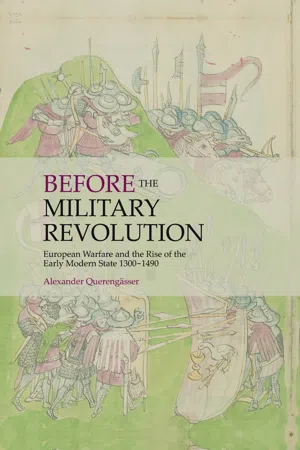
Before the Military Revolution
European Warfare and the Rise of the Early Modern State 1300–1490
- 256 pages
- English
- ePUB (mobile friendly)
- Available on iOS & Android
eBook - ePub
Before the Military Revolution
European Warfare and the Rise of the Early Modern State 1300–1490
About this book
Information
Subtopic
European Medieval HistoryIndex
HistoryChapter 1
Medieval Warfare 1000–1300
In the popular image, but also to an alarming extent in much modern scholarship, medieval warfare is often reduced to knights and castles – yet this stereotype does not even hold true for the centres of European chivalric culture. However, to start this book, it seems worthwhile to recapitulate the work of Robert Bartlett, who divided the military cultures of Europe into three regions. The first one includes Northern France, England and Germany and was dominated by heavy cavalry. The second is Wales, Scotland and Scandinavia, which were shaped by foot warriors. The third is Ireland, the Western Slavic cultures and the Baltic regions, which were dominated by light cavalry. Interestingly, Bartlett gives no information about the Mediterranean.1 Here, especially in Italy, there were forms of organisation that are usually more associated with later periods. For example, Italy during the 11th–14th centuries was densely urbanised, and the north of the country was involved with trying to shake off the rule of the Roman emperors. In these conflicts, urban militias, especially foot soldiers, played an important role, for example during the Battle of Legnano in 1176.2 This fact alone demonstrates that however schematic Bartlett’s classification is, there was not just a single medieval military culture in Europe.
The reason that the culture of the first region – Northern France, England and Germany – seems to dominate our vision of the period is because it had certain obvious and iconic advantages: heavy armoured cavalry, the crossbow, siege artillery and stone castles. The last in particular was important during the time of expansion, for example the crusades into Palestine, the German eastern colonisation or the Baltic crusades of the Teutonic Order. Stone castles gave the Western and Central European knights a stronghold from which they could defend against enemy attacks, especially if the enemies lacked siege artillery. The latter, in turn, gave crusaders an advantage when attacking the wooden fortifications of the Lithuanians or Irish.
The tactic of a charge of armoured knights seems to be of lesser importance when compared with the advantages of castles. Of course, the use of knights could decide a battle and Saladin feared the “Franconian” knights of the Third Crusade and tried to avoid a full-fledged battle against them, but they were not invincible. For instance, in the Baltic regions, the heavily armed knights of the Sword Brothers or the Teutonic Order were repeatedly defeated by lighter-armed Lithuanian or Novgorod forces, as happened in the Battle of Saule in 1236 and at Lake Peipus in 1242. Moreover, in the densely forested areas of Lithuania, the heavy armament of the knights was no real advantage.
However, focusing on knights and their battles is an approach that tends to ignore the complexity of high medieval warfare and army organisation.3 Infantry, which was of increasing importance in the 14th and 15th centuries, had been more than just an auxiliary force earlier. A military history that is focused on battles easily misses this point. Medieval warfare – in the 11th as in the 15th century – was dominated by siege operations, not field battles. And during a siege, a mounted knight was of no use to an attacker. This is borne out by the statistics: for the siege of Jerusalem in 1099 during the First Crusade, the Christian army had about 12,000 foot soldiers, compared to 1,500 mounted knights;4 for the siege of Wexford in 1169, the first Norman attempt to invade Ireland, Norman forces consisted of 100 knights and men-at-arms, but 360 bowmen and 500 foot soldiers. Thus, despite the fact that for most sieges of the high medieval period we lack specific numbers and if we have some, they are only totals, it is clear that mounted knights were of low value for attacking fortifications during sieges. Furthermore, even battles were not solely cavalry affairs. For instance, although the fight itself was dominated by cavalry, the majority of the French army at the Battle of Bouvines (1214) comprised infantry from the militias from Picardy, while the allied army relied on Brabançon mercenaries.
The latter were another important aspect of high medieval warfare. Men who earned their income by offering their services as mercenaries during wartime have long existed, probably due to the fact that in cultivated societies there was always a portion of the population who could not secure employment on the land or were even unable to work at all, and for whom military service offered an alternative way of living. Whether or not actually joining the service was easy in the Middle Ages, when mercenaries had to arm and equip themselves, is a matter of debate, because it required starter cash – something that was often lacked by those hoping to join.
Nevertheless, initial fiscal difficulties aside, mercenaries were widely used throughout Europe. King John I of England, for example, hired them during the First Barons’ War and used them successfully during the siege of Rochester Castle in 1215.5 Earlier, Flemish mercenaries formed a part of the invasion force of William the Conqueror in 1066 and were also hired later by the Plantagenets. Another famous body of mercenaries was the Varangian Guard, recruited by Viking warriors and maintained by the Byzantine emperors,6 whose army had a long tradition of recruiting mercenaries. From time to time, mercenary forces even formed the majority of an empire’s army, and in the High Middle Ages, the Varangian Guards were recognised as the elite of the basileus’ forces. Their use was also an expression of his wealth – something that was lacked by many European rulers at the time, rendering them unable to employ mercenaries in large numbers or for a longer period.7
The backbone of the military organisation between about 1000 and 1300 was what Philippe Contamine described as a “feudo-vassalic system”.8 This was far from a uniform pattern. In fact, the feudo-vassalic relationship varied from region to region and with each lord-vassal relationship. In the Holy Land, for example, military service within this relationship was for life and throughout the entire year, probably due to the perpetual threat of infidels. In the Holy Roman Empire, by comparison, service was often restricted to a couple of days here and there and in some cases only for the defence of the lord’s territory, making effective warfare very complicated.
1 Bartlett, R., The Making of Europe: Conquest, Colonization and Cutural Change 950–1350 (London: Penguin 1993), pp. 70–71.
2 Settia, A., Infantry and Cavalry in Lombardy (11th–12th Centuries), in: Journal of Medieval Military History 6 (2008), pp. 58–78.
3 As a good reconsideration see: Morillo, S., The “Age of Cavalry” revisited, in: Kagay, D. J./Villalon, L. J., (eds), The circle of war in the Middle Ages. Essays on Medieval Military and Naval History (Woodbridge: The Boydell Press 1999), pp. 45–58.
4 Kostick, C., The siege of Jerusalem. Crusade and conquest in 1099 (London: Continuum 2009); Peters, E., The First Crusade. The chronicle of Fulcher of Chartres and other source materials (Philadelphia: University of Pennsylvania Press 1998).
5 Seel, G. E., King John. An Underrated King (London: Anthem Press 2012), pp. 159–162.
6 Blondal, S., Varangians of Byzantium: An Aspect of Byzantine Military History (New York: Cambridge University Press 1978).
7 A good overview is presented by: France, J. (ed.), Mercenaries and Paid Men. The Mercenary Identity in the Middle Ages (Leiden – Boston: Brill 2008).
8 Contamine, P., War in the Middle Ages (Hoboken: Wiley 1986), p. 77.
Chapter 2
War in Europe 1300–1400
The 13th century is generally regarded as a period of European economic and social expansion and prosperity, which caused the population to grow. However, the pace of this development and population increase slackened and even came to standstill at the end of the century, and the 14th century was shaped by its reversal. This was in part caused by the fact that the years between 1315 and 1317 were exceptionally wet. Long periods of rain destroyed crops and also led to shortages of salt (saline production needs long periods of sun), and the rains were followed by epidemics of murrain (an infectious disease) among sheep and cattle. All of this led to death. In many regions of Europe, the years 1321 and 1322 were similarly bad. Then, beginning in around 1348, the Black Death (which was probably a virus epidemic rather than the bubonic plague it has long been held to be) led to extremely high death rates across the whole of Europe: up to 60 per cent in some regions.
All of these catastrophes resulted in a decline in agricultural production, which affected the whole of society because prices for grain and meat rose. Inevitably, this caused more and more people to fall into poverty. These crises also stirred up a more violent and belligerent mood among the populace, while economic decline and poverty resulted in there being a large number of people who were ready and prepared to earn money as mercenaries. This created a perfect storm: on the one hand, the mood was ripe for war and on the other, people were willing to fight in it – if nothing else, simply in order to make a living. This complex situation reflects that military history, especially during this period, has to be regarded in the more general terms of a history of violence, of which war was just a part.
Towards the end of the century, the already violent mood was exacerbated by the Western Schism. Starting in 1378, this was a split within the Catholic Church that saw two popes existing simultaneously – one living in the traditional fashion in Rome, the other backed by the French in Avignon. The palatial living style of the high ecclesial nobility and the fact that indulgence sellers, begging monks and other preachers wandered the countryside collecting money for two separate but pompous papal courts provoked much criticism of the Church. In England, for instance, John Wycliffe launched an attack on ecclesial pomp and even challenged papal authority. When English King Richard II married a Bohemian princess in 1382, students of Prague University came to England, acquainted themselves with Wycliffe’s ideas and took them back to Bohemia, where, in the 15th century, they strongly influenced the ideas of the reformer Jan Hus. Wycliffe’s and Hus’ criticism of the Church added fuel to the fire caused by the social problems of wide sections of the population, triggering off a serious revolt in Bohemia in 1419. The fact that in many German sources the Bohemian heretics in the following war were called “Wyclyffen” is ample proof that his ideas were not just discussed in academic circles, but were mainstream.
Arms and weapons technology
There is a tendency, especially among Anglo-American historians, to overemphasise the effect of technological developments on tactics and military structures. Of course, tactics were always shaped to make best use of the available men and weapons and there is also a propensity to produce better-quality weapons than those used by the enemy. “Quality”, however, is difficult to define. It could mean killing effectiveness, but also how easily they can be mass-produced – and in effect it was a mix of both. The English longbow, for example, represented a good combination of effectiveness and ease of manufacture. Nevertheless, especially on the Continent, the bow and later the crossbow were replaced during the 15th and 16th century by handheld guns. This is the reminder of a third important requirement of weapons technology: it must be easy to use. Archery was an art that needed to be taught and practised. Indeed, there are many examples of English kings abolishing every other kind of sport in favour of archery, so that there was always a sufficient pool of skilled men.1 By contrast, the handling of a gun could be taught within a few hours or days – depending on the man – enabling commanders to raise and exercise troops within a very short time.
However, despite considerable advancements in weapons technology, namely the invention of gunpowder weapons, it is important to remember that there are other, less sophisticated weapons that also shaped military systems. One of these was the pike, which was used to great effect by the Scots in the 14th century, the Swiss in the 15th century and the Germans in the 16th century, and yet was far from being a technological milestone; the Macedonians had used it in the 4th century BC. Simple to make and use and deadly effective, it was adopted successively in the Late Middle Ages by societies that lacked a horse culture but were able to provide huge quantities of foot soldiers to face cavalry forces. The circumstances of both the men using the weapon and the enemy they faced defined the adoption of the pike, and this fact was more important than the weapon defining the overall tactical system. This prominent example thus proves that technological developments, while certainly not unimportant, are less significant than is often presented. In short, the appearance of guns would ultimately change the art of war, but their effect on 14th-century warfare was limited.
Guns are reported to have first been used at the Battle of Crécy (1346) and after that their use spread quickly over the whole of Europe, being first recorded i...
Table of contents
- Front Cover
- Title Page
- Copyright Page
- Contents
- Acknowledgements
- Introduction
- 1. Medieval Warfare 1000–1300
- 2. War in Europe 1300–1400
- 3. War in Europe 1400–1450
- 4. War in Europe 1450–1490
- 5. Naval Warfare
- 6. Guns and Pike Squares: Revolutions of Medieval Warfare?
- 7. A Revolution of Knowledge
- 8. From the Feudal Levy System to Mercenary Armies: a Social-Military Revolution
- 9. Military Change and the Development of the Early Modern State
- Conclusions
- Selected Further Reading
Trusted by 375,005 students
Access to over 1.5 million titles for a fair monthly price.
Study more efficiently using our study tools.
Frequently asked questions
Yes, you can cancel anytime from the Subscription tab in your account settings on the Perlego website. Your subscription will stay active until the end of your current billing period. Learn how to cancel your subscription
No, books cannot be downloaded as external files, such as PDFs, for use outside of Perlego. However, you can download books within the Perlego app for offline reading on mobile or tablet. Learn how to download books offline
Perlego offers two plans: Essential and Complete
- Essential is ideal for learners and professionals who enjoy exploring a wide range of subjects. Access the Essential Library with 800,000+ trusted titles and best-sellers across business, personal growth, and the humanities. Includes unlimited reading time and Standard Read Aloud voice.
- Complete: Perfect for advanced learners and researchers needing full, unrestricted access. Unlock 1.5M+ books across hundreds of subjects, including academic and specialized titles. The Complete Plan also includes advanced features like Premium Read Aloud and Research Assistant.
We are an online textbook subscription service, where you can get access to an entire online library for less than the price of a single book per month. With over 1.5 million books across 990+ topics, we’ve got you covered! Learn about our mission
Look out for the read-aloud symbol on your next book to see if you can listen to it. The read-aloud tool reads text aloud for you, highlighting the text as it is being read. You can pause it, speed it up and slow it down. Learn more about Read Aloud
Yes! You can use the Perlego app on both iOS and Android devices to read anytime, anywhere — even offline. Perfect for commutes or when you’re on the go.
Please note we cannot support devices running on iOS 13 and Android 7 or earlier. Learn more about using the app
Please note we cannot support devices running on iOS 13 and Android 7 or earlier. Learn more about using the app
Yes, you can access Before the Military Revolution by Alexander Querengässer in PDF and/or ePUB format, as well as other popular books in History & European Medieval History. We have over 1.5 million books available in our catalogue for you to explore.