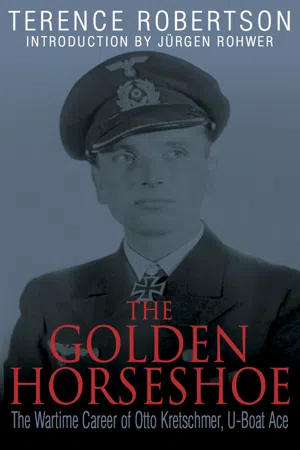
The legendary U-boat ace Otto Kretschmer was branded 'the wolf of the Atlantic', and for good reason. In his dramatic wartime career he sank ship after ship, sowing terror among Allied convoys and dismay in those charged with their protection.Kretschmer was a daring officer who favoured bringing his U-boat into the heart of the convoy and destroying it from within. He earned himself a tremendous reputation before his capture in March 1941, and The Golden Horseshoe makes it clear why. Terence Robertson's biography of the U-boat ace draws upon first-hand experience of conditions and the deadly game as the hunter sought to outfox the hunted. He paints a masterly portrait of life at sea and weaves in the fascinating story of Kretschmer and the exploits of his U-Boats. Kretschmer was eventually captured and interviewed by Captain McIntyre of HMS Walker, an episode which is also recounted in this book.Otto Kretschmer became a prisoner of war in March 1941 and spent most of the rest of the war in Bowmanville camp, Canada, before his release in 1947.
- 208 pages
- English
- ePUB (mobile friendly)
- Available on iOS & Android
eBook - ePub
About this book
Information
Subtopic
Military BiographiesIndex
HistoryCHAPTER ONE
THE RING ROUND BRITAIN
IN 1934, when German arms were limited by the Treaty of Versailles, the first Army cadres and Luftwaffe squadrons took shape under a variety of skilful guises. Only the Navy launched a reconstruction programme openly, and then it was impossible for anyone outside the inner sanctums of authority to determine if it was confined to the limits laid down by the Allies. Under the energetic guidance of Admiral Raeder, newly-appointed Supreme Commander of the Navy, the vast jungle of dockyards in Bremen, Hamburg, Wilhelmshaven and Kiel became the breeding grounds of a new fleet with modern battleships, cruisers and destroyers slipping from beneath canopies of cranes and scaffolding. But Raeder was not satisfied. At the last Fuehrer’s Naval Conference of that year in Berlin he told Hitler: “The key to German power at sea lies below the surface. Give us submarines and we shall have the teeth to attack.”
Hitler gave him his reply six months later, when he summoned Raeder to the Reich Chancellery and handed him a message with the curt comment: “There are your teeth.” It was a telegram from Ribbentrop in London bearing the news that Britain had signed the Anglo-German Naval Treaty of 1935 giving Germany the right to build a surface fleet of up to thirty-five per cent of Britain’s. Then came a clause which provided Raeder with the “biting ” power he had demanded. The Germans could build a new submarine Service of forty-five per cent of the Royal Navy’s and up to parity if “a situation arose which in their opinion made it necessary ”. U-boats had taken a dangerously firm grip on Britain’s lifelines during 1917. Now a British Government gave its blessing to a new German Navy which could legally build more submarines than any other class of warship.
The first round of the desperate struggle, to be known not so many years later as the Battle of the Atlantic, had been won on the deceptively calm seas of diplomacy. Raeder swiftly turned this paper victory into a practical programme of construction. He rescued Germany’s leading U-boat “ace ” of the First World War, Captain Karl Doenitz, from the cruiser Emden, and charged him with the task of building up a new U-boat Arm.
Doenitz, overjoyed at returning to submarines, contacted his former submarine colleagues who were still interested, and with their help laid the basis for a long-term training programme. The existing “Anti-Submarine School ” at Kiel became the centre not only for the teaching of the defensive tactics implied by its name, but also for offensive training. By the end of 1935 the technical hurdles had been overcome, and early the following year the first batches of officer-trainees arrived at Kiel, all little more than twenty years of age. They were welcomed with a reminder of their heritage and a hint of the intense work ahead.
“The Navy,” Doenitz told them, “represents the cream of the Armed Forces. The U-boat Arm represents the cream of the Navy. A few of you will command your own submarines one day. But most of you will be sent back to the big ships you came from. The future of each of you depends on your individual efforts to meet the standards I require of you.”
Among the first of the young officers to feel the impact of these words were Gunter Prien, Joachim Schepke and Otto Kretschmer, three sub-lieutenants who had rebelled against the obscurity of “big-ship ” wardrooms and arrived at Kiel in search of freedom for their individualistic personalities. Apart from this common denominator, they differed widely in appearance and character.
Prien was a dapper, slim wire of a man with a mild expression that hid a stubborn, impetuous nature. His quick temper, as yet unfettered by maturity, found exit in a biting wit which kept at bay would-be friends whom he regarded as invaders of his personal life.
Schepke was the reverse. Tall and cheerful, he was the fortunate possessor of great charm and fair good looks that attracted the admiration in which he revelled. This was to be revealed as his major weakness.
Kretschmer, the twenty-four-year-old son of a teacher in Lower Silesia, was in many respects the toughest of the trio. Every sea-power produces its quota of men who prefer ships to women. They find greater contentment on the bridge than in a fireside chair. Kretschmer was of this breed; his searching mind was ruthless in its quest for knowledge of the sea and ships, and he carried himself with the confident bearing of a man who, though still young, knows instinctively not only what he is doing but also why he is doing it. Alongside these characteristics, less desirable qualities were already reaching the surface; a cruel contempt for weakness; an intolerance of anything that did not conform to his personal standards; a bigoted refusal to allow ordinary human failings to interfere with duty; and a self-sufficient pride which was saved from becoming insufferable only by a ready sense of humour and a willingness to listen to the problems of others providing they did not trespass on his privacy or lead to familiarity. During the next three years this trio became linked by reputation ; their rapid rise to command and their adventures forging between them a loose friendship nourished more by rivalry than affection.
In the first few months of training, Kretschmer became a cigar chain-smoker, rarely being seen without a black cheroot or some other kind of cigar clamped firmly between his teeth. And this inevitable cigar led him into trouble before the year was out while he was serving as Second Lieutenant of U-35.
One day they had been taking part in diving exercises in the Baltic, and by dusk everyone except the captain was sick and tired of behaving like a porpoise. Shortly before nightfall they surfaced, and Kretschmer joined the captain on the conning-tower to relax and light a cigar. He took a first long, pleasure-filled draw and glanced speculatively at the captain, and satisfied himself that for the time being at any rate they would stay on the surface. Then he saw the captain grin widely, as though at some secret joke, and his confidence was replaced by a strong suspicion that an unexpected “alarm dive” was about to be sounded. He tried to head off the impending dive by diverting his commander’s attention to the faulty stopper in the muzzle of the gun which was letting water leak into the barrel. He suggested going down to see if he could fix it and at the captain’s nod, scrambled down to the foredeck, his cigar jutting from his lips.
He took his time about draining away the water and then inspected the stopper, knowing full well it was impossible to tighten it until they returned to harbour. He had just moved the gun back to its normal sea position when suddenly he heard a frighteningly familiar sound; the loud hiss of air being blown from the ballast tanks, accompanied by the throbbing of engines increased to full speed. They were diving. Frantically, he rushed to the conning-tower, to find the hatch closed. He stamped on it furiously, hoping that someone inside would hear him. In a few seconds they reached periscope depth. He attempted to swarm up the raised periscope column, but it was kept well greased, and this, plus the weight of his now sodden clothes, dragged him back. It occurred to him that if he hugged the periscope column, the pressure of water would force him upwards to the top, and then he could peer through the “eye ” lens and let the officers inside know that he was out.
He was dragged down to about thirty-five feet in as many seconds, and the sea around him became a thick, impenetrable green wall. He could hold his breath no longer, and reluctantly he allowed himself to be shot to the surface. He came up gasping and spluttering, and at once found that the weight of his clothes made swimming an effort that would tire him dangerously. He decided to float, and the last things he saw before darkness fell were his uniform cap bobbing alongside him and near it, the soaked, mashed remnants of his cigar. U-35 surfaced nearby and a Petty Officer rushed to the bows to throw him a lifebuoy. He had just enough strength to grab the buoy, but not enough to climb on board. He had to be lifted on to the deck and helped to the conning-tower.
Weak with cold and fatigue, he could think of nothing adequate to say to his captain, so he tottered to attention, attempted a salute, and whispered: “Lieutenant Kretschmer reporting back on board, sir.” The astonished captain returned the salute and replied automatically: “Thank you, Lieutenant.” Kretschmer was taken below and hot-water bottles were packed against his skin while hot rum was poured down his throat. He slept until morning, and wakened to find the bitter cold of the Baltic had been sweated from his body, leaving him fit and well except for a sore throat and a severe hangover from the amount of rum he had swallowed.
By mid-1938 the U-boat Arm was a going concern, growing rapidly from one or two ancient training boats to thirty modern ocean-going and coastal attack craft. More important, trainee crews were waiting impatiently for submarines still on the assembly lines. In Berlin, Raeder was feeling happier about the state of his under-water weapon. The “teeth ” were appearing, and the forty-five per cent permitted under the Naval Treaty had been reached. He was ready to let the baby fostered by the London Treaty flex its muscles.
On the eve of the third meeting between Hitler and Neville Chamberlain at Munich in September 1938, Doenitz, now promoted to Admiral and appointed Commander-in-Chief of the U-boat Arm, summoned his officers to a secret conference at his new headquarters on the Baltic. More than fifty officers crowded the small briefing room, sitting in rows facing a raised dais; and among them were the three one-time sub-lieutenants, each wearing now the extra stripe of a Lieutenant.
In front sat Prien, who had emerged from his training as commander of the 500-ton, ocean-going U-47. Behind him was the debonair Schepke, commander of a smaller boat. His tilted cap and casual manner towards superiors and sailors alike had given him a dashing air. It was an affectation encouraged by Doenitz, who guessed shrewdly that morale might soar if this fashion became the proud and distinctive stamp of a U-boat officer. In the rear of the room stood the still aloof and taciturn Kretschmer, who was the new commander of U-23, a small 250-ton coastal attack craft. He had earned in the last two years the reputation of being the finest torpedo shot in the Navy.
There was an air of nervous tension at the conference, which, they had guessed, would throw some light on the persistent rumours of war. Doenitz did not keep them waiting long. When they had all reported present, he stepped up on to the dais and opened the briefing.
“Gentlemen,” he began, “you will know by now that the Fuehrer has left Berlin to meet the British Prime Minister at Munich. I am assured by Admiral Raeder that he is determined to reach an agreement with England, but it is our duty to be prepared for the failure of any political settlement and the consequences which may result. You will therefore hold yourselves in readiness for hostilities as from now until further notice.
“Before leaving here you will be issued with sealed envelopes containing secret orders, and I must impress upon you that the seals are not to be broken until you receive signals from me indicating that hostilities have been declared. You will receive sailing orders from your flotilla leaders, and every operational submarine must be at battle stations within the next three days.
“Tomorrow a public announcement will be made that the German Navy is carrying out fleet exercises in the North Sea and the Baltic. This will serve to cover our real purpose. I hope—indeed I am confident—that the Munich Conference will succeed in reaching a settlement with England. But should it fail, then you will serve Germany in the forefront of the armed forces. Good luck.”
Within the next twelve hours, twenty-five submarines sailed into the North Sea from Kiel and Wilhelmshaven and dispersed to take up patrols ranging from the Shetlands in the north to the Atlantic coast of France in the south. In effect, Doenitz had thrown a loop of steel round the British Isles, while in Munich Chamberlain argued patiently for peace with an irascible Fuehrer.
Two days later U-23 patrolled below the surface some fifteen miles east of the Humber, stored and fuelled to keep her crew of twenty-five at sea for a month’s cruise. Her normal complement of four torpedoes had been reduced to one to allow for the magnetic mines in the tubes. In the control-room, Warrant Officer Petersen, the lean navigator who had spent some years on the mess decks before his instinct for navigation had been rewarded by promotion, handed over the watch to the Second Lieutenant and made up the Deck Log:
1200. Overcast and cloudy with light rain. Visibility fair. Short sea and swell. Wind force five (stiff breeze). Depth trimmed to thirty feet. Fishing-boats bearing 310 degrees range four miles. No warship sighted.
Petersen signed the entry and made his way to the torpedo-room, where Kretschmer and the First Lieutenant, U. Schnee,2 were discussing the latest news from Berlin of the Munich Conference. The First Lieutenant could not conceal his anxiety at the prospect of having to probe Britain’s anti-submarine defences—still virtually unknown to the U-boat Arm. A few months before, the British submarine M.2 had sunk in the Channel, and German Naval Intelligence had reported that the wreck had been located by destroyers using some form of listening device.3 But no further details had been published in the Navy’s secret memoranda for the U-boat Arm.
“Well, we will soon know what the Royal Navy has ready for us if we have to open those sealed orders,” Kretschmer told him. “I don’t like carrying mines. It is not too comfortable to think we might have to close the coast to lay them.”
At dusk they surfaced to charge batteries, and spent the rest of the night keeping clear of fishing-boats and coastal steamers. At dawn they returned to periscope depth and resumed their patrol across the Humber approaches. In this way, submerged by day and surfaced by night, U-23 remained at battle stations for three days.
To the north lay Prien, in U-47, patrolling off Scapa Flow, main anchorage of the Home Fleet, only too unhappily aware that a declaration of war might send him into operations on the Royal Navy’s personal doorstep. Having assumed that his sealed orders would reveal some such brain-wave on the part of the High Command, he reasoned that if any harbour in Britain was well defended against U-boat attack it would be Scapa Flow.
Less concerned about the efficiency of Britain’s coastal defences, and not a natural worrier about future problems, was Lieutenant Schepke, in the southern North Sea. He delighted his crew with caustic comments as he carried out dummy attacks on passenger liners and large freighters ploughing to and from the Channel.
On the evening of the third day Doenitz signalled his commanders afloat : “All units return to base with utmost dispatch. Exercises completed.” Overnight the steel noose round Britain. melted away as twenty-five menacing, black-painted shapes slipped unseen into the protection of their bases. Hitler had given Chamberlain his word that Germany had no further territorial ambitions, and the Prime Minister had flown back to London to wave a slip of paper promising “peace in our time”. The cheers of the London crowds struck a sympathetic chord in the hearts of the U-boat crews. Their relief was just as great as that of the millions who listened to Chamberlain’s broadcast report of his Munich Conference. Particularly pleased was the wily “ace” of the first war, Admiral Doenitz. His cubs had shown they could prowl. When the next crisis came, he would see if they could fight.
On their return Doenitz instructed flotilla leaders to have all captains unseal their secret orders and hold inquests on them. There was to be free discussion, and the opinions expressed were to be sent to him in a composite report. The result was a howl of protest heard in Berlin. The commanders found they had been expected to lay mines in the entrances of harbours and rivers round Britain and attack targets under the noses of shore batteries and inside what they regarded as a well-defended belt, in which they would have to cope with a variety of unknown anti-submarine devices. In their view, to undertake operations inside several miles from the British coastline might easily amount to suicide, or at least to the crippling of the U-boat Arm.
Doenitz replied: “I shall see to it that those orders are modified should the need for them arise again. I have no intention of throwing away either you or your boats. You cost too much to be lost easily. So don’t wet your pants before the shooting starts.”
CHAPTER TWO
BATTLE STATIONS
ADMIRAL RAEDER, as the Navy’s Supreme Commander, was a weak influence indeed when faced with extracting production priorities from a Fuehrer who favoured the Army, and against a Field Marshal politician who cherished the Luftwaffe. Despite all his entreaties that the U-boat Arm should have top priority in the factories, it was tanks and planes that filled the assembly lines, while submarines arrived in the Baltic at what was a mere trickle when related to the dream of a three-hundred-strong underwater offensive. But the trickle was consistent enough to make it possible in April 1939 for the Navy to recommend to Hitler that the parity clause of the Naval Treaty be invoked on the ground that “in their opinion circumstances made it necessary ”. This was followed by the scrapping of the Treaty.
In May, the Navy promulgated its Fleet Battle Instructions, which called for all operational U-boats to be at battle patrols before the outbreak of any major war in the West. And in August, when Doenitz had a total strength of fifty-six U-boats,4 of which forty were operational, he decided the time had come to put the Battle Instructions into effect. He moved his headquarters from the Baltic to Wilhelmshaven, as he had done in 1938, and issued his commanders with sealed orders. This time there was no public statement to the effect that they were taking part in Fleet exercises. Instead, officers and men of the U-boat Arm were placed under strict security restrictions and banned from communicating with friends or relatives “until the position has been clarified”.
After nightfall on the 19th, seventeen of the large 740-ton, long-range U-boats slipped their moorings and vanished into the North Sea en route to patrol points stretching from the southern tip of Ireland to Gibraltar. By the 27th, six of the 250-ton coastal attackers had taken up positions in the northern North Sea. Two days later another six of this class were deployed across the central North Sea and four more entered the Channel, ready to attack British and Fren...
Table of contents
- Title Page
- Copyright Page
- PREFACE
- AUTHOR’S FOREWORD
- INTRODUCTION
- Table of Contents
- CHAPTER ONE - THE RING ROUND BRITAIN
- CHAPTER TWO - BATTLE STATIONS
- CHAPTER THREE - ORKNEYS AND SHETLANDS
- CHAPTER FOUR - THE FRONT MOVES WEST
- CHAPTER FIVE - THE HAPPY TIME
- CHAPTER SIX - CONVOY H.X.72
- CHAPTER SEVEN - ONE TORPEDO, ONE SHIP
- CHAPTER EIGHT - HUNTER’S MOON
- CHAPTER NINE - HITLER’S GUEST
- CHAPTER TEN - ON LEAVE
- CHAPTER ELEVEN - THE “ACES” AT SEA
- CHAPTER TWELVE - TRAPPED
- CHAPTER THIRTEEN - THE SECRET MEETING
- CHAPTER FOURTEEN - WAR BEHIND BARS
- CHAPTER FIFTEEN - BOWMANVILLE
- CHAPTER SIXTEEN - WITH THE CREW
- CHAPTER SEVENTEEN - HOME PORT
- EPILOGUE
- APPENDIX A
- APPENDIX B
- APPENDIX C
- APPENDIX D
- APPENDIX E
- APPENDIX F
- INDEX
Trusted by 375,005 students
Access to over 1.5 million titles for a fair monthly price.
Study more efficiently using our study tools.
Frequently asked questions
Yes, you can cancel anytime from the Subscription tab in your account settings on the Perlego website. Your subscription will stay active until the end of your current billing period. Learn how to cancel your subscription
No, books cannot be downloaded as external files, such as PDFs, for use outside of Perlego. However, you can download books within the Perlego app for offline reading on mobile or tablet. Learn how to download books offline
Perlego offers two plans: Essential and Complete
- Essential is ideal for learners and professionals who enjoy exploring a wide range of subjects. Access the Essential Library with 800,000+ trusted titles and best-sellers across business, personal growth, and the humanities. Includes unlimited reading time and Standard Read Aloud voice.
- Complete: Perfect for advanced learners and researchers needing full, unrestricted access. Unlock 1.5M+ books across hundreds of subjects, including academic and specialized titles. The Complete Plan also includes advanced features like Premium Read Aloud and Research Assistant.
We are an online textbook subscription service, where you can get access to an entire online library for less than the price of a single book per month. With over 1.5 million books across 990+ topics, we’ve got you covered! Learn about our mission
Look out for the read-aloud symbol on your next book to see if you can listen to it. The read-aloud tool reads text aloud for you, highlighting the text as it is being read. You can pause it, speed it up and slow it down. Learn more about Read Aloud
Yes! You can use the Perlego app on both iOS and Android devices to read anytime, anywhere — even offline. Perfect for commutes or when you’re on the go.
Please note we cannot support devices running on iOS 13 and Android 7 or earlier. Learn more about using the app
Please note we cannot support devices running on iOS 13 and Android 7 or earlier. Learn more about using the app
Yes, you can access The Golden Horseshoe by Terence Robertson in PDF and/or ePUB format, as well as other popular books in History & Military Biographies. We have over 1.5 million books available in our catalogue for you to explore.