Learn how to ask deeper questions and develop better questioning habits with this important resource. Author Benjamin Stewart Johnson takes you step by step through the key considerations and brain- based research to keep in mind when developing questions. He begins with an overview of why it's important to understand participants' thought process when being asked questions. He then shows how to set expectations for virtual questions and face- to- face questions; how to plan authentic, higher- order questions; how to scaffold and differentiate questions; and how to avoid zombie questions. In addition, he debunks myths such as wait time and points out the best ways to help learners support their answers, use questions to check for understanding, and more. Each section concludes by helping you create an action plan to improve your skills in a given area. Appropriate for teachers, instructional coaches, training facilitators, and specialists, the book can be used independently or in schoolwide book studies to help educators of all subjects and grades improve the depth and quality of their questioning.
eBook - ePub
Better Questioning for Better Learning
Strategies for Engaged Thinking
- 236 pages
- English
- ePUB (mobile friendly)
- Available on iOS & Android
eBook - ePub
Better Questioning for Better Learning
Strategies for Engaged Thinking
About this book
Information
Section II
Planning Learning
This section is the foundation of using questions effectively. As you will repeatedly read, the largest problem with traditional questioning is that little thought is invested by the instructor prior to asking the questions. Either the questions come from the textbook or out of the instructors’ own heads; they tend to be low-level questions for recalling facts. The travesty is that, often, some instructors never go beyond low-level fact-based questions.
In this section you will learn to create progressions of questions that start at low-level and then go beyond that to the high cognitive levels. If 80% of what instructors do is ask questions, then at least 80% of the planning should be about what are the best, most effective questions to ask and what is the best way to get learners to answer them.
6
Wild Hog Questions
How Do You Prepare Effective Questions Before Instruction?
6.1 Why Plan for Questions?
Just like the brain, the process of instruction is complicated, but if you would indulge me for a moment, I would like to set the stage for more learning in terms of syllogistic logic. If we accept that the entire purpose of “teaching” is to increase participant learning … and learning is categorized by how much learners remember … and how much learners remember is dependent on how engaged the learners are in the learning … then how engaged the learners are in the learning must depend on the quality of the instruction or learning delivery.1 … and the quality of the learning delivery depends wholly on how well it was designed … then it follows that the amount of participant learning can be increased by enhancing the learning design portion of the learning cycle (see Figure 6.1). This is where WILD HOG Questions are made—while the lesson is being planned.
6.2 What Are WILD HOG Questions?
I will answer that question in a moment, but I will provide some background information first. Let me tell you something you may not know about Texas, one of my favorite states. It is full of wild hogs … millions of them! Why do you want to know this? I will get to that in a bit, but for now, I needed something that would grab your attention and imagination. Did it work?
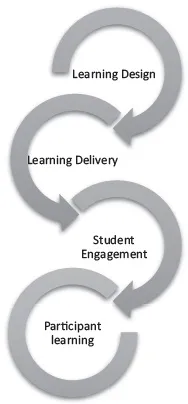
Figure 6.1 The Process of Instruction
Anyway, to continue, these wild hogs can be quite a nuisance to farmers and ranchers, but Texans have found a way to make the best of the what could be a difficult situation. Texas landowners,2 farmers, and ranchers have battled with these pesky hogs for many years, which has now fostered a thriving wild-hog-hunting industry.3 Some farmers, ranchers, and other land owners, rather than simply shooting the hogs, trap them and sell them to restaurants or ship them overseas as exotic meat. Other ranchers have specialized even further by throwing up tall fences around their property and then enticing gun and bow hunters to hunt the hogs on their land for a fee.4 More adventurous entrepreneurs take their hunter clients up in helicopters to hunt the hogs from the air.5 Wild hog hunting in Texas is a big deal, and wild hogs are things you simply can’t ignore, just like WILD HOG Questions.
Where did these hogs come from? Back when the Spaniards first came to Texas, certain numbers of domesticated hogs escaped. Later someone thought the black European wild boar would be fun to hunt and introduced those into the Texas wild. What we have today is a mix of the two. Which means, like domestic hogs, they are prolific breeders, and like the wild boar, they are tough and resilient survivors. These animals can protect themselves with their long tusks and thick hide and are extremely intelligent. Ranchers and farmers will tell you that it takes a special fence to keep wild hogs out. For regular fences, as soon as one fence gets fixed, the hogs will find a weakness someplace else. Like most hogs, they are omnivorous—i.e., they eat vegetation, insects, and meat indiscriminately, which means they are opportunistic feeders and will destroy large portions of crops and ruin harvests if left unchecked. There are estimated to be over 2.6 million wild hogs in Texas, and all the helicopter hunting, bow hunting, and live trapping has failed to diminish the population.6 As it turns out, that could be a good thing for wild hog hunters because wild hog meat from Texas is a delicacy, much leaner and more flavorful than the pen-fed pork we buy at the supermarket.7
Now that you know all about wild hogs, I would like to make a comparison of the characteristics of these interesting animals to a process for developing effective questions. I will call this process WILD HOG Questioning. I need to clarify that, while WILD HOG Questions have similar properties to wild hogs, they are not known to be nuisances as are the feral pigs of Texas. Rather, they are quite beneficial for instructors and learning participants.
Definition of WILD HOG Questions
To be specific, WILD HOG Questions are questions that, just like the feral pigs, are “in your face”; “can’t be ignored”; “have to do something with them” questions. Like the wild hogs, they reproduce rapidly and multiply and create more questions. They are unpredictable, voracious, and challenging. WILD HOG Questions (not to be confused with “hog wild” questions) are also deliberate, they ignore fences, they overcome poor thinking, they are intelligent and designed to make learners think.
WILD HOG stands for Written Intentionally for Learning Depth and Higher-Order Genius. (OK, I know it is corny, but my family and I worked hard to come up with this acronym!) But again, the name “WILD HOG” says it all: in-your-face, challenging, unavoidable, and unpredictable (see Figure 6.2).
6.3 WILD HOG Questions: Written Intentionally
The WI in WILD stands for Written Intentionally . The act of writing questions must be deliberate and intentional. A question must be crafted to meet the learners’ needs and the instructor’s needs. Unfortunately, because in many learning situations little thought is invested in deciding beforehand what questions to ask, questioning in most situations is haphazard and, as discussed earlier, largely ineffective. Not surprisingly, these questions made “on the fly” are typically low-level questions, because that is pretty much the best you can do when you are in the middle of directing a learning activity with 30 or more learners.
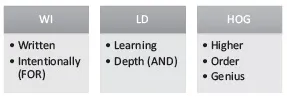
Figure 6.2 WILD HOG Acronym Spelled Out
Perhaps you have seen the movie I-Robot.8 Will Smith, who played the character Detective Spooner, was called to an accident scene of a supposed suicide. When called to investigate Dr. Lanning’s death, Detective Spooner has a conversation with a device that projects a prerecorded holograph of Dr. Alfred Lanning—the robotics genius who is recently deceased. Detective Spooner asks the holographic Dr. Lanning several low-level questions, to each of which the hologram responded, “I’m sorry. My responses are limited. You must ask the right questions.” But when he asked “Why would you kill yourself?” the holograph responded, “That is the right question.” Note that it is an open-ended question that gets to the heart of why Detective Spooner was there and what he really needed to investigate. In any learning situation, the “right questions” have to do the same thing: “What do I want the participants to learn?” followed closely by “How do I get them to learn it?” Low-level questions will always bring limited responses, and that is why we need to ask the right WILD HOG Questions.
While you are preparing your learning activities, it just takes a few more minutes to jot down the key Wild Hog Questions that build on each other (tiered). Crystal-clear learning objectives simplify designing and creating appropriate questions. Grant Wiggins and Jay McTighe proposed in Understanding by Design9 that creating the assessment before you teach is a powerful “best practice” to ...
Table of contents
- Cover
- Half Title
- Series
- Title
- Copyright
- Dedication
- Contents
- Acknowledgments
- Meet the Author
- Foreword
- Introduction to Better Questioning for Better Learning
- Questioning Skills Inventory
- Section I Questioning Foundation
- Section II Planning Learning
- Section III Learning
- Section IV Assessing Learning
- Index
Trusted by 375,005 students
Access to over 1.5 million titles for a fair monthly price.
Study more efficiently using our study tools.
Frequently asked questions
Yes, you can cancel anytime from the Subscription tab in your account settings on the Perlego website. Your subscription will stay active until the end of your current billing period. Learn how to cancel your subscription
No, books cannot be downloaded as external files, such as PDFs, for use outside of Perlego. However, you can download books within the Perlego app for offline reading on mobile or tablet. Learn how to download books offline
Perlego offers two plans: Essential and Complete
- Essential is ideal for learners and professionals who enjoy exploring a wide range of subjects. Access the Essential Library with 800,000+ trusted titles and best-sellers across business, personal growth, and the humanities. Includes unlimited reading time and Standard Read Aloud voice.
- Complete: Perfect for advanced learners and researchers needing full, unrestricted access. Unlock 1.5M+ books across hundreds of subjects, including academic and specialized titles. The Complete Plan also includes advanced features like Premium Read Aloud and Research Assistant.
We are an online textbook subscription service, where you can get access to an entire online library for less than the price of a single book per month. With over 1.5 million books across 990+ topics, we’ve got you covered! Learn about our mission
Look out for the read-aloud symbol on your next book to see if you can listen to it. The read-aloud tool reads text aloud for you, highlighting the text as it is being read. You can pause it, speed it up and slow it down. Learn more about Read Aloud
Yes! You can use the Perlego app on both iOS and Android devices to read anytime, anywhere — even offline. Perfect for commutes or when you’re on the go.
Please note we cannot support devices running on iOS 13 and Android 7 or earlier. Learn more about using the app
Please note we cannot support devices running on iOS 13 and Android 7 or earlier. Learn more about using the app
Yes, you can access Better Questioning for Better Learning by Benjamin Stewart Johnson,Benjamin Johnson in PDF and/or ePUB format, as well as other popular books in Education & Education General. We have over 1.5 million books available in our catalogue for you to explore.