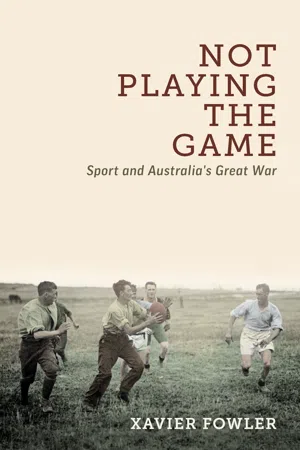
War remembrance and sport have become increasingly entwined in Australia, with AFL and NRL Anzac Day fixtures attracting larger crowds than dawn services. National representative teams travel halfway around the world to visit battle sites etched in military folklore. To validate their integration into this culturally sacred occasion, promoters point to the special role of sport in the development of the Anzac legend, and with it, the birth of the nation. The air of sombre reflection that surrounds each Anzac Day is accompanied by a celebratory nationalism that sport and war supposedly embody. But what exactly is being remembered, and indeed forgotten, in these official commemorations and tributes? In Not Playing the Game, Xavier Fowler reveals that the place of sport in the Great War was highly contested. Civilian patriots and public officials complained that spectator sport distracted young men from enlisting and wasted public finances better spent elsewhere. Sport's defenders argued it was a necessary escape for a population weary of the pressures of war. These competing views often reflected differences of class, politics and ethnicity, and resulted in ferocious, sometimes violent, clashes. Not Playing the Game challenges the way our memories of the war are influenced by the fervour of sport, painting a picture not of triumph but immense turmoil and tragedy.
- English
- ePUB (mobile friendly)
- Available on iOS & Android
eBook - ePub
About this book
Trusted by 375,005 students
Access to over 1.5 million titles for a fair monthly price.
Study more efficiently using our study tools.
Information
Subtopic
Australian & Oceanian HistoryIndex
HistoryChapter 1
On the playing fields of Australia: social division, sport and national defence, 1900–14
When the tocsin sounds the call to arms not the last, but the first, to acknowledge it will be those who have played and played well, the Australian game of football, before they play the Australian game of nation-making and nation-preserving to stand by the old land.
Prime Minister Alfred Deakin, 19081
I was carving out a football career, and I refused to train on Saturdays.
A boy registered in compulsory military training2
Divisions within the Australian sporting community reached their apex during World War I. The emotional intensity of the period saw disputes break out on the sporting field, in the grandstands, the committee rooms, and the press. Spiteful verbal attacks were common, and often ended in violence. The war, however, was not the originator of this turmoil, but rather its exacerbator. In the two decades preceding 1914, sport both revealed and instigated various social tensions that simmered beneath the proud declarations of its contribution to a unified national consciousness. The bitterness with which ideological, class, ethnic, and political conflicts were waged under the pressures of total war, therefore, cannot be fully understood unless an effort is made to appreciate their entrenched nature in Australian life.
Organised sport played a critical role in the development of Australian society and culture long before 1914. Often described as religion of sorts, sport’s popularity resided in its hundred years of practice by settlers in a foreign land, not to mention its British antecedents. From the inner-city streets and suburban backyards of Australia’s major metropolitan hubs to its rural farms and central deserts, people were enamoured with organised games. Men and women; Anglo, Scottish, Welsh, Irish, and Indigenous; Catholic and Protestant; poor and wealthy; sport dominated the lives of millions, regardless of social affiliation. Historian Gordon Inglis observed in 1912, ‘When one writes a book about Australian sport people may say “Oh that is all very well, but it seems to us that this country thinks about nothing else.”’3 Sport obtained the love and affection that other cultural pursuits could only envy. Australian social commentators have regularly debated whether the bush, goldfield, or city contributed most to the emergence of a collective national identity during the nineteenth century, however, avid participation and noteworthy achievements in athletic games stand alongside more conventional explanations.4 American author Mark Twain, impressed by the sporting obsession of the locals, even designated the running of the Melbourne Cup ‘the Australian National Day’ six years before the Federation.5
Assisted by this sporting mythology, popular understanding of white Australian history envisions an egalitarian paradise void of division and conflict. In 1915, Sir Frederic Eggleston, a conservative Australian politician and writer, declared ‘workers are generally content in their position … class loyalty, let alone consciousness, can hardly be said to exist. The class war may be a reality in England, America, or Europe, but in Australia it is a figment of the imagination.’6 But this claim failed to align with reality. The beloved narrative of a nation founded by convicts, workers, bushmen, and sportsmen, which already overlooks the violent nature of frontier conflict with the Indigenous population, simultaneously ignores the momentous presence of social tensions within the settler society.7 This conflict pitted a social establishment against a variety of intertwining oppressed and marginalised groups.
Class division was a powerful force in late nineteenth and early twentieth-century Australia, even if commitment to class war was less so. An economic crash and subsequent depression in the 1890s prompted employers to force salaries down, instigating unrest among wage earning workers (skilled artisans, unskilled labourers, and unemployed). As the financial gap widened the physical distance between employer and employee also increased. The factory owner no longer lived on the site; more and more of the middle-class abandoned the inner suburbs, leaving them to develop a distinctive working-class character.8 This character took on a notable militancy as the depression worsened and economic tension became acute. The national maritime strike of 1890 was followed by strikes involving shearers in 1891 and 1894, the Broken Hill miners in 1892, Victorian railway workers in 1903, Sydney tram workers in 1908, New South Wales coal miners in 1909–10, and the mass of Brisbane workers in 1912. The failure of direct action forced the labour movement to take a parliamentary route to better wages and working conditions, including the formation of several colonial labour parties and later the Australian Labor Party (ALP). The political representatives of such organisations were supported by a substantial trade union power base. By 1912, over 50 per cent of male employees in New South Wales and nearly 44 per cent in Victoria were unionised.9 The Australian egalitarian myth produced a certain pride in a life of honest labour, yet it grated against a recurrent dissatisfaction with poor salaries and subordinate place on the social hierarchy.10 Thus, a jaded, if not radical, Australian working-class consciousness developed.
Opposite to the labour movement was the ‘middle-class’. This group’s designation should not be confused with contemporary notions of the term. It was in fact the dominant Australian social class, or what John Rickard labels the ‘power elite’, and was not a recognised ‘upper’ class of society as there was in England.11 This loosely connected group comprised not merely employers, united in concern of the growing labour militancy, but also affluent professionals (doctors, lawyers) and lower wage-earning professionals (clerks, teachers). Educated in elite schools and beneficiaries of the system that produced them, white-collar Australians were concerned by the belligerence of the labour movement and its destructive impact on social stability, producing an improvised yet tangible middle-class solidarity.12 This social group was represented politically by the Liberal Party, a product of the 1909 fusion between the conservative free-traders and protectionists.
There was an ethnic and cultural dimension to this socio-economic divide. Rowan Ireland and Paul Rule, with excerpts from Richard Ely, have outlined the intersectional nature of national ancestry and religious denomination in the construction of Australian class consciousness. On one hand existed the ‘Catholic world’, which cherished its own, distinctively working-class, values.
Irish culture and Liberty (variously interpreted), religious-national festivals (such as St Patrick’s Day), the right to work, to unionise and strike, mateship among workmen … (and) the right of the ‘people’.13
The Irish population, 75 per cent of whom were Catholic, were indeed under-represented among top-income earners and over-represented in low-income earners and the unemployed.14 Consequently, Irish Catholics, as a result of this economic disparity and accompanying prejudicial stereotypes, struggled to ascend to positions of political and civic influence. Just 13 of 88 colonial premiers between 1855 and 1900 were of Irish decent. Of these 13, only five were Catholic.15 Against this group stood the ‘British Australian Protestant’, who awarded sacredness to traditional middle-class ideals.
The British Empire and Britishness, the monarchy, the Bible … self-improvement and work ethic, the rights and duties of property, freedom of contract, civil and religious liberty, the ‘British Sunday’, national development (and) law and order …16
Individuals originating from this group occupied key leadership roles in the political, civic, economic, and cultural life of Australia. Post-war census data, for example, reveals Protestant men to be overrepresented in high-income earners and under-represented in low-income earners. Meanwhile, English, Scottish, and Welsh men made up 85 per cent of colonial premiers between 1855 and 1900, another numerical over-representation.17 Through such roles, the Anglo Protestant middle class axis was able to impress their ethnocentric worldview on the rest of the country. Admittedly, these boundaries were not fixed. There was social mobilisation between these groups, including substantial Anglo Protestant poor and wealthy Irish Catholics. Nor does this social model entirely accommodate the divide between the city and the country. Yet the primary source of social and political tension in pre-war white Australia revolved around the relationship between class, ethnicity, and religion, one recognised by both sides of the divide. This ideological and economic discrepancy, as well as the diametrically opposed cultural ‘objects’ of identification they produced, fuelled real-world conflict. As these two communities, however inclusively conceived, struggled for supremacy in Australia, they also clashed in their shared cultural pastime: sport.
The establishment and marginalised groups understood the purpose of sport in vastly different ways. For the middle-class, sport was primarily a means of preparing adolescent boys for life, an ideology inherited from the English upper-classes, and cultivated in Australia’s elite public schools.18 Athletic contests were believed to impart qualities commonly associated with idealised masculinity: courage, determination, self-reliance, resilience, loyalty, stoicism, chivalry or fair play, as well as physical prowess, all considered attributes necessary to confront the male exclusive trials of public life. Sport was thus an ennobling pursuit that went beyond mere leisure. It even possessed a spiritual dimension, producing muscular Christians who would live a life of moral righteousness. Monetary involvement only acted to taint this purity, for it encouraged selfishness, gambling, and corruption. It was cautioned against at all costs, an easy principle to live by g...
Table of contents
- Cover
- Title
- Copyright
- Dedication
- Contents
- Acknowledgements
- Illustrations
- Introduction
- Chapter 1: On the playing fields of Australia: social division, sport and national defence, 1900–14
- Chapter 2: This race of athletes: outbreak of war to Gallipoli
- Chapter 3: Will they never come? Sport and recruitment, 1915–17
- Chapter 4: And this is sport in wartime! Fundraising and the debate over sport, 1915–17
- Chapter 5: At the point of the bayonet: government curtailment of sport, 1915–18
- Chapter 6: A spirit of prejudice, bigotry and sectarianism: racial and ethnic conflict in sport
- Chapter 7: She could be a ‘sport’ too: women and gender conflict over sport
- Chapter 8: Playing at hate: public school sport in wartime
- Conclusion
- Bibliography
- Index
Frequently asked questions
Yes, you can cancel anytime from the Subscription tab in your account settings on the Perlego website. Your subscription will stay active until the end of your current billing period. Learn how to cancel your subscription
No, books cannot be downloaded as external files, such as PDFs, for use outside of Perlego. However, you can download books within the Perlego app for offline reading on mobile or tablet. Learn how to download books offline
Perlego offers two plans: Essential and Complete
- Essential is ideal for learners and professionals who enjoy exploring a wide range of subjects. Access the Essential Library with 800,000+ trusted titles and best-sellers across business, personal growth, and the humanities. Includes unlimited reading time and Standard Read Aloud voice.
- Complete: Perfect for advanced learners and researchers needing full, unrestricted access. Unlock 1.5M+ books across hundreds of subjects, including academic and specialized titles. The Complete Plan also includes advanced features like Premium Read Aloud and Research Assistant.
We are an online textbook subscription service, where you can get access to an entire online library for less than the price of a single book per month. With over 1.5 million books across 990+ topics, we’ve got you covered! Learn about our mission
Look out for the read-aloud symbol on your next book to see if you can listen to it. The read-aloud tool reads text aloud for you, highlighting the text as it is being read. You can pause it, speed it up and slow it down. Learn more about Read Aloud
Yes! You can use the Perlego app on both iOS and Android devices to read anytime, anywhere — even offline. Perfect for commutes or when you’re on the go.
Please note we cannot support devices running on iOS 13 and Android 7 or earlier. Learn more about using the app
Please note we cannot support devices running on iOS 13 and Android 7 or earlier. Learn more about using the app
Yes, you can access Not Playing the Game by Xavier Fowler in PDF and/or ePUB format, as well as other popular books in History & Australian & Oceanian History. We have over 1.5 million books available in our catalogue for you to explore.