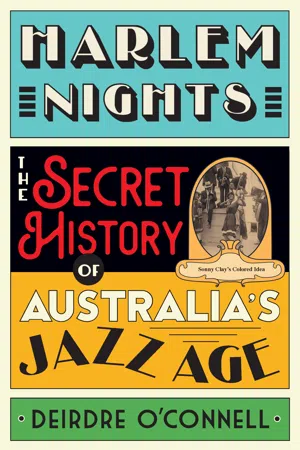
The 1920s were a time of wonder and flux, when Australians sensed a world growing smaller, turning faster—and, for some, skittering off balance. American movies, music and dance brought together what racial lines kept apart. A spirit of youthful rebellion collided with the promise of racial perfectibility, stirring deep anxieties in white nationalists and moral reformers. African–American jazz represented the type of modernism that cosmopolitan Australians craved—and the champions of White Australia feared.Enter Sonny Clay's Colored Idea. Snuck in under the wire by an astute promoter, the Harlem-style revue broke from the usual blackface minstrel fare, delivering sophisticated, liberating rhythms. The story of their Australian tour is a tale of conspiracy—a secret plan to kick out and keep out 'undesirable' expressions of modernism, music and race. From the wild jazz clubs of Prohibition-era LA to Indigenous women discovering a new world of black resistance, this anatomy of a scandal-fuelled frame-up brings into focus a vibrant cast of characters from Australia's Jazz Age.
- English
- ePUB (mobile friendly)
- Available on iOS & Android
eBook - ePub
About this book
Trusted by 375,005 students
Access to over 1.5 million titles for a fair monthly price.
Study more efficiently using our study tools.
Information
Subtopic
Australian & Oceanian HistoryIndex
HistoryPART I

TIJUANA NIGHTS IN PHOENIX AND LOS ANGELES
1
THE EDUCATION OF SONNY CLAY
CRUEL IRONY RENT Sonny Clay’s Australian tour. Major Lloyd’s surveillance operation focused not on him, but his bandsmen. Even so, his name lay at the heart of a scandal that besmirched his good reputation back in the United States, and clung like a bad smell for years to come. The even crueller irony is that, if not for the incident in Australia, Sonny Clay would be little more than a footnote in jazz history.
The annals of Black jazz have been written as the triumphant tales of Big Men (leavened by occasional Big Women): The First, Greatest, Legendary, Most Famous. Beneath this pantheon of generals was an army of travelling performers, struggling year in, year out. Some attained fleeting success, others never realised their ambitions. Sonny Clay was something of a captain in this army. He led a band of working musicians at a time when ‘the Negro’ was in vogue and Jim Crow segregation was at its height. He negotiated business deals that opened up new markets for Black jazz bands and travelled across oceans and geopolitical borders to seed the Harlem sound.
He was the spokesperson, first ballyhooing his band, then defending it. The lone voice accusing the Australian government of a ‘frame-up’ and asserting the right of his bandsmen to associate with whomever they chose. He fought a battle not of his own making, but hardly at odds with the struggles faced by New Negroes back home in the States. His courage to speak truth to power was shaped by a life journey that owed as much to heavyweight boxer Jack Johnson as educator Booker T Washington, that looked as much to the Mexican Revolution as the Harlem Renaissance.
Before the clock struck eight on the morning of Friday, 22 September 1911, a hundred or so people gathered outside the Sante Fe depot in Phoenix, Arizona, waiting for their honoured guest, the great educator Dr Booker T Washington to arrive. Forty-eight years had passed since Abraham Lincoln’s Emancipation Proclamation and the city’s three hundred or so Black residents were staging a jubilee.1
Balancing a solid bass drum on his chest stood tall, skinny, elevenyear-old Sonny Clay in a military-style uniform. Close by was his father, William Henry Clay, and fourteen young men in identical attire, each carrying a selection of horns, cymbals and kettle drums. They were bearers of a tradition born in the wake of emancipation: the Colored Brass Band.2
In the Black sections of Washington County, Texas, where Sonny Clay’s father was born forty years earlier, the free people’s brass bands had trumpeted the path from American slave to American citizen. Whether opening a Black Republican convention, honouring a visit from a congressional nominee, or celebrating an election day victory, the jubilant marches of the hometown ‘colored band’ kept the community’s eyes on the prize. They were the mortar in the bricks of the free people’s democratic life—even as White supremacists waged a campaign of terror.3
When Sonny Clay’s family moved west to the newly irrigated soils of Arizona’s Salt River Valley in 1910, his father carried this flame, forming and bankrolling the Phoenix Famous Colored Young Men’s Band.4 The tunes they rehearsed for Dr Washington’s visit had altered little since Reconstruction days, yet the march of ‘Negro progress’ no longer beat to the same political drum.5
Since the end of the Reconstruction in 1877, White supremacists had torn down the scaffolds of the nascent multi-racial democracy. Few in Washington County dared cast their vote after three Black Republican leaders were found hanging from a pecan tree. No brass band played outside the courthouse in 1897 when Sonny Clay’s grandfather sued the railroad company for throwing him off a White only carriage.6 Knowing one’s place became a fact of Black daily life, enshrined in law and policed by vigilantes beyond law.
The Clay family hoped for a new beginning when they moved west to Arizona. Boosters promoted the territory as the last patch of frontier, a ‘land of tomorrow where a man could forget his past and begin again’.7 But the spirit of Texas also followed them. Arizona would enter the Union upholding a legal doctrine the Supreme Court called ‘separate but equal’ but most people knew as the anything but equal ‘Jim Crow’. From housing to hospitals, a line separated people according to race.8
Yet as Booker T Washington insisted, racial segregation and political disenfranchisement did not impede race progress. ‘In all things that are purely social, we can be as separate as the fingers, yet one as the hand in all things essential to mutual progress’, ran the most quoted line from Washington’s most famous speech.9
He measured advancement, not by political office, but in the trappings of respectability and restraint; in the school, church house, business and home; by the absence of violence and the protection of the law. This was the message the triumphant fugues of the Phoenix Famous Colored Young Men’s Band would announce to the Emancipation Jubilee. The progressive Phoenix Negro was on the up and up.
It was close to half-past eight before Dr Washington’s train pulled into the depot. William Clay’s brass band serenaded the revered leader as he ambled to a waiting automobile. The vehicle then set off down an avenue festooned with stars and stripes, followed by a carefully ordered parade. Jubilee queens proclaimed the civilising waters of feminine virtue. The Indian School Band confirmed the complex nature of southwestern race relations. Brightly coloured floats advertised a pantheon of prosperity and enterprise, while the Phoenix Famous Colored Young Men’s Band stretched their six-march repertoire all the way to Eastlake Park.10
Thus began the Phoenix Emancipation Jubilee, a three-day extravaganza of jollification and education. On Saturday night an ox was cooked up for the grand march and barbecue. Thousands filled the tabernacle tent to hear Dr Washington extoll the virtues of education, respectability and restraint; of Black men and women labouring with their hands.
Whatever the topic, Dr Washington’s mantra of racial uplift did not change. Each lecture reiterated the value of a high moral standard. Stable employment. A bank account. Savings. Home ownership. Income tax. He warned them against the ‘menace of the drifting class’, rootless individuals, prone to superficial displays of wealth and profligate, unclean behaviour. ‘A man without a home is an unsafe citizen,’ he cautioned, while prosperity would reward the industrious, thrifty and patient. Just as the ‘laws’ of human progress had elevated the ‘stronger’ White race, so it would uplift the Black but never so far as to outstrip them. By being the servant of all, the Negro could be great.11
Phoenix’s White newspapers proclaimed Dr Washington as ‘the greatest Negro of the twentieth century’, applauding a message free from demands for political representation and the vote.12
Sonny Clay made no mention of Booker T Washington’s visit to Phoenix during his 1960 interview with John Bentley. Perhaps it’s unsurprising. Jazz record collectors such as Bentley were mostly White, middle-class men invested in a history of jazz founded in brothels and lowdown juke joints, not regimental bands and Black enterprise. But for all its limitations, John Bentley’s interview—a mix of taped recordings plus a sketchy handwritten transcript of the tapes that perished— remains the most comprehensive account of Sonny Clay’s thoughts and career.13
In 1960, Sonny Clay was sixty-one years old and a postman, his health ruined by alcoholism. Regret seeped through the stories of his life— the bad decisions, the bootleg liquor, the ‘scalping knives’ in Australia, the phone calls he never made. Untouched by the bitter tears of self-reproach were two childhood memories, both centred on the romance of the travelling musician.
The first was the Circus Days in his childhood home of Houston, Texas. On those days, either Ringling Brothers or Sells Floto arrived by railroad, a procession of stock cars and coaches bearing a thousand people and creatures from every corner of the globe. Sonny Clay lived in the ‘colored’ section of town, directly opposite the tracks, and on Circus Days his front yard view of the railroad became a ringside seat to the greatest show on earth.14
A short scramble away at the rail yard, a boy smitten by the circus could count off the Barbary lions, Bengal tigers and Californian seals descending from the stock cars. Or help roustabouts cloak the elephants, ready for the downtown street parade.15
Few could resist the call. On Circus Days, city workers turned away from the cotton trade to behold gravity-defying acrobats and body-befuddling contortionists. It was a time of wonder and drift. A readiness to abide situations that, only the day before, would have been unthinkable.
As a rule, a Black man in a fine cut suit was not a sight tolerated in Houston, Texas. And if a travelling man in a plaid ensemble appeared at Union Station, likely an officer of the law would escort him to a locker room and insist he change into a porter’s uniform, lest he start forgetting his place.16 But on Circus Day, Sonny Clay had every reason to believe the people of his race could do more than serve. He founded his faith in one man: PG Lowery, the cornet player who led the circus sideshow band, first at Sells Floto and later at Ringling Brothers. Hands down, Lowery fronted the finest brass band and ragtime orchestra from the mid- to southwest.17
‘It ain’t but the one and that’s P.G.,’ Sonny Clay once told a newspaper columnist, remembering the thrill of Lowery’s band marching through the business streets of Houston, looking sharp as a haircut in suits of blue wool and gold braid.18 Clay fixed his attention on the three drummers— bass, snare and cymbal—who twirled and tossed their sticks, setting a beat that slid between the ragged and the regimented. He could see Black and White people cheering them on. Hear the wave of applause that followed them down the street.
If it were not PG Lowery’s year in Texas, it would be ano...
Table of contents
- Cover
- Title
- Copyright
- Contents
- Prologue: The Frame-Up
- Part I: Tijuana Nights in Phoenix and Los Angeles
- Part II: In California With Harry Muller
- Part III: Rattlin’ Fine Sydney
- Part IV: Views Of Commonwealth Policy
- Part V: The Making Of Modern Melbourne
- Part VI: Keeping Orchestras British
- Part VII: Petty Sessions
- Part VIII: Idle and Disorderly
- Part IX: Unwritten Law
- Part X: Purifification Rites
- Part XI: On Their Way
- Part XII: The Quarantine Blues
- Acknowledgements
- Bibliography
- Notes
- Index
- Back Cover
Frequently asked questions
Yes, you can cancel anytime from the Subscription tab in your account settings on the Perlego website. Your subscription will stay active until the end of your current billing period. Learn how to cancel your subscription
No, books cannot be downloaded as external files, such as PDFs, for use outside of Perlego. However, you can download books within the Perlego app for offline reading on mobile or tablet. Learn how to download books offline
Perlego offers two plans: Essential and Complete
- Essential is ideal for learners and professionals who enjoy exploring a wide range of subjects. Access the Essential Library with 800,000+ trusted titles and best-sellers across business, personal growth, and the humanities. Includes unlimited reading time and Standard Read Aloud voice.
- Complete: Perfect for advanced learners and researchers needing full, unrestricted access. Unlock 1.5M+ books across hundreds of subjects, including academic and specialized titles. The Complete Plan also includes advanced features like Premium Read Aloud and Research Assistant.
We are an online textbook subscription service, where you can get access to an entire online library for less than the price of a single book per month. With over 1.5 million books across 990+ topics, we’ve got you covered! Learn about our mission
Look out for the read-aloud symbol on your next book to see if you can listen to it. The read-aloud tool reads text aloud for you, highlighting the text as it is being read. You can pause it, speed it up and slow it down. Learn more about Read Aloud
Yes! You can use the Perlego app on both iOS and Android devices to read anytime, anywhere — even offline. Perfect for commutes or when you’re on the go.
Please note we cannot support devices running on iOS 13 and Android 7 or earlier. Learn more about using the app
Please note we cannot support devices running on iOS 13 and Android 7 or earlier. Learn more about using the app
Yes, you can access Harlem Nights by Deirdre O'Connell in PDF and/or ePUB format, as well as other popular books in History & Australian & Oceanian History. We have over 1.5 million books available in our catalogue for you to explore.