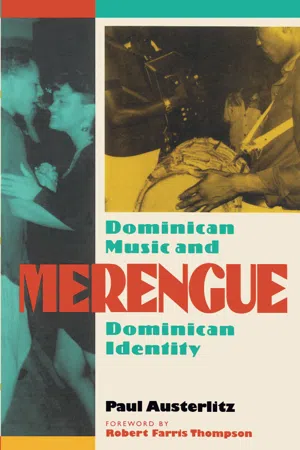
Merengue
eBook - PDF

Merengue

Dominican Music and Dominican Identity

  1. English
  2. PDF
  3. Available on iOS & Android
eBook - PDF

Merengue

Dominican Music and Dominican Identity

About this book

Merengue—the quintessential Dominican dance music—has a long and complex history, both on the island and in the large immigrant community in New York City. In this ambitious work, Paul Austerlitz unravels the African and Iberian roots of merengue and traces its growth under dictator Rafael Trujillo and its renewed popularity as an international music.

Using extensive interviews as well as written commentaries, Austerlitz examines the historical and contemporary contexts in which merengue is performed and danced, its symbolic significance, its social functions, and its musical and choreographic structures. He tells the tale of merengue's political functions, and of its class and racial significance. He not only explores the various ethnic origins of this Ibero-African art form, but points out how some Dominicans have tried to deny its African roots.

In today's global society, mass culture often marks ethnic identity. Found throughout Dominican society, both at home and abroad, merengue is the prime marker of Dominican identity. By telling the story of this dance music, the author captures the meaning of mass and folk expression in contemporary ethnicity as well as the relationship between regional, national, and migrant culture and between rural/regional and urban/mass culture. Austerlitz also traces the impact of migration and global culture on the native music, itself already a vibrant intermixture of home-grown merengue forms.

From rural folk idiom to transnational mass music, merengue has had a long and colorful career. Its well-deserved popularity will make this book a must read for anyone interested in contemporary music; its complex history will make the book equally indispensable to anyone interested in cultural studies.

Frequently asked questions

Yes, you can cancel anytime from the Subscription tab in your account settings on the Perlego website. Your subscription will stay active until the end of your current billing period. Learn how to cancel your subscription.
No, books cannot be downloaded as external files, such as PDFs, for use outside of Perlego. However, you can download books within the Perlego app for offline reading on mobile or tablet. Learn more here.
Perlego offers two plans: Essential and Complete
  • Essential is ideal for learners and professionals who enjoy exploring a wide range of subjects. Access the Essential Library with 800,000+ trusted titles and best-sellers across business, personal growth, and the humanities. Includes unlimited reading time and Standard Read Aloud voice.
  • Complete: Perfect for advanced learners and researchers needing full, unrestricted access. Unlock 1.4M+ books across hundreds of subjects, including academic and specialized titles. The Complete Plan also includes advanced features like Premium Read Aloud and Research Assistant.
Both plans are available with monthly, semester, or annual billing cycles.
We are an online textbook subscription service, where you can get access to an entire online library for less than the price of a single book per month. With over 1 million books across 1000+ topics, we’ve got you covered! Learn more here.
Look out for the read-aloud symbol on your next book to see if you can listen to it. The read-aloud tool reads text aloud for you, highlighting the text as it is being read. You can pause it, speed it up and slow it down. Learn more here.
Yes! You can use the Perlego app on both iOS or Android devices to read anytime, anywhere — even offline. Perfect for commutes or when you’re on the go.
Please note we cannot support devices running on iOS 13 and Android 7 or earlier. Learn more about using the app.
Yes, you can access Merengue by Paul Austerlitz in PDF and/or ePUB format, as well as other popular books in Social Sciences & Hispanic American Studies. We have over one million books available in our catalogue for you to explore.

Table of contents

  1. Contents
  2. Foreword by Robert Farris Thompson
  3. Preface
  4. 1. Introduction
  5. Part I: The History of Merengue, 1854-1961
  6. Part II: The Contemporary Era, 1961-1995
  7. 9. Conclusion
  8. Notes
  9. Bibliography
  10. Interviews
  11. Index