A "thoroughly researched, stranger-than-fiction" history of the world's tiniest rebel nation, filled with intrigue, armed battles, and radio pirates (Robert Jobson, author of
Prince Philip's Century).
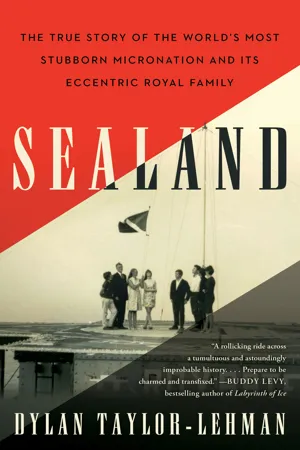
In 1967, a retired army major and self-made millionaire named Paddy Roy Bates cemented his family's place in history when he inaugurated himself ruler of the Principality of Sealand, a tiny dominion of the high seas. And so began the peculiar story of the world's most stubborn micronation on a World War II anti-aircraft gun platform off the British coast.
Sealand is the raucous tale of how a rogue adventurer seized the disused Maunsell Sea Fort from pirate radio broadcasters, settled his eccentric family on it, and defended their tiny kingdom from UK government officials and armed mercenaries for half a century. Incorporating original interviews with surviving Sealand royals, Dylan Taylor-Lehman recounts the battles and schemes as Roy and his crew engaged with diplomats, entertained purveyors of pirate radio and TV, and even thwarted an attempted coup that saw the Prince Regent taken hostage. Incredibly, more than fifty years later, the self-proclaimed independent nation still stands—replete with its own constitution, national flag and anthem, currency, and passports.
Featuring rare vintage photographs of the Bates clan and their unusual enterprises, this account of a dissident family and their outrageous attempt to build a sovereign kingdom on an isolated platform in shark-infested waters is the stuff of legend.
"Memorable . . . This idiosyncratic history entertains." ?
Publishers Weekly
"Endlessly captivating, like a thriller, and filled with crisp, evocative writing. Now, you'll have to excuse me, I'm visiting the principality to become an official 'Lord of Sealand.'" ?Bob Batchelor, author of
The Bourbon King
eBook - ePub
Sealand
The True Story of the World's Most Stubborn Micronation and Its Eccentric Royal Family
- 380 pages
- English
- ePUB (mobile friendly)
- Available on iOS & Android
eBook - ePub
Sealand
The True Story of the World's Most Stubborn Micronation and Its Eccentric Royal Family
About this book
Information

Chapter 1
The War Hero and the Beauty Queen
_____________
“I fought for both sides. I didn’t care, I just wanted to fight.”
—Roy Bates
—Roy Bates
For months on end in winter and spring 1944, the men of the British Army’s 8th Indian Infantry Division stared up at a monastery in central Italy that hovered over the sodden soldiers like the sigil of a cruel god. The monastery sat atop a promontory of a 5,000-foot-tall mountain, overlooking the Liri Valley and a small town called Cassino. The Nazis occupied the hill and guarded it fiercely with machine gun nests and mines, as it gave them a commanding view of the landscape in every direction and thus control of the resupply route to Rome.
Built in 652 by Benedictine monks, the monastery was preposterously well endowed. With concrete walls 10 feet thick and 150 feet tall, the readout offered a genuinely impenetrable vantage point. A consortium of Allied troops, representing countries as far-flung as Poland, New Zealand, and Nepal, were tasked with wresting control from the Nazis.
The four major attacks on Monte Cassino were legendary in their wretchedness. The only way up the mountain was a path comprised of hairpin turns and jagged, rocky terrain. The first assault was launched in January in the midst of remarkably harsh winter conditions. In the spring the flooded Gari and Rapido Rivers turned the roads into a morass of mud. Frostbite and trench foot were common, and in many cases the “venomous outbursts” of fighting at Monte Cassino amounted to slaughter. Fighting was so concentrated in the ruined town of Cassino below that individual buildings were sometimes occupied by troops from both sides.
Standing straight-backed and proud among this rank agglomeration of violence and miserable weather was Roy Bates,2 age twenty-three, who hailed from Essex, an industrial county in southeastern England studded with shipping warehouses and fishing boats. Roy was a soldier with the Royal Fusiliers, an infantry division attached to the 8th Indian Regiment, and he had been fighting in battles across the world since 1939. Roy had black, slicked-back hair and a slight underbite. Over six feet in height, he also was noticeably tall among the forces in the valley.
Roy was a seasoned fighter, having joined the military as soon as he turned eighteen. In fact, by the time he was fighting at Monte Cassino, he had fought in two wars on three sides. When he was fifteen he dropped out of boarding school to fight in the Spanish Civil War. It was a wrenching ideological conflict for control of the Spanish state, pitting the ultimately successful fascists against united leftists, anarchists, and communists, but Bates’s interests were less political and more visceral. “I fought for both sides,” he said. “I didn’t care, I just wanted to fight.”
That ambition for adventure called again during the Second World War, though this time Roy had a more vested interest in the conflict, fighting in defense of his beloved England. Roy “was a throwback,” said a friend and colleague named Bob Le-Roi. “He should have been born in the time of the first Queen Elizabeth and sailed with Drake. If ever there was a true buccaneer, it was Roy.”
Winter slowly turned into summer in the Liri Valley, and on a muggy day in May 1944, Roy and his fellow Fusiliers were briefed on an upcoming assault just south of the town of Cassino. He and two other soldiers were carrying supplies for the attack to be launched the next day, in which the Fusiliers would paddle rubber boats across the river and wipe out the German defenses on the other side. Following the briefing, Roy crouched as he ran with his Bren gun to a bank of trees to prepare for the assault. Suddenly, the ground below him erupted in a geyser of fire and dirt. One of the thousands of mines laid by German troops had exploded under foot, sending rock and shrapnel ripping through trees and human flesh. Roy was in and out of consciousness, his breathing heavy in his own brain, as he was rushed away from the battlefield by expeditious medics.
Roy missed out on the upcoming assault on account of the explosion, but it turned out to be another battle of indeterminate importance. The Fusiliers had crossed the river but were unable to get much farther, pinned down by machine gun fire until Canadian tanks made their way to the front line and gave the Fusiliers the chance to pull themselves out of their holes. Nevertheless, it burned Roy that he couldn’t be there, and he lay in the field hospital willing his wounds to heal.
Roy recuperated enough to rejoin his men in July, who by that point had excised the Germans from Monte Cassino and were pushing their way further north. Roy had already been stabbed, shot, and crippled by frostbite and disease, and being blown up by a mine was merely an inconvenient setback to the horrendous and wildly exciting duty of being a Royal Fusilier. “I rather enjoyed the war,” Roy was known to say throughout his life, and he always maintained he’d do it all over again as soon as he was called.
Fittingly, this was the man who would go on to found a kingdom in the North Sea and reign for decades as its prince. Roy was indeed a buccaneer from times of yore, and he would put his blood, sweat, tears, and family savings into a singular experiment whose reverberations would endure well into the next century.
Birth of a Scalawag
Roy’s preternatural bravery and knack for survival came from tragic circumstances. He was born on August 29, 1921, to Harry and Lilyan Bates in the west London suburb of Ealing,3 the lone surviving child of six brothers and sisters, who had himself overcome a severe bowel obstruction when he was a baby.
Harry Bates, a butcher, had earned a Military Cross for bravery in World War I and was by many accounts a fairly severe and demanding figure. Lilyan, a nurse during both World Wars, was a force to be reckoned with herself. Things could get so volatile that at one point young Roy was accidentally knocked into the fireplace when his parents were fighting, and to toughen Roy up, his father used to draw bathwater in the evening, let it freeze overnight in the unheated bathroom, and then break the ice in the morning and throw Roy in.
The family moved to Southend-on-Sea in Essex when Roy was a few months old because of his father’s lung condition. Harry had been gassed in the war and had difficulty breathing; at one point he had been given no more than a year to live on account of the damage. Southend, built along the north shore of the River Thames where it empties into the North Sea, was popular at the time as a resort city. With its ample seaside air and mud said to contain healing properties, Harry had fond memories of Southend from when he was stationed there during his tenure in the army. (The “on-Sea” suffix was added to many area towns to make them more attractive to tourists.)
When Roy was a boy, Southend had become a midsized, bustling city, characterized by winding thoroughfares and residential streets lined with rows of tightly packed townhouses and apartments. With a shopping district and esplanade filled with arcades along the shore, Southend sits atop steep hills that slope down to the Thames, treating residents and visitors to incredible views of the river that seems oceanic in its vastness. Far off in the distance lies the Isle of Sheppey and the county of Kent forming the opposite shore, with numerous islands in between separating the river into channels that flow out to sea. Extending more than a mile into the estuary is the Southend Pier, the longest pleasure pier in the world, which is serviced by its own train.
The Bates family settled into a home in the upscale Thorpe Bay neighborhood in eastern Southend, but imposing trees gave the property a despairing aura. Grim foliage notwithstanding, the climate suited Harry, and he lived very actively until he died at age seventy-nine. Meanwhile, Lilyan continued as a practicing nurse well into her late seventies.
Young Roy was a day boy at a boarding school but was not engaged by the experience. He was expelled a few times, though typically allowed to resume his studies at the start of the next term. “It was a quite nice school and they were quite efficient, except what they wanted to teach me and what I wanted to learn were quite different,” he said. “The only examination I ever passed in my life was my medical.”
Roy dropped out of boarding school to fight in Spain, and when he was deported back to England, he began apprenticing with thirty other young men as a rancher for Lord Edmund Vestey, whose family owned a meat processing empire that spanned three continents. There was a big map behind Vestey’s desk, and the Lord asked young Roy where he wanted to be stationed. “All the same to me,” Roy said as he pointed to a random area of South America. Vestey told him that was Argentina. “Great,” Roy replied.
Roy’s Argentinean escapade was scrapped when Britain declared war on Germany in September 1939. The chance to travel and fight once again beckoned, so Roy tried to extricate himself from his responsibility to Lord Vestey in order to fight against the Nazis. But the Vestey outfit had already booked him a ticket to Brazil, and, try as he might, Roy couldn’t get himself fired. As a “controlled job,” his was necessary for war production, and his country needed him to tend to his post. So Roy simply stopped going to work, and after sending a series of telegrams trying to persuade him to return, they finally cut him loose.4
Meanwhile, the military didn’t immediately accept Roy’s enlistment because the war wasn’t projected to last longer than six months. But it quickly became apparent that the world would be mired in another hideous conflict, so Roy was accepted into the Coastal Battalion. To Roy, this was not a suitable option, however, since a home front defense force assignment meant that he wouldn’t be sent overseas for combat. Roy successfully worked his way into the army, where he was put into the Essex Regiment and then commissioned into the Royal Fusiliers.
The British line infantry regiment Roy was assigned to got its start in 1685 as a unit of weapons’ bearers who carried special rifles that could be lit with a less caustic spark, thereby providing cover for the artillery without accidentally blowing up barrels of gunpowder. Since that time the Fusiliers had been dispatched to conflicts all over the globe, including the American War of Independence and the slaughterhouse that was World War I’s Battle of Passchendaele. During the Second World War, they were attached to the 8th Indian Division, fighting in Iraq, Syria, and Iran. In 1943, the 8th Indian Division was moved to Europe, traveling north through Italy, where Roy and his fellow soldiers would engage in the four battles of Monte Cassino. “As fighting men they were of one piece—the warp and woof of an unsurpassed military fabric,” recalled one historian.
Roy was officially discharged in 1946, when he was barely twenty-five, as the only surviving officer from his battalion. He had entered the army as a private but came out as A2 Major—a company commander in charge of up to two hundred people. At one point the youngest Major in the British Army, Roy “would’ve gone further up the rank in the war had he not kicked an officer for rebuking him for doing things the way he wanted to do them,” his son Michael later said.
In addition to the numerous injuries he sustained during the war, at one point a German grenade exploded right in front of Roy’s face, shattering his jaw and shredding the skin on his rubicund visage. The damage was so severe that a doctor told him that no woman would ever be able to love him again. A born contrarian, Roy defied the words of the doctor and met Joan, the woman who would be his partner in crime—sometimes literally—for the rest of their lives.
When Roy Met Joan
As Roy recalled, sometime in late December 1948, he went to the famed Kursaal dancehall on the Southend shore simply “to drink.” There he caught sight of Joan Collins, just eighteen years old at the time. She was laughing with friends and trying to look at Roy without looking at him at the same time. The scene was one of classic romance, where the room darkens, a spotlight shines on two people on opposite sides of the room, and the music becomes fuzzy as they stare at each other through the swaying of an indistinct mass of people. Roy floated across the room, looked at her tenderly, and asked her to dance.
“It was stunning, like what you read in a book,” Joan recalled. “He was tall, dark, and handsome. There was no question in my mind that we would always be together from the first minute.”
Joan was a striking woman with a radiant smile and long, blonde hair, her aura shining as brightly as any actress of the time. She did a good bit of modeling, lending her face to a variety of ad campaigns, magazines, and fashion shows organized for charitable purposes. Her modeling career continued throughout the 1970s. In fact, Michael would take his girlfriends to a club in town where a picture of his mother, donning fur, hung in the foyer.
Roy and Joan were seemingly fated to be together. Joan herself was from a military family whose forebears were coalminers from northern England and Ireland. She was born in the Aldershot Barracks on September 2, 1929, to Elizabeth and Albert Collins—a relatively quiet, normal family as compared to Roy’s—but there were some odd coincidences between them. For example, Roy and Joan’s fathers had served together at the Battle of the Somme, both were in the Royal Horse Artillery, both were stationed at the same barracks, and both even had the same toe blown off the same foot.
Joan grew up with her younger brother in Wakering, a small town just east of Southend housing various military installations. Eight years younger than Roy, she was too young to work in munitions factories during the war years, so she took jobs like theater usherette or chocolate biscuit factory employee that were perennially staffed by teens. Joan’s parents sometimes kept her out of school to help around the house, which had water pumps in front and back that straddled the line between the Victorian era and the modern day.
Technically Roy was already engaged when they met (and to Joan’s friend, at that), but it was one of those situations in which the direction he had to take was clear. It took Roy three days to propose, Joan said, “and I thought he was taking a hell of a long time.” The two were married at the Caxton Hall registry office in Westminster in February 1949. They would stay married for more than six decades. “After all these years we never need anyone else around. We’re never bored together,” Joan said later in life. “I met Roy at eighteen and married him after six weeks. I admired him then, and still do.”
Roy initially embarked on the dutiful responsibilities of a husband, putting on a tie and commuting to work at a company that imported poultry by the trainload from Southern Ireland to the rationed North. “There was rationing in the country then, and I found the only thing that wasn’t rationed that people could really eat plenty of was poultry,” he said. But Roy found that this endeavor involved a lot of dreary deskwork, and he soon had an Office Space moment about the horrors of the nine-to-five.
“I found myself sitting in a train one day at Leigh station and there were five [businessmen] sitting on my side with blue suits and briefcases and bowler hats, and five sitting on the other side,” Roy said. “So I got up at Leigh and threw my bowler hat and my briefcase in the water and phoned up my lawyer and said ‘Get rid of everything. I’m not going to do this any longer.’ And I went and bought a fishing boat.”
While the couple had friends who sailed or fished, neither of the Bateses had any practical experience working in the commercial fishing industry. Fortunately, cheap boats were in ready supply on account of the surplus of vessels built for the war, and the Bateses bought an old military harbor launch that he called the Mizzy Gel. The thirty-six-foot boat was previously used to shuttle troops between ship and shore, and the couple outfitted it with other bits of military surplus. B&B Fisheries, the family’s fishing business, would grow to become a decent-sized operation with around a half-dozen boats, but Roy and Joan began looking into additional business options onc...
Table of contents
- Cover Page
- SEALAND
- Title Page
- Copyright
- Dedication
- Contents
- Introduction: The Old Man and the Sea (Fort)
- PART I: The Making of a North Sea Kingdom (1921–1967)
- PART II: Guns, Germans, and the Defense of a Dynasty (1967–2000)
- PART III: Surviving the Cyber Age (2000–present)
- Epilogue: All Hail the Stubborn Kingdom
- Appendix: Precedent, Justification, and Scholarly Opinion on Sealand as a Sovereign Nation
- Notes
- Bibliography & Sources
- Photos
- Acknowledgments
- Footnotes
Trusted by 375,005 students
Access to over 1.5 million titles for a fair monthly price.
Study more efficiently using our study tools.
Frequently asked questions
Yes, you can cancel anytime from the Subscription tab in your account settings on the Perlego website. Your subscription will stay active until the end of your current billing period. Learn how to cancel your subscription
No, books cannot be downloaded as external files, such as PDFs, for use outside of Perlego. However, you can download books within the Perlego app for offline reading on mobile or tablet. Learn how to download books offline
Perlego offers two plans: Essential and Complete
- Essential is ideal for learners and professionals who enjoy exploring a wide range of subjects. Access the Essential Library with 800,000+ trusted titles and best-sellers across business, personal growth, and the humanities. Includes unlimited reading time and Standard Read Aloud voice.
- Complete: Perfect for advanced learners and researchers needing full, unrestricted access. Unlock 1.5M+ books across hundreds of subjects, including academic and specialized titles. The Complete Plan also includes advanced features like Premium Read Aloud and Research Assistant.
We are an online textbook subscription service, where you can get access to an entire online library for less than the price of a single book per month. With over 1.5 million books across 990+ topics, we’ve got you covered! Learn about our mission
Look out for the read-aloud symbol on your next book to see if you can listen to it. The read-aloud tool reads text aloud for you, highlighting the text as it is being read. You can pause it, speed it up and slow it down. Learn more about Read Aloud
Yes! You can use the Perlego app on both iOS and Android devices to read anytime, anywhere — even offline. Perfect for commutes or when you’re on the go.
Please note we cannot support devices running on iOS 13 and Android 7 or earlier. Learn more about using the app
Please note we cannot support devices running on iOS 13 and Android 7 or earlier. Learn more about using the app
Yes, you can access Sealand by Dylan Taylor-Lehman in PDF and/or ePUB format, as well as other popular books in History & Historical Biographies. We have over 1.5 million books available in our catalogue for you to explore.