The former advisor to President Trump shares an insider account of the investigation into Russian collusion in a memoir that "unfolds like a spy thriller" (
Publishers Weekly).
As a young, ambitious foreign policy advisor to Donald Trump's presidential campaign, George Papadopoulos became the first Trump official to plead guilty in special Counsel Robert Mueller's investigation into Russian interference in the 2016 election. He then became the first campaign advisor sentenced to prison.
But as he explains in
Deep State Target, there was an intricate set up at play, and it was neither Trump nor the Russians pulling the strings. American and allied intelligence services set out to destroy a Trump presidency before it even started. Here, Papadopoulos gives the play-by-play of how operatives like Professor Joseph Mifsud, Sergei Millian, Alexander Downer, and Stefan Halper worked to invent a Russian conspiracy that would irreparably damage the Trump administration.
Papadopoulos was there: In secret meetings across the globe, on city streets being tailed by agents, and ultimately being interrogated by Mueller's team and agreeing to a guilty plea.
eBook - ePub
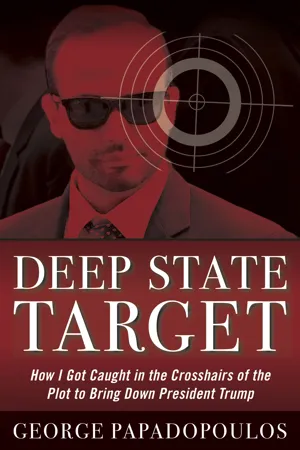
Deep State Target
How I Got Caught in the Crosshairs of the Plot to Bring Down President Trump
- 197 pages
- English
- ePUB (mobile friendly)
- Available on iOS & Android
eBook - ePub
Deep State Target
How I Got Caught in the Crosshairs of the Plot to Bring Down President Trump
About this book
Information
CHAPTER 1
A BEGINNING
I REMEMBER WATCHING a 2000 presidential election debate between George W. Bush and Al Gore when I was in eighth grade. I was not a middle-school policy wonk—far from it. I really didn’t know much beyond what I’d learned about politics in my social studies classes and at home listening to my dad. But I remember two things about the debate: I really was impressed by Gore at first. He was articulate and came across as a very educated person. Yet despite that, there was something in George Bush’s manner that made me gravitate toward him. I liked him more. He seemed much more pleasant than Gore, like he was the warmer guy who would connect well with Americans. I mention this mini-awakening because I think it may resonate with others who are moved by a personality, not a policy. Years later, I would react positively to another candidate with a unique persona.
Although I graduated from Niles West High School in Skokie, Illinois, I was in ninth grade at Hinsdale Central High School when—sitting in biology class—I heard about the 9/11 attack. I was horrified and enraged. For the first time in my life, I was aware that I felt a sense of national pride. I was fourteen years old, amped by outrage, injustice, and the carnage. I started to understand what it means to be an American. To recognize the privilege of living in a country where we have freedom of speech, where my own immigrant family was able to settle, safely, securely, and attain a remarkable amount of affluence. We were “united” by this country and these laws. I couldn’t believe foreigners were attacking our country—a land like no other, with guaranteed freedoms of religion and the press and the right to live in the pursuit of happiness. I felt proud to be part of this country. I wanted to support it, this place, my homeland.
I know I wasn’t alone in my reaction. As everyone remembers, there was an enormously powerful, national, rally-round-the-flag response. Everywhere, with everyone. But as a young teenager, I felt it profoundly—like falling in love for the first time. And also, for the first time, I thought that maybe life had something else in store for me instead of becoming a doctor. This was heresy in my immediate family, where practicing medicine was seen as my destiny—following in the footsteps of my grandfather, my father, and, later, my brother. But it was the beginning of an awakening. I had begun to realize that I didn’t want to follow the family medical school path. My father’s first cousin, Vasilis Papadopoulos, worked for many years at the European Commission, and so did other relatives. Meanwhile, my uncle Alex Papadopoulos had a PhD from the University of Chicago in geography, and he frequently taught classes that touched on wealth, power, and the world.
Maybe I wanted to get into the other “family business”—politics.
LONDON SWINGS
When I graduated from DePaul University with a degree in political science, I had my sights set on diplomacy and politics. So I enrolled at the University College London’s School of Public Policy. It didn’t take me long to realize I was more interested in security and geopolitical issues, so I switched to the school’s security studies program.
I loved the courses, my classmates, and the city itself. London felt like the most cosmopolitan, international city on the planet to me. I was a twenty-two-year-old kid from the suburbs of Chicago, and now I was having discussions with people from all over the world, many of whom had direct connections to the corridors of power. One of my classmates was the son of the Sri Lankan minister of defense. Another was the son of the mayor of Tbilisi, the capital of the Republic of Georgia. There were a bunch of Israelis, fresh out of the military. The closest I had ever been to any political power before this was when my father hosted a fundraiser in our home for the now-disgraced congressman Dennis Hastert, who was the Speaker of the House at the time. Now I was making my own real connections to people who inhabited the worlds of politics, diplomacy, and power. It was a heady experience for me, and I wanted more of this life.
I returned to Chicago to write my master of science thesis on the rise and fall of Islamist governments in the wake of the Arab Spring. I relished the research into a model of governance that stripped citizens of civil rights and had little in common with America’s fundamental values. The paper, which was well received, would come in handy on a professional level when I later advised governments on the fall of Egyptian president Morsi and the rise of Field Marshal Sisi.
I began to think, reluctantly, about the inevitable next step: law school. Although it seems like a natural progression for someone interested in politics to understand the laws that govern our nation, I wasn’t sure I wanted to spend the next three years studying the law. I wanted to be more engaged with the world and with work. Right then.
I wrote letters to dozens and dozens of think tanks and research institutes. It was 2010, and the economy was still hobbling after the 2008 fiscal meltdown. With my job search faltering, I began taking LSAT practice tests.
I was sitting in a bookstore grabbing coffee when an older man about sixty years old spotted my LSAT practice guide on the table.
“Law school? Don’t go to law school,” he said, taking a seat at the next table. “I’m a lawyer. It’s not worth it. Maybe for some people it is, but not for me. You work long hours. You overcharge clients because you can. And the government bureaucracy exists to bill more hours! Sometimes I think it’s a kickback scheme. Trials are delayed, postponed, reordered, and who pays? First the client. Then the law firm pays the government in taxes—that’s the kickback!”
He was a bit of a crank. But he also struck me as completely sincere. He said that law school might actually be the worst part of the whole process because the pressure of the experience strips the joy from being young.
“I should have been traveling. Seeing the world! There are so many more interesting topics and things to do in the world than being stuck in law school and then working like a pig. Instead, I was running up a lot of debt. And if you don’t land with a big firm, that debt can hang around. It did for me. So watch yourself.”
I had no idea who this gentleman was. But he seemed intent on giving me friendly advice. It was, to be honest, a perspective I’d never heard. The well-dressed lawyers on TV never seem to have regrets about their position. Other than Jimmy McGill in Better Call Saul, that is.
As luck would have it, later that very same day I received an email from a man named Richard Weitz at the Hudson Institute think tank and research center. He liked my résumé and asked if I would be interested in working remotely, helping him research a number of foreign policy papers he was working on as the Institute’s Director of the Center for Political-Military Analysis. We talked on the phone soon thereafter, and the conversation went very well.
I couldn’t help thinking about the words of that mysterious lawyer from earlier in the day. This seemed like a sign. A potential reprieve, even, from law school. I would only be, technically, an intern for the institute, but I didn’t care. It was a start. It put me a step closer to Washington and the kind of work I envisioned myself doing.
And it’s where the story of my ascent into the world of foreign policy, presidential campaigns, and partisan politics—and the chilling spy games that unfold in the shadows—begins.
CHAPTER 2
MR. PAPADOPOULOS GOES TO WASHINGTON
IT’S THE SUMMER of 2011. And after months of collaboration and working on articles relating to nuclear nonproliferation, NATO, and China relations with Taiwan now on my résumé, Weitz invites me to attend a conference in D.C. I visit him at the institute with a goal in mind. I need paying work.
The Hudson Institute was founded in 1961 in the New York suburb of Croton-on-Hudson by nuclear strategist and futurist Herman Kahn. A former analyst for the RAND Corporation, Kahn leaped into prominence for his controversial book On Thermonuclear War, which, among other things, envisioned a Doomsday Machine and examined how America should plan for such a catastrophic event. The institute relocated to D.C. in 2004 and established itself as one of the leading conservative American think tanks, focusing on national security, leadership, and global engagement.
During my visit, Weitz introduces me to a man named Seth Cropsey, who had served as deputy undersecretary of the US Navy in the Reagan and Bush administrations and had worked as a fellow for the Heritage Foundation. He is in his sixties, but despite our age gap, we hit it off. We’re both from Chicago, and his father, Joseph Cropsey, was a political theorist at the University of Chicago where my uncle got his geography PhD. As it happens, Seth not only helps me with my writing and thinking, he ultimately changes the direction of my life. He is working on a book at the time, Mayday, about the decline of US naval supremacy, and asks if I’ll help him with research.
Seth also explains the inner workings of the Hudson Institute and how fellows are funded. The institute is in many ways a nonprofit consulting firm. Donors fund the research, and bringing in clients is essential to obtaining the kind of research analyst position that I was suited for. Essentially, I need to fundraise to create a position for myself—to find my own sponsors. That is a bit of a blow. The good news, though, is that I leave with the sense that Seth and others at the institute think I might be a good fit.
But how does a kid from Chicago crack into D.C.’s clubby, policy-shaping world, where everyone seems to be an ex-Pentagon official, law school graduate, or have connections to a previous presidential administration or congressman? And who can I induce to hire me to create position papers? First, I need an angle, an agenda, an insight to make people stand up and take notice.
A NEW VISION
I start to think critically about American foreign policy and my vision of the world. I am drawn to Greece and the Mediterranean theater.
My name, obviously, broadcasts my family’s Greek roots, which run deep on both sides of my family. My father’s grandparents left their hometown of Thessaloniki, in northern Greece, during World War II and settled in the Belgian Congo, where they ran a number of successful businesses.
My grandmother’s parents—yes, they were named Anthony and Cleopatra—eventually divested in their various enterprises and moved back to Greece. My grandmother married my grandfather and went to France where he trained as a surgeon. That is where my dad, Antonios, was born. Eventually they moved back to Thessaloniki, but at age eighteen, he moved to Brussels to begin his medical studies.
My mother, Kate, was born in Greece. Her parents, Konstantinos and Demetra Bouroukas, were more blue collar. They immigrated to the United States with the clothes on their back and three young children in tow. Like so many other immigrants that built our nation, they were determined to turn the American Dream into a reality. My grandfather got a job as a painter. Eventually, he became a painting contractor. He saved money and bought property in Chicago, gradually developing a small real estate empire. He and my grandmother became self-made millionaires. My mother, Kate, continues working in real estate to this day.
My parents met in Boston. My father was completing his medical residency at Tufts University, and my mother was in town visiting relatives when they met at a dance. They married and settled in Chicago, where I was born in 1987. We didn’t stay in town long; my father, a Greek citizen, had to complete his compulsory military service, so we relocated to Thessaloniki for two years. We moved back to Chicago just before I entered kindergarten. At the time, my Greek was better than my English.
America, for years, has given short-shrift to Greece and aligned itself with Turkey and Israel. Those two countries shared a quiet, under-the-radar coexistence for decades. But in 2010, the hidden ties between the two nations started to fray. Israelis were found to be aiding Kurds—long a political problem for Turkey—in Iraq, along the Turkish border. Meanwhile, pro-Palestinian activists, including the Turkish Foundation for Human Rights and Freedoms and Humanitarian Relief, launched a flotilla of six ships intended to deliver aid to the Gaza Strip, defying a blockade instituted by Israel and Egypt.
The Israeli Navy’s Flotilla 13 unit stormed one of the Turkish ships, the Mavi Marmara, and all hell broke loose. Ten activists died. A number of Israeli commandos were injured. The flotilla and the raid generated international headlines, and relations between Israel and Turkey hit a new low.
Also in 2010, Noble Energy, a Texas-based company, announced that the recently discovered natural gas fields off the coast of the tiny nation’s Mediterranean coastline, later named “Leviathan” and “Tamar,” far exceeded earlier expectations. This discovery set off enormous shock waves in the energy business. It meant total energy independence for Israel and a new source of natural gas for the international market.
Meanwhile, in Turkey, Recep Tayyip Erdoǧan, Turkey’s prime minister since 2004, was consolidating power. Turkey has been held to the West as the ideal model for secular Muslim democracy. But that vision has become blurred. Erdoǧan is an Islamist. He believes in Islamic law. For another, he has anti-democratic, strongman tendencies. His record for quashing opposition is well-documented.
Despite these realities, President Obama’s administration continued working with Turkey.
It is hard not to see Erdoǧan in the same light as so many other Muslim leaders who embrace Islamic law. Sadly, very few of these countries have proven to be friendly to democracy or American interests. Look at Pakistan, Libya, and Iran. Saudi Arabia, for all the money it spends in the West, isn’t any better; it may be the most anti-Western, repressive country on the planet. As much as I was gung-ho about the invasion of Iraq, it is now quite clear that the Iraqi War, tragically, was a huge mistake. Bush may have had the best intentions, but his war destabilized the Middle East, cost America billions of dollars and thousands of lives, and failed to bring true democracy to a region that—judging from all recent fallout—has scant interest in civil liberties and freedom.
Given all this, when I look at a map of the Mediterranean, I wonder why Israel, Egypt, Greece, and Cyprus aren’t viewed as a natural alliance? And why doesn’t America seek to strengthen relations between them? Turkey, of course, has been seen as strategically vital because it controls the Bosporus Strait, which is where the Russian Navy would, theoretically, enter the Mediterranean via the Black Sea. But establishing a military presence with Greece and Cyprus would provide a substantial buffer for any Turkish delusions of grandeur in the area. As for funneling the natural gas from Israel to Turkey? Why give Turkey more strategic power?
I conclude that backing Turkey, despite its NATO membership, is not ideal for American or Israeli interests. I share my thoughts with Seth Cropsey, Richard Weitz, and Douglas Feith, the director of national security strategies at the institute. They tell me I may be onto something.
It turns out I am.
TH...
Table of contents
- Cover Page
- Deep State Target
- Title Page
- Copyright
- Dedication
- Contents
- Prologue
- 1 A Beginning
- 2 Mr. Papadopoulos Goes to Washington
- 3 Campaign Fever
- 4 Power Games
- 5 Target Practice
- 6 The Devil from Down Under
- 7 Greece, Cleveland & Millian
- 8 The Halper Set-Up
- 9 Victory Spoils
- 10 Men in Black Attack
- 11 Love Among the Ruins
- 12 The Arrest
- 13 The Grinding Wheels of Justice
- 14 Connecting the Pieces
- 15 Incarceration & Inspiration
- Acknowledgments
- About the Author
Trusted by 375,005 students
Access to over 1.5 million titles for a fair monthly price.
Study more efficiently using our study tools.
Frequently asked questions
Yes, you can cancel anytime from the Subscription tab in your account settings on the Perlego website. Your subscription will stay active until the end of your current billing period. Learn how to cancel your subscription
No, books cannot be downloaded as external files, such as PDFs, for use outside of Perlego. However, you can download books within the Perlego app for offline reading on mobile or tablet. Learn how to download books offline
Perlego offers two plans: Essential and Complete
- Essential is ideal for learners and professionals who enjoy exploring a wide range of subjects. Access the Essential Library with 800,000+ trusted titles and best-sellers across business, personal growth, and the humanities. Includes unlimited reading time and Standard Read Aloud voice.
- Complete: Perfect for advanced learners and researchers needing full, unrestricted access. Unlock 1.5M+ books across hundreds of subjects, including academic and specialized titles. The Complete Plan also includes advanced features like Premium Read Aloud and Research Assistant.
We are an online textbook subscription service, where you can get access to an entire online library for less than the price of a single book per month. With over 1.5 million books across 990+ topics, we’ve got you covered! Learn about our mission
Look out for the read-aloud symbol on your next book to see if you can listen to it. The read-aloud tool reads text aloud for you, highlighting the text as it is being read. You can pause it, speed it up and slow it down. Learn more about Read Aloud
Yes! You can use the Perlego app on both iOS and Android devices to read anytime, anywhere — even offline. Perfect for commutes or when you’re on the go.
Please note we cannot support devices running on iOS 13 and Android 7 or earlier. Learn more about using the app
Please note we cannot support devices running on iOS 13 and Android 7 or earlier. Learn more about using the app
Yes, you can access Deep State Target by George Papadopoulos in PDF and/or ePUB format, as well as other popular books in Politics & International Relations & Political Biographies. We have over 1.5 million books available in our catalogue for you to explore.