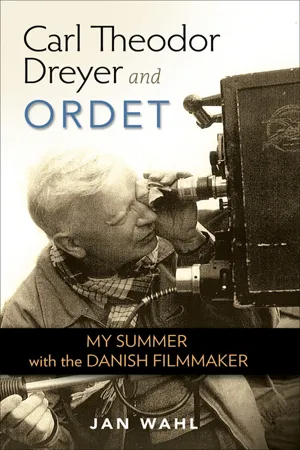
This illustrated memoir shares a rare inside look at the legendary director's process and vision during the filming of his award-winning masterpiece.
Danish director Carl Theodor Dreyer is considered one of the most influential filmmakers in cinematic history. His 1955 film
Ordet (The World) won numerous prizes, including the Venice Film Festival's Golden Lion. In 1954, Dreyer invited young film student Jan Wahl to accompany him during this classic work.
This captivating account of Wahl's time with the director is based on Wahl's daily journal and transcriptions of his conversations with Dreyer. Offering a glimpse into the filmmaker's world, Wahl fashions a portrait of Dreyer as a man, mentor, friend, and director. Wahl's detailed account is supplemented by exquisite photos of the filming and by selections from Dreyer's papers, including his notes on film style, his introduction for the actors before the filming of
Ordet, and a visionary lecture he delivered at Edinburgh.
- 155 pages
- English
- ePUB (mobile friendly)
- Available on iOS & Android
eBook - ePub
About this book
Information
Subtopic
Film History & Criticism1 Pastries at Rungsted
When I arrived, the day was shining. The Dreyers were staying at a modest painted house on a low hill surrounded by a yellow-green, abundant, leafy garden. I went up the round stone steps to ring the bell. Carl Theodor Dreyer opened the door himself, remarking gently, “The sun has come to light your visit.”
In the hallway he informed me that his wife, Ebba, was absent, buying cakes and cookies for us at the bakery, and would soon be back; perhaps we could wait for her in the parlor. He led me in.
Nowhere in the house did I find the signs of movie preparation one might expect. No paper, pens, ink, typewriter. I saw nothing of model sets or sketches or books. The house was spotless, filled with fresh flowers. The windows and the back door were open. “I am busy at work,” Dreyer said smiling, tapping his forehead.
We sat in the parlor. Herr Dreyer offered a cigarette, then looked at me eagerly. “Did you see Limelight?” he asked. I answered yes; the film had played in Copenhagen for six months.
“I learned much about poetic unity from Chaplin. As you might move in a museum, from one Rembrandt to another, seeing the essential harmony but having the sense of exploring depths that were unknown to you before, I could see both The Kid and Limelight on the same afternoon. Like Paul Klee too, he invents all the time. Shoulder Arms and The Great Dictator, I think, are the best documents we have against war. It was wonderful to have the war in the trenches in Shoulder Arms represented as a bad dream the Tramp was having.”
Dreyer said he could still hum the theme from Monsieur Verdoux and did so. It was a sinister, satirical Viennese waltz. I proceeded to whistle the irresistible dance of the shadow people from Vampyr; the German composer Wolfgang Zeller had written the score for Dreyer's film.
“Yes, I am fond of it also,” he admitted. Then he suggested that we carry two lawn chairs out into the garden. “In Denmark we learn to drink up every bit of the sunshine.” Once we were sitting outside, he said: “Now I want to ask what you think of Poul Schierbeck's music in Day of Wrath.”
Day of Wrath deals with religious hypocrisy and witch-burning in the seventeenth century. The opening is direct and ominous—with no titles but the unrolling of a decree of death for Herlof's Marte, a foolish, harmless old woman who brews herbs. When a large number of farm sheep die, she is suspected and judged to be a witch. As the scroll unwinds, a massive organ-like orchestration of “Dies Irae” is played. The music ceases.
Next we are shown two women in a hut, bent over a steaming kettle; one of them mutters, “Water from the gallow's bank.” Suddenly in the distance a witch-bell is heard, and a crowd chants the name of Herlof's Marte. She stands up stiffly, with a kind of fatalistic dignity. The bell rings incessantly, coming closer—it keeps on tolling. The music, used sparingly in Day of Wrath, is powerful and somber, rather Bach-like.
I replied that I found the music extremely suitable. “You know,” Dreyer mused, “I promised Poul Schierbeck after we finished Day of Wrath if I ever did another film in Denmark he must again write the music. And so he is indeed, for The Word.”
“Isn't that impossible?” I protested. “Schierbeck is dead.”
“Yes. But I shall still keep the promise. His widow is giving me his unpublished manuscripts. From them I'll fit a score together. His music is just right for The Word.”
I asked Dreyer if he planned to make The Word a contemporary piece.
“Well, I shall keep it in the time in which Kaj Munk wrote it; in other words, 1925. However, since it occurs out in the country, which is always touched less by the whim of fashion, its people will wear those dresses or suits which are timeless and rustic.”
Then Dreyer's wife appeared. At the door she made a signal with her hand. Dreyer rose from his chair. “It's the telephone,” he explained. “It must have sounded as she came in.” He excused himself and entered the house.
Fru Dreyer was fashioned like graceful Dresden china. “We shall have tea in a minute,” she said, as I helped her with her parcels. “The studio has called. They want to know what color to paint the farmhouse kitchen. I am sure he wants it yellow. You cannot get away from such matters, even out here in Rungsted. Oh,” she whispered, taking off her bonnet, “I hope for his sake the weather stays nice. He is going to make the outdoor scenes at Vedersø in Jutland, where Kaj Munk lived.”
After Dreyer's return, he consulted his watch. “I have a visitor every afternoon at three-thirty,” he declared. Soon after, a gray bird flew down and walked over to the back terrace, where we were sitting. Dreyer then broke up a cake into small pieces and flung them out into the grass.
The bird regarded us with a cool, steady eye and ate the crumbs—finally giving us a look of thanks and sweeping up into the air again. “Yes, it's the same one,” Fru Dreyer laughed. “She has a black patch on her left wing.”
“Do you think it is a she?” her husband asked. “Well, it must be—since she eats everything herself, leaving nothing to take home!”
As Fru Dreyer poured more tea, she announced, “Do you know, I was thinking of Maria Falconetti this afternoon. We were so much in love with her.”
I asked if it was true that MGM had once (Dreyer later showed me the wire: it was 1938) suggested he remake The Passion of Joan of Arc with Garbo. He replied that it was so.
“But I told them once you have made something the way you want it, you don't repeat it. Falconetti gave herself up entirely to the personality of Jeanne d'Arc. She did not act it—she was Jeanne, completely. That is the difference between theater and film. It's all in the close-up. That is the give-away.”
He continued. “Don't misunderstand me. Perhaps Greta Garbo could have done it. Even in her first films when she was a child, she knew how to respond intelligently to a camera. For instance, in Pabst's The Joyless Street, where Werner Krauss and Asta Nielsen, admirable as they are, cloaked themselves in the pompous air of theater, Greta Garbo was content to show the great purity of her personality alone.”
In Pabst's German-made film from 1925, there's a touching sequence: Garbo is a young girl whose family in postwar Vienna is nearly starving; she goes into the office of a brothel keeper, offering to sell herself.
After I described that scene, Dreyer added, “Yes, you can believe in her humility and desperation.”
Then we returned to Falconetti. Fru Dreyer said, “Her tastes varied; she would do a heavy drama one week and Juliette, or The Key of Dreams the next.”
“So many people have thought,” Dreyer explained, “that Falconetti was ‘unknown' when I used her in Jeanne d'Arc. She was not; she was famous and well esteemed. She had a luxurious apartment on the Champs Elysées.
“But I talked to her, and she had faith in our project. She exercised a prima donna's temper just a few times—or [and his eyes twinkled] you might call it woman's vanity. It was in her contract that she agreed to have her hair clipped off in one of the scenes. But when the day arrived, the camera ready, she protested. She said, ‘I will not do it.' She wept. I pleaded with her; I told her we had to have the real thing, that she must suffer it. After all, Jeanne did.
“That calmed her a bit, and we started the scene.” Dreyer paused, then continued. “The man came up to her with the shears. She became hysterical, but I insisted and finally she gave way. ‘All right,' she said. And we shot the scene.”
The film concentrates solely on the merciless trial and burning of the peasant child who declares she hears voices. I added that I could imagine Elisabeth Bergner (for whom an adoring James Matthew Barrie wrote The Boy David in 1936 in London) dressed in armor, leading the French army. But this is not the Joan that Dreyer dealt with.
He acknowledged there was room for multiple interpretations, adding, “All inspirations must spring from the same source. She was honest and naïve. She must be treated that way.
“Now—Ingrid Bergman is a very fine woman and has much talent. However, she was not right for the role, just as she was not right in For Whom the Bell Tolls. Because no matter what you say, Bergman is too much a product of modern culture and civilization to portray a primitive peasant girl.”
We finished the last of the whipped cream pastries. Before Fru Dreyer took the tea tray inside, she said, “During the war, Falconetti, Louis Jouvet, and others went to South America to perform. She soon fell upon hard times. She ended up opening a drama school to make her living but only got a few pupils.” Her husband added, “Falconetti died there. She was our friend.”
It was nearly the hour for my train. Dreyer telephoned the station to check its exact arrival time.
“I shall be leaving for Vedersø in two weeks,” he informed me. “The interiors will be completed in the Copenhagen studios by then, so that when we finish with the outdoor scenes in Jutland, there will be no delay. We'll go directly into the interiors.
“In May, Fru Kaj Munk went with me to Jutland, helping to find ‘motifs.' We would choose two or three sites for each, talking over the points every night until midnight. All the platforms and camera tracks have been set up and tried. Things should go quickly if the weather is good.”
There was no sound from outside the house. Through the window, mellow Danish, early-evening summer's light filled the trees and grass with a soft, luminous yellow-green glow.
Herr Dreyer sat with me in the parlor. “I discussed,” he said, “my script for The Word with Fru Munk. I wanted to be certain she felt it was true to Kaj Munk's spirit. I made changes, of course, because this is a film, not a play.
“When I first saw The Word performed, I wrote Kaj Munk, asking if he would care to sell the rights. He replied, humorously, yes, he'd sell—for two hundred fifty thousand kroner. So I have had to wait until the circumstances were right.
“In a way, this will be an ‘in-between' experience for me. I want to see how people will react to a miracle, since the Christ film will be full of them. I think this will help prepare audiences for seeing him, too, on the screen. The opening of the Book of the Evangelist says: ‘In the beginning was the Word, and the Word was with God, and the Word was God.'
“You will recall that John, when he was not preaching, was sometimes mistaken for Jesus. In Danish, John is called Johannes. Munk's story in The Word tells of a divinity student who, in that period of intense study just before examinations, has suffered a mental collapse. He thereupon assumes the identity of Jesus.
“Consequently, this young man, named Johannes, thinks he can work miracles. He tries to raise a young woman in his family from the dead—as Jesus had spoken unto the corpse of the daughter of Jairus. ‘Talitha cumi: I say unto thee, arise.' His attempt fails. Johannes forgot to ask God for the power. It comes as a great shock to him.
“His sane mind is restored to him, young Inger yet in her coffin. With a pure mind, he asks again for a miracle to occur: for her to wake. It is a question of faith. Johannes still believes. The girl comes alive and sits bolt upright in her coffin.”
At the conclusion of this narrative, we sat for a moment in silence. Perhaps it was an effect from the light, but while he was speaking, his enthusiasm grew. The faint blue color in Dreyer's eyes seemed to leave altogether; they became an intense white, as if you could see through to the fire-hot vision burning in his head.
“This is a theme,” he said quietly, “that suits me—Faith's triumph in the skeptical twentieth century over Science and Rationalism.
“And now,” he said in a different tone, smiling, “we must go find my wife in the kitchen before you take your train.”
In the second week of July, I received a simple postcard from Carl Th. Dreyer in Jutland, inviting me to attend the shooting. Since he ordinarily worked with a strictly closed set, I didn't hesitate. The school term was over—I was free for the remainder of the summer.
As I boarded the early ferry train crowded with expectant holiday-goers bound for the country and the seashore, I noticed the sky was clouded over. After a few hours, heavy, unceasing rains fell.
It's possible to travel from one end of Denmark to the other in less than half a day—as I was doing—from eastern Sealand to western Jutland. If I had booked a seat on one of the lightning trains, it would have been possible to accomplish the journey in several hours. However, now I had time to review in my mind the course of Dreyer's artistic career, so I traveled on two journeys simultaneously, with The Word forming the destination of each.
2 Small room with a view
Vedersø is located in a remote part of Jutland, which sticks up from Germany like a rather large thumb. To reach it, I took a series of trains with a boat in between—coming to the last part of the trip by bus. That is, I arrived as far as the village of Ulfborg, where there was a travelers' inn. Carl Th. Dreyer and his company had used up every spare room in the vicinity of Vedersø. I'd left Copenhagen on the island of Sealand, crossing the tiny island of Fyn (going through Hans Christian Andersen's birthplace of Ødense), and coming at last to the peninsula of Jutland.
The Denmark known to most of the world is a composite of many islands. Every inch of space is made interesting. There are little fishing harbors with painted houses and wide nets spread out to dry, elfin hideaways and beech forests, and the King's Deer Park at Klampenborg. The baroque, noble, splendid city of Copenhagen is full of spires and sharply slanted roofs, a network of delicate parks and busy canals, and bicycles that appear in full force in late afternoon. Tivoli Gardens has a fireworks display at midnight that sends explosions of color into the sky. Outside the city are workers' suburbs with modern apartment houses and active playgrounds. In the countryside, next to the clean roads, lie handsome cultivated farms—some houses wearing thatched roofs. A few abandoned windmills relieve the vast plane of flat landscape. A decade after World War II, Denmark hadn't changed much.
I was told that during World War I, however, a real change of spirit did occur. On a late summer's night, most of Copenhagen had walked down to the harbor at Langelinie to bid farewell to the small, gallant navy. One by one, the boats slipped away from the Sound, heading out to open sea. The people stayed until the last boat disappeared from view. Most of the fleet never returned.
In World War II, Denmark was quickly conquered by the German invaders. The heroic story of Danes one night taking the Jews across to Sweden by fishing boats to safety is well known. It speaks to the courage of the inhabitants of this special “little land.” Generally, Danes keep a cheerful mien. They demand their social rights, and they are famous for wanting to live in reasonable comfort.
But the stimmung of Jutland in many respects is different from the rest of Denmark. For one, the terrain is more difficult. Long ago, the great oak forests that covered Jutland got chopped down to build Viking ships, leaving the unprotected land to be whipped by the North Sea and beaten by the strong winds.
The land fell to waste, becoming a lonely, sparse area of heath and moors and fjords. Still, the people clung to it and managed to grow simple crops. On the coast, every farmer also became a fisherman, and these two occupations fed the families.
A significant advance in the last century has been a growing movement to reclaim parts of the land and make the soil usable. This is done by marking off...
Table of contents
- Cover Page
- Title Page
- Copyright Page
- Dedication Page
- Contents
- Preface
- Introduction
- 1. Pastries at Rungsted
- 2. Small Room with a View
- 3. Sardines and Cigars
- 4. Lambs in the Front Yard
- 5. A Feeling for Atmosphere
- 6. The Rain and The Fiddle
- 7. Magic of the Lens
- 8. Something about Jesus
- 9. In the End is My Beginning
- 10. The Word That Crushes Cliffs
- 11. Leaves from a Journal
- 12. Did they Catch the Ferry?
- Afterword
- Appendix A. “Now the Life will Begin”: Dreyer's Introduction for Actors in the Film
- Appendix B. Plot Summary of Ordet
- Appendix C. Letters from Denmark
- Appendix D. Dreyer on Color Film
- Appendix E. Dreyer's Lecture at Edinburgh: “New Impulses”
- Appendix F. Dreyer on Film Style
- Filmography
- Index
- Illustrations
Trusted by 375,005 students
Access to over 1.5 million titles for a fair monthly price.
Study more efficiently using our study tools.
Frequently asked questions
Yes, you can cancel anytime from the Subscription tab in your account settings on the Perlego website. Your subscription will stay active until the end of your current billing period. Learn how to cancel your subscription
No, books cannot be downloaded as external files, such as PDFs, for use outside of Perlego. However, you can download books within the Perlego app for offline reading on mobile or tablet. Learn how to download books offline
Perlego offers two plans: Essential and Complete
- Essential is ideal for learners and professionals who enjoy exploring a wide range of subjects. Access the Essential Library with 800,000+ trusted titles and best-sellers across business, personal growth, and the humanities. Includes unlimited reading time and Standard Read Aloud voice.
- Complete: Perfect for advanced learners and researchers needing full, unrestricted access. Unlock 1.5M+ books across hundreds of subjects, including academic and specialized titles. The Complete Plan also includes advanced features like Premium Read Aloud and Research Assistant.
We are an online textbook subscription service, where you can get access to an entire online library for less than the price of a single book per month. With over 1.5 million books across 990+ topics, we’ve got you covered! Learn about our mission
Look out for the read-aloud symbol on your next book to see if you can listen to it. The read-aloud tool reads text aloud for you, highlighting the text as it is being read. You can pause it, speed it up and slow it down. Learn more about Read Aloud
Yes! You can use the Perlego app on both iOS and Android devices to read anytime, anywhere — even offline. Perfect for commutes or when you’re on the go.
Please note we cannot support devices running on iOS 13 and Android 7 or earlier. Learn more about using the app
Please note we cannot support devices running on iOS 13 and Android 7 or earlier. Learn more about using the app
Yes, you can access Carl Theodor Dreyer and Ordet by Jan Wahl in PDF and/or ePUB format, as well as other popular books in Media & Performing Arts & Film History & Criticism. We have over 1.5 million books available in our catalogue for you to explore.