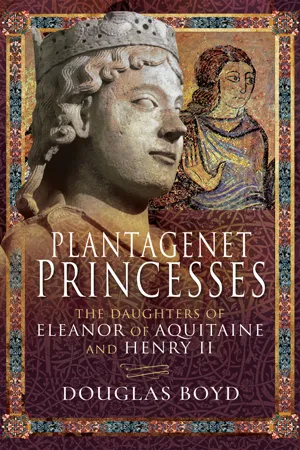
A look at the royal women of twelfth-century England—from the empowered to the imprisoned—and their roles in the ruling dynasty.
Eleanor of Aquitaine and her second husband, Henry II, are commonly considered medieval figures, but their era was really the violent transition from the Dark Ages, when countries' borders were defined with fire and sword. Henry grabbed the English throne thanks largely to Eleanor's dowry, because she owned one third of France. But their less famous daughters also lived extraordinary lives.
If princes fought for their succession to crowns, the princesses were traded—usually by their mothers—to strangers to gain political power without the usual accompanying bloodshed. Years before what would today be marriageable age, royal girls were dispatched to countries whose speech was unknown to them, and there became the property of unknown men—their duty the bearing of sons to continue a dynasty and daughters who would be traded in their turn. Some became literal prisoners of their spouses; others outwitted would-be rapists and the Church to seize the reins of power when their husbands died.
Eleanor's daughters Marie and Alix were abandoned in Paris when she divorced Louis VII of France. By Henry II, she bore Matilda, Aliénor, and Joanna. Between them, these extraordinary women and their daughters knew the extremes of power and pain. Joanna was imprisoned by William II of Sicily and treated worse by her brutal second husband in Toulouse. Eleanor may have been libeled as a whore, but Aliénor's descendants include two saints, Louis of France and Fernando of Spain. And then there were the illegitimate daughters, whose lives read like novels. This fascinating volume tells their stories.
- 256 pages
- English
- ePUB (mobile friendly)
- Available on iOS & Android
eBook - ePub
About this book
Information
Topic
HistoireSubtopic
Biographies historiquesChapter 1
Eleanor of Aquitaine, Founder of the Dynasty
Perhaps surprisingly to non-medievalists, the early Middle Ages saw a number of women exercise great power. In the ninth century, the Lombard queen Angilberga was given the honorific consors regni. In the tenth century the Byzantine princess Theophano, married to Holy Roman Emperor Otto II, ruled the Empire after his death as regent for her son Otto III and, in England the Lady Aethelflaed both ruled Mercia and led its army into battle. In the eleventh century, Gisela, wife of Salian Emperor Konrad II, reigned with him as consors imperii. Early in the twelfth century, Adelaide of Savona governed Sicily as regent until her son Roger II came of age. In Visigothic Spain, Petronila of Aragon and Urraca of León-Castile were both queens regnant.
Another of these strong and powerful women was the daughter of England’s King Henry I named Matilda or Maud. After the death in May 1125 of her first husband, the Holy Roman Emperor Heinrich V, she returned to the land of her birth at the age of 23 but kept the title of Empress for the rest of her life. Her father was a son of William the Conqueror and succeeded to the throne on the allegedly accidental death of his brother William Rufus in 1100. Having lost his legitimate 18-year-old son William Adelin and several of his illegitimate sons in the disastrous sinking of the White Ship off Barfleur in 1120, he named his only surviving legitimate child Matilda as his heir to the English crown and the Duchy of Normandy, forcing the Anglo-Norman barons of the island realm to swear allegiance to her.
At the time, nobody called sons and daughters of royalty by the title ‘prince’ or ‘princess’; for example, William Adelin was known as guilelmus filius regis – William, the king’s son or guilelmus filius Henrici with everybody knowing which Henry was being referred to. So, strictly speaking, the title of this book is a misnomer, but a convenient one for modern readers. Frustratingly, the only extant images of most of these women are the wax imprints of their seals that legitimised documents, and these give little impression of the person even in colour photographs – and none in monochrome.
When Henry I died in December 1135, his nephew Stephen of Blois was among the first to hear the news in Boulogne. Breaking the oath he had sworn to recognise Matilda as the legitimate successor, he immediately took ship from there to England. He seized the treasury with the help of his brother, Bishop Henry of Winchester, bribed the citizens of London to support his claim and persuaded William de Corbeil, Archbishop of Canterbury, to officiate at a coronation ceremony before the end of the year. Speed had won him the throne, allied to the dislike of many Anglo-Norman barons for the idea of being ruled by a woman – although Matilda Empress was far from a shrinking violet, being described in the eulogy later pronounced by Bishop Arnulf of Lisieux as ‘an exceptional woman, devoid of womanliness’.1 High praise indeed! Married for the second time to the lusty Count Geoffrey the Fair of Anjou, who was ten years her junior, the ‘unwomanly’ empress nevertheless more than fulfilled her duty to give him a male heir by bearing him three sons.
The Plantagenet dynasty takes its name from Geoffrey the Fair’s custom of sporting a sprig of bright yellow flowering broom (in French, genêt) in his helmet as a highly visible rallying point to his supporters during battle and in mêlées, those violent free-for-all skirmishes at a tournament, confronting two teams of armed and mounted knights, where prisoners could be taken and held for ransom, and wounds and deaths were common. The earliest Plantagenets were from Geoffrey’s county of Anjou in France, and therefore known as the Angevins, who ruled England 1154–1216. After the loss of the county of Anjou, came the Plantagenets proper, ruling 1216–1399, followed by the cadet branches, usually referred to as the houses of Lancaster and York, which ruled 1399–1485.
Following the difficult birth of her third son, christened Henry after his regal grandfather, Matilda Empress decided – as had Henry I’s queen Matilda of Scotland after two births – to cease sexual relations with her husband, leaving him, as a chronicler once said, to take his pleasures elsewhere. Matilda’s efforts to claim her legitimate inheritance on the death of Henry I were hampered by her last pregnancy. In the castle of Argentan in Normandy she produced the third son, christened William, at the end of July 1136, by which time Stephen of Blois had already been acclaimed king by the citizens of London. It was not until September 1139 that an offer of support from her half-brother Robert of Gloucester emboldened Matilda to cross the Channel and claim her throne with a mixed force of Angevin2 and Norman knights and nobles, the latter wavering somewhat in their support because, if Stephen won the confrontation, they stood to lose their estates in England. For the next decade Matilda lived the precarious life of a female warlord in France and England. There was little contact with her sons until after her famous escape from Oxford castle, wrapped in a white cloak during a snowstorm in December 1140 which was thought by Stephen’s force besieging the castle too severe for any man, let alone a woman, to venture out of doors. Clambering down the unguarded riverbank, Matilda and a few companions walked through the blizzard on the ice of the Thames to Wallingford and made their escape.
After her next major defeat by Stephen’s forces at Winchester in 1141, she retreated to Devizes in Wiltshire, styling herself ambiguously as domina anglorum or ‘Lady of the English’. Her eldest son, 9-year-old Henry Plantagenet, was sent to England to be brought up in Robert of Gloucester’s household with the aim of making him the warrior-statesman capable of realising Matilda’s frustrated political ambitions. Seven years later Matilda fled the country and retired to the Norman capital of Rouen a bitter and frustrated woman, leaving young Henry Plantagenet in England as figurehead for her forces in the bloody civil war, known as ‘the anarchy’, that ravaged England 1139–1153.
Here we run into a complication of medieval history. When Matilda died and her remains were taken to Rouen cathedral, her epitaph there read, and still reads: Ci-gît la fille, femme et mère d’Henri, which translates as Here lies the daughter, wife and mother of Henry. A witty epitaph for the daughter of England’s King Henry I, wife of German Emperor Heinrich V and mother of England’s King Henry II. So many males were christened using a handful of names rendered in English as William, Henry, Robert, Geoffrey and so on that eponymous individuals had often to be distinguished by sobriquets like Fat Louis, Henry the Proud, Geoffrey the Fair and William the Bastard or toponyms, as in Robert of Gloucester or Stephen of Blois. Similarly, so many female children were named Matilda or Maud, Eleanor or various forms of Mary and Margaret that use of the name alone can be confusing.
When Empress Matilda’s eldest son Henry married Duchess Eleanor3 of Aquitaine, his wife was an equally extraordinary woman. Her father Duke William X died on pilgrimage to the shrine in the Galician town of Santiago de Compostela at Easter 1137. As the older of his two surviving children, both girls, Eleanor inherited at the age of 15 the county of Poitou and duchy of Aquitaine – a vast slice of southwest France. Because many young noblewomen were carried off for their dowries and married against their will, the duke’s death was hushed up by his companions when they returned to Bordeaux, for fear that some unruly vassal or neighbour might force Eleanor into marriage and become the new duke of Aquitaine by fait accompli. Physically beautiful, highly intelligent, literate in, and speaking, several languages, Eleanor was described by one who knew her well as avenante, vaillante et courtoise – or approachable, courageous and courtly.4
In searching for a suitable match, her guardian, the politically shrewd archbishop of Bordeaux Geoffroi de Lauroux set his sights high, arranging for her to marry the 17-year-old French crown prince Louis of the house of Capet. During the weeks it took Prince Louis to gather a suitable mesnie of nobles and knights to make the 300-mile journey from the royal domain around Paris to Bordeaux, Eleanor and her younger sister Aelith, also known as Petronilla, were effectively under house arrest for their own protection, closely guarded so that no intruder could snatch either of them away and foil the archbishop’s plan. By the standards of the time, their quarters in the ducal palace of l’Ombreyra were luxurious indeed.
Society was then divided into three estates. In Latin, they were oratores, bellatores et laboratores: those who prayed, those who fought and those who laboured to support the totally unproductive knightly classes. It has been calculated that twenty-three entire families of serfs were required to support one modest knight and his household, and correspondingly more for grander knights and nobles. Outside the city of Bordeaux the serfs laboured from dawn to dusk in the fields. In summer, the men stripped to their brais – a cross between loincloth and underpants and the women laboured alongside them with their skirts hitched up, to free their legs. They also cleared the vast forests of the region to make more productive land for their masters. So much land was cleared and so many new settlements established on it that even today twenty-five per cent of all place names in southwest France date from this period.

Eleanor’s inheritance.
Eleanor and her sister Aelith wore ankle-length dresses of the finest cloth, some of silk trimmed with fur. The fashionable sleeves were so long they reached the floor and had to be knotted up out of the way much of the time. Their feet were protected from the cold flagstones of the palace by slippers of vair, the fur from the soft under-belly of squirrels – which became mistranslated as the homophone verre or glass in the fairy tale of Cinderella. Their arms and hands were embellished with bracelets and rings which, like their earrings, were set with precious stones. They also used cosmetics like eye shadow and rouge, and wore their hair long and loose, not confined in a wimple.
Such glamour horrified the most famous monk in France. Abbé Bernard at the Benedictine abbey of Clairvaux, who had a gift for words, deplored ‘the beauty that is put on in the morning and laid aside at night.’5 So, perhaps Eleanor dressed down to meet her bridegroom, when he finally arrived, for Prince Louis had been raised in the cloister until obliged by his elder brother’s accidental death to abandon a religious career. The very disparate bride and groom were married in Bordeaux’s Cathedral of St André on 25 July 1137. Louis and his entourage did not impress the locals, his monkish demeanour earning him the label colhon – a word in the Occitan language of southern France meaning ‘testicle’ or ‘a stupid man’. It seems likely that a fight broke out on the wedding day between the Frankish northerners and the proud Aquitaine nobility, for the bride and groom fled before the wedding feast ended, riding on relays of horses for eighty miles to reach the safety of the castle of Taillebourg before nightfall.
On the death two weeks later of his long-suffering father Louis VI, once known as Battling Louis, but for years called just Fat Louis, Eleanor became the 15-year-old queen consort of France, for her new husband had already been crowned in accordance with Capetian custom, to ensure there was no break in the succession. Her official coronation came later. Raised in the pleasure-loving ducal court of Aquitaine to enjoy music, poetry and dance, accustomed since girlhood to flirting with sons of important vassals and courtly troubadours – some noble, some penniless – and free to ride the length and breadth of the duchy as the heir to her father Duke William X, she understandably chafed at the restrictions imposed at Louis’ court in Paris as proper conduct for a Frankish queen by her devout and forceful mother-in-law Adelaide de Maurienne. Instead of complying, Eleanor did everything in her power to thwart the dowager queen until finally driving her away from court to reside in one of her dower castles in Champagne.
As pliant as his mother was dominant, Louis VII had been raised for high office in the Church until his older brother broke his spine when thrown by his mount stumbling over a pig snuffling through the garbage in a Parisian street. The fatal injury compelled his younger brother, who would have made a good abbot, to act the part of monarch in the turbulence of the twelfth century – a position he occupied from duty and for which he had little liking. Once back in Paris after the trip to Bordeaux, Louis returned to the cloister, where he felt at ease, fasting with the other monks and sharing their all-night vigils. This was not how Eleanor had imagined married life would be. Accidental succession to a title was the only thing the royal couple had in common, and their relationship is summed up in Eleanor’s frequent complaint, ‘I thought I had married a king, and found I had wed a monk.’6
For a while she used her excess energy in introducing southern comforts into the rude Capetian palace on the Ile de la Cité. Heating there was by charcoal embers in braziers, producing dangerous carbon monoxide, until she had a chimney installed in her quarters. Similarly, she had the narrow windows, through which came all the clamour of the citizenry and the stench of tanneries and sewage, glazed for warmth and quiet – and precious wall-hangings brought from Aquitaine and Poitou. For her entertainment, scandalising the religious members of Louis’ court, she brought troubadours to recite poetry and sing songs for her pleasure. As to her queenly duty to provide a male heir for Louis, that was made more difficult by his preference for spending more nights in vigil on his knees at an altar than in her bed.
Eleanor’s first surviving daughter Princess Marie was the incarnation of her failure to fulfil the queenly duty, as was the previous stillbirth. In between births, her domination of the monkish monarch led him far from the religious paths for which he had been trained – into warfare and worse.7 Trying to live up to her expectations of a warrior husband, on one occasion he personally hacked off the feet of a recalcitrant vassal, so that he would be unable to mount a horse, the king’s feeble build requiring many strokes of his sword to cut through bone and sinew. His worst excess under Eleanor’s influence at the siege of Vitry-en-Perthois, during his 1143 invasion of Champagne, came when 1,300 men, women and children were burned alive after the town was fired by his troops. Seeking sanctuary in the church, virtually the entire population died when its blazing roof fell in on them. For this, Louis was excommunicated and denied all the comforts of confession, the sacrament and the rituals of the Mass that he adored.
When Louis sought the remission of his sin by taking the cross in the Second Crusade,8 there was no way Eleanor intended to miss the greatest adventure of her lifetime. Knowing that her personal wealth and the manpower of her vassals were essential to the crusade, she ignored the interdiction of Pope Eugenius III on women9 accompanying their menfolk, who had taken a vow of chastity. Gathering a personal court of noble ladies to go with her meant that the long baggage train of ox-drawn carts transporting their clothes, food, bedding and rich pavilions for the night, had to set off before the crusading army, to avoid causing a huge traffic jam. For part of the outward journey the queen and her ladies rode bare-breasted to taunt Louis’ flagging and exhausted troops in the Anatolian mountains, suffering by day and night injury and death from harassing hit-and-run SeljukTurks.
Meanwhile, back in France the wives of the crusader knights and barons were governing the...
Table of contents
- Cover
- Title Page
- Copyright
- Contents
- Chapter 1 Eleanor of Aquitaine, Founder of the Dynasty
- Chapter 2 Poems of Love and Bloodshed
- Chapter 3 Founding a Dynasty
- Chapter 4 A Grand Design?
- Chapter 5 Eleanor’s Bid for Freedom
- Chapter 6 Matilda and the Lion
- Chapter 7 Princess Eleanor becomes la Reína Leonor
- Chapter 8 Joanna, the Pregnant Nun
- Chapter 9 Princess Blanca Becomes Queen Blanche
- Chapter 10 Two Isabels at King John’s Court
- Chapter 11 The Tragic Pearl of Brittany
- Chapter 12 Siwan, Lady of Wales
- Chapter 13 Blanche, the Warrior Wife of Prince Louis
- Chapter 14 Blanche, Queen of France
- Chapter 15 Marguerite of Provence
- Chapter 16 A Confusion of Kings
- Chapter 17 The Provençal Sorority
- Chapter 18 The Scottish Play
- Chapter 19 An Imprisoned Empress and a Girl Called Gwenllian
- Chapter 20 Enduring Love: Eleanor of Castile
- Chapter 21 Isabelle of France and Her Reluctant Husband
- Chapter 22 Three Queens in One Castle
- Epilogue
- Appendix I
- Appendix II
- Appendix III
- Acknowledgements
- Notes
- Plate section
Trusted by 375,005 students
Access to over 1.5 million titles for a fair monthly price.
Study more efficiently using our study tools.
Frequently asked questions
Yes, you can cancel anytime from the Subscription tab in your account settings on the Perlego website. Your subscription will stay active until the end of your current billing period. Learn how to cancel your subscription
No, books cannot be downloaded as external files, such as PDFs, for use outside of Perlego. However, you can download books within the Perlego app for offline reading on mobile or tablet. Learn how to download books offline
We are an online textbook subscription service, where you can get access to an entire online library for less than the price of a single book per month. With over 1.5 million books across 990+ topics, we’ve got you covered! Learn about our mission
Look out for the read-aloud symbol on your next book to see if you can listen to it. The read-aloud tool reads text aloud for you, highlighting the text as it is being read. You can pause it, speed it up and slow it down. Learn more about Read Aloud
Yes! You can use the Perlego app on both iOS and Android devices to read anytime, anywhere — even offline. Perfect for commutes or when you’re on the go.
Please note we cannot support devices running on iOS 13 and Android 7 or earlier. Learn more about using the app
Please note we cannot support devices running on iOS 13 and Android 7 or earlier. Learn more about using the app
Yes, you can access Plantagenet Princesses by Douglas Boyd in PDF and/or ePUB format, as well as other popular books in Histoire & Biographies historiques. We have over 1.5 million books available in our catalogue for you to explore.