An analysis of the air mast-equipped German U-boats in World War II and Allied countermeasures.
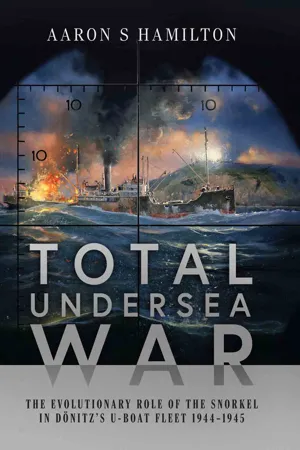
During the last year of World War II, the once surface-bound diesel-electric U-boat ushered in the age of "total undersea war." This was due to the introduction of an air mast, or "snorkel" as it became known among the men who served in Doenitz's submarine fleet. U-boats no longer needed to surface to charge batteries or refresh air; they rarely communicated with their command, operating silently and alone among the shallow coastal waters of the United Kingdom and across to North America. At first, U-boats could remain submerged continuously for a few days, then a few weeks, and finally for months at a time, and they set underwater endurance records not broken for nearly a quarter of a century. The introduction of the snorkel was of paramount concern to the Allies, who strived to frustrate the impact of the device before war's end. Every subsequent wartime U-boat innovation was subordinated to the snorkel, including the new Type XXI Electro-boat wonder weapon. The snorkel's introduction foreshadowed the nearly un-trackable weapon and instrument of intelligence that the submarine became in the postwar world.
Total Undersea War answers many long-standing questions about the last year of the war: How and why did U-boats patrol so close inshore? How effective was acoustic and anti-radar camouflage? Why was U-boat wireless communication so problematic? How did U-boats navigate so effectively submerged? What were the health implications of staying submerged for a month or more? What does an accurate snorkel-configuration look like?
This previously unpublished historical data is applied to a maritime archaeological case study about how the snorkel-equipped
U-869 likely met its demise off the United States' east coast in February, 1945. The theory that emerges based on a precise understanding of late-war snorkel operations is new and compelling.
This exhaustive study, the first of its kind, draws upon wartime documents from archives around the world to re-evaluate the last year of the U-boat's deployment, all its key technological innovations, the evolving operations and tactics, and Allied countermeasures. It is destined to become an authoritative reference on late-war U-boat development for historians and maritime archaeologists alike for years to come.
Praise for
Total Undersea War
"The snorkel's powerful influence during the Battle of the Atlantic is reflected in this riveting book that is filled with action photographs, schematics, and page-turning accounts of the great advantage given to the German navy by this revolutionary piece of equipment." —
Maritime Engineering Journal
eBook - ePub
Total Undersea War
The Evolutionary Role of the Snorkel in Dönitz's U-Boat Fleet, 1944–1945
- 508 pages
- English
- ePUB (mobile friendly)
- Available on iOS & Android
eBook - ePub
Total Undersea War
The Evolutionary Role of the Snorkel in Dönitz's U-Boat Fleet, 1944–1945
About this book
Information
Table of contents
- Cover
- Title
- Copyright
- Contents
- Acknowledgements
- Preface
- Introduction
- Chapter 1: The U-boat War in 1939–1944
- Part I Technical Innovations
- Part II Evolution of Operations and Tactics
- Part III A Case Study in U-Boat History and Maritime Archaeology
- Conclusion
- Appendix A
- Appendix B
- Appendix C
- Appendix D
- Appendix E
- Bibliography
- Notes
Trusted by 375,005 students
Access to over 1.5 million titles for a fair monthly price.
Study more efficiently using our study tools.
Frequently asked questions
Yes, you can cancel anytime from the Subscription tab in your account settings on the Perlego website. Your subscription will stay active until the end of your current billing period. Learn how to cancel your subscription
No, books cannot be downloaded as external files, such as PDFs, for use outside of Perlego. However, you can download books within the Perlego app for offline reading on mobile or tablet. Learn how to download books offline
Perlego offers two plans: Essential and Complete
- Essential is ideal for learners and professionals who enjoy exploring a wide range of subjects. Access the Essential Library with 800,000+ trusted titles and best-sellers across business, personal growth, and the humanities. Includes unlimited reading time and Standard Read Aloud voice.
- Complete: Perfect for advanced learners and researchers needing full, unrestricted access. Unlock 1.5M+ books across hundreds of subjects, including academic and specialized titles. The Complete Plan also includes advanced features like Premium Read Aloud and Research Assistant.
We are an online textbook subscription service, where you can get access to an entire online library for less than the price of a single book per month. With over 1.5 million books across 990+ topics, we’ve got you covered! Learn about our mission
Look out for the read-aloud symbol on your next book to see if you can listen to it. The read-aloud tool reads text aloud for you, highlighting the text as it is being read. You can pause it, speed it up and slow it down. Learn more about Read Aloud
Yes! You can use the Perlego app on both iOS and Android devices to read anytime, anywhere — even offline. Perfect for commutes or when you’re on the go.
Please note we cannot support devices running on iOS 13 and Android 7 or earlier. Learn more about using the app
Please note we cannot support devices running on iOS 13 and Android 7 or earlier. Learn more about using the app
Yes, you can access Total Undersea War by Aaron S. Hamilton in PDF and/or ePUB format, as well as other popular books in History & European History. We have over 1.5 million books available in our catalogue for you to explore.