An investigation of how a man could become a Roman emperor, and the failure to create an enduring, consistent system for selecting the next emperor.
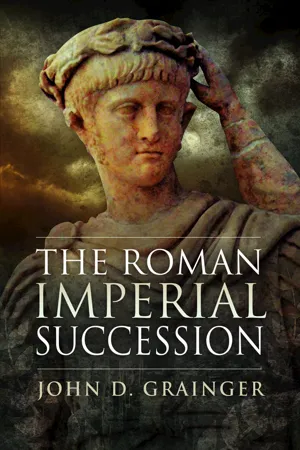
John D. Grainger analyses the Roman imperial succession, demonstrating that the empire organized by Augustus was fundamentally flawed in the method it used to find emperors. Augustus's system was a mixture of heredity, senatorial, and military influences, and these were generally antagonistic. Consequently, the Empire went through a series of crises, in which the succession to a previous, usually dead, emperor was the main issue. The infamous "Year of the Four Emperors," AD 69, is only the most famous of these crises, which often involved bouts of bloody and destructive civil war, assassinations and purges. These were followed by a period, usually relatively short, in which the victor in the "crisis" established a new system, juggling the three basic elements identified by Augustus, but which was as fragile and short lived as its predecessor; these "consequences" of each crisis are discussed. The lucid and erudite text is supported by over 22 genealogical tables and 100 images illustrating the Emperors.
Praise of
The Roman Imperial Succession
"For a general introduction to the question of how one becomes a Roman emperor, Grainger has provided a sound guide." —
Bryn Mawr Classical Review
- 337 pages
- English
- ePUB (mobile friendly)
- Available on iOS & Android
eBook - ePub
The Roman Imperial Succession
About this book
Information
Table of contents
- Cover
- Title
- Copyright
- Contents
- List of Illustrations
- List of Genealogical Tables
- List of Tables (Emperors)
- Introduction
- Part I: Augustus Defines the System
- Part II: The Augustan Process
- Part III: The Senate’s Revival
- Part IV: Heredity and Absolutism
- Part V: Breakdown
- Conclusion
- List of Emperors
- Notes
- Bibliography
Trusted by 375,005 students
Access to over 1.5 million titles for a fair monthly price.
Study more efficiently using our study tools.
Frequently asked questions
Yes, you can cancel anytime from the Subscription tab in your account settings on the Perlego website. Your subscription will stay active until the end of your current billing period. Learn how to cancel your subscription
No, books cannot be downloaded as external files, such as PDFs, for use outside of Perlego. However, you can download books within the Perlego app for offline reading on mobile or tablet. Learn how to download books offline
Perlego offers two plans: Essential and Complete
- Essential is ideal for learners and professionals who enjoy exploring a wide range of subjects. Access the Essential Library with 800,000+ trusted titles and best-sellers across business, personal growth, and the humanities. Includes unlimited reading time and Standard Read Aloud voice.
- Complete: Perfect for advanced learners and researchers needing full, unrestricted access. Unlock 1.5M+ books across hundreds of subjects, including academic and specialized titles. The Complete Plan also includes advanced features like Premium Read Aloud and Research Assistant.
We are an online textbook subscription service, where you can get access to an entire online library for less than the price of a single book per month. With over 1.5 million books across 990+ topics, we’ve got you covered! Learn about our mission
Look out for the read-aloud symbol on your next book to see if you can listen to it. The read-aloud tool reads text aloud for you, highlighting the text as it is being read. You can pause it, speed it up and slow it down. Learn more about Read Aloud
Yes! You can use the Perlego app on both iOS and Android devices to read anytime, anywhere — even offline. Perfect for commutes or when you’re on the go.
Please note we cannot support devices running on iOS 13 and Android 7 or earlier. Learn more about using the app
Please note we cannot support devices running on iOS 13 and Android 7 or earlier. Learn more about using the app
Yes, you can access The Roman Imperial Succession by John D. Grainger in PDF and/or ePUB format, as well as other popular books in History & Military & Maritime History. We have over 1.5 million books available in our catalogue for you to explore.