One man's quest to investigate a dismissed eyewitness account of the assassination of President John F. Kennedy.
Victoria Elizabeth Adams worked on the fourth floor of the Texas School Book Depository in 1963. She was on the back staircase of the building at the precise moment that Lee Harvey Oswald—according to the Warren Commission's account—was making his escape. Yet, Adams saw and heard no one.
This is the story—both frightening and fascinating—about a journey to seek the truth in the assassination of President John F. Kennedy. After a three-decade quest and an array of obstacles, investigative journalist Barry Ernest brings the full account of the girl on the stairs to life.
Ernest, a frequent lecturer on the topic of the Kennedy assassination, won the 2011 Mary Ferrell Pioneer Award, a national honor presented for a lifetime of searching for the truth.
David S. Lifton, author of the
New York Times bestseller
Best Evidence: Disguise and Deception in the Assassination of John F. Kennedy, provides a foreword to this intriguing saga.
Praise for
The Girl on the Stairs
"Beautifully paced writing takes the reader along as Ernst searches for crucial information. . . . Highly recommended." —Debra Conway, president, JFK Lancer Productions & Publications, Inc.
"Ernest demonstrates there are still important lessons to learned and good historical research to be done." —Larry Hancock, author of
Someone Would Have Talked: The Assassination of President John F. Kennedy
"Brilliant, utterly compelling, very, very dark, and deeply troubling." —Dr. Stephen Dorril, author of
MI6:Fifty Years of Special Operations
"Deserves space on the shelf of every Kennedy assassination buff in the country." —Maj. Glenn MacDonald,
Military Corruption
"Totally engrossing and fascinating." —Terry West, WAXX FM
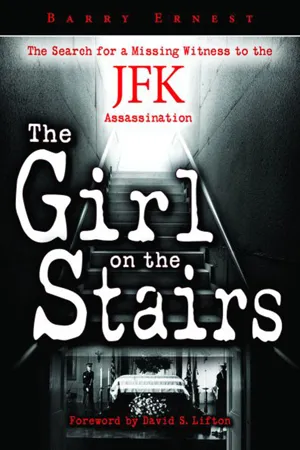
eBook - ePub
The Girl on the Stairs
The Search for a Missing Witness to the JFK Assassination
- 336 pages
- English
- ePUB (mobile friendly)
- Available on iOS & Android
eBook - ePub
About this book
Information
CHAPTER 1
February 1967
I really don’t know what it was that made me want to find her.
Perhaps I thought she was somehow important in this mess. Perhaps it was because the government tried so hard to convince me otherwise. Maybe I was just bored.
That afternoon began like any other at Kent State University. It was three years before innocent kids would be gunned down there; three short years before America would suffer still another debilitating blow to its sense of stability. I had just turned nineteen and found myself stuffed into an overcrowded Moulton Hall on an overpopulated campus.
On this cold day, a guy I recognized from one of my classes hurriedly approached. I was minding my own business, content in waiting for the cafeteria doors to open.
“Hi. I’m Terry. Why is it you believe the Warren Report?”
I blinked. “Huh?”
“In class one day when we were asked if anyone had read the Warren Report, you said you had and you felt it was true. I’m wondering what makes you think so.”
I recalled a debate on the Kennedy assassination in a U.S. history seminar some weeks earlier. Terry was accurate with his recap. “I guess it’s because all the evidence points to Oswald being the lone assassin. The rifle was his; he was the only one who ran from where the shots were fired; he killed a Dallas police officer—J. D. Tippit, I think his name was.”
Terry nodded.
“And I’ve read enough testimony that supports those conclusions.”
“Have you read all of the testimony?” he prodded. Before I could answer, he continued. “Have you ever heard of the grassy knoll? What about the violent backward motion of Kennedy’s head in the Zapruder film? How about all the witnesses ignored and never called before the Warren Commission?”
“What are you talking about?” I asked.
“Ah! Never heard of those things, huh?” Terry was pleased at making his point, a point that, quite frankly, eluded me. “The government is not telling us the truth about the assassination.”
“Why would the government lie about something like this?” I asked.
Terry persisted. “Our library has a set of the twenty-six volumes of testimony. Take a look at them. In the meantime, read this.” He pushed a magazine into my arms. “I’ll be in touch.” Then he was gone.
His comments hit a nerve. I settled down with my tray of food. Like others, I had read the Warren Report, every word of its 888 pages—twice, as a matter of fact. The accompanying twenty-six volumes of supporting evidence weren’t readily available, so I had done the next best thing and read highlights of that evidence in a paperback put out by the New York Times.
I had admired John F. Kennedy, his style, his goals. He was a breath of fresh air. His wife, I had to admit, was my first infatuation. Lee Harvey Oswald ended all that.
Oswald worked in the Texas School Book Depository. The shots came from there. Bullet fragments matched the rifle that had his fingerprints on it. People saw him do it. He was picked from a police lineup. He had no alibi and he tried to escape. He even shot a policeman.
Why all the fuss? But I still glanced at the magazine Terry had left behind: Playboy. It was already opened to what he apparently wanted me to read, that month’s interview. Staring back at me was a bespectacled attorney-turned-author from New York named Mark Lane. Lane had written a book about his private investigation into the assassination. His remarks revealed a heavy bias against the Warren Report.
By the time I lifted my nose from the lengthy article, my food was cold and I was alone. Everyone else had finished lunch and had left for afternoon lectures. My “How to Think Straight” logic class was now nearly over.
I decided to salvage the day by visiting a local bookshop to pick up a copy of Lane’s work, titled Rush to Judgment. Along the way I stopped at the university’s library. As Terry said, the Warren Report and its twenty-six volumes were there, occupying forty inches of shelf space, impressive in their dark-blue covers and gold lettering.
That night I settled in to read, accompanied by a sack of heart-stoppers from McDonald’s. It was good to be young.
Lane was brutal as he sliced his way through the Warren Report’s conclusions. He quoted witnesses who saw smoke rising from the grassy knoll, a raised plot of ground to the right front of Kennedy’s motorcade; witnesses who saw someone running from there; or saw two gunmen instead of only one in the sixth-floor window; or saw Oswald in places he wasn’t, shouldn’t have been, or couldn’t have been. He discussed the backward snap to Kennedy’s head when the final bullet struck home. He named names and brought up contradictions between what witnesses said they saw and what the government ultimately said happened.
I had never read anything like it. I was mesmerized. And he introduced me, inadvertently as it may have been, to Victoria Adams.
Miss Adams worked on the fourth floor of the Texas School Book Depository. She witnessed the assassination from there, the shots coming from only two floors above. Lane, quoting from her official Warren Commission testimony, wrote that following the last shot, “she and a co-worker ‘ran out of the building via the stairs and went in the direction of the railroad where we had observed other people running.’”1
Since “the railroad” was located on the grassy knoll, Lane used her remarks as further evidence that shots originated from there. What caught my eye, though, was her comment that she “ran out of the building via the stairs.” I remembered that Oswald had escaped the sixth floor by running down a back staircase. Could that staircase have been the same one Miss Adams was on?
“So, do you still believe the Warren Report?” Terry inquired when I returned his magazine a few days later.
“Yeah, I do,” I said. “But Lane raises some interesting points in his book. Ever hear of Victoria Adams?”
“Ah, so you were interested enough to buy his book, huh? I knew you would. And yes. I’ve heard of her. Why?”
“Lane mentioned her. I was curious, that’s all.”
“Check what the Warren Report said,” Terry advised, “then go read her testimony in the twenty-six volumes. You should compare a lot of the witnesses that way. You might be surprised.”
My professors weren’t doling out this much work.
“We should get together on a regular basis and compare notes,” he added. “Might be good. For both of us.” The guy had an ego. But I liked him anyway.
That night, after checking out the relevant books from the library, I focused on the story of Miss Adams. According to the Warren Report, Oswald fired three shots from a sixth-floor window. He then hurried across that floor, hid his gun under some boxes at the top of the back staircase, and descended those stairs. For some reason, he exited the stairs on the second floor and ducked into a nearby lunchroom. Seconds later he was confronted there by Dallas policeman Marrion Baker and building superintendent Roy Truly, who had run up the stairs from the first floor.
Baker, riding a motorcycle in the parade, wanted to get to the roof of the Depository. He thought shots might have come from there. Truly was showing him the way when the policeman spotted a man later identified as Oswald through the window of a door leading to the lunchroom.
The timing was crucial. Could Oswald have fled the sixth floor and arrived in the second-floor lunchroom within the ninety seconds allotted by the Report? Shouldn’t Miss Adams, if she was descending the same stairs after the shots were fired, have been privy to this footrace?
The Warren Report had little to say about her:
Victoria Adams, who worked on the fourth floor of the Depository Building, claimed that within about 1 minute following the shots she ran from a window on the south side of the fourth floor, down the rear stairs to the first floor, where she encountered two Depository employees—William Shelley and Billy Lovelady. If her estimate of time is correct, she reached the bottom of the stairs before Truly and Baker started up, and she must have run down the stairs ahead of Oswald and would probably have seen or heard him. Actually she noticed no one on the back stairs. If she descended from the fourth to the first floor as fast as she claimed in her testimony, she would have seen Baker or Truly on the first floor or on the stairs, unless they were already in the second-floor lunchroom talking to Oswald. When she reached the first floor, she actually saw Shelley and Lovelady slightly east of the east elevator. . . .
Shelley and Lovelady, however, have testified that they were watching the parade from the top step of the building entrance when Gloria Calvery, who works in the Depository Building, ran up and said that the President had been shot. Lovelady and Shelley moved out into the street. About this time Shelley saw Truly and Patrolman Baker go into the building. Shelley and Lovelady, at a fast walk or trot, turned west into the railroad yards and then to the west side of the Depository Building. They reentered the building by the...
Table of contents
- Contents
- Foreword
- Acknowledgments
- Prologue: November 22, 1963
- CHAPTER 1: February 1967
- CHAPTER 2: March 1964
- CHAPTER 3: February 1967
- CHAPTER 4: February 1967
- CHAPTER 5: March-June 1967
- CHAPTER 6: July 1966
- CHAPTER 7: March 1968
- CHAPTER 8: March 1968
- CHAPTER 9: April 1968
- CHAPTER 10: July 1968
- CHAPTER 11: July 1968
- CHAPTER 12: August 1968
- CHAPTER 13: September 1966-August 1975
- CHAPTER 14: August 1968-March 1969
- CHAPTER 15: April-December 1969
- CHAPTER 16: January 1970-February 1981
- CHAPTER 17: February 1981-October 1998
- CHAPTER 18: January 1991-March 1994
- CHAPTER 19: April 1994-April 1999
- CHAPTER 20: May-June 1999
- CHAPTER 21: May-September 1999
- CHAPTER 22: October 1999
- CHAPTER 23: June 1999
- CHAPTER 24: February 2-3, 2002
- CHAPTER 25: January 2000-February 2002
- CHAPTER 26: February 3, 2002
- CHAPTER 27: February 3, 2002
- CHAPTER 28: February 4-9, 2002
- CHAPTER 29: February 10-12, 2002
- CHAPTER 30: February 13, 2002
- CHAPTER 31: September 18-November 15, 2007
- CHAPTER 32: June 2011
- EPILOGUE: Yesterday
- APPENDIX 1: Testimony of Miss Victoria Elizabeth Adams
- APPENDIX 2: Relevant Testimony of Billy Nolan Lovelady
- APPENDIX 3: Relevant Testimony of William H. Shelley
- APPENDIX 4: The Martha Joe Stroud Letter
- Notes
Trusted by 375,005 students
Access to over 1.5 million titles for a fair monthly price.
Study more efficiently using our study tools.
Frequently asked questions
Yes, you can cancel anytime from the Subscription tab in your account settings on the Perlego website. Your subscription will stay active until the end of your current billing period. Learn how to cancel your subscription
No, books cannot be downloaded as external files, such as PDFs, for use outside of Perlego. However, you can download books within the Perlego app for offline reading on mobile or tablet. Learn how to download books offline
Perlego offers two plans: Essential and Complete
- Essential is ideal for learners and professionals who enjoy exploring a wide range of subjects. Access the Essential Library with 800,000+ trusted titles and best-sellers across business, personal growth, and the humanities. Includes unlimited reading time and Standard Read Aloud voice.
- Complete: Perfect for advanced learners and researchers needing full, unrestricted access. Unlock 1.5M+ books across hundreds of subjects, including academic and specialized titles. The Complete Plan also includes advanced features like Premium Read Aloud and Research Assistant.
We are an online textbook subscription service, where you can get access to an entire online library for less than the price of a single book per month. With over 1.5 million books across 990+ topics, we’ve got you covered! Learn about our mission
Look out for the read-aloud symbol on your next book to see if you can listen to it. The read-aloud tool reads text aloud for you, highlighting the text as it is being read. You can pause it, speed it up and slow it down. Learn more about Read Aloud
Yes! You can use the Perlego app on both iOS and Android devices to read anytime, anywhere — even offline. Perfect for commutes or when you’re on the go.
Please note we cannot support devices running on iOS 13 and Android 7 or earlier. Learn more about using the app
Please note we cannot support devices running on iOS 13 and Android 7 or earlier. Learn more about using the app
Yes, you can access The Girl on the Stairs by Barry Ernest in PDF and/or ePUB format, as well as other popular books in History & North American History. We have over 1.5 million books available in our catalogue for you to explore.