Let’s Get Started
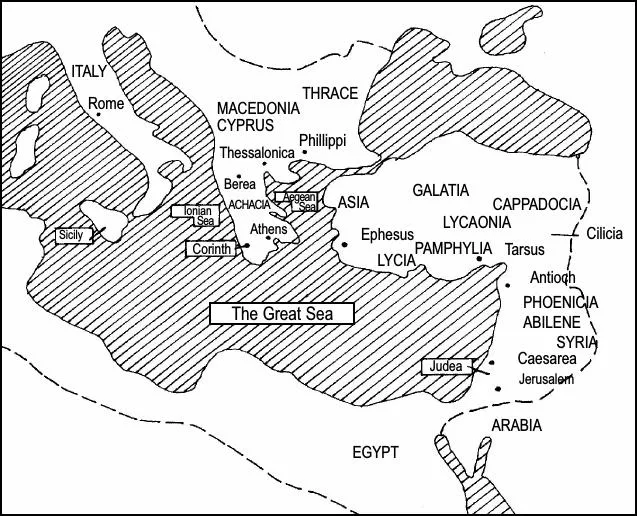
The apostle Paul wrote the book of Romans in the first century, which was a time of rapid growth for Christianity. Good roads and internal political peace made for swift evangelism throughout the Roman Empire (see Illustration #1). New churches were founded regularly.
differences
Ephesians 2:14–17;
Colossians 3:8–11
Christian church
Acts 7:54–60;
1 Corinthians 15:9;
Philippians 3:6
Jewish Christians
Jews who believed in Jesus
edict
edict a royal command binding on everyone
Rome
the capital of the Roman Empire
Gentiles
non-Jews, whatever their race or religion
Both biblical and nonreligious history report that many of the founders of the church in the city of Rome were Jewish Christians. Sometime around AD 45 the emperors (first Tiberius and then Claudius) announced an edict to expel Jews from Rome so the only people left in the Roman church were Gentiles. When the edict against the Jews was repealed at the time of Claudius’s death, many of the Jews who loved their Roman heritage returned to the city.
When they came back, Jewish believers experienced a form of culture shock. The Gentiles gave little regard to many of the traditions and beliefs that the Jews dearly loved. The Roman church, therefore, was in tremendous tension. Paul, a seasoned saint and an expert on church growth, felt their concerns. He knew the Gospel could empower people to stick together despite their differences.
Paul: Mr. About-Face
As a Pharisee, Paul, whose first name was Saul, believed in the Old Testament prophecies about a Messiah, a great leader who would emerge from the family line of King David. He, like most Jews, believed the Messiah would dethrone Roman rule, impose Old Testament law as national law, and usher in God’s new kingdom.
One of Saul’s duties as a member of the Sanhedrin was to travel around the country and arrest Christians because they were thought to be a serious threat to Judaism. Saul zealously sought to put an end to the exploding work of the Christian church in Jerusalem and all of Judah. We have no record that Paul actually killed Christians, but in Acts 8 we do see him approving of the execution of the Christian disciple, Stephen. The text reveals, “Saul was consenting to [Stephen’s] death” (Acts 8:1 NKJV.)
three
Acts 9:1–31;
22:5–21; 26:9–20
prison
Acts 28:17–31
Damascus
a city in Syria
Ephesian
of the city of Ephesus, in modern Turkey
Not long afterwards Saul was on his way to Damascus to imprison Christians when “suddenly a light shone around him from heaven. Then he fell to the ground, and heard a voice saying to him, ‘Saul, Saul, why are you persecuting Me?’ And he said, ‘Who are You, Lord?’ Then the Lord said, ‘I am Jesus, whom you are persecuting’ ” (Acts 9:3–5 NKJV). This encounter with the risen Christ changed Saul forever. His testimony is recorded three times in the book of Acts.
Paul spent the rest of his life traveling from city to city spreading the good news that God forgives. At the end of his life he is faithfully serving his Lord in a Roman prison.
In Acts 20 we gain some insight into how Paul arrived at his understanding of truth. The apostle had been in active ministry for a number of years. Prepared to depart from Asia for the next stage of his ministry, he gathered the elders of the Ephesian church, men whom Paul had trained for ministry, so that he could encourage and advise them one last time.
Illustration #1 Map of Roman Empire—The dashed lines show the boundaries of the eastern half of the Roman Empire about the time Paul wrote Romans in AD 57. The believers who lived in Rome were the recipients of Paul’s letter.
teaching
1 Timothy 4:9–16;
2 Timothy 4:1–8;
Titus 3:1–10
title
Galatians 1:10;
Titus 1:1
kingdom
the rule of God
“You know, from the first day that I came to Asia, in what manner I always lived among you,” Paul declared, “serving the Lord with all humility, with many tears and trials . . . For I have not shunned to declare to you the whole counsel of God” (Acts 20:18–19, 27 NKJV). The phrase “the whole counsel of God” is very important. It probably refers in part to the incompleteness of the Old Testament, foreshadowing what the New Testament reveals in full-orbed beauty. Paul is also pointing out that his teaching is not unbalanced. He doesn’t, for instance, emphasize grace at the expense of responsibility.
Israel emphasized carrying out every detail of the law while neglecting what Jesus thought were the weightier matters (things like caring for sick people and nurturing good heart attitudes). This unbalanced perspective led the Jews to lose sight of God’s purposes entirely and drift into legalism, satisfied with externals and unaware that their hearts were far from God. Paul is providing a balanced picture of God’s plans and purposes, in which no aspect is emphasized at the expense of another, and with such harmony that the whole can be seen and understood by Jesus’ people.
what others say
D. Martyn Lloyd-Jones
[Romans] was written as a letter by a great pastor. . . . It is a letter written to a church, and like all New Testament literature it had a very practical aim and end in view. The apostle was concerned to help these Christians in Rome, to build them up and establish them in their most holy faith.1
ROMANS 1:1 Paul, a bondservant of Jesus Christ, called to be an apostle, separated to the gospel of God (NKJV)
Paul built his identity on being a servant of Jesus. The word bondservant is literally the word for slave in that culture, and it means “one who completely belongs to his owner and has no freedom to leave,” not that Paul would want to leave. He wore this title gladly.
Once Paul was free, God commissioned him personally to be an apostle in the work of the kingdom of God. Paul told the Corinthian church, “I am the least of the apostles, who am not worthy to be called an apostle, because I persecuted the church of God. But by t...