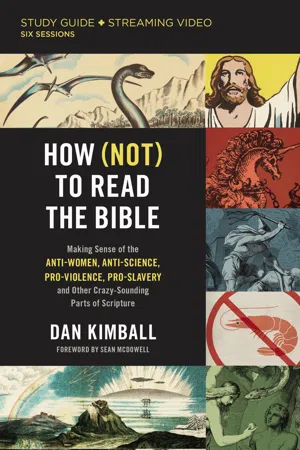
In this six-session video study (video streaming code included) bestselling author Dan Kimball guides you step-by-step through making sense of the most misunderstood, difficult, and disturbing Bible passages.
This study guide has everything you need for a full Bible study experience, including:
The study guide itself—with discussion and reflection questions, video notes, and a leader's guide.
An individual access code to stream all six video sessions online (you don't need to buy a DVD!).
For centuries, the Bible was called "the Good Book," a moral and religious text that guides us into a relationship with God and shows us the right way to live. Today, however, some people argue the Bible is outdated and harmful, with many Christians unaware of some of the odd and disturbing things the Bible says or how to understand them.
Whether you're a Christian, a doubter, or someone exploring the Bible for the first time, Dan Kimball is your guide to understanding and contextualizing passages in Scripture that seem backward on topics related to women, science, violence, slavery, and world religions.
Filled with stories, visual illustrations, and memes reflecting popular cultural objections, How (Not) to Read the Bible is a lifeline for individuals who are confused or discouraged with questions about the Bible.
Sessions include:
Never Read a Bible Verse
Stranger Things
Boys' Club Christianity
Jesus Riding a Dinosaur
My God Can Beat Up Your God
Rated NC-17
This study can be done in youth groups, single's groups, small groups, Sunday classes, and by individuals.
Streaming video access code included. Access code subject to expiration after 12/31/2027. Code may be redeemed only by the recipient of this package. Code may not be transferred or sold separately from this package. Internet connection required. Void where prohibited, taxed, or restricted by law. Additional offer details inside.
Frequently asked questions
Yes, you can cancel anytime from the Subscription tab in your account settings on the Perlego website. Your subscription will stay active until the end of your current billing period. Learn how to cancel your subscription.
At the moment all of our mobile-responsive ePub books are available to download via the app. Most of our PDFs are also available to download and we're working on making the final remaining ones downloadable now. Learn more here.
Perlego offers two plans: Essential and Complete
Essential is ideal for learners and professionals who enjoy exploring a wide range of subjects. Access the Essential Library with 800,000+ trusted titles and best-sellers across business, personal growth, and the humanities. Includes unlimited reading time and Standard Read Aloud voice.
Complete: Perfect for advanced learners and researchers needing full, unrestricted access. Unlock 1.4M+ books across hundreds of subjects, including academic and specialized titles. The Complete Plan also includes advanced features like Premium Read Aloud and Research Assistant.
Both plans are available with monthly, semester, or annual billing cycles.
We are an online textbook subscription service, where you can get access to an entire online library for less than the price of a single book per month. With over 1 million books across 1000+ topics, we’ve got you covered! Learn more here.
Look out for the read-aloud symbol on your next book to see if you can listen to it. The read-aloud tool reads text aloud for you, highlighting the text as it is being read. You can pause it, speed it up and slow it down. Learn more here.
Yes! You can use the Perlego app on both iOS or Android devices to read anytime, anywhere — even offline. Perfect for commutes or when you’re on the go. Please note we cannot support devices running on iOS 13 and Android 7 or earlier. Learn more about using the app.
Yes, you can access How (Not) to Read the Bible Study Guide plus Streaming Video by Dan Kimball in PDF and/or ePUB format, as well as other popular books in Theology & Religion & Christian Theology. We have over one million books available in our catalogue for you to explore.
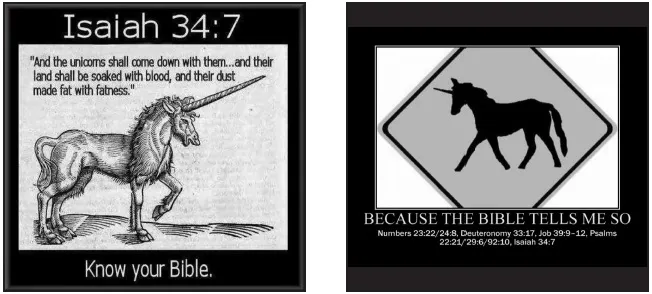
God brought them out of Egypt; he hath as it were the strength of an unicorn.
NUMBERS 23:22 KJV
And the unicorns shall come down with them . . .
ISAIAH 34:7 KJV
Welcome
When I first tried to read the Bible as a teenager, it seemed more like a work of fiction than anything else—a book filled with epic battles and angels, stories of demons, and even a red dragon.* That’s why it was placed on a bookshelf between my fantasy and horror books. It fit right in with Bram Stoker’s Dracula and J. R. R. Tolkien’s Lord of the Rings trilogy. As I read and studied more of the Bible in college, I was still disturbed by some of the oddities I found, namely, talking animals. These oddities didn’t bode well for someone like me who was trying to make a serious attempt at considering the claims of the Christian faith. The Bible didn’t make sense and I was surprised there was so much violence, even in the life of Jesus. I knew that if the Bible was the foundation of Christianity, I had to make sense of these passages.
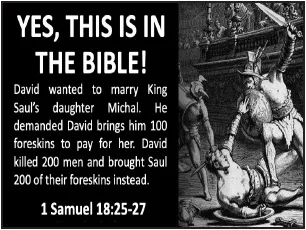
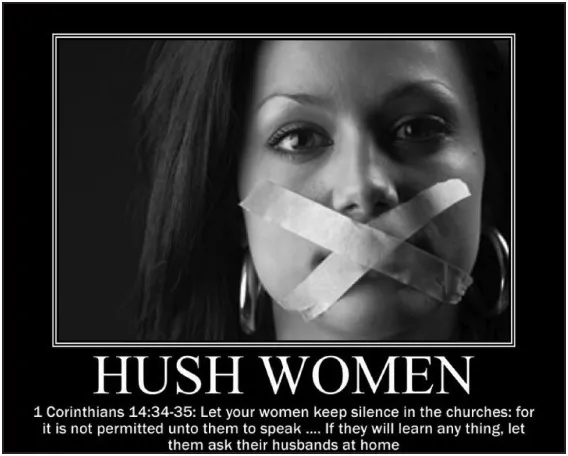
But making sense of the disturbing passages of the Bible gets complicated in a world full of memes. In addition to seeming anti-women and pro-slavery, it’s not hard to find Bible verses that seem to endorse violence, even against babies and small children. And it’s not hard to find websites and YouTube videos dedicated to calling out these sorts of Bible verses. What was once known as “The Good Book” is now considered “The Evil Book” by so many. To make matters worse, it’s becoming more commonplace to see people quote Bible verses all over the internet and on memed-merchandise to illustrate how strange, crazy, and primitive sounding the Bible is.
If I were reading these bizarre verses for the first time, seeing them in isolation like this, I would feel the same way. But here’s the good news: there are ways to better understand these crazy-sounding Bible verses. We must learn how to, and how not to, read the Bible. If you are willing to look beyond the visual image and explore beyond a literal, out-of-context reading of a verse, you’ll discover the Bible is not “sheer nonsense.” The Bible is an amazing, fully inspired, life-changing collection of writings by people who were directed by God through God’s Spirit. When we read, interpret, and understand the Bible accurately—not just individual verses, but how they fit into the Bible as a whole—our questions and concerns are answered, and we come to better know the author of the Bible. We come to know God.
Watch
Play the video segment for session one (see the streaming video access provided on the inside front cover). As you watch, use the following outline to record any thoughts or concepts that stand out to you.
Video Notes
Questions people are asking about the Bible:
• Is God pro-violence?
• Is the Bible anti-women?
• Is the Bible anti-science?
• Does God endorse slavery?
The Good News: there are reasonable responses to these questions.
Four basic ways to look at the Bible to make sense of these disturbing Bible passages:
1. The Bible is a library, not a book.
It is a library of books. It was written by over forty different authors, over 1,500 years, on three continents, in three languages, many different cultural settings, and many different genres.
The Holy Spirit is the Author who guided the human authors (2 Timothy 3:16; 2 Peter 1:21).
Examining the genres. The poetry of Song of Solomon 4:15.
[Your Response Here]
2. The Bible is written for us, not to us.
Understanding the author’s intent and for whom the passage was written. The dangers of misinterpreting Scripture.
[Your Response Here]
KEY QUESTIONS TO ASK:
Who was the book or letter of the Bible originally written to?
[Your Response Here]
Why was it written?
[Your Response Here]
What was happening in the world of the original recipients?
[Your Response Here]
What questions were they asking that God was answering to them?
[Your Response Here]
3. Never read a Bible verse in isolation.
Understanding the storyline, the timeline, and the context. Bible scrolling.
Genesis 1:29 and Genesis 9:3.
[Your Response Here]
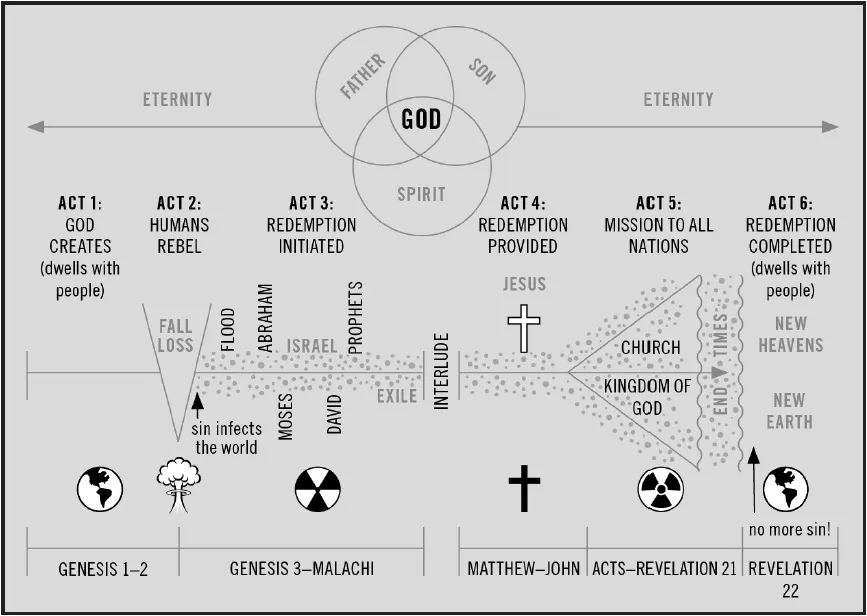
4. All the Bible points to Jesus.
The storyline is about Jesus from Genesis to Revelation.
“This is what I told you while I was still with you: Everything must be fulfilled that is written about me in the Law of Moses, the Prophets and the Psalms.”
LUKE 24:44 NIV
What about the unicorns?
[Your Response Here]
Group Discussion
Take a few minutes with your group members to discuss what you just watched and explore these concepts in Scripture.
1. What stood out to you from listening to Dan today? How can you identify with the stories or memes he shared?
[Your Response Here]
2. What questions or concerns do you have about the Bible? Which verses or stories have tripped you up because you don’t quite understand the original context?
[Your Response Here]
3. Have you ever considered the Bible as a library of books, rather than a book in the library? How does this shift in mindset change things for you regarding the Bible?
[Your Response Here]
4. Read 2 Timothy 3:14–17. How does Paul encourage Timothy to use the Bible? Why is it worth studying all of the Bible, even with the challenging passages?
[Your Response Here]
5. Placing the challenging verses of Scripture within their proper context is vital to understanding the meaning of these verses. What practices or tools do you use, or could you start using, to make sure you understand the context of a verse or story?
[Your Response Here]
6. Read Isaiah 7:1–17 and Luke 24. What does it mean when Dan says all the Bible points to Jesus? How do we know this to be true?
[Your Response Here]
Reflection
Briefly reflect on the teaching and any notes you took. In the space below, write down your most significant takeaway from this session. Also, consider what discussion question or Bible passage you plan to explore as a result of today’s session. If time permits, share it with your group.
Wrap-Up
Pray as a group before you close your time together. Be honest with God about the questions and concerns you have about the sacred text of the Bible. Thank God for creating a library of content written for us even when it’s not written to us. Ask God to give you the courage and discipline to explore the context of passages and places in the Bible that seem strange to you. And ask God to give you the vision to see the story of Jesus throughout the entire lens of the Bible.
Note
*1 Samuel 11:1–11; 2 Samuel 10:10–19; Isaiah 37:36; Revelation 16:12–16; 12:3
SESSION ONE
How You Can Respond
Choose at least one of the following suggested activities/reflections to complete over the next week. Consider sharing with your friends or small group members the impact the activity or reflection had on you as you spent this time exploring. Before you begin, you may want to review book chapters 1–3 in...
Table of contents
Cover Page
Title Page
Copyright Page
Streaming Video Access
Ebook Instructions
Contents
Introduction
How to Use This Guide
Session 1: Never Read a Bible Verse (or You Will Have to Believe In Magical Unicorns)
Session 2: Stranger Things: Shrimp, Slavery and Skin of a Dead Pig
Session 3: Boys’ Club Christianity: Is the Bible Anti-Women?
Session 4: Jesus Riding a Dinosaur: Is the Bible Anti-Science?
Session 5: My God Can Beat Up Your God: Does Christianity Claim All Other Religions Are Wrong?
Session 6: Rated NC-17: The Horror of Old Testament Violence