Gathering Blossoms Under Fire
eBook - ePub

Gathering Blossoms Under Fire

The Journals of Alice Walker, 1965–2000

  1. 560 pages
  2. English
  3. ePUB (mobile friendly)
  4. Available on iOS & Android
eBook - ePub

Gathering Blossoms Under Fire

The Journals of Alice Walker, 1965–2000

About this book

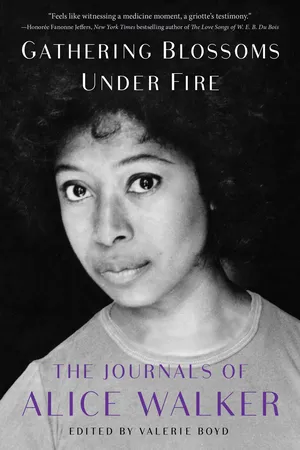
From National Book Award and Pulitzer Prize­–winning author Alice Walker and edited by critic and writer Valerie Boyd, comes an unprecedented compilation of Walker’s fifty years of journals drawing an intimate portrait of her development over five decades as an artist, human rights and women’s activist, and intellectual.

For the first time, the edited journals of Alice Walker are gathered together to reflect the complex, passionate, talented, and acclaimed Pulitzer Prize winner of The Color Purple. She intimately explores her thoughts and feeling as a woman, a writer, an African American, a wife, a daughter, a mother, a lover, a sister, a friend, a citizen of the world.

In an unvarnished and singular voice, she explores an astonishing array of events: marching in Mississippi with other foot soldiers of the Civil Rights Movement, led by Martin Luther King, Jr.; her marriage to a Jewish lawyer, defying laws that barred interracial marriage in the 1960s South; an early miscarriage; writing her first novel; the trials and triumphs of the Women’s Movement; erotic encounters and enduring relationships; the ancestral visits that led her to write The Color Purple; winning the Pulizter Prize; being admired and maligned, sometimes in equal measure, for her work and her activism; and burying her mother. A powerful blend of Walker’s personal life with political events, this “revelation, a road map, and a gift to us all” (Tayari Jones, New York Times bestselling author of An American Marriage) offers rare insight into a literary legend.
Frequently asked questions

Yes, you can cancel anytime from the Subscription tab in your account settings on the Perlego website. Your subscription will stay active until the end of your current billing period. Learn how to cancel your subscription.
No, books cannot be downloaded as external files, such as PDFs, for use outside of Perlego. However, you can download books within the Perlego app for offline reading on mobile or tablet. Learn more here.
Perlego offers two plans: Essential and Complete
  • Essential is ideal for learners and professionals who enjoy exploring a wide range of subjects. Access the Essential Library with 800,000+ trusted titles and best-sellers across business, personal growth, and the humanities. Includes unlimited reading time and Standard Read Aloud voice.
  • Complete: Perfect for advanced learners and researchers needing full, unrestricted access. Unlock 1.4M+ books across hundreds of subjects, including academic and specialized titles. The Complete Plan also includes advanced features like Premium Read Aloud and Research Assistant.
Both plans are available with monthly, semester, or annual billing cycles.
We are an online textbook subscription service, where you can get access to an entire online library for less than the price of a single book per month. With over 1 million books across 1000+ topics, we’ve got you covered! Learn more here.
Look out for the read-aloud symbol on your next book to see if you can listen to it. The read-aloud tool reads text aloud for you, highlighting the text as it is being read. You can pause it, speed it up and slow it down. Learn more here.
Yes! You can use the Perlego app on both iOS or Android devices to read anytime, anywhere — even offline. Perfect for commutes or when you’re on the go.
Please note we cannot support devices running on iOS 13 and Android 7 or earlier. Learn more about using the app.
Yes, you can access Gathering Blossoms Under Fire by Alice Walker, Valerie Boyd in PDF and/or ePUB format, as well as other popular books in Social Sciences & Literary Biographies. We have over one million books available in our catalogue for you to explore.

PART ONE MARRIAGE, MOVEMENT, AND MISSISSIPPI THE 1960S

Image

June 1, 19651

Today is my parents’ anniversary. They have been married thirty-two years. That seems so long to live with someone and still enjoy being with them occasionally.…
… Charles2 is always like a prisoner let out of confinement, stalking here and there, running—sometimes I think from Charles. I love him as I would have loved my brothers if they had been more affectionate. Yet more too, because we always love our friends more dearly than our relatives; friendship is a matter of choice, a commitment to love another person who is unlike you, unrelated to you in any way.
A letter from Marian Wright3 agreeing with Charles that it would be good if I went to Mississippi. I wonder if I will be able to overcome my nausea about the South (the murders, the fear) if I have someone invincible like her to look up to and to follow around. People have called me brave so often that I almost believe it—if fear is brave I am brave.
Have put the thousand dollars from Charles in the bank along with my own measly three hundred. I am curious to know how long this will last and feel at present that it might well last forever as I feel no need of anything. Most of my clothes I want to give away. It seems ridiculous to keep dresses one doesn’t even like.
I must stop fooling myself that certain people can mean more to me than they can. It is not fair to them to lead them on and one’s togetherness with one’s self is too precious to interrupt with outsiders who bring no spiritual food. As to why we fritter away our lives on acquaintances of no real value I have no idea, except that it is a waste of which many weak hearts are guilty.
I have written a little yesterday and today and the feeling of being able to create something out of blank paper and vapory thoughts is good. I want now to reach a level of patience and precision which I have not had in my other stories. I must also read some more authors and see how they handle dialogue, as dialogue for me is very Tom Wolfe, which is to say, wooden.

June 13, 19654

Orientation (SCOPE, summer student faction of SCLC, Southern Christian Leadership Conference) was one long conversation. Sometimes with one person, often with five, ten, or three hundred. I flew to Atlanta (late) having missed both bus and train and wanting tremendously to get in on every part of the week-long discussions. For the first time in my life Southern accents (the airline hostesses) did not cause my heart to beat faster either in fear or disgust. The slow, nasal voices, accompanied by rather congenial though not quite spontaneous smiles came only as a surprise. I could even understand the charm of them, which Northerners often profess. Two hours in the air from Newark and I am in Atlanta… ā€œWhere progress always has the right-of-way.ā€ Seeing old familiar words, hearing them rolled over the tongue, through the nose and over the lips, realizing once more the peculiar glare and penetration of the heat—fighting an urge mainly because of the heat to get on another jet and go back to New York where the day before had been cool, the accents usually clear and precise—except those from the Bronx, Brooklyn, Queens.
The Atlanta skyline was like a stranger glimpsed again after several days have passed. I noted the newest buildings with some curiosity but no feeling. The Atlanta I knew began on Hunter Street—the southern portion of the Negro section.
From the bus I could see the historic spire of Morris Brown—the oldest Negro college in Atlanta—rising from its hill, visible from numerous points about the city. Its spire visible to all, its body hidden like a tree root, deep in the soil of the Negro community. Off the bus I ran into many arms and kisses from old friends—all met at one time or another during the past five years—on walks, marches, pickets, etc. All over the North and South. ā€œBrother!ā€ and ā€œSister!ā€ followed by all kinds of swings in the air—all accompanied by a freedom song in the background, ā€œThis Little Light of Mine,ā€ I believe, let me know that I was finally in ā€œthe Movementā€ and that what this one had here in the Delta that the ones in the North did not was ā€œsoul!ā€ Even while restrained by the usual ā€œickā€ of registration I felt more or less home and comfortable with the kind of soldiers I had volunteered to work with. That was the first day.
Monday morning began with grits—

Tuesday Night, June 29, 1965, Liberty County, Georgia

Tonight two hundred members of the Liberty County community attended a mass meeting at the Dorchester Cooperative in Mid-Way. They came to hear reports on the Liberty County Headstart program, the recent upsurge of racial unrest and demonstrations following the arrest of a local schoolteacher on what protesters termed a ā€œmade-upā€ charge. Part of a long chain of harassment of Negroes. The community was told about the serious injury done one of its young citizens, 14 years old, by local Gainesville whites. Johnny Lee Jones is in danger of losing an eye or perhaps both his eyes after being cornered in a poolroom where his father worked by a group of whites. Local Negroes say they know the whites involved and that they are not ā€œyouths of about 14 years of ageā€ as local papers and the local sheriff claim. They say that the two chief attackers are both probably in their thirties. No arrests have been made.
The main speaker at the meeting was Rev. B.J. Johnson of Atlanta, Georgia, who told Liberty Countians that they have shamefully misused the power of their ballots if such an example of racial violence as occurred after the demonstration could take place. He demanded that the people take into consideration the lack of protection provided for them and their children by local police and officials when they go to the polls to vote next election time. Liberty County is unique, he said, in that it has more Negroes on the books (registered) than whites, yet the Negroes have not got a single representative on the board of county officials. The mood of the crowd was bewildered and indignant. Several young people expressed concern and anger as regards the corrupting methods used by county officials in the Negro community in order to buy votes at election time.

Undated5

Things have fluctuated here between extreme boredom and intense, often dangerous excitement. I managed to get two friends of mine in the Chatham County jail for a night, as well as huge, ridiculous fines for ā€œtraffic violations,ā€ and so consider that time has not lain too heavily on my hands. We’ve been doing night demonstrating—sitting down (ā€œinā€) on the porch of the Georgia state patrol. Hit slightly by a bottle and several rebel yells ending in ā€œNiggerā€ā€”accompanied by the usual crowd of onlookers including many ā€œpride of the Southsā€ using dirty words and making obscene gestures. Somehow I’m always mildly surprised when women carry on so.
One of the most rewarding people I’ve met is an eighteen year old boy who is about as brave (rather empty ā€œbraveā€ is, but still useful) as I’ve ever seen anyone be and still live down here. Recently whites attempted to frighten him by pulling alongside his jalopy and aiming a .38 at him. He stared them down. He had led all the demonstrations in this county and the amazing thing about him is that he is how he is—willing to argue, to march, to fight back, naturally—and that he doesn’t even know any real swear words! You probably can imagine how hard it is to be a man in the South if you’re Negro—but he is, I hope, an indication that all that other is going to be changed—and the South will rise again—but as a nation of men (like him) and not a lot of finky little Confederate flagwavers who don’t know Sherman from Grant.
Another exciting experience has been my roommate, a girl from Philadelphia whose mother is a raging anti-integrationist. I’ve read one of her letters to C. and consider her quite pathetically mad; and very, very sick and out of step with the world—and her own daughter. C. tells me, however, that her mother’s beliefs (that Negroes are all preoccupied with sex, they all use filthy language, they all want to marry white wives, they all have lice and worse) is more or less typical of a large segment of the (white) population.…
… The rest of the people here I like. It is not easy to leave (I’m leaving tomorrow). They are such open, aware, people. Some of them are very young and yet they know things that old men and hotheads have all missed.

Undated6

Haiku… Beautiful
And unexpected
Like the friend
One sees maybe
Once a year
Who can say
I am
African
American
Indian
When the next minute
he may be
a butterfly?

July 28, Nairobi Bus Station

ā€œBeware of Pick Pocketā€ reads a black block-lettered sign over the back entrance to the bus station in what I suppose is the slum section of Nairobi. The front opens on a shabby street compared to the other streets in Nairobi. There are no flowers on _______ street, only a scrubby shrub or two settled rootedly but thinly in red, washed out dirt. Unlike the airport in Nairobi, which is modern, stylish and colorfully chic, the bus station is decidedly down-at-the-heels.
The cold is quite a surprise—July and August are the winter months and I suppose it is close to fifty degrees outside the bus now. What is interesting though is cold weather not withstanding flowers bloom in happy, extravagant profusion.

Undated7

I have been reading Tolstoy and wondering how one comes to true honesty with oneself and at which point honesty becomes exaggeration. For a month or more I have known I could be classified with that 10th of the world’s women who are capable of being completely sensual. What will develop I cannot imagine but I feel very little fear and a great deal of curiosity.
It seems to me that sex has become a barrier and a taboo when in actuality I cannot see that the complete act in terms of moral value is any worse than a kiss that is meant. In either case one follows in practice the closeness one feels in abstract. This is naĆÆve—because there are more possible serious consequences after sex than after a kiss.8
I have at last established a certainty which has meant a great deal to me to know. I do not want _______ for a husband. As a sexual partner this is still the only man who satisfies me but two minutes after climax I am irritated at such petty things about him that I know my ā€œloveā€ to be completely sham—I must say we irritate each other for I get a kind of crazy pleasure from tormenting him.
He can’t change what he is (white, middle class American) any more than I can change what I am now (Black middle class American). It is interesting how I always felt I loved him because he wanted me to love him and also because he was so tender and easygoing with me in spite of my ā€œambitions.ā€
What am I really? And what do I want to do with me? Somehow I know I shall never feel settled with myself and life until I have a profession I can love—teaching Dickinson and Donne to crew-cuts would suit me somewhat. Marriage is not even a possibility for me at the moment—though there are three suitors excluding David who’ve asked to marry me. ā€œPrincetonā€ would never do for a husband. He has traveled all over the world but it has made him spattered rather than wide. Some day he will live in a house with Japanese rugs and perhaps a swimming pool and probably in Atlanta. I cannot talk to him long—he finds everything I say fascinating to the nth degree and I find most of what he says irrelevant. I’ve been in bed once with him after drinking too much to keep from having to hear his repetitions but regretted it so much that I made myself quite sick. There is (I learned from this experience) a limit beyond which one must not push sex if there is to be enough good about it to make it worth having. One should never give one’s self out of drunkenness, pity, contempt, curiosity only, or passion only. There must somewhere be about a sexual liaison a spot of cleanliness, of joy and exuberance. There is nothing more sodden and unforgiveable than the giving of one’s body and the closing off, simultaneously, of one’s mind.

T...

Table of contents

  1. Cover
  2. Title Page
  3. Dedication
  4. Epigraph
  5. Introduction
  6. Part One: Marriage, Movement, and Mississippi / The 1960s
  7. Part Two: The Nature of This Flower is to Bloom / The 1970s
  8. Part Three: Be Nobody’s Darling / The 1980s
  9. Part Four: You Can’t Keep a Good Woman Down / The 1990s
  10. Postscript
  11. Acknowledgments
  12. About the Authors
  13. Index
  14. Illustration Credits
  15. Copyright