
eBook - ePub
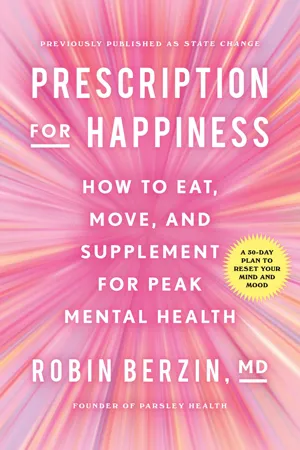
Prescription for Happiness
How to Eat, Move, and Supplement for Peak Mental Health
- 320 pages
- English
- ePUB (mobile friendly)
- Available on iOS & Android
eBook - ePub
About this book
A “compassionate, authoritative, and wise” (Mark Hyman, MD, New York Times bestselling author of The Pegan Diet) 30-day program that “will shift the way you think about your body and your health” (Gabrielle Bernstein, #1 New York Times bestselling author and international speaker) based on a paradigm-shifting idea: You have to change your body to change your mind and mood.
Prescription for Happiness offers a 30-day program for reaching a new level of energy, clarity, and calm. Too often, conventional medicine treats the mind as separate from the body. However, science shows that physical issues, such as chronic illness and weight fluctuation, are oftentimes intricately entwined with mental health conditions like depression, anxiety, fatigue, and more. This must-read book explores the new science of optimizing the body in ways that will help anyone attain a new baseline for energy, calm, and optimism.
Dr. Berzin draws on cutting-edge research and her work with thousands of patients to tell the complete story of how our physical health influences our energy level, mood, focus, and emotional wellbeing. This builds on her work at her nationally renowned holistic health service Parsley Health, where Dr. Berzin and her team of over 100 highly trained medical providers focus on treating the whole patient, yielding extraordinary results for those dealing with gastrointestinal, hormone-related, autoimmune, and mental health conditions. Leveraging Parsley’s unique patient data and successful proprietary protocols, Prescription for Happiness is the ultimate gateway to creating your new baseline for peak physical and mental health.
Prescription for Happiness offers a 30-day program for reaching a new level of energy, clarity, and calm. Too often, conventional medicine treats the mind as separate from the body. However, science shows that physical issues, such as chronic illness and weight fluctuation, are oftentimes intricately entwined with mental health conditions like depression, anxiety, fatigue, and more. This must-read book explores the new science of optimizing the body in ways that will help anyone attain a new baseline for energy, calm, and optimism.
Dr. Berzin draws on cutting-edge research and her work with thousands of patients to tell the complete story of how our physical health influences our energy level, mood, focus, and emotional wellbeing. This builds on her work at her nationally renowned holistic health service Parsley Health, where Dr. Berzin and her team of over 100 highly trained medical providers focus on treating the whole patient, yielding extraordinary results for those dealing with gastrointestinal, hormone-related, autoimmune, and mental health conditions. Leveraging Parsley’s unique patient data and successful proprietary protocols, Prescription for Happiness is the ultimate gateway to creating your new baseline for peak physical and mental health.
Frequently asked questions
Yes, you can cancel anytime from the Subscription tab in your account settings on the Perlego website. Your subscription will stay active until the end of your current billing period. Learn how to cancel your subscription.
No, books cannot be downloaded as external files, such as PDFs, for use outside of Perlego. However, you can download books within the Perlego app for offline reading on mobile or tablet. Learn more here.
Perlego offers two plans: Essential and Complete
- Essential is ideal for learners and professionals who enjoy exploring a wide range of subjects. Access the Essential Library with 800,000+ trusted titles and best-sellers across business, personal growth, and the humanities. Includes unlimited reading time and Standard Read Aloud voice.
- Complete: Perfect for advanced learners and researchers needing full, unrestricted access. Unlock 1.4M+ books across hundreds of subjects, including academic and specialized titles. The Complete Plan also includes advanced features like Premium Read Aloud and Research Assistant.
We are an online textbook subscription service, where you can get access to an entire online library for less than the price of a single book per month. With over 1 million books across 1000+ topics, weâve got you covered! Learn more here.
Look out for the read-aloud symbol on your next book to see if you can listen to it. The read-aloud tool reads text aloud for you, highlighting the text as it is being read. You can pause it, speed it up and slow it down. Learn more here.
Yes! You can use the Perlego app on both iOS or Android devices to read anytime, anywhere â even offline. Perfect for commutes or when youâre on the go.
Please note we cannot support devices running on iOS 13 and Android 7 or earlier. Learn more about using the app.
Yes, you can access Prescription for Happiness by Robin Berzin in PDF and/or ePUB format, as well as other popular books in Medicine & Alternative & Complementary Medicine. We have over one million books available in our catalogue for you to explore.
Information

CHAPTER ONE The True Secret to Transformation
Two large coffees, skim milk, three Splendas, two dollarsâit was the same every day. The guy behind the street cart outside my downtown New York City office knew my order without having to ask.
This was 2003. I had just turned twenty-one years old and was freshly out of college. In those days, I lived off this coffee concoction loaded with artificial sweetener, caffeine, and the hope it would somehow make my day go by faster.
As I sipped the coffee on a bench steps away from the subway entrance, the Financial District in downtown Manhattan in the month of September felt like a movie set to me: the smell of roasted nuts mixed with the taxi exhaust, people in suits no matter how sweltering the outside air, and the feeling that things were always beginning.
I should have felt like I had the whole world in front of me, but instead I was lost. Graduating summa cum laude and Phi Beta Kappa from an Ivy League university with a degree in international relations meant that I was really, really good at schoolâand not good at much else. I had learned to use my intellect as armor, always having the right answer, always making the right choice, justifying the wrong choices as right ones, and living perpetually in my head. Armed with this âI must have all the answersâ outlook, I subsisted on a rinse-and-repeat combination of caffeine, red wine, and calorie restriction (in the body-dysmorphic way, not the biohacker way) that cycled me through days in the office and nights out partying. I was very far away from becoming the doctor, mom, and CEO I am todayâin fact, I could never have imagined this kind of future then.
My first job out of college was as a paralegal in New York, where I prosecuted securities fraud for the US Attorneyâs Office. The job was a gift, and not just because it was a relatively distinguished opportunity for a recent college grad and came with the highest security clearance I will certainly ever have in my lifetime. It was a gift, because in a mere six months it showed me exactly what I didnât want to do with the rest of my life. While someone very smart should absolutely prosecute securities fraud on behalf of all Americans, I remember telling my best friend over drinks one night that I didnât think it should be me.
The âthis is not workingâ feeling I had about my career was compounded by my romantic relationship at the time. I had been with the same boyfriend for almost three years, but weâd long cruised past the territory of âhealthy relationshipâ into what I would describe as a wildly immature, dysfunctional, and competitive relationship. I regularly spent lunch breaks outside the office, tracing the paths of City Hall Park, sipping my fake-sugar-sweet street-cart coffee while crying and arguing with him on the phone.
In my early twenties, I survived on coffee, green apples from the farmersâ market outside my apartment building, protein bars, and grilled chicken from the sandwich counter at my local bodegaâno exaggeration. I unknowingly subscribed to the cult of orthorexia before the obsession with âhealthyâ eating became a thing. At the time, I had no pretenses around being âhealthy.â Instead, I just thought healthy equaled skinny.
To accomplish that end, I also ran on the treadmill at the YMCA three to four times a week, Z100 blasting in my headphones as I thought about which flavor of Tasti D-Lite I would reward myself with after my run. Being âhealthyâ to me simply meant fitting into a size Small while simultaneously subsisting on sugar in alcohol, protein bars, and fake sweeteners. I was doing well at work, and despite my crazy gone-on-too-long relationship with my boyfriend, I had a great social life, lots of friends, and endless evening plans. The lack of sleep, perma-hangover, daily brain fog, and mood swings didnât seem to me to be an issue. Itâs what we all did.
The only problem was that I didnât feel good. I was anxious, stressed, and lost, and without realizing it, I started to try to find a way outâof everything. On some visceral level I knew that I wasnât on the right pathâI certainly wasnât on the path to become who I am today. But I had absolutely no idea where that path was or how to find it.
Like a mouse in a maze, I started walking, a lot. Initially, it was just around the neighborhood where I worked. My paralegal duties most days were manageable, so unless one of the cases I was responsible for was at trial, I had extra time on my hands, and walking took the place of sitting at my desk reading the New York Times online for the fifth time. A few months into my wanderings, I happened upon a flyer pasted to a streetlight on Warren Street. It was for $5 classes at a yoga studio in a fourth-floor walk-up above one of those jam-packed ground-floor shops in New York City that has a little of everythingâstaplers, screwdrivers, Halloween costumes. The neighborhood was slowly coming back to life after 9â11, and my first three classes were going to be only $15. This was attractive because I was broke (my government paralegal salary barely paid the rent), and I signed up because I needed something to do when I didnât feel like window shopping or crying on the phone. I knew nothing about yogaâthe practice was hardly standard curriculum for college students in those days, and my upbringing in Baltimore had emphasized team sports like soccer and lacrosse instead.
I was skeptical of yoga at first. The studio was only one room, and you changed behind a curtain. The windows had been retrofitted with stained glass. Was this a church? The people in class, mostly women, were older than me for the most part and appeared to be very fit, but not in the skinny Splenda-wine-and-coffee way. They actually looked strong. I wasnât sure that I was supposed to be there, because it felt like they all knew one another. But I had nothing better to do.
Yoga was immediately different from running on the treadmill at the Y. My breathing slowed. My focus stayed in the room. I discovered that holding still was more difficult than moving quickly. After the thoughts stopped racing through my head, I became acutely aware of my body in space for the first time. My sweat felt like it was coming from a deeper place than just below the surface of my skin.
It wasnât just energizingâit was also frustrating. I realized that I had no core strength whatsoever. I learned that while I was great at moving forward through time and space, I was terrible at balancing in the here and now, as I fell over simply trying to stand on one foot for several seconds. The âOmâ-ing was weird and awkward, and the corpse pose, which meant lying around on the ground doing nothing, felt like a waste of time for a workout class. I had no idea what the Sanskrit words meant, just that I felt a little too woo-woo for even being in a room where they were said out loud.
After my first class, I threw my drenched clothes in a bag. It wasnât hot yoga; the class had just been that hard. As I walked back down the four flights of stairs, I noticed a strange feeling. First, my legs were shaking like Iâd just run ten miles. Second, I was calm, possibly for the first time ever. My head wasnât spinning through that cycle of external blame and internal shame that Iâd been stuck in for yearsâthe same one I had used to rationalize my reality. Instead, I felt suddenly in the present, without worrying about what was going to happen next or reexamining everything that had already happened in the hopes of reaching a different outcome. That feeling of constant tension, like my body was attached to a live wire, was gone. I felt free.
While I didnât appreciate it at the time, I had just used my body to change my mindâI had used my physiology to overhaul my psychology. This wasnât just a quick fix, feel-good moment: This was the beginning of a transformation of my baseline emotional state leveraged by a shift in my physical state.
This metamorphosis of your emotional and mental health triggered by a change in your physical health is what I call a State Change. A State Change is when you establish a new normal, or a new set point for how you feel on a daily basis. At baseline, you feel happier, have an easier time discovering what you want, are able to tap into your passions, feel more confident in your decisions, and are able to unlock a new level of consciousness that you may have never realized even existed.
State Changes donât happen after one yoga class. But for me, one yoga class was the unexpected first step toward rethinking my daily behaviors, or core actions, as I call them throughout this book: the things we do every day with or to our bodies that can have a huge impact on our physical and mental health.
After my first yoga class, I found myself going back for a second and a third. After ten classes or soâand a similar experience following each oneâI became fascinated by the connection between my mind and my body. I hadnât ever known I could feel so clear, present, calm, and connected. The feeling lasted far beyond the hour-long class, influencing the way I saw my life and myself. Yoga was still weird to me, and I routinely made fun of it to my friends, but I found myself going back again and again, searching for that feeling and the consequential confidence that seemed to magically result.
My first State Change led to a major shift that ultimately changed my life. This started, though, with a physical, mental, and emotional wake-up call. Suddenly, I realized just how many of my waking hours were spent in a continual state of distraction and anxiety, as I began to discover through yoga more clarity, energized calm, and mindfulness. Eventually, a calmer, more energized state wasnât just my in-class mode but my new baselineâhow I felt on a consistent, regular basis. Unlike other types of exercise where I felt exhausted afterward or like I was literally and figuratively stuck on a treadmill, yoga showed me how to slow down, enjoy the moment, and feel more comfortable in my skin. The practice helped me see that my body wasnât the enemyâsomething I had to beat into shape or force to tone up or whittle downâbut a beautiful vehicle for movement. I started to focus on feeling strong rather than making sure I worked out for a certain amount of time, lifted X pounds of weights, or burned Y number of calories.
But it wasnât just about yogaâor even exercise in general. After my first State Change, I began to examine other core actionsâthe foods I regularly ate, how I slept, how and how much I stared at screensâand ways I might be able to shift these core actions, like I had done with exercise, to achieve a State Change on another level. In particular, I started paying attention to how certain foods made me feel, as I realized many of the things I consumed on a regular basis left me feeling wired, tired, or bloated. Similar to exercise, I began to see that I had been using food for the wrong reasonsâto be skinny, for example, not to feel more vibrant, alive, calm, and comfortable in my digestion. As I experimented with what I ate, I began to understand there were lots of ways to have a State Change. I didnât have to start or stick with exerciseâI could use any core action to achieve a new baseline. These core actions, or what I did daily with my body, werenât just a âlifestyle,â which had always seemed like a wishy-washy concept, but doorways I could open to feel better, healthier, and happier.
My State Changes werenât just physical, mental, and emotional. After I discovered a new baseline with yoga, I found myself reevaluating what I wanted to do with the rest of my life (surprise, federal prosecution was not my future), not from a place of fear but rather from a place of tapping into the things I now cared about. The first was a new interest in health. So in the summer of 2004, I quit my paralegal job and started working in the psychiatric research unit at NYUâs School of Medicine.
I also stopped running like my life (and my weight) depended on it. I broke up with the boyfriendâeventually. And over the next year, I slowly cut out all the calorie-counting and fake sugars and began to eat real meals. Amazingly, I was shocked to find I still fit into my jeans. Actually, they fit even better, as I discovered I was far less fixated on the number inside the waistband.
I also discovered that I liked working in psychiatric research at the Manhattan Veterans Administration hospital. I liked administering EKGs and drawing blood. I liked interviewing patients. I liked learning about brain scans. It was work with a purpose that felt helpful, not punitive. I liked my colleagues, too. I didnât have time to wander or be lonely, although I did work it out with my boss to come in earlyâ7 a.m. most daysâso that I could leave by 4 p.m. to make it to 4:15 p.m. yoga in FiDi.
One day, as I was getting coffee at a bodega on Twenty-Third Street during my walk from the 6 train to work, I found myself in line behind a middle-aged woman ordering a large coffee with skim milk and two Splendas. âI donât mean to pry,â I told her, âbut that stuff will kill you.â She looked at me evenly for a beat. I thought she was going to tell me to mind my own business. But before I could mumble âSorry,â she turned back to the counter and said, âNever mind about the Splenda.â She then looked at me, smiled, and said, âBless you.â
This is when I began to turn the intellectualism I had once used as a shield into a key, plying it to get into medical school at Columbia. I worked hard to earn my medical degree and finish my residency before deciding I could do better than just medicate and operate: I wanted to help people get truly better. I wanted to find and treat the root causes of physical pain and emotional distress. I wanted to help patients discover how wonderful life could beâand feelâwhen they no longer had to rely on caffeine, alcohol, sugar, and/or addictive drugs. Most of all, I wanted to help them experience their own physical-emotional transformations that I knew would change their lives like my own transformation had already changed mine. It would be years before I knew enough about medicine to actually help people make these changes through testing, medications, and science, but my âwhyâ was set, and I was on my path.
Now itâs your turn. I believe that a more impassioned, empowered, energetic, and healthier life is possible, no matter who you are or what youâre dealing with. You can have a State Change. And it all starts with one thing: your body.
The Big Problem with the Health Issues We All Have
F41.9. R53.83.
They may look like model numbers for the next Android phone, but thereâs nothing cutting-edge about them. Theyâre medical classification codesâF41.9 for an anxiety diagnosis, R53.83 for general fatigue.
I know them like my own phone number because theyâre the two most common diagnosis codes used at my medical clinic, despite the fact that most patients come see me for physical problems like migraine headaches, gastrointestinal conditions, arthritis, and hormone imbalances.
I donât hand out these codes like candy because I like to play part-time shrink. Quite the opposite: I care about how my patients feel, both physically and emotionally. I also screen for anxiety, depression, sleep disorders, and general fatigue as part of our general intake process.
Thatâs not standard practice at most primary care offices, but Parsley Health, which is the medical clinic I started in 2016 that now sees tens of thousands of patients across the country, is not a standard practice. At Parsley, we want to know as much about your mood, ability to focus, and whether you can find joy, as we do about your blood pressure and bowel movements. If your doctor isnât also asking you these types of questions, I canât say Iâm surprisedâbut you may want to find a new doctor.
Some patients want to know why Iâm so interested in their mental and emotional health. I tell them that if youâre anxious, depressed, not sleeping well, or tired all the time, getting rid of that stomach problem you came in for is going to be much more difficult, if not impossible.
More important, thereâs a good chance that your stomach problemâwhether itâs from an ulcer because youâre not dealing with your stress, or an imbalance in gut bacteria because youâre eating too much sugarâis whatâs causing you to feel anxious, depressed, restless, or tired all the time in the first place.
F41.9 and R53.84 arenât the only diagnoses that are populating our patient records like suggested passwords, eitherâthere are also the codes for brain fog, burnout, depression, attention deficit hyperactivity disorder, and insomnia. And this isnât just happening at Parsley Healthâitâs a phenomenon thatâs happening everywhere.
Feeling like general crap is so pervasive, in fact, that in 2018, the World Health Organization added âburnoutâ as a diagnosable medical condition (Z73.0 for the code-curious). Today, more than 90 percent of US workers say they feel burned out, as if they canât wake up and donât have the will or a way to try.
The stats on other aspects of our mental and emotional health are similarly staggering. For example, one in five Americans has clinical anxiety. One in twelve has major depression. Ten percent of all kids are diagnosed with ADHD, a condition that doesnât magically disappear on someoneâs eighteenth birthday.
These numbers reflect only those who seek help and get a clinical diagnosis as a result. In reality, the prevalence of these mental health issues is much higher, because most people donât raise their hand and ask for help from anyone, let alone a doctorâand if they do, too often no one is there to help them, given the shortage in mental health services.
Outside of clinical diagnoses, one in every three Americans doesnât get enough sleep, which may be why three-quarters of us say we feel tired all the time at work. In 2018, 13 percent of the country also reported feeling unhappyâa more than 50 percent uptick since 1990.
Unfortunately, the coronavirus pandemic hasnât done anything to help our national emotional health emergency. Instead, the outbreak has practically put anxiety, depression, and stress into the public water supply. In spring 2020, some exper...
Table of contents
- Cover
- Title Page
- Dedication
- Chapter One: The True Secret to Transformation
- Chapter Two: How You Really Feel
- Chapter Three: What Your Life Is Doing to Your Brain
- Chapter Four: The Diagnostic Tests You Really Need
- Chapter Five: Move the Energy
- Chapter Six: Food for Energy, Focus, and Flow
- Chapter Seven: The Universal Addiction Killing Our Minds and Draining Our Mood
- Chapter Eight: Supplements to Change Your Energy and Flow
- Chapter Nine: The New Frontiers: Psychedelics, Meditation, and Energy Healing
- Chapter Ten: Putting Words to Work: A Thirty-Day Plan to Reset Your Mind and Mood
- Acknowledgments
- About the Author
- Bibliography
- Index
- Copyright