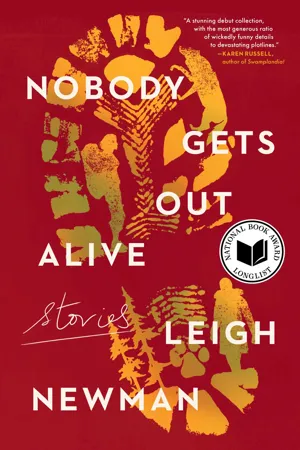
Nobody Gets Out Alive
eBook - ePub

Nobody Gets Out Alive

Stories

  1. 320 pages
  2. English
  3. ePUB (mobile friendly)
  4. Available on iOS & Android
eBook - ePub

Nobody Gets Out Alive

Stories

About this book

LONGLISTED FOR THE NATIONAL BOOK AWARD AND THE STORY PRIZE

Named a BEST BOOK OF 2022 by Oprah Daily, Vogue, Kirkus Reviews, Library Journal, and Electric Lit

From a prizewinning author comes an “electric...stunning” (Publishers Weekly, starred review) debut story collection about women navigating the wilds of male-dominated Alaskan society.

Set in Newman’s home state of Alaska, Nobody Gets Out Alive is an exhilarating collection about women struggling to survive not just grizzly bears and charging moose, but the raw legacy of their marriages and families.

Alongside stories set in today’s Last Frontier—rife with suburban sprawl, global warming, and opioid addiction—Newman delves into remote wilderness of the 1970s and 80s, bringing to life young girls and single moms in search of a wilder, freer, more adventurous America. The final story takes place in a railroad camp in 1915, where an outspoken heiress stages an elaborate theatrical production in order to seduce the wife of her husband’s employer.

“Rich with wit and wisdom, showing us that love, marriage, and family are always a bigger and more perilous adventures than backcountry trips” (Kirkus Reviews, starred review), these keenly observed stories prove there are some questions—about love, heartbreak, and the meaning of home—that can’t be outrun, no matter how hard we try. Nobody Gets Out Alive is a dazzling foil to the adventure narratives of old.
Frequently asked questions

Yes, you can cancel anytime from the Subscription tab in your account settings on the Perlego website. Your subscription will stay active until the end of your current billing period. Learn how to cancel your subscription.
At the moment all of our mobile-responsive ePub books are available to download via the app. Most of our PDFs are also available to download and we're working on making the final remaining ones downloadable now. Learn more here.
Perlego offers two plans: Essential and Complete
  • Essential is ideal for learners and professionals who enjoy exploring a wide range of subjects. Access the Essential Library with 800,000+ trusted titles and best-sellers across business, personal growth, and the humanities. Includes unlimited reading time and Standard Read Aloud voice.
  • Complete: Perfect for advanced learners and researchers needing full, unrestricted access. Unlock 1.4M+ books across hundreds of subjects, including academic and specialized titles. The Complete Plan also includes advanced features like Premium Read Aloud and Research Assistant.
Both plans are available with monthly, semester, or annual billing cycles.
We are an online textbook subscription service, where you can get access to an entire online library for less than the price of a single book per month. With over 1 million books across 1000+ topics, we’ve got you covered! Learn more here.
Look out for the read-aloud symbol on your next book to see if you can listen to it. The read-aloud tool reads text aloud for you, highlighting the text as it is being read. You can pause it, speed it up and slow it down. Learn more here.
Yes! You can use the Perlego app on both iOS or Android devices to read anytime, anywhere — even offline. Perfect for commutes or when you’re on the go.
Please note we cannot support devices running on iOS 13 and Android 7 or earlier. Learn more about using the app.
Yes, you can access Nobody Gets Out Alive by Leigh Newman in PDF and/or ePUB format, as well as other popular books in Literature & Literature General. We have over one million books available in our catalogue for you to explore.

Information

Publisher
Scribner
Year
2022
Print ISBN
9781982180317
eBook ISBN
9781982180324

HOWL PALACE

THIS SEPTEMBER, I FINALLY PUT Howl Palace up for sale. Years of poor financial planning had led to this decision, and I tried to take some comfort in my agent’s belief in a buyer who might show up with an all-cash offer. My agent, Silver, was a highly organized, sensible woman who grew up in Alaska—I checked—but when she advertised the listing, she failed to mention her description on the internet. ā€œAttractively priced teardown with plane dock and amazing lake views,ā€ she wrote under the photo. ā€œInvestment potential.ā€
I am still puzzled as to why the word ā€œteardownā€ upset me. Anybody who buys a house on Diamond Lake brings in a backhoe and razes the place to rubble. The mud along the shoreline wreaks havoc with foundations, and the original homes, like mine, were built in the sixties, before the pipeline, back when licensed contractors had no reason to move to Anchorage. If you wanted a house, you either built it yourself, or you hung out in the parking lot of Spenard Builders Supply handing out six-packs to every guy with a table saw in the back of his vehicle until one got broke enough or bored enough to consider your blueprints. Which is why the walls in Howl Palace meet the ceiling at such unconventional angles. Our guy liked to eyeball instead of using a level.
To the families on the lake, my home is a bit of an institution. And not just because the wolf room, which Silver suggested we leave off the list of amenities, as most people wouldn’t understand what we meant. About the snow-machine shed and clamshell grotto, I was less flexible. Nobody likes a yard strewn with snow machines and three-wheelers, one or two of which will always be busted and covered in blue tarp. Ours is just not that kind of neighborhood. The clamshell grotto, on the other hand, might fail to fulfill your basic home-owning needs, but it is a showstopper. My fourth husband, Lon, built it for me in the basement as a surprise for my fifty-third birthday. He had a romantic nature, when he hadn’t had too much to drink. Embedded in the coral and shells are more than a few freshwater pearls that a future owner might consider tempting enough to jackhammer out of the cement.
Silver brought me a box of Girl Scout cookies to discuss these matters, and so I tried my hardest to trust the rest of her advice. When she said not to bother with pulling out the chickweed or flattening the rusted remnants of the dog runs, I left both as is. But then I started thinking about what people say about baking blueberry muffins and burning vanilla candles. Buyers needed to feel the atmosphere of the place, the homeyness. Fred Meyer had some plug-in tropical air fresheners on sale. I bought a few. I shoved them into the outlets. Within minutes, the entire downstairs smelled like a burning car wreck in Hawaii.

SILVER SCHEDULED THE OPEN HOUSE for the first Saturday in September. ā€œNoon,ā€ she said. ā€œBefore families have put the kids down for a nap.ā€ The night before, I lay back in my recliner and thought how every good thing that had ever happened to me had happened in Howl Palace. And every bad thing too. Forty-three years. Five husbands. Two floatplanes. A lifetime. It felt as if I should honor my home, that strangers shouldn’t come around poking through the kitchen or kicking the baseboards, seeing only the mold in the hot tub and the gnaw marks on the cabinets from the dogs I’d had over the years, maybe even laughing at the name. ā€œHowl Palaceā€ was coined by Jamie Donovan, Danny Bob Donovan’s little daughter during a New Year’s Eve party in 1977. She said it with awe, standing in the middle of the wolf room with a half-eaten candy cane. ā€œMrs. Dutch,ā€ she said, ā€œthis is so beautiful, I think I need to howl a little.ā€ And howl she did, cupping her hands around her mouth and letting loose a wild, lonely cry that endeared her to me for forever.
Howl Palace was still beautiful, in my mind. And could be to other people, given the right welcome. Silver had said to just relax, to let her finesse the details, but buyers needed to experience how the house would feel if they lived in it—friends coming over, kids in the backyard pitching mud chunks at mallards, a little music going on the speakers. I went to the locker freezer and pulled out fifty pounds of caribou burger, plus four dozen moose dogs. All we needed now were a few side dishes. And some buns.

THE NEXT MORNING WAS BUST a hump. The menu for the cookout had expanded to include green bean casserole, macaroni salad, guacamole, and trout almondine. Trout almondine requires cream for the cream sauce, which I forgot on my eight-thirty run to Costco, leading me to substitute powdered milk mixed with a few cans of cream of mushroom soup. My fifth husband, Skip, used to call me the John Wayne of the Home Range, not in the nicest way, until he got dementia and forgot who I was or that he had to follow me around explaining how I’d organized the produce drawer wrong or let too much hair fall off my head in the shower or failed to remove every single bone from his barbecued salmon because I didn’t fucking ever think. Shipping him off to a facility in Washington near his daughter wasn’t exactly something I struggled with.
The pool table, where I planned to lay out the buffet, was coated with so much dust it looked as though a fine, silver fungus had sprouted over the felt. I dragged an old quarter sheet of plywood from the snow-machine shed and heaved it on top. If you are looking for a reason to split five cords of wood by hand each year for forty-odd years, consider my biceps at age sixty-seven.
The air had the bright, whistly feel of coming cold. Even as the grass on the back lawn lay in drunken clumps, flattened by twenty-hour days of summer sunlight. Out in the garage, I found a flowery top sheet from a long-gone water bed. That went over the pool table. Soon followed the side dishes, the salads, the condiments. On went the grill, the meat at the ready on the little side table that folded up, with an indentation to rest your tongs and spatula. All that was left was the guacamole. Which was when Carl’s pickup pulled into the driveway.
Carl wasn’t my husband. Carl was the beautiful, bedeviling heartbreak of my life. His hair had thinned, but not so you saw his scalp, and age spots mottled his arms. His smell was the same as ever: WD-40, line-dried shirt, the peppermint soap he used to cut through fish slime. For one heady second, I believed he had come back to say in some soft, regretful voice: Remember when we ran into each other at Sportsman’s Warehouse? It got me thinking, well, maybe we should give it another try.
As Carl told me long ago, ā€œInside you hides a soft, secret pink balloon of dreams.ā€ He wasn’t incorrect, but the balloon had withered a little over the years. And it was not a reassuring sign that Carl had a dog in the back of his vehicle.
ā€œI thought you might need a new Lab,ā€ he said. ā€œShe’s pedigree, real obedient.ā€
I had some idea what he meant: She jumped ducks before he got off a shot and went after half-dead birds in the rapids despite the rocks he threw at her backside, trying to save her from injury. Once, she had eaten a healthy portion of his dishwasher.
Over my years at Howl Palace, I’d had a lot of dogs, all of them black Labs with papers proving their champion field-and-trial bloodlines. I loved every one of them and loved hunting with them, but no matter how you deal with these animals at home—stick or carrot—they just can’t deviate from the agenda panting through their minds, an agenda born of instinct and inbreeding, neither of which suggests that they sit there wagging their tails when a bumblebee flies through a yard. Or a bottle rocket zooms by.
I have seen my share of classic family retrievers on this lake—black or yellow Labs, dumb, drooling goldens, the occasional hefty Chessie—who live only to snuggle up with the kids and ignore the smoked salmon you are about to insert into your mouth. But I have never had one in my kennel or my house. My last dog, Babs, was a hunt nut, willful, with a hole in her emotional reasoning where somebody yanked out her uterus without a fully approved vet license. I picked her up for free from an ad in the Pennysaver, and maybe that had something to do with it. She drowned after jumping out of a charter boat to retrieve the halibut that I had on the line, unaware of the tide about to suck her into the Gulf of Alaska.
Still, I enjoyed her company more than Skip’s and Lon’s combined. Babs slept not just in my bed but under the covers, where we struggled over the one soft pillow. When she died, I was ready to retire from a lifetime of animal management. I was sixty-three years old and single, and I vowed to myself: no more Labs, no more husbands, no more ex-husbands either.
The kennel in the bed of Carl’s truck only confirmed the wisdom of my decision. The whole thing lay flipped on its side, jumping and heaving from the campaign being waged against the door. Nuthatches flickered through the yellowing trees, made frantic by the sound of claws against metal. Squirrels fled for other yards.
ā€œCarl,ā€ I said. ā€œI’m about to have an open house. I can’t take your dog.ā€
He looked over at the woodpile, where the remains of the chain-link runs sagged along the ground. ā€œYou could put her in the basement. In the clamshell grotto,ā€ he said. Then laughed. He had a wonderful laugh, the kind that tickled through you, slowly, inch by inch, brain cell by brain cell until you were mentally unfit to resist him.
ā€œNo, Carl,ā€ I said—not even talking about the animal.
ā€œShe can drink out of the fountain.ā€
ā€œNo,ā€ I said. ā€œN. O.ā€
ā€œI’m not a dog,ā€ he said, his voice quiet.
Wind riffled through the aspens, exposing the silverish undersides of the leaves. A plane buzzed by overhead. Carl jammed his hands in his pockets. ā€œBesides,ā€ he said, ā€œyou can’t sell Howl Palace.ā€
I looked at him, daring him to tell me that he and I needed to live here together. The way I had always wanted. He had a suitcase in the back of his cab.
Carl looked back at me—as if about to say all this. Then he said, ā€œIt’s your home, Dutch. You love it.ā€ He smiled, the way he always smiled. Time drained away for a few moments and we were back in the trophy room at Danny Boy’s, thirty-five and tipsy, his finger laced through the loop of my jeans. The Eagles skipped on the turntable and my second husband, Wallace, ceased to exist. Tiny, dry snowflakes clung to the edges of the window like miniature paper stars. Carl kissed me and a dark, glittery hole opened up and I fell through, all the way to the bottom.
ā€œI hate you, Carl,ā€ I said, but as so often happens around him, it came out sounding backward, fraught with tenderness.
The kennel creaked all of a sudden. We both looked over and, blam, the door snapped off. Seventy pounds of black, thundering muscle shot out of the truck and into the alders.
ā€œOh boy,ā€ he said. ā€œNot good.ā€
ā€œHand me the zapper.ā€
ā€œShe doesn’t have a shock collar.ā€
I tried a two-fingered whistle. Nothing. Not a snapped twig.
ā€œI hate to say it,ā€ he said. ā€œBut there’s this appointmentā€”ā€
ā€œCarl, I’ve got an open house.ā€
He toed something, a weed. ā€œIt’s a flight,ā€ he said. ā€œTo Texas. I’m fishing down in Galveston for a few weeks.ā€
All the dewy romance inside me turned to gravel as I watched him move toward his vehicle. When he bent down to pick up the door to the kennel, his shirt twisted. The shirt was a fly-fishing model, with a mesh panel for hot Texas days, through which I caught a glimpse of the pager-looking box strapped to his side. It was beige. A green battery light blinked on top.
Everybody our age knew what that box was. Carl was not here in my driveway to romance me all over again. Or even piss me off. Carl needed someone to dog-sit while he went off to get fancy last-ditch chemo down in the Lower 48. Houston, probably.
I took a minute to organize my face. ā€œGet your animal,ā€ I said. ā€œGet her back in the goddamn kennel and take her with you.ā€
ā€œOr what?ā€ he said. ā€œYou’ll hang her on a wolf peg?ā€
The cheapness of his comment released us both. I turned and went inside to not watch his truck peel down the driveway. Carl and I had always disagreed about the wolf room, which was the only thing that he, Lon, Skip, Wallace, and my third husband, RT, might have ever had in common. None of them liked it, and I respected that. But it didn’t mean I had to rip it out. I was proud of it. It was beautiful. It was mine.

BACK IN THE KITCHEN, A case of avocados sat on the counter, waiting. People wail about chain stores ruining the views in Anchorage, but if you lived through any part of the twentieth century up here, when avocados arrived off the barge, hard as the pits at their centers, you relish each trip to the vast cinder-block box of dreams known as Costco. All forty-eight in the case were packed with meat. Out each one popped under my spoon like a creamy, green baby butt headed to the bottom of the salad bowl.
Next came mayonnaise, then mashing. I didn’t hurry. Carl’s dog needed to run off her panic and aggression. And I needed not to envision a wonderful, loving couple arriving for the open house—the husband in dungarees from the office, the wife in beat-up XtraTufs because she wanted to wade around in the shallows and check out the dock for rot. Across the lawn they went, admiring the amazing lake views, telling Silver that the place was underpriced, actually, and sending their polite, unspoiled toddler to go catch minnows. At which point Carl’s dog came charging in, fixated on a dragonfly she believed might be a mallard, knocking over the toddler and grinding him into the gravel beach.
I also needed not to think about Carl being sick, Carl not getting better, Carl having left, and how I had acted on the steps. He didn’t have the money for a kennel, I suspected. Or for cancer.
Mashing avocados helped. I mashed away, thinking how RT—a man I yelled at daily for three years just because he wasn’t Carl—once said, ā€œMaybe the reason you shout so much, Dutch, is that you really long to whisper.ā€
RT was an orthodontist, a World War II model airplane builder, and an observant man. But all I thought at the time was that if Carl had realized about the shouting instead of RT, he and I might still be together.
Luckily, I had moose ribs in the freezer. Labs are not spaniels or pointers, they don’t have the upland sense of smell, and Carl’s was deep in the alders. I couldn’t call her over to my hand and grab her collar. She didn’t know my voice, and I didn’t know her name, and even if I had, a few hours in a kennel had no doubt left her suspicious of my motives. A rib tossed in the bushes and dragged in front of her nose, however, might kindle some interest.
All I needed was something to spice up that rib. My neighbor Candace Goddard was at home; I sighted her with the scope I kept in the kitchen. Candace’s decor scheme is heavy on the chandeliers. Every room features at least one upside-down wedding cake made of cut lead glass, and this was generally how I found her when I needed her. Where the crystals wink.
It was ten a.m., two hours before the open house, and she was still in her nightgown, bumping into furniture. By the time I got over there, she was playing acoustic guitar. The guitar was supposed to help with her anxiety when her husband, Rodge, flew off to go sheep hunting and forgot to check in by sat phone every three hours. Stopping to call home while halfway up a shale-covered peak under a sky so blue you taste the color in your lungs pretty much ruins the moment. Not surprisingly, Rodge often forgot.
Candace was fiddling around on the guitar, picking out some prelude number by Johann Sebastian Bach. Like more and more of the younger wives on the lake, she had dealt with turning forty by investing in injections that left her with a stunned, rubberized expression. Her hair was many, many shades of high-voltage blond. Her guitar playi...

Table of contents

  1. Cover
  2. Title Page
  3. Dedication
  4. 1. Howl Palace
  5. 2. High Jinks
  6. 3. Nobody Gets Out Alive
  7. 4. Alcan, an Oral History
  8. 5. Slide and Glide
  9. 6. Valley of the Moon
  10. 7. Our Family Fortune-Teller
  11. 8. An Extravaganza in Two Acts
  12. Acknowledgments
  13. About the Author
  14. Copyright