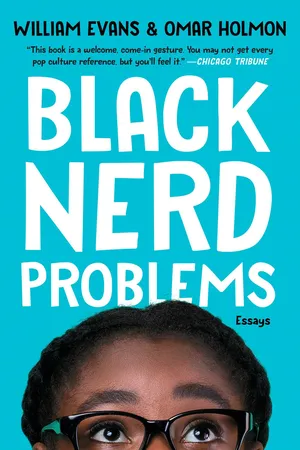
Black Nerd Problems
eBook - ePub

Black Nerd Problems

Essays

  1. 304 pages
  2. English
  3. ePUB (mobile friendly)
  4. Available on iOS & Android
eBook - ePub

Black Nerd Problems

Essays

About this book

The creators of the popular website Black Nerd Problems bring their witty and unflinching insight to this engaging collection of pop culture essays—on everything from Mario Kart to issues of representation—that "will fill you with joy and give you hope for the future of geek culture" (Ernest Cline, #1 New York Times bestselling author). When William Evans and Omar Holmon founded Black Nerd Problems, they had no idea whether anyone beyond their small circle of friends would be interested in their little corner of the internet. But soon after launching, they were surprised to find out that there was a wide community of people who hungered for fresh perspectives on all things nerdy.In the years since, Evans and Holmon have built a large, dedicated fanbase eager for their brand of cultural critiques, whether in the form of a laugh-out-loud, raucous Game of Thrones episode recap or an eloquent essay on dealing with grief through stand-up comedy. Now, they are ready to take the next step with this vibrant and hilarious essay collection, which covers everything from X-Men to Breonna Taylor with "alternately hilarious, thought-provoking, and passionate" ( School Library Journal ) insight and intelligence.A much needed and fresh pop culture critique from the perspective of people of color, "this hugely entertaining, eminently thoughtful collection is a master class in how powerful—and fun—cultural criticism can be" ( Publishers Weekly, starred review).

Frequently asked questions

Yes, you can cancel anytime from the Subscription tab in your account settings on the Perlego website. Your subscription will stay active until the end of your current billing period. Learn how to cancel your subscription.
No, books cannot be downloaded as external files, such as PDFs, for use outside of Perlego. However, you can download books within the Perlego app for offline reading on mobile or tablet. Learn more here.
Perlego offers two plans: Essential and Complete
  • Essential is ideal for learners and professionals who enjoy exploring a wide range of subjects. Access the Essential Library with 800,000+ trusted titles and best-sellers across business, personal growth, and the humanities. Includes unlimited reading time and Standard Read Aloud voice.
  • Complete: Perfect for advanced learners and researchers needing full, unrestricted access. Unlock 1.4M+ books across hundreds of subjects, including academic and specialized titles. The Complete Plan also includes advanced features like Premium Read Aloud and Research Assistant.
Both plans are available with monthly, semester, or annual billing cycles.
We are an online textbook subscription service, where you can get access to an entire online library for less than the price of a single book per month. With over 1 million books across 1000+ topics, we’ve got you covered! Learn more here.
Look out for the read-aloud symbol on your next book to see if you can listen to it. The read-aloud tool reads text aloud for you, highlighting the text as it is being read. You can pause it, speed it up and slow it down. Learn more here.
Yes! You can use the Perlego app on both iOS or Android devices to read anytime, anywhere — even offline. Perfect for commutes or when you’re on the go.
Please note we cannot support devices running on iOS 13 and Android 7 or earlier. Learn more about using the app.
Yes, you can access Black Nerd Problems by William Evans,Omar Holmon in PDF and/or ePUB format, as well as other popular books in Social Sciences & Social Science Biographies. We have over one million books available in our catalogue for you to explore.

The Disney Two-Step

WILLIAM EVANS, aka Tiana’s Security Detail
THERE’S A SCENE early on in The Departed when Dignam (Mark Wahlberg) is interrogating Billy (Leonardo DiCaprio) in the hopes of convincing him to be an undercover agent. The scene intensifies when Dignam begins to press Billy’s background and the duality of his personality: ā€œYou were kind of a double kid, I bet, right?ā€ ā€œYou have different accents?ā€ He was exposing the vulnerability of Billy’s accommodating identity. Trapped in two worlds, Billy assimilated, sometimes on a weekly basis, to the crowd he serviced in hopes of fitting in or not facing ridicule.
I think about this a lot when it comes to how diversity works in the media and political space. Because the demands and desires of diversity have grown louder at about every level of human interaction, many institutions feel they are caught between wanting to be more progressive in their representation and opportunity while not pissing off their core base and support too much. And by core base and support, I mean white people. There is forever an attempt to appease one group and not piss off the other, whether we’re talking left-leaning politics or network programming.
There is perhaps no bigger entity that has mastered this half-in, half-out two-step than Disney. Well, rewind, perhaps there is no bigger entity than Disney. Full stop. And maybe resources, practice, and some mystical charm strung around the statue of Mr. Disney himself have contributed to how it is more versed at it than anyone else. Perhaps it was the easiest target first. While Disney now is all things to all people, the most common association that populates someone’s mind when Disney is mentioned is either the mouse or the princesses. And for a while, the princesses weren’t great. Outside of the very real and valid feminist critique of what the princesses used to be, which were bystanders in their own stories, they were mostly white. And if they weren’t, well, I mean, Pocahontas shouldn’t exist as a Disney entity and there’s not much more to argue on that.
Now, Disney has produced more diverse characters than just about anyone. The landscape is full of women of color doing amazing and active things. Ruling kingdoms, solving crimes, opening a restaurant with the best gumbo in New Orleans. It has been an amazing thing to watch, from my youthful years where Snow White looked like Black people might startle her to seeing Moana dodge arrows and swing to her escape from a pirate ship. But I guess my question is, what exactly is Moana?
Well, she’s Polynesian, I think that’s one of our few exacts. Though that itself is not a definite, as Polynesian is such a catchall for the many different cultures, dialects, and traditions of many people. The film is set in Samoa, but is kind of portrayed as Hawaii for American audiences? Maui in the film is a demigod who is huge and bullish and a buffoon in many ways. But he’s based on or at least named for the actual Maui from Polynesian culture, a thin teenager on his journey to adulthood. Not to mention the erasure of Hina, the companion goddess of Maui, who never appears in the film. I mean, we already have one heroine here so… see you on the other side of the ocean, I guess?
The mixing and ambiguity of marginalized characters and cultures in Disney films is not a bug. It’s a feature. It’s a calculated risk of building bridges into cultures but never venturing too deep to ensure (white) American audiences will walk the length of it. If I can show you a sanitized culture with some hallmarks that seem cool and exotic without committing you, the viewer, to investing in it, I can check the box on diversity and not turn disinterested white folks away. Maybe the starkest example of this is the Aladdin live-action movie, where we revisit a fictional Muslim city where our hero goes from street rat to sultan. The animated Aladdin, a thrill ride, was released in 1992 in a much less connected world where ridicule and concerns rarely interrupted big business in real time. Specifics to Islamic culture were nonexistent in ’92, but their erasure was more stark in 2019, when there was much more pressure to get cross-cultural experiences right. But I can’t imagine the anxiety of trying to replicate one of the most known Disney properties that occurs in the Middle East in an increasingly hostile Islamophobic climate. Well, you just erase any association with Islam or Muslim identities from the film. You get close-enough casting. You call turbans ā€œhats.ā€ You work in some spitting camels and monkeys hopping through the streets and hope people forget the significance of where the story takes place. And I guess, if you’re willing to do that, then maybe you didn’t have much anxiety about it to begin with. So, never mind.
As Disney is much bigger than just multimillion-dollar movies, this philosophy is existent in much of its outreach—i.e., cross-cultural projects. Princess Elena is definitely Latina but most definitely not any specific culture. The Indian detective Mira’s city aesthetics and holidays borrow from many specific Indian cultures that don’t intersect. And yes, Disney spends what I’m sure is some minor king’s ransom for consultation on these projects where they are close enough to appeasement and haven’t ventured far enough away from the status quo. But it raises the question of how long will we continue to have consultants informing white filmmakers and showrunners instead of employing creators who are versed at making movies and TV shows and also have a strong familiarity with the source? Which, ya know, maybe that’s the next generation of Disney, in another twenty years or so. But the intent is rarely a fully realized effort, and it’s hard to divorce the model of using marginalized experts with proximity to the story that white creators want to tell from that.
As much as some would scapegoat marginalized people wanting the media they consume to be more representative and forcing Disney’s hand in submitting to that, it’s about the choices that Disney has decided to make. I think about how Frozen 2 was the big animated tent-pole movie for Disney in its release year, and I was curious if it would do anything to answer the fact that people of color didn’t exist in the first movie. Well, Frozen 2 rectified that in ways that I’d generously label as nefarious. Outside of the fact that Arendelle apparently relaxed its immigration laws because Brown folks could now be seen walking the streets, the way the othered people are seen is used as a bigger issue. In the movie, the Northuldra tribe is basically its stand-in for a fictional Indigenous tribe. It is revealed that the conflict between Arendelle and the Northuldra had been a false narrative given to Elsa and Anna—an opportunity to be a commentary on how we struggle with past tragedies toward a group of people. When we realize that Anna and Elsa’s grandfather was the villain, the agitator who tried to conquer the Northuldra, there is a very clear moment where the princesses could’ve tried to reckon with their family history. One where they were not responsible for the fallout, but also had been given—and believed—false tales of its origins.
At this point, we’ve been given a movie and a half to know that Anna and Elsa are good people. We know they are flawed but kindhearted women. They pursue what is right and just with generosity and empathy. This is a classic ā€œsins of the father with a chance at redeeming the family by doing the right thingā€ scenario. But Frozen 2 doesn’t do that. Instead, it builds in a way to make the princesses blood related to the tribe through their mother. Which has two immediate effects: First, it allows for a quick reconciliation of the aggrieved Northuldra to instantly forgive and now trust the rulers of a kingdom responsible for its oppression. In the movie it happens in seconds, so fast I had whiplash while seated in the theater as my eight-year-old appropriately asked me what just happened. I had few answers. It was the true wish fulfillment of those that say shit like, ā€œI don’t know why you’re still mad about slavery,ā€ or even those ā€œthe only race I believe in is the human raceā€ bastards.
The second issue is the investment factor. Frozen 2 doesn’t make (let’s just call a non-spade a non-spade) white people reckon with their family lineage and what trauma their ancestors caused upon another people. It makes the investment partial to the personal stakes of the white folks involved. By making the princesses some de facto descendants of the Northuldra tribe, now the tribe’s struggle is the princesses’ struggle as well. The action to right those wrongs comes from there and not because it would’ve been the human thing to do in the first place. This tactic is tried and true and problematic as all hell. It is the politician that doesn’t support gay rights until their son comes out. It’s the white executive that speaks with authority of their role in society by positing their adopted, marginalized children. Frozen 2 is the animated version of what fighting the good fight for big business looks like now. We can reckon with systemic and colonizing actions against the oppressed. But only as long as we make it the struggle of the beneficiaries too. And oh yeah, Anna and Elsa are biracial, I guess. I think about this all the time now.
And if Anna and Elsa are biracial now, what is Tiana from The Princess and the Frog? Single race, multispecies? For all my love of Tiana’s characterization and my lightweight unhealthy adoration of Anika Noni Rose, it’s impossible to not see that The Princess and the Frog started a thing where Black voice actors are cast for Black-human-identified characters in movies where the character is only a Black human for part of the time. The math is simple here. You’ve got the big Disney princesses that preceded Tiana like Cinderella, Snow White, Pocahontas, Princess Aurora, Hua Mulan, Ariel… Tiana was the first Black Disney princess and the first one to get turned into some shit that wasn’t a person. Hell, Ariel became MORE human. Where can a sista sign up to become MORE human as her plot point? Now, if you give me a story of a woman in New Orleans wanting to open up her own soul food spot, who also happens to get transformed into a frog, yes, I’d rather her be Black.
The fact that Tiana is turned into a frog isn’t necessarily the problem. This is my [Game of Thrones spoiler warning incoming…………] Missandei dying theory. Folks were mad when Missandei got merked and tossed off of a castle wall. And yes, it was upsetting because Missandei was a great character. But yo, you missed me with the actual problem. The situation wasn’t that a Black woman got killed on Game of Thrones. The whole brutal point of the show was that no one was particularly precious and that fairy-tale narratives were subverted and often dismantled. The problem was that Missandei was the only Black woman of note on the show. And so when she dies, you now have zero.
With Disney, Tiana being a frog most of the movie is made more significant because there are now zero Black princesses who get to be Black women for the majority of the movie. The solution isn’t necessarily for The Princess and the Frog to not exist but for there to be more Disney movies with Black princesses. Now because of Disney’s influence, this has become a thing. Take a movie like Spies in Disguise, where Will Smith is an ultra-cool Black 007-type with way more charisma, but the catch of the film is that he’s a damn bird for most of it. And then, you have a movie like Soul. I don’t really know where to begin with Soul, but for the uninitiated, here’s the pitch: Joe (Jamie Foxx), a Black high school music teacher whose dream it is to play his own gigs as opposed to teaching uninspired kids how to hold a trombone, gets his big break. In the process of celebrating his first big gig, he falls into a manhole, uncovered as they frequently are. And then poof, Joe is dead (or as we learn later, he’s in a coma). But his soul is moving toward the ā€œGreat Beyondā€ nonetheless. Joe freaks out because it isn’t his time yet and finds himself mentoring a very reluctant soul in the ā€œGreat Beforeā€ named ā€œ22ā€ (Tina Fey). Eventually hijinks ensue that land both Joe and 22 on Earth. Except 22’s soul is in Joe’s body and Joe’s soul is in… a cat. Through this misadventure they both come to understand living life for the moment, what their true spark is, and how to repair relationships with themselves and others.
Listen, Pixar has a formula. They know how to circle the human heart and often in the last act devour it like sharks. We are almost helpless to their very well-structured emotional manipulation. They aren’t making bad movies. And Soul isn’t a bad movie. But the weight that Soul tries to carry seems too heavy for the folks that created it, specifically when dealing with the pronounced Black elements of the movie. It’s important to know at least one very big preproduction note about the film: Joe, when the film was conceived, wasn’t originally Black. Who knows how much of this story was constructed with a white protagonist in mind before this change, but here’s the exercise you can do to articulate how much that matters. Was White Joe (sorry, that’s the best code name I got) a musician too? Was he even a teacher? What was in place of the barbershop scene? (I don’t think any of us can see White Joe going into a Sport Clips during this movie.) What was White Joe’s conflict with his mother? Was his father still alive? Yes, these are loaded-ass questions, but it makes it easy to see the ā€œBlack checklistā€ in Soul. Depending on how generous you are, they either make the Black aesthetics in Soul feel authentic or well within the realm of stereotypes. There are scenes where the possible copy and pasting feels prevalent in the film. Take Paul, a very brief antagonist of Joe, who makes fun of Joe and tries to crush his dreams at every interval. The comeuppance for Paul happens later in the film. Terry, the record keeper from the Great Beyond, who is obsessed with finding and retrieving Joe (pardon the slave-catcher vibes, but I didn’t write the movie, yo), finds Paul and briefly pulls Paul’s soul out of his body because she believes that Paul is Joe. Yes, somehow, the record keeper for millions and millions of souls who have passed on mistook one Black man for another. In a movie where Paul is white and this is just ā€œthe bully getting scared straightā€ this probably goes off as a typical gag. But when you have so many examples of unprovoked violence placed on Black people, which includes, way too often, mistaken identity, this joke isn’t hitting the same.
Perhaps the most damning thing about Soul though? Probably the gentrification of Joe’s life by 22. We’ve seen movies before where people switch roles, or in this case switch bodies, and through experiencing a differing perspective help solve each other’s problems. The problem is, the culture divide between Joe and the aesthetic we attach to 22 (a middled-aged white woman) isn’t simply different perspectives. It implies that a simple tell-it-like-it-is approach would solve Joe’s problems. Whether it’s his relationship with his mom. His bully. His career choice. It flattens the complexities that occur in these Black relationships and treats them like they operate in a bubble. When 22 stands up to Joe’s Bully (Paul) in the barbershop it assumes the anxiety from Joe is just a product of a typical antagonist relationship. It erases the factors of Black masculinity and the tightrope that Black men walk in their efforts to be accepted within their community and not seem threatening outside of it. When 22 helps facilitate Joe repairing his relationship with his mom, it is spawned by 22 being abrupt and speaking out of turn to his mom. It plays like a very typical parents-not-supporting-my-dreams conversation. But there is an erasure here of the weightiness of Joe’s mom being a Black widow and a business owner in the city. Of wanting her Black son to have easy-to-see hallmarks of success because his father did not. This shouldn’t be as generic a moment as it is, but the revelation is flat. Both of these examples carry the pathology that Joe has just made these situations too complicated to untangle. And that it really just takes this witty and naive middle-aged white woman to solve his problems. Problems that we assume came from years of friction during Joe’s life, she solves in about five minutes of total screen time. And ya know, that’s cute. I’m sure there are plenty of people that responded well to that. ā€œJoe was just in his own way, he just never stood up for himself and thank god 22 showed him the way.ā€ But there’s a lot of historical context missing in those moments. For example, we don’t get to see why Joe’s mother would be apprehensive about Joe pursuing a music career. It assumes she’s just like every other parent who has a pragmatic approach for their children. But there’s a story that feels particularly unique to this Black woman who has owned her own business for decades, now seeing her departed husband’s face when she looks at her son. Her son, she believes, is underachieving. And if we don’t have the screen time to tell that story, we should at least feel the weight of it. Maybe not have the mouthy never-been-a-real-person-before character break down her concerns so easily. That feels reductive, to say the least. And at one point, 22 steals Joe’s body. And when the smoke clears, Joe ends up apologizing for his behavior. Which is after he saves 22’s soul. I mean, we got Black abduction. Magical Negro stuff in the last act… It’s a lot, fam. It’s a whole, Black, lot.
Movies like Spies in Disguise and Soul can be enjoyable films. But it’s a weird way to go with the pressing want and need of diversity to promote these marginalized characters in the name of representation just for them to transform into a thing not representative of the community you’re wanting to appeal to.
Maybe it’s generous, but I still think these blunders or oversights are more neglect based than malicious. The Mulan movie debacle feels different though. I think about all the press of Mulan being this big tent-pole achievement. About how they weren’t going to disrespect China and its folklore this time. How the location and the actors involved proved that they were taking this seriously. And yes, the actors were sort of representative of what Mulan should look like. But behind the camera it was the complete opposite. The tone changes from that tone of ā€œwe’re doing the right thing this timeā€ when you see it for what it was: white people telling someone else’s story in a location exotic to them. This was far from the only problem with Mulan from a cultural perspective, including things Disney couldn’t really control like the lead actress being a fierce defender of the Chinese state and its violence against protestors in Hong Kong. But then there’s the Xinjiang thing. And to be more acute, the filming in Georgia thing.
I couldn’t give a damn about what outrages Republican senators have these days… or the length of my personal existence… but Disney made a big show about the possibility of no longer filming in Georgia over an abortion heartbeat bill. And ya know what, this ain’t that essay, but big business taking a stand on ā€œsomethingā€ that people feel is a worthy social fight? I’m not mad at that, not even a little bit. Butttttt when that same big-ass company decides to film in Xinjiang, which has been a specific region where China has been committing human rights abuses to Uighur Muslims for years, it does make a brotha tilt his head and say, ā€œHow, Sway?ā€ What is this supposed to mean? Was it merely an oversight? Was the Georgia thing virtue signaling for progressives in the U.S., thinking no one would notice or care about these issues outside of our borders? Is this some Muslim-hating, self-described liberal Bill Maher shit?! It’s pretty confusing, if you’re not cynical. I am cynical. It just feels like some bullshit to me.
When I say that there are people at Disney that care about diversifying its media, that’s not to be flippant and assuming. I’ve had the privilege to meet a great deal of people working with the Mouse who take these things seriously and do all they can to make a more equitable entertainment complex for the widest range of people. But there’s a limit to the power folks have if they aren’t making the biggest decisions as far as movie scripts and casting calls. And at the end of the day, Disney didn’t become Disney because it didn’t want to maximize profit. TV shows and movies with marginalized figures as the focal point may be an untapped resource, but that still isn’t bigger than predominantly white au...

Table of contents

  1. Cover
  2. Title Page
  3. Dedication
  4. Intro: From the Top
  5. Re-Definition: Nerd Isn’t a Person, It’s a Spectrum
  6. It’s Time We Stop Pretending That Simba Wasn’t Garbage in ā€œThe Lion Kingā€
  7. Raising the Avatar: No One Woman of Color Should Have All Them Haters
  8. You Can’t Win When Escapism Won’t Let You Escape
  9. ā€œInto the Spider-Verseā€ Got Three Moments Better Than the Best Moment of Your Favorite Comic Book Movie Not Named ā€œInto the Spider-Verseā€
  10. I Hate It Here: ā€œFood Warsā€ Would Be the Most Annoying Anime to Live In
  11. Y’all Gotta Chill with the Slander and Let Batman Cook
  12. What Happens to a New Fictional Black Character Deferred?
  13. Two Dope Boys and a Comic Book: The Superhero Fade Heard Round the Multiverse
  14. My Theory on How Black Folks’ Black Card Actually Works
  15. Top Five Dead or Alive: Tai Lung (ā€œKung Fu Pandaā€)
  16. ā€œGreen Lanternā€ Comics Have Low-Key Been Tackling Police Accountability for a Minute
  17. The 2000s and 2010s Golden Era of TV Gave Us a Lot of Great Television and Made Me So Damn Tired
  18. ā€œCraig of the Creekā€: When We See Us
  19. The Disney Two-Step
  20. Y’all Mind if I Wyl Out over Black Love and POC Love Real Quick?
  21. Whenever I Watch ā€œUnderworldā€, I Feel Like Kate Beckinsale Wants to Break Up with Me
  22. An Open Letter to Gohan: You Gonna Stop Being Trash Anytime Soon or Nah?
  23. The Want to Protect Taraji’s ā€œProud Maryā€, Critiquing the Choir, and How We Judge Black Art
  24. For Dark Girls Who Never Get Asked to Play Storm
  25. How My Black Ass Would Survive Every Horror Movie
  26. Jordan Peele Should Get His Flowers while He’s Here
  27. Top Five Dead or Alive: Red Hood in the DC Animated Universe
  28. If My Black Ass Was Enrolled in the X-Men’s School, Charles Xavier Would Have Been Fed Up
  29. ā€œGo Onā€: An Evergreen Comedic Series That Helped Me Navigate Loss
  30. The Sobering Reality of Actual Black Nerd Problems
  31. Bury the Stringer Bell but Let Idris Live
  32. An Open Letter to the Starks: Y’all Should’ve Taken Better Care of Your Direwolves
  33. ā€œHaikyuu!!ā€ Roughly Translated Means ā€œBall Is Lifeā€
  34. I Read Mark Millar’s ā€œJupiter’s Legacyā€ and I Saw the Father I Am and the Father I Hope I Never Have to Be
  35. ā€œHajime no Ippoā€ Is Just a Manga about Boxing but I’m Over Here Crying My Guts Out
  36. Do You Have a Moment to Talk About Our Lord and Savior Aloy from ā€œHorizon Zero Dawn’?
  37. Two Dope Boys and Movin’ Weight with Pusha T’s ā€œDaytonaā€
  38. Killing Floor: Navigating Real-World Gun Violence as a Hardcore Gamer
  39. ā€œHamiltonā€ and the Case of Historical Fanfics
  40. Graduating to the Grown Folks’ Table: I Finally Learned How to Play Spades
  41. Two Dope Boys and an— Oh My God, the Flash Got Fucked Up!
  42. Black Nerd Crush Blues: Myra Monkhouse Deserved Way Better
  43. The Push and Pull of Watching ā€œMad Men’ while Black
  44. ā€œMario Kartā€ Reveals Who You Truly Are
  45. Top Five Dead or Alive: Monica Rambeau (Marvel Comics)
  46. On Hope, Escapism, and Attrition Discussed Between Black Men
  47. Two Dope Boys and a Comic Book: ā€œHouse of Xā€
  48. ā€œBlade IIā€ Still Has the Most Disrespectful Superhero Fades My Black Ass Has Ever Seen
  49. Chadwick Boseman’s Wakanda Salute Is Canon in the History of Black Language
  50. Outro
  51. Acknowledgments
  52. About the Authors
  53. Copyright