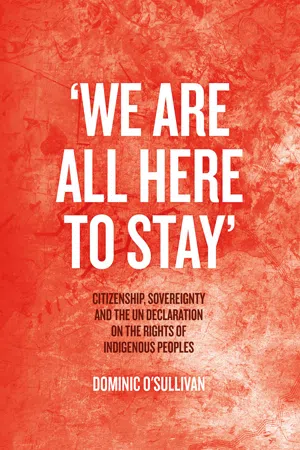
'We Are All Here to Stay'
Citizenship, Sovereignty and the UN Declaration on the Rights of Indigenous Peoples
- 270 pages
- English
- PDF
- Available on iOS & Android
'We Are All Here to Stay'
Citizenship, Sovereignty and the UN Declaration on the Rights of Indigenous Peoples
About this book
In 2007, 144 UN member states voted to adopt a Declaration on the Rights of Indigenous Peoples. Australia, Canada, New Zealand and the US were the only members to vote against it. Each eventually changed its position. This book explains why and examines what the Declaration could mean for sovereignty, citizenship and democracy in liberal societies such as these. It takes Canadian Chief Justice Lamer's remark that 'we are all here to stay' to mean that indigenous peoples are 'here to stay' as indigenous.
The book examines indigenous and state critiques of the Declaration but argues that, ultimately, it is an instrument of significant transformative potential showing how state sovereignty need not be a power that is exercised over and above indigenous peoples. Nor is it reasonably a power that displaces indigenous nations' authority over their own affairs. The Declaration shows how and why, and this book argues that in doing so, it supports more inclusive ways of thinking about how citizenship and democracy may work better. The book draws on the Declaration to imagine what non-colonial political relationships could look like in liberal societies.
Frequently asked questions
- Essential is ideal for learners and professionals who enjoy exploring a wide range of subjects. Access the Essential Library with 800,000+ trusted titles and best-sellers across business, personal growth, and the humanities. Includes unlimited reading time and Standard Read Aloud voice.
- Complete: Perfect for advanced learners and researchers needing full, unrestricted access. Unlock 1.4M+ books across hundreds of subjects, including academic and specialized titles. The Complete Plan also includes advanced features like Premium Read Aloud and Research Assistant.
Please note we cannot support devices running on iOS 13 and Android 7 or earlier. Learn more about using the app.
Information
Table of contents
- List of Abbreviations
- Acknowledgements
- Introduction
- 1. The Declaration on the Rights of Indigenous Peoples
- 2. Reconciliation, Trust and Liberal Inclusion
- 3. The Declaration and the Postsettler Liberal State: Perspectives from Australia, New Zealand, Canada and the United States
- 4. Plurality, Human Rights and Whatās Wrong with Liberal Inclusion?
- 5. Self-Determinationāthe Power and the Practice
- 6. The Declaration in Comparative Context
- 7. Sovereignty
- 8. Difference, Deliberation and Reason
- 9. Differentiated Citizenship: A Liberal Politics of Potential
- Conclusion
- References