1
Introduction
Christopher Allen
Art in the Australian continent has two very different stories, which have become intertwined in recent times, but can never be reduced to a single narrative. The first of these, of course, is the story of the art produced by the original inhabitants of the land, who came here tens of thousands of years before the Neolithic Revolution and the beginning of urban life in the northern hemisphere, and whose way of life seems to have remained remarkably stable, all but untouched by the history of the rest of humanity, until the beginning of British settlement at the end of the eighteenth century. First contact with the Europeans, in fact, was much earlier, at the beginning of the seventeenth, but this encounter and others that followed had virtually no effect on the lives of the Aborigines until the colony of Sydney was established in 1788.
Aboriginal art before settlement is a complex and specialized subject, the study of archaeologists and anthropologists, who work with necessarily limited resources, since the indigenous people left no architecture and had no writing; their cultural artefacts were almost all perishable and discarded after their use in ceremonies, and the earliest samples of such material that we possess today were collected by explorers and missionaries from the late eighteenth century onwards. The most significant permanent monuments of past Aboriginal culture are in remarkable sets of cave paintings and stone engravings, but their significance is not always clear today. Traditional culture was entirely oral, and such a culture requires a constant line of transmission: when people are displaced from their ancestral lands and lose their local languages, such transmission is inevitably compromised.
The study of the ancient culture of the Aboriginal people, including their beliefs, their art and their languages, represents therefore a vast field, or a series of fields of research, but it is not the subject of this book. The Aborigines are constantly present to varying degrees in the art and the consciousness of European Australians throughout the history of modern Australia, and so appear in many of the chapters of this book. Aboriginal artists appear in the story too, as they begin to take part in the European practice of art. And an outstanding chapter by Philip Jones deals with the emergence of a new Aboriginal art and its embrace by the art market in the last decades of the twentieth century.
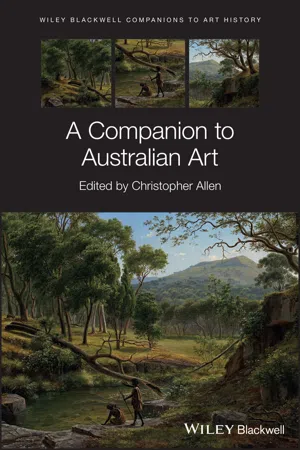
The second story, which is the main focus of this book, is that of the European settlers in Australia which, if we start with the art of Captain Cook’s voyages, is now some 250 years old. This story is, from one point of view, and like all colonial art histories, that of a branch of a much older tradition, or perhaps a better metaphor is a cutting transplanted and finding its own growth and development in a new soil. This image gives a better sense of the level of adaptation to the new environment, sometimes underestimated by careless observers who see only the rehearsal of imported customs and habits of seeing.
Nonetheless, if we compare what was achieved here with the great movements of Neo-classicism, Romanticism, Realism, Impressionism and the various phases of modernism that succeeded each other during the same two and a half centuries, Australian art will inevitably look like a very small corner of art history. Like all colonial traditions, it suffers from the asymmetry of center and periphery: the inhabitants of the periphery cannot understand themselves or their own history without reference to the metropolitan center from which they originated, while those of the center have no such reciprocal need to understand the colonial periphery.
At least so it seems, and even for American art, which has no real incidence on international art history until America, or New York at least, became part of the center with the postwar explosion of Abstract Expressionism. On the face of it, regional art is primarily of interest to the inhabitants of the region in question. And yet many such regional traditions, including that of Australia, have been extensively written about, especially in the last half-century, with the growth of an academic industry that demands the constant production of discussion, commentary and speculation that is called research in the humanities, even if it frequently adds little of substance to our knowledge of its subject.
Looking at the field of Australian art and at the vast amount of writing surveyed in Molly Duggins’ impressive bibliographic study in this volume, an outsider could be tempted to conclude that this was a rather modest subject crushed by a disproportionate weight of discourse, much of it dull and much ideological, too often engaging in ultimately sterile discussion with other regional academics rather than addressing a broader public of cultivated lay people, the ultimate audience for the art itself. And there would be some truth in this perception: writing about art in Australia reflects the general problems of humanities scholarship in universities today, burdened on the one hand by the ineffectual ideologies of a post-political age and on the other by the mechanical imperatives of production.
This book sets out to avoid, as much as possible, the futility of ingrown academic discussion, and is put together with the aim of helping the intelligent non-specialist reader understand and enjoy the art of Australia. It has no intention of preaching or of attempting to impose any ideological reading of our history. It seeks to present a clear and unbiased account of events from the time of settlement and trusts that readers will be able to draw their own moral and other conclusions. The book’s aim, in other words, is to make the art of Australia more accessible to its readers, including through an awareness of the historical circumstances of its production, but never losing sight of the role of art as an organon of knowledge and consciousness.
For art, in all its manifestations, is not simply a set of artefacts, of material deposits left behind by historical processes; it is a way of thinking that long predates rational thought and self-conscious, theoretical reflection. These tools of the human mind are only some two and half millennia old, dating from the first beginnings of philosophical and theological thinking; literacy itself is only twice as old as that, and alphabetic writing, which immensely amplified the power and range of literacy, is much more recent, only five centuries or so older than the beginnings of philosophy. But for thousands of years before literacy and the rise of rational thinking, art in its various forms, as stories, songs and pictures, was a vehicle for the human mind to represent the world to itself and assign meaning and shape to it.
And because the questions that concern human beings are much more obscure and subtle than can be fully dealt with by rational discourse, art was not made obsolete by the rise of philosophy and later of science. It has continued to be a way of thinking about qualities of experience that are not amenable to logical analysis: an intuitive mode of thinking that is deeply rooted in the beliefs, assumptions and aspirations that make up its ambient culture – as well as the collective memory of its community.
Some art has the power to transcend its specific circumstances, to become foundational to its whole culture and to successive centuries or even millennia, and even to reach beyond the boundaries of its original cultural universe and to impress itself on the minds of people raised in different circumstances. By far the greatest proportion of artistic practice in any form or at any time is much less significant. Even most art of relatively high quality remains more or less bound to its time and place, so that it becomes of interest and even accessible only to those who take the trouble to become acquainted with the culture in which it originated.
Regional or colonial art is a particularly interesting case. Typically, and with occasional exceptions, especially as the colonial societies mature, they are influenced by the center, while, as already noted, the metropolitan center is barely influenced by its colonial offshoots. And this appears at first sight to be true of Australia as well. Few Australian artists have had any influence on the mainstream of art in the last two centuries; some have made reasonable careers abroad or even been appreciated for their distinctive vision, as was the case with Sidney Nolan, Russell Drysdale and Arthur Boyd in the postwar years. But none has made any perceptible difference to the course of western art.
However we may be inclined to temper such a brutal assessment, it is a useful starting-point, mainly in order to be quite clear that the interest of Australian art has nothing to do with its significance or influence outside this country. Its primary value, especially in the first century or more, lies in the way that it speaks of the experience of settlement in a new and strange land. Then the experience that it articulates becomes more complex, pondering the relative importance of local culture and belonging to an international world of modernism; but even in the last half-century, a wider reflection on the evolving ethnic composition of our population and a greater awareness of the prior occupation and the current plight of the Aboriginal people have constantly brought us back to the dialogue of a colonial, if increasingly cosmopolitan society with the land in which it has established itself.
When I first wrote about Australian art over 20 years ago, I was struck by the many fallacies about the subject, and in subsequent years of lecturing, I was astonished to find that these fallacies were extremely hard to weed out, even when I had explicitly refuted them in the course of teaching. One of these was the habit of seeing every style or movement in Australian art as a late and pale copy of something done earlier in the metropolitan center. This was probably a habit of mind born in the postwar years, especially the 1960s and 1970s, when for a time Australian artists became neurotically obsessed with imitating the art fashions of New York. But such imitation was not at all the rule in the first century and half of Australian art.
The second and even more stubborn fallacy was that the colonial artists who came to Australia throughout the nineteenth century brought with them inflexible routines of seeing and painting the world, and lazily repeated these in the new continent, with the result that they could not see what our country was really like. It was not until the Heidelberg School painters, Tom Roberts, Arthur Streeton, Frederick McCubbin and others, that Australian artists finally opened their eyes and saw the brightness of the light and the distinctive forms of the eucalyptus trees. This was clearly the view of the Heidelberg painters themselves, who only recognized Abram Louis Buvelot as a true precursor, and when they were subsequently canonized as the founders of the Australian school, the insignificance of the work of those who had come before them became axiomatic.
The demolition of this second fallacy has been a long and slow process, and although it has probably by now been recognized by Australian art historians and anyone seriously interested in the ...