eBook - ePub
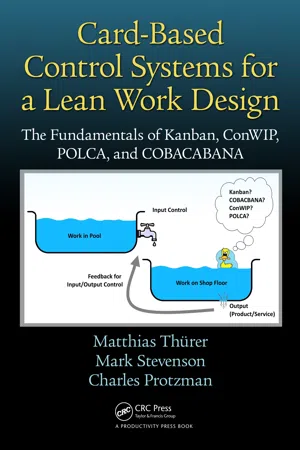
Card-Based Control Systems for a Lean Work Design
The Fundamentals of Kanban, ConWIP, POLCA, and COBACABANA
- 219 pages
- English
- ePUB (mobile friendly)
- Available on iOS & Android
eBook - ePub
Card-Based Control Systems for a Lean Work Design
The Fundamentals of Kanban, ConWIP, POLCA, and COBACABANA
About this book
Many shops have simplified their production control by using card-based systems such as kanban and Constant Work-in-Process (ConWIP). Although these systems provide a simple and highly effective visual approach for controlling manufacturing and service operations, all too many shops struggle with failed implementations or achieve results that fall
Information
Publisher
Productivity PressYear
2017Print ISBN
9781498746946
9781138437906
Edition
1eBook ISBN
9781498788342
Chapter 1
Basic Concepts
Highlights
- We outline how we conceptualize a production/service system and the business operations/processes executed.
- We outline what a card-based control system does.
- We outline what a card-based control system does not do.
- We make some important points concerning why you should choose a card-based control system rather than the latest technology.
This book promises to be different. Earlier books have typically focused on one particular card-based control system before presenting environments where it is argued that they provide the best solution. This creates the approach of putting the solution ahead of determining the problem.
In contrast, we first discuss how to diagnose a problem and then discuss a range of possible solutions from which to choose. This seems more logical, but it is a much more complicated task, since we cannot start directly by presenting a well-defined solution. Rather, we first have to build the foundations for diagnosing the problem that your shop is faced with; and we must do this for a problem that we all know is quite complex:
The coordination of product/service flows through a set of capacity resources, in your shop, that transform materials, people, information, etc., into final products/services.
From here on in, we call this “the control problem.” This control problem is complex since resources are typically scarce and/or constrained; and because different product/service flows often compete for the same resources.
Before starting any diagnosis, we must take a step back and introduce some basic concepts. We first need to understand how a production/service system can be described. This then clarifies the role that card-based control systems can and cannot play in supporting such a system. It is also important that we use the same concepts throughout the book to provide the required clarity. You may find this somewhat technical, but bear with us. We will use a lot of “timeouts” to give you some breathing space, some time to conceptualize things and perhaps to relate them to your own shop.
You may agree or disagree with our conceptual definitions. That is fine. There is no “true” conceptualization of a production/service system. But what is important is that you understand how we define and use the concepts in this book. Only this will make our suggestions on how to diagnose a control problem (and consequently use the most suitable control solution) clear. But let’s just start.
What Is a Production/Service System?
We start by looking at the different parts that constitute a production/service system. We will first approach this from the perspective of the product/service. Thus, we describe a production/service system in terms of its product/service flows. In doing so, it is common practice to start with the input to a product/service flow. But we arbitrarily turn this around and start with the most important aspect—the customer. So let’s define the first five concepts that will be used in this book to describe a product/service flow.
The Customer
One of the primary objectives of any company is to make money. Environmental and social responsibility is also important, but firms also do not need to be ashamed of the desire to be profitable. To make money—someone has to be willing to pay for something. The “someone” is the customer. The “something” is the product/service. Even though we say someone is willing to pay, sometimes no real payment takes place; for instance, if we refer to an internal customer belonging to the same company, department, operation, etc.
The Product/Service
The output is the product/service or range of products/services that you sell. If you don’t sell the product, it has to be scrapped; if you don’t sell the service, you waste your time (and time is m...
Table of contents
- Preface
- Acknowledgments
- Authors
- Chapter 1: Basic Concepts
- Chapter 2: Basic Principles Underpinning a Card-Based Control System
- Chapter 3: Simplified Scheduling through Pool Sequencing and a Shop Floor Dispatching Rule
- Chapter 4: How to Diagnose a Control Problem?
- Chapter 5: The Inventory Control Problem: Kanban Systems
- Chapter 6: The Low Variability Order Control Problem: ConWIP
- Chapter 7: Inventory Control Plus Material Requirements Planning for the Order Control Problem: POLCA
- Chapter 8: How to Solve the High Variety Order Control Problem: COBACABANA
- Chapter 9: COBACABANA’s Card-Based System for Delivery Time Estimation
- Chapter 10: Summary: Framework of Applicability
- References
- Appendix: Summary of Card-Based Systems
Trusted by 375,005 students
Access to over 1.5 million titles for a fair monthly price.
Study more efficiently using our study tools.
Frequently asked questions
Yes, you can cancel anytime from the Subscription tab in your account settings on the Perlego website. Your subscription will stay active until the end of your current billing period. Learn how to cancel your subscription
No, books cannot be downloaded as external files, such as PDFs, for use outside of Perlego. However, you can download books within the Perlego app for offline reading on mobile or tablet. Learn how to download books offline
Perlego offers two plans: Essential and Complete
- Essential is ideal for learners and professionals who enjoy exploring a wide range of subjects. Access the Essential Library with 800,000+ trusted titles and best-sellers across business, personal growth, and the humanities. Includes unlimited reading time and Standard Read Aloud voice.
- Complete: Perfect for advanced learners and researchers needing full, unrestricted access. Unlock 1.5M+ books across hundreds of subjects, including academic and specialized titles. The Complete Plan also includes advanced features like Premium Read Aloud and Research Assistant.
We are an online textbook subscription service, where you can get access to an entire online library for less than the price of a single book per month. With over 1.5 million books across 990+ topics, we’ve got you covered! Learn about our mission
Look out for the read-aloud symbol on your next book to see if you can listen to it. The read-aloud tool reads text aloud for you, highlighting the text as it is being read. You can pause it, speed it up and slow it down. Learn more about Read Aloud
Yes! You can use the Perlego app on both iOS and Android devices to read anytime, anywhere — even offline. Perfect for commutes or when you’re on the go.
Please note we cannot support devices running on iOS 13 and Android 7 or earlier. Learn more about using the app
Please note we cannot support devices running on iOS 13 and Android 7 or earlier. Learn more about using the app
Yes, you can access Card-Based Control Systems for a Lean Work Design by Matthias Thurer,Mark Stevenson,Charles Protzman in PDF and/or ePUB format, as well as other popular books in Business & Operations. We have over 1.5 million books available in our catalogue for you to explore.