eBook - PDF
Domestic Contradictions
Race and Gendered Citizenship from Reconstruction to Welfare Reform
- 249 pages
- English
- PDF
- Available on iOS & Android
eBook - PDF
Domestic Contradictions
Race and Gendered Citizenship from Reconstruction to Welfare Reform
About this book
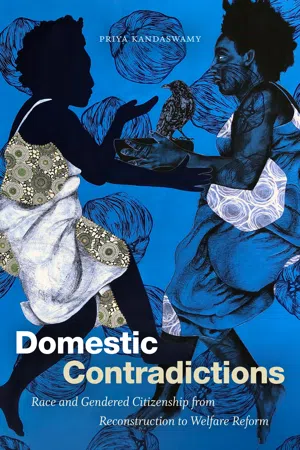
In Domestic Contradictions, Priya Kandaswamy analyzes how race, class, gender, and sexuality shaped welfare practices in the United States alongside the conflicting demands that this system imposed upon Black women. She turns to an often-neglected moment in welfare history, the advent of the Freedmen's Bureau during Reconstruction, and highlights important parallels with welfare reform in the late twentieth century. Kandaswamy demonstrates continuity between the figures of the "vagrant" and "welfare queen" in these time periods, both of which targeted Black women. These constructs upheld gendered constructions of domesticity while defining Black women's citizenship in terms of an obligation to work rather than a right to public resources. Pushing back against this history, Kandaswamy illustrates how the Black female body came to represent a series of interconnected dangers—to white citizenship, heteropatriarchy, and capitalist ideals of productivity —and how a desire to curb these threats drove state policy. In challenging dominant feminist historiographies, Kandaswamy builds on Black feminist and queer of color critiques to situate the gendered afterlife of slavery as central to the historical development of the welfare state.
Information
Publisher
Duke University Press BooksYear
2021Print ISBN
9781478014317
9781478013402
eBook ISBN
9781478021629
Table of contents
- Cover
- Contents
- Acknowledgments
- One. Welfare Reform and the Afterlife of Slavery
- Two. Making State, Making Family
- Three. Marriage and the Making of Gendered Citizenship
- Four. Domestic Labor and the Politics of Reform
- Five. The Chains of Welfare
- Conclusion
- Notes
- Bibliography
- Index
Trusted by 375,005 students
Access to over 1.5 million titles for a fair monthly price.
Study more efficiently using our study tools.
Frequently asked questions
Yes, you can cancel anytime from the Subscription tab in your account settings on the Perlego website. Your subscription will stay active until the end of your current billing period. Learn how to cancel your subscription
No, books cannot be downloaded as external files, such as PDFs, for use outside of Perlego. However, you can download books within the Perlego app for offline reading on mobile or tablet. Learn how to download books offline
We are an online textbook subscription service, where you can get access to an entire online library for less than the price of a single book per month. With over 1.5 million books across 990+ topics, we’ve got you covered! Learn about our mission
Look out for the read-aloud symbol on your next book to see if you can listen to it. The read-aloud tool reads text aloud for you, highlighting the text as it is being read. You can pause it, speed it up and slow it down. Learn more about Read Aloud
Yes! You can use the Perlego app on both iOS and Android devices to read anytime, anywhere — even offline. Perfect for commutes or when you’re on the go.
Please note we cannot support devices running on iOS 13 and Android 7 or earlier. Learn more about using the app
Please note we cannot support devices running on iOS 13 and Android 7 or earlier. Learn more about using the app
Yes, you can access Domestic Contradictions by Priya Kandaswamy in PDF and/or ePUB format, as well as other popular books in History & North American History. We have over 1.5 million books available in our catalogue for you to explore.