- 240 pages
- English
- ePUB (mobile friendly)
- Available on iOS & Android
eBook - ePub
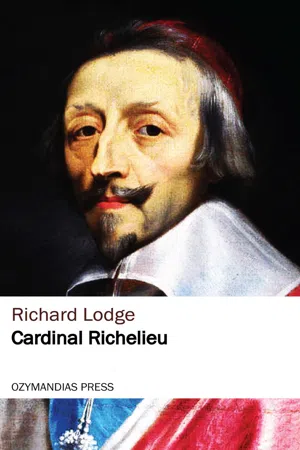
Cardinal Richelieu
About this book
THE death of Concini and the fall of Mary de Medici seemed at first to effect a complete revolution. The rebellion of the nobles was at an end; in fact, they were received at court as if they had been fighting the king's battles against his enemies But they soon discovered that the change of policy was not so complete as it appeared at first. They were jealously excluded from the royal council. Condé, on whose release they had confidently reckoned, was removed from the Bastille to Vincennes, but his prison doors were as securely guarded as ever. The nobles realised that the ascendency of the king's favourite was as intolerable as that of Concini. Nothing had happened to reconcile the hostile interests of the monarchy and the aristocracy...
Trusted by 375,005 students
Access to over 1.5 million titles for a fair monthly price.
Study more efficiently using our study tools.
Information
Subtopic
European HistoryIndex
HistoryTHE MANTUAN SUCCESSION AND THE DAY OF DUPES 1628-1631
~
THE QUESTION OF THE MANTUAN succession—Siege of Casale—Louis XIII. and Richelieu cross the Alps for its relief—Treaty of Susa—Peace with England—Treaty between Spain and Rohan —Campaign in Languedoc—Submission of the Huguenots— They retain religious toleration but lose their political privileges —Discontent of Gaston of Orleans—He goes to Lorraine— Enmity of Mary de Medici against Richelieu—Its motives— Relations of Richelieu and Louis XIII.—Gaston returns to France—Imperialist troops sent to Mantua—Richelieu’s second expedition to Italy—Attitude of Charles Emmanuel of Savoy— The French take Pinerolo—Conquest of Savoy—Fall of Mantua —Siege of Casale—Truce of Rivalta—Relations of France with Gustavus Adolphus—The emperor and the Catholic League— Diet of Ratisbon—Treaty of Ratisbon—Richelieu refuses to confirm it—Illness of Louis XIII.—Relief of Casale—Open quarrel of Mary de Medici with Richelieu—The Day of Dupes —Gaston goes to Orleans—Mary de Medici at Compiègne— Gaston goes to Lorraine—The queen-mother escapes to Brussels —Settlement of the Mantuan succession by treaties of Cherasco —France keeps Pinerolo—Successes of Richelieu.
LA ROCHELLE had fallen, but Casale was still holding out. It was not yet too late for Richelieu to resume that policy of opposition to Spain which the quarrel with England and the revolt of the Huguenots had compelled him for a time to abandon. He had allied himself with the Ultramontane party, but he was not their slave. To their intense disgust he again postponed the annihilation of Rohan and the Huguenots in the south, while he concentrated his attention upon the maintenance of French interests in Italy. The question of the Mantuan succession requires a few words of explanation.
Vincenzo di Gonzaga, who had succeeded two of his brothers as duke of Mantua and marquis of Montferrat, died without issue on December 26, 1627. His nearest male heir was Charles of Gonzaga, duke of Nevers, a French subject, and governor of the French province of Champagne. But though female succession was excluded in Mantua, it was lawful in Montferrat, and to prevent the separation of his territories, the late duke had married his niece, Mary, to Nevers’s son, the duke of Rethel. In January 1628 the duke of Nevers took possession of his inheritance, to which his legal claim was unquestionable. But Spain, the dominant power in Italy, was determined to prevent the establishment of French influence within that country. Encouraged by the prospect of Spanish support, various claimants came forward to oppose the succession of the French duke. The duke of Guastalla, also a descendant of the Gonzagas, laid claim to Mantua on the ground that the Nevers family had forfeited its rights by having borne arms against the emperor. The duchess of Lorraine, sister of the three last dukes, maintained the legality of female succession in Montferrat, and Charles Emmanuel of Savoy advanced an old claim of his family to the same province. The emperor Ferdinand II., urged on by Spain, asserted his right as suzerain to settle these disputes, and in the meanwhile ordered the provinces to be handed over to his commissioner, John of Nassau.
The new duke of Mantua, trusting in support from France, refused to obey this order, and the Spaniards at once undertook to enforce the imperial authority. They were most immediately interested in Montferrat, which they regarded as a bulwark of the duchy of Mila n. The alliance of Savoy was easily purchased by the promise of considerable territories in Montferrat, and Don Gonzales, governor of Milan, led an army to the siege of Casale, the chief fortress of the province. Nevers, hardly established in Mantua, could not hope to resist the combined forces of Spain and Savoy. France, occupied in the siege of La Rochelle, could not interfere effectually in Italy, and a small force which was sent under the marquis of Uxelles was repulsed at the entrance into Piedmont. Fortunately a small body of French volunteers had thrown themselves into the citadel of Casale, where the defective skill and vigilance of the besiegers enabled them to maintain themselves until the fall of La Rochelle set Richelieu and the royal army at liberty.
Although the season was extremely ill-suited for such an enterprise, Richelieu determined to cross the Alps for the relief of Casale, and if possible to take the king with him. Mary de Medici, who cherished an old grudge against Nevers, and disapproved of the expedition altogether, did all in her power to induce her son to stay in Paris. But Louis XIII. had tasted the sweets of martial glory before La Rochelle, and the success of his arms had inspired him with enthusiastic confidence in the cardinal. On January 15, 1629, they quitted Paris together, and after travelling through Champagne they reached Grenoble on February 14. No other minister accompanied them, Schomberg having fallen ill at Troyes, and the whole burden of making preparations for the campaign fell upon Richelieu. The administrative system in the provinces was extremely corrupt and inefficient, and only the most authoritative supervision could secure that orders should be punctually carried out. But the cardinal’s energy vanquished all obstacles, and on February 22 the king set out from Grenoble for the pass of Mont Genèvre. Charles Emmanuel sent his eldest son, who had married Louis’s sister, to negotiate, but Richelieu discovered that the negotiations were merely intended to procure delay while the intrenchments on the Italian side of the pass were being strengthened. The order to advance was given, and the French attack carried all before it. The intrenchments were forced, and on March 3 the king entered Susa in triumph. This vigorous action brought the duke of Savoy to reason, and the prince of Piedmont was again sent to arrange terms with Richelieu. The treaty of Susa was signed on March 11. The duke promised to give the French passage through his territories, and to furnish supplies for the relief of Casale. As security for the fulfilment of his promise Susa was to be left in French occupation. He also undertook for Don Gonzales that the Spaniards would retire from Casale and Montferrat, that they would abstain from any further acts of hostility against the duke of Mantua, and that the confirmation of these terms by Philip IV. should be obtained within six weeks. Louis, on the other hand, promised to procure for the duke the town of Trino and other lands in Montferrat to the value of 15,000 crowns, as the price of the renunciation of his claims. At the same time Richelieu drew up a projected league for mutual defence between France, the pope, Venice, Mantua, and Savoy. Charles Emmanuel undertook to adhere to this league when it had been joined by the other states.
The prompt action of the French had thus secured for them a second military triumph within six months. The Spaniards could not hope to resist the royal army, and Don Gonzales was compelled to accept the terms which Charles Emmanuel had arranged for him. Casale was relieved, and there was yet plenty of time left to reduce the Huguenots. Louis XIII. set out from Susa in April to commence this task. Richelieu remained behind to watch the duke of Savoy, who was too veteran an intriguer to be trusted to fulfil his engagements of his own accord, but on May 19 the cardinal was able to join the king before Privas, the Protestant stronghold of the Vivarais. He had already dealt a crushing blow to the Huguenots by concluding a treaty with England. Charles I. abandoned the cause of the rebels, who had been led to rely upon English assistance, and Louis withdrew his demand for the restoration of Henrietta’s household. Rohan, who had foreseen the defection of England, had sought compensation in an alliance with Spain, and the Most Catholic king had not hesitated to sign a treaty with the leader of Protestantism in France. If any had been needed, this treaty would have supplied ample justification to Richelieu for his determination to crush the Huguenots. It provided that if they succeeded in forming an independent state, they would grant toleration to Roman Catholic worship. The possibility of such an ideal being entertained was enough to convince Richelieu that he must strike boldly and decisively if he wished to effect that unity of France which was the ultimate object of all his exertions.
Before Spanish assistance could arrive the blow had been struck. Privas was taken soon after Richelieu’s arrival, and sacked with all the horrors of war. This severity, which the cardinal in his Memoirs maintains to have been unintentional, was as effective as if it had been deliberately planned. The Vivarais submitted, and the king entered the Cevennes, offering amnesty and toleration to all who submitted, and to those who resisted the fate of Privas. The alternative was irresistible, and one town after another opened its gates. The rebellion had collapsed, and the Huguenot deputies hastened to accept the terms which were offered to them, not as a treaty between equals, but as an act of grace from a sovereign to his subjects. The Edict of Nantes was confirmed, but the political privileges which had been granted at the same time by supplemental edicts were cancelled. The Huguenot fortifications were to be razed to the ground, and there were to be no more “towns of surety.” Freedom of worship and of individual belief was granted, but it was granted as a royal favour which could at any time be revoked. Henry IV. had not been strong enough to enforce toleration by the royal authority, and had been forced to place weapons of self-defence in the hands of the Huguenots. Thanks to Richelieu, the monarchy could now afford to dispense with such precautions, and could thus revoke privileges which its own weakness had rendered necessary, and which had been used against itself. The danger of the formation of “a state within the state” was at an end. The only misfortune was that Richelieu could not ensure that the monarchy should always be tolerant.
After a triumphal entry into Nimes, Louis XIII. set out for Paris on July 25. Richelieu remained behind to obtain the submission of Montauban, only second to La Rochelle as a Huguenot fortress, to supervise the destruction of the fortifications, and to put an end to the administrative independence of Languedoc. It was not till September 14 that he was able to rejoin the king at Fontainebleau. He soon found that he had to confront difficulties at court quite as serious as those which he had coped with abroad. Gaston of Orleans had never been well disposed to Richelieu, whom he accused of a deliberate scheme to exclude him from all voice in public affairs. He was still the puppet of a small group of interested associates, who wished to use him as a catspaw for their own advancement. His first wife had died in childbirth, and he was anxious to marry Mary of Gonzaga, the daughter of the duke of Mantua. This was opposed both by his brother and mother; and Mary de Medici, during the king’s absence in Italy, went so far as to imprison the princess Mary at Vincennes. Gaston then demanded an increase of his appanage, and the government of some important provinces, such as Champagne and Burgundy. Louis was so jealous of his younger brother that Richelieu’s advice was not needed to convince him of the danger of handing over frontier provinces to a discontented heir-apparent. Gaston, however, attributed the refusal to the influence of the cardinal, and loudly demanded his dismissal. When Louis returned from Languedoc, Gaston refused to meet him at court, and retired to Champagne. There he professed to believe that he was in personal danger, and proceeded to Lorraine, where Charles IV., always willing to harass the French government, received him with open arms.
Still more formidable to Richelieu was the open hostility displayed to him on his arrival by Mary de Medici. For the last three years the relations of the queen-mother and her former servant had been growing more and more strained, and the chief causes of her ill- will are not difficult to trace. Throughout her life Mary de Medici was guided rather by passion than by policy. She cherished strong likes and dislikes, but they were directed against persons, not against principles. She had learnt to regard Richelieu as a creature of her own, who owed his advancement to her patronage, and she was chagrined to find him acting in complete independence of her wishes. She intended to keep her elder son entirely under her own control, and she discovered, to her dismay, that the cardinal’s influence over Louis was stronger than her own. The guiding thread to the tortuous labyrinth of her caprices is to be found in a steady attachment to dynastic interests, and especially to those of her three daughters.
This brought her into direct collision with the cardinal’s policy, which was dictated solely by a regard to the interests of France. Her eldest daughter was the queen of Spain, and Richelieu was the arch opponent of that power. Another daughter was married into the house of Savoy, and Mary de Medici would gladly have supported its claims to Montferrat. But Richelieu had actually carried Louis off to Piedmont, had humiliated the duke of Savoy, and had forced him to resign his claims in favour of the duke of Nevers, whom she hated, both for his past career, and because he wished to become the father-in-law of her younger son. The third daughter was the wife of Charles I., and her interests—so her mother thought—had been completely sacrificed in the last treaty with England. After the interests of her family, Mary de Medici was most solicitous for the interests of religion, and these were specially urged upon her at this time by her most intimate advisers, Cardinal Bérulle and Michel Marillac. They wished for a general alliance of Catholic against Protestant states, for the maintenance of a good understanding with Spain, and for the persecution of the Huguenots at home. But their aims were not those of Richelieu. If political reasons rendered it advisable, he was as willing to ally himself with Holland or Sweden as with Bavaria or Austria. He had ample experience of the hollowness of Spanish promises, and of the resolution of the court of Madrid to do all in its power to weaken France by stimulating internal discord and encouraging foreign enemies. He may also have been actuated by a sentiment of personal rivalry against the Spanish minister, Olivares, who certainly entertained that feeling towards Richelieu. Finally, he had reduced La Rochelle and Languedoc, but Bérulle, a bigoted mystic, could not pardon him for having left the heretics in enjoyment of religious toleration.
Against the hostility of the queen-mother, based upon personal, dynastic, and religious motives, Richelieu was not without supporters. Mary de Medici, as in the days of her regency, had connected herself with the Guise party at court. Her favourite confident was the princess of Conti, a sister of the duke of Guise. She made up her former quarrel with her daughter-in-law, Anne of Austria, also a vigorous hater of Richelieu, and opened a connection with the queen’s exiled favourite, Madame de Chevreuse, whose husband was a Guise. The duke of Guise himself had a personal quarrel with Richelieu because he claimed the command in the Mediterranean as pertaining to his governorship of Provence, whereas the cardinal held that his office gave him control over all maritime affairs in every sea. But the old antagonism between the Guises and the princes of the blood—a dominant factor in the history of the later part of the sixteenth century—still subsisted, and the cardinal could oppose to the queen’s partisans the support of Condé, who had become his enthusiastic admirer since the siege of La Rochelle, and of the count of Soissons, who had now returned to France, and had made up his quarrel with the government. His only real security, however, lay in the hold which he had acquired over Louis XIII. Richelieu was no favourite, in the proper sense of the word. He did not rise to power, like Buckingham, by personal favour, nor did he retain it by flattering his master and humouring his foibles. But he was a favourite in the sense that every minister of a despotic sovereign must be a favourite. He could not hold his office if he forfeited the king’s confidence or incurred his serious displeasure. Circumstances had brought him into Louis XIII.’s service, and he had so employed them as to make himself indispensable. Much has been written, in contemporary memoirs and in later histories, of the ascendency acquired by Richelieu over the king, and of the jealous hatred which Louis entertained against the minister, whose superiority he resented, but whom he dared not thwart or dismiss. Much of this can be proved by documentary evidence to be an exaggeration of the cardinal’s enemies. Louis XIII. was rather timid than weak, and his moral cowardice made him eager to say what would please the person he was talking to. He was also slow and hesitating in his speech, and he was often unable to find words to answer the violent expostulations of his mother, or the voluble entreaties of his wife. His silence was easily interpreted to imply what he had no intention of expressing, for under his apparent weakness was concealed considerable obstinacy of opinion and purpose. He really shared his minister’s devotion to the aggrandisement of France in Europe and the increased authority of the monarchy. Probably they often differed as to the means which were to be employed, and the cardinal’s superior abilities doubtless enabled him as a rule to convince and persuade the king; but there were several occasions when Richelieu found it advisable to give way, and any temporary resentment which Louis may have entertained was more than removed by the success which attended their joint exertions. It is impossible to prove that Louis loved his minister, but he respected him, and he loved nobody.
The coldness with which the queen-mother received Richelieu at Fontainebleau was too obvious to escape the notice of a curious court. Richelieu met the hostility of his former patroness by offering his resignation—a favourite weapon in the hands of a minister conscious of his fidelity and of the merit of his services. Louis, who “wept bitterly for nearly a whole day” on account of his mother’s importunities, refused to accept the resignation, and issued letters-patent conferring upon the cardinal the formal dignity of “principal minister of state.” Mary de Medici was compelled to swallow her indignation, and she was the more willing to postpone her desire for vengeance as the death of Bérulle—whom Richelieu was absurdly accused of poisoning—deprived her of one of her most trusted advisers. Richelieu now set himself to arrange terms with Gaston of Orleans, whose residence at a foreign court was a glaring proof of French dissensions, and an encouragement to the enemies of France. Months were wasted in the attempt to satisfy the jealous prince and his ambitious councillors, and it was not till January 1630 that the offer of an increased appanage induced Gaston to return to France, though he still refused to see his brother or to appear at court.
Meanwhile Richelieu discovered that he ran the risk of losing all that he had achieved by his march to Piedmont. The emperor, elated by his victories over the German Calvinists and their Danish champion, was furious at the attempt of France to settle the succession to imperial fiefs without any regard to his authority. He looked on the treaty of Susa as an insult, and withdrew a considerable number of his troops from the north to vindicate his suzerainty in Italy. In the spring of 1629 the imperial army entered the Grison territory and proceeded to occupy the Valtelline and other passes. After some time had been spent in negotiations, the imperial general, Colalto, descended into the Lombard plain. Philip IV. and Olivares were eager to seize the opportunity for resuming the schemes which they had been forced for the moment to abandon. The unconquered Spinola was sent to supersede Don Gonzales in the government of Milan. While the Imperialists advanced upon Mantua, where the duke himself was shut up, Spinola led the Spanish troops into Montferrat and again threatened Casale, which was now defended by a French garrison under Toiras, the hero of St. Martin.
France could not allow Spain and the empire to triumph in Italy, and the despatch of a new army was an obvious necessity. But who was to lead it? The expedition involved diplomatic as well as military difficulties, and their solution could not safely be trusted to a subordinate. Richelieu, of course, was anxious not to leave Louis XIII. to resist unaided the influence and intrigues of Mary de Medici and her partisans. On the other hand, he could hardly venture once more to expose the still childless king to the hardships and dangers of a winter campaign. Moreover the treaty with Gaston was not yet finally settled, and there was danger of an attack from Germany on the side of Champagne. In the interests of France Richelieu was compelled to risk his personal security. On December 29, 1629, he set out from Paris with powers such as have rarely been granted to a subject. He was appointed “lieutenant-general, representing the person of the king with his army both within and without the kingdom.” He had authority to receive and send envoys, and to conclude or reject treaties. Under him served Marshals Créqui, Schomberg, and la Force.
The passage of the Alps was effected without opposition, though not without considerable loss, and in the first week of March the French army reached Susa. Richelieu had made up his mind not only to fight the battles of the duke of Mantua, but also to secure some fortress at the foot of the Alps that would enable France at any time to interfere decisively in Italy. He had no intention of falling into the error of Louis XII. and Francis I., and of attempting to make France the mistress of Italian provinces, but he meant to strike a blow at Spanish domination, and to gain the confidence of those Italian states which still retained a shadow of independence. The great difficulty in his way was the attitude of Savoy. If Charles Emmanuel had been willing to fulfil the treaty of Susa, it would have been impossible to pick a quarrel with him, and it was only at his expense that the desired fortress could be acquired. But the wily duke played into the cardinal’s hands. His one idea was to involve France and Spain in open hostilities with each other, and to make his own profit by selling his support to the highest bidder. He offered to aid the French, if they would join him in attacking Milan and Genoa, and would promise not to lay down arms till both had been conquered. This Richelieu refused, as he did not wish for an open rupture with Spain, and desired that France should continue to play the part of an auxiliary and not of a principal in the war. Then the duke offered to remain neutral, and to supply provisions for the French. This Richelieu at first accepted, in order that Casale might obtain ample supplies to resist a blockade. But he soon discovered that Charles Emmanuel was also negotiating with Spinola and Colalto, and that he was strengthening the intrenched camp which he had formed at Avigliana, between Susa and Turin, as a barrier against the French advance. Richelieu now decided to abandon negotiations, and to turn his arms against his treacherous ally, as it would be madness to advance upon Casale with a hostile Piedmont in his rear. On March 19 the French army advanced against Rivoli, where Charles Emmanuel had his headquarters. An eye-witness has described the cardinal’s appearance as he crossed the little river Dora at the head of the troops. “He wore a blue cuirass over a brown coat embroidered with gold. He had a feathe...
Table of contents
- RICHELIEU’S EARLY LIFE 1585-1614
- THE STATES-GENERAL—RICHELIEU’S FIRST MINISTRY 1614-1617
- RICHELIEU AND THE QUEEN-MOTHER 1617-1624
- THE VALTELLINE AND LA ROCHELLE 1624-1628
- THE MANTUAN SUCCESSION AND THE DAY OF DUPES 1628-1631
- FRANCE INVOLVED IN THE EUROPEAN WAR 1631-1635
- REVERSES AND TRIUMPHS 1635-1640
- DOMESTIC GOVERNMENT
- RICHELIEU AND THE CHURCH
- RICHELIEU’S LAST YEARS 1641-1642
Frequently asked questions
Yes, you can cancel anytime from the Subscription tab in your account settings on the Perlego website. Your subscription will stay active until the end of your current billing period. Learn how to cancel your subscription
No, books cannot be downloaded as external files, such as PDFs, for use outside of Perlego. However, you can download books within the Perlego app for offline reading on mobile or tablet. Learn how to download books offline
Perlego offers two plans: Essential and Complete
- Essential is ideal for learners and professionals who enjoy exploring a wide range of subjects. Access the Essential Library with 800,000+ trusted titles and best-sellers across business, personal growth, and the humanities. Includes unlimited reading time and Standard Read Aloud voice.
- Complete: Perfect for advanced learners and researchers needing full, unrestricted access. Unlock 1.5M+ books across hundreds of subjects, including academic and specialized titles. The Complete Plan also includes advanced features like Premium Read Aloud and Research Assistant.
We are an online textbook subscription service, where you can get access to an entire online library for less than the price of a single book per month. With over 1.5 million books across 990+ topics, we’ve got you covered! Learn about our mission
Look out for the read-aloud symbol on your next book to see if you can listen to it. The read-aloud tool reads text aloud for you, highlighting the text as it is being read. You can pause it, speed it up and slow it down. Learn more about Read Aloud
Yes! You can use the Perlego app on both iOS and Android devices to read anytime, anywhere — even offline. Perfect for commutes or when you’re on the go.
Please note we cannot support devices running on iOS 13 and Android 7 or earlier. Learn more about using the app
Please note we cannot support devices running on iOS 13 and Android 7 or earlier. Learn more about using the app
Yes, you can access Cardinal Richelieu by Richard Lodge in PDF and/or ePUB format, as well as other popular books in History & European History. We have over 1.5 million books available in our catalogue for you to explore.