- 154 pages
- English
- ePUB (mobile friendly)
- Available on iOS & Android
eBook - ePub
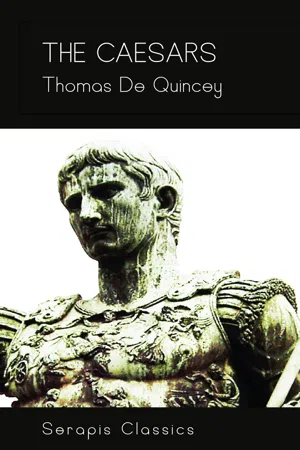
The Caesars (Serapis Classics))
About this book
The condition of the Roman Emperors has never yet been fully appreciated; nor has it been sufficiently perceived in what respects it was absolutely unique. There was but one Rome: no other city, as we are satisfied by the collation of many facts, either of ancient or modern times, has ever rivalled this astonishing metropolis in the grandeur of magnitude; and not many—if we except the cities of Greece, none at all—in the grandeur of architectural display. Speaking even of London, we ought in all reason to say—the Nation of London, and not the City of London; but of Rome in her palmy days, nothing less could be said in the naked severity of logic. A million and a half of souls—that population, apart from any other distinctions, is per se for London a justifying ground for such a classification; à fortiori, then, will it belong to a city which counted from one horn to the other of its mighty suburbs not less than four millions of inhabitants [Footnote: Concerning this question—once so fervidly debated, yet so unprofitably for the final adjudication, and in some respects, we may add, so erroneously—on a future occasion.] at the very least, as we resolutely maintain after reviewing all that has been written on that much vexed theme, and very probably half as many more. Republican Rome had herprerogative tribe; the earth has its prerogative city; and that city was Rome.
Information
Subtopic
Roman Ancient HistoryIndex
HistoryCHAPTER I.
The character of the first Cæsar has perhaps never been worse appreciated than by him who in one sense described it best—that is, with most force and eloquence wherever he really did comprehend it. This was Lucan, who has nowhere exhibited more brilliant rhetoric, nor wandered more from the truth, than in the contrasted portraits of Cæsar and Pompey. The famous line, "Nil actum reputans si quid superesset agendum," is a fine feature of the real character, finely expressed. But if it had been Lucan's purpose (as possibly, with a view to Pompey's benefit, in some respects it was) utterly and extravagantly to falsify the character of the great Dictator, by no single trait could he more effectually have fulfilled that purpose, nor in fewer words, than by this expressive passage, "Gaudensque viam fecisse ruina." Such a trait would be almost extravagant applied even to Marius, who (though in many respects a perfect model of Roman grandeur, massy, columnar, imperturbable, and more perhaps than any one man recorded in history capable of justifying the bold illustration of that character in Horace, "Si fractus illabatur orbis, impavidum ferient ruinæ") had, however, a ferocity in his character, and a touch of the devil in him, very rarely united with the same tranquil intrepidity. But for Cæsar, the all-accomplished statesman, the splendid orator, the man of elegant habits and polished taste, the patron of the fine arts in a degree transcending all example of his own or the previous age, and as a man of general literature so much beyond his contemporaries, except Cicero, that he looked down even upon the brilliant Sylla as an illiterate person,—to class such a man with the race of furious destroyers exulting in the desolations they spread, is to err not by an individual trait, but by the whole genus. The Attilas and the Tamerlanes, who rejoice in avowing themselves the scourges of God, and the special instruments of his wrath, have no one feature of affinity to the polished and humane Cæsar, and would as little have comprehended his character, as he could have respected theirs. Even Cato, the unworthy hero of Lucan, might have suggested to him a little more truth in this instance, by a celebrated remark which he made on the characteristic distinction of Cæsar, in comparison with other revolutionary disturbers; for, whereas others had attempted the overthrow of the state in a continued paroxysm of fury, and in a state of mind resembling the lunacy of intoxication, that Cæsar, on the contrary, among that whole class of civil disturbers, was the only one who had come to the task in a temper of sobriety and moderation, (unum accessisse sobrium ad rempublicam delendam.)
In reality, Lucan did not think as he wrote. He had a purpose to serve; and in an age when to act like a freeman was no longer possible, he determined at least to write in that character. It is probable, also, that he wrote with a vindictive or a malicious feeling towards Nero; and, as the single means he had for gratifying that, resolved upon sacrificing the grandeur of Cæsar's character wherever it should be found possible. Meantime, in spite of himself, Lucan for ever betrays his lurking consciousness of the truth. Nor are there any testimonies to Cæsar's vast superiority more memorably pointed, than those which are indirectly and involuntarily extorted from this Catonic poet, by the course of his narration. Never, for example, was there within the same compass of words, a more emphatic expression of Cæsar's essential and inseparable grandeur of thought, which could not be disguised or be laid aside for an instant, than is found in the three casual words—Indocilis privata loqui. The very mould, it seems, by Lucan's confession, of his trivial conversation was regal; nor could he, even to serve a purpose, abjure it for so much as a casual purpose. The acts of Cæsar speak also the same language; and as these are less susceptible of a false coloring than the features of a general character, we find this poet of liberty, in the midst of one continuous effort to distort the truth, and to dress up two scenical heroes, forced by the mere necessities of history into a reluctant homage to Cæsar's supremacy of moral grandeur.
Of so great a man it must be interesting to know all the well attested opinions which bear upon topics of universal interest to human nature; as indeed no others stood much chance of preservation, unless it were from as minute and curious a collector of anecdotage as Suetonius. And, first, it would be gratifying to know the opinion of Cæsar, if he had any peculiar to himself, on the great theme of Religion. It has been held, indeed, that the constitution of his mind, and the general cast of his character, indisposed him to religious thoughts. Nay, it has been common to class him amongst deliberate atheists; and some well known anecdotes are current in books, which illustrate his contempt for the vulgar class of auguries. In this, however, he went no farther than Cicero, and other great contemporaries, who assuredly were no atheists. One mark perhaps of the wide interval which, in Cæsar's age, had begun to separate the Roman nobility from the hungry and venal populace who were daily put up to sale, and bought by the highest bidder, manifested itself in the increasing disdain for the tastes and ruling sympathies of the lowest vulgar. No mob could be more abjectly servile than was that of Rome to the superstition of portents, prodigies, and omens. Thus far, in common with his order, and in this sense, Julius Cæsar was naturally a despiser of superstition. Mere strength of understanding would, perhaps, have made him so in any age, and apart from the circumstances of his personal history. This natural tendency in him would doubtless receive a further bias in the same direction from the office of Pontifex Maximus, which he held at an early stage of his public career. This office, by letting him too much behind the curtain, and exposing too entirely the base machinery of ropes and pulleys, which sustained the miserable jugglery played off upon the popular credulity, impressed him perhaps even unduly with contempt for those who could be its dupes. And we may add—that Cæsar was constitutionally, as well as by accident of position, too much a man of the world, had too powerful a leaning to the virtues of active life, was governed by too partial a sympathy with the whole class of activeforces in human nature, as contradistinguished from those which tend to contemplative purposes, under any circumstances, to have become a profound believer, or a steadfast reposer of his fears and anxieties, in religious influences. A man of the world is but another designation for a man indisposed to religious awe or contemplative enthusiasm. Still it is a doctrine which we cherish—that grandeur of mind in any one department whatsoever, supposing only that it exists in excess, disposes a man to some degree of sympathy with all other grandeur, however alien in its quality or different in its form. And upon this ground we presume the great Dictator to have had an interest in religious themes by mere compulsion of his own extraordinary elevation of mind, after making the fullest allowance for the special quality of that mind, which did certainly, to the whole extent of its characteristics, tend entirely to estrange him from such themes. We find, accordingly, that though sincerely a despiser of superstition, and with a frankness which must sometimes have been hazardous in that age, Cæsar was himself also superstitious. No man could have been otherwise who lived and conversed with that generation and people. But if superstitious, he was so after a mode of his own. In his very infirmities Cæsar manifested his greatness: his very littlenesses were noble.
"Nec licuit populis parvum te, Nile, videre."
That he placed some confidence in dreams, for instance, is certain: because, had he slighted them unreservedly, he would not have dwelt upon them afterwards, or have troubled himself to recall their circumstances. Here we trace his human weakness. Yet again we are reminded that it was the weakness of Cæsar; for the dreams were noble in their imagery, and Cæsarean (so to speak) in their tone of moral feeling. Thus, for example, the night before he was assassinated, he dreamt at intervals that he was soaring above the clouds on wings, and that he placed his hand within the right hand of Jove. It would seem that perhaps some obscure and half-formed image floated in his mind, of the eagle, as the king of birds; secondly, as the tutelary emblem under which his conquering legions had so often obeyed his voice; and, thirdly, as the bird of Jove. To this triple relation of the bird his dream covertly appears to point. And a singular coincidence appears between this dream and a little anecdote brought down to us, as having actually occurred in Rome about twenty-four hours before his death. A little bird, which by some is represented as a very small kind of sparrow, but which, both to the Greeks and the Romans, was known by a name implying a regal station (probably from the ambitious courage which at times prompted it to attack the eagle), was observed to direct its flight towards the senate-house, consecrated by Pompey, whilst a crowd of other birds were seen to hang upon its flight in close pursuit. What might be the object of the chase, whether the little king himself, or a sprig of laurel which he bore in his mouth, could not be determined. The whole train, pursuers and pursued, continued their flight towards Pompey's hall. Flight and pursuit were there alike arrested; the little king was overtaken by his enemies, who fell upon him as so many conspirators, and tore him limb from limb.
If this anecdote were reported to Cæsar, which is not at all improbable, considering the earnestness with which his friends labored to dissuade him from his purpose of meeting the senate on the approaching Ides of March, it is very little to be doubted that it had a considerable effect upon his feelings, and that, in fact, his own dream grew out of the impression which it had made. This way of linking the two anecdotes, as cause and effect, would also bring a third anecdote under the same nexus. We are told that Calpurnia, the last wife of Cæsar, dreamed on the same night, and to the same ominous result. The circumstances of her dream are less striking, because less figurative; but on that account its import was less open to doubt: she dreamed, in fact, that after the roof of their mansion had fallen in, her husband was stabbed in her bosom. Laying all these omens together, Cæsar would have been more or less than human had he continued utterly undepressed by them. And if so much superstition as even this implies, must be taken to argue some little weakness, on the other hand let it not be forgotten, that this very weakness does but the more illustrate the unusual force of mind, and the heroic will, which obstinately laid aside these concurring prefigurations of impending destruction; concurring, we say, amongst themselves—and concurring also with a prophecy of older date, which was totally independent of them all.
There is another and somewhat sublime story of the same class, which belongs to the most interesting moment of Cæsar's life; and those who are disposed to explain all such tales upon physiological principles, will find an easy solution of this, in particular, in the exhaustion of body, and the intense anxiety which must have debilitated even Cæsar under the whole circumstances of the case. On the ever memorable night when he had resolved to take the first step (and in such a case the first step, as regarded the power of retreating, was also the final step) which placed him in arms against the state, it happened that his headquarters were at some distance from the little river Rubicon, which formed the boundary of his province. With his usual caution, that no news of his motions might run before himself, on this night Cæsar gave an entertainment to his friends, in the midst of which he slipped away unobserved, and with a small retinue proceeded through the woods to the point of the river at which he designed to cross. The night [Footnote: It is an interesting circumstance in the habits of the ancient Romans, that their journeys were pursued very much in the night-time, and by torchlight. Cicero, in one of his letters, speaks of passing through the towns of Italy by night, as a serviceable scheme for some political purpose, either of avoiding too much to publish his motions, or of evading the necessity (else perhaps not avoidable), of drawing out the party sentiments of the magistrates in the circumstances of honor or neglect with which they might choose to receive him. His words, however, imply that the practice was by no means an uncommon one. And, indeed, from some passages in writers of the Augustan era, it would seem that this custom was not confined to people of distinction, but was familiar to a class of travellers so low in rank as to be capable of abusing their opportunities of concealment for the infliction of wanton injury upon the woods and fences which bounded the margin, of the high-road. Under the cloud of night and solitude, the mischief-loving traveller was often in the habit of applying his torch to the withered boughs of woods, or to artificial hedges; and extensive ravages by fire, such as now happen, not unfrequently in the American woods, (but generally from carelessness in scattering the glowing embers of a fire, or even the ashes of a pipe,) were then occasionally the result of mere wantonness of mischief. Ovid accordingly notices, as one amongst the familiar images of daybreak, the half-burnt torch of the traveller; and, apparently, from the position which it holds in his description, where it is ranked with the most familiar of all circumstances in all countries,—that of the rural laborer going out to his morning tasks,—it must have been common indeed:
"Semiustamque facem vigilatâ nocte viator
Ponet; et ad solitum rusticus ibit opus."
This occurs in the Fasti;—elsewhere he notices it for its danger:
"Ut facibus sepes ardent, cum forte viator
Vel nimis admovit, vel jam sub luce reliquit."
He, however, we see, good-naturedly ascribes the danger to mere carelessness, in bringing the torch too near to the hedge, or tossing it away at daybreak. But Varro, a more matter-of-fact observer, does not disguise the plain truth, that these disasters were often the product of pure malicious frolic. For instance, in recommending a certain kind of quickset fence, he insists upon it, as one of its advantages, that it will not readily ignite under the torch of the mischievous wayfarer: "Naturale sepimentum," says he, "quod obseri solet virgultis aut spinis, prætereuntis lascivi non metuet facem." It is not easy to see the origin or advantage of this practice of nocturnal travelling (which must have considerably increased the hazards of a journey), excepting only in the heats of summer. It is probable, however, that men of high rank and public station may have introduced the practice by way of releasing corporate bodies in large towns from the burdensome ceremonies of public receptions; thus making a compromise between their own dignity and the convenience of the provincial public. Once introduced, and the arrangements upon the road for meeting the wants of travellers once adapted to such a practice, it would easily become universal. It is, however, very possible that mere horror of the heats of day-time may have been the original ground for it. The ancients appear to have shrunk from no hardship so trying and insufferable as that of heat. And in relation to that subject, it is interesting to observe the way in which the ordinary use of language has accommodated itself to that feeling. Our northern way of expressing effeminacy is derived chiefly from the hardships of cold. He that shrinks from the trials and rough experience of real life in any department, is described by the contemptuous prefix of chimney-corner, as if shrinking from the cold which he would meet on coming out into the open air amongst his fellow-men. Thus, a chimney-corner politician, for a mere speculator or unpractical dreamer. But the very same indolent habit of aerial speculation, which courts no test of real life and practice, is described by the ancients under the term umbraticus, or seeking the cool shade, and shrinking from the heat. Thus, an umbraticus doctor is one who has no practical solidity in his teaching. The fatigue and hardship of real life, in short, is represented by the ancients under the uniform image of heat, and by the moderns under that of cold.] was stormy, and by the violence of the wind all the torches of his escort were blown out, so that the whole party lost their road, having probably at first intentionally deviated from the main route, and wandered about through the whole night, until the early dawn enabled them to recover their true course. The light was still gray and uncertain, as Cæsar and his retinue rode down upon the banks of the fatal river—to cross which with arms in his hands, since the further bank lay within the territory of the Republic, ipso facto proclaimed any Roman a rebel and a traitor. No man, the firmest or the most obtuse, could be otherwise than deeply agitated, when looking down upon this little brook—so insignificant in itself, but invested by law with a sanctity so awful, and so dire a consecration. The whole course of future history, and the fate of every nation, would necessarily be determined by the irretrievable act of the next half hour.
In these moments, and with this spectacle before him, and contemplating these immeasurable consequences consciously for the last time that could allow him a retreat,—impressed also by the solemnity and deep tranquillity of the silent dawn, whilst the exhaustion of his night wanderings predisposed him to nervous irritation,—Cæsar, we may be sure, was profoundly agitated. The whole elements of the scene were almost scenically disposed; the law of antagonism having perhaps never been employed with so much effect: the little quiet brook presenting a direct, antithesis to its grand political character; and the innocent dawn, with its pure, untroubled repose, contrasting potently, to a man of any intellectual sensibility, with the long chaos of bloodshed, darkness, and anarchy, which was to take its rise from the apparently trifling acts of this one morning. So prepared, we need not much wonder at what followed. Cæsar was yet lingering on the hither bank, when suddenly, at a point not far distant from himself, an apparition was descried in a sitting posture, and holding in its hand what seemed a flute. This phantom was of unusual size, and of beauty more than human, so far as its lineaments could be traced in the early dawn. What is singular, however, in the story, on any hypothesis which would explain it out of Cæsar's individual condition, is, that others saw it as well as he; both pastoral laborers, (who were present, probably, in the character of guides,) and some of the sentinels stationed at the passage of the river. These men fancied even that a strain of music issued from this aerial flute. And some, both of the shepherds and the Roman soldiers, who were bolder than the rest, advanced towards the figure. Amongst this party, it happened that there were a few Roman trumpeters. From one of these, the phantom, rising as they advanced nearer, suddenly caught a trumpet, and blowing through it a blast of superhuman strength, plunged into the Rubicon, passed to the other bank, and disappeared in the dusky twilight of the dawn. Upon which Cæsar exclaimed:—"It is finished—the die is cast—let us follow whither the guiding portents from Heaven, and the malice of our enemy, alike summon us to go." So saying, he crossed the river with impetuosity; and, in a sudden rapture of passionate and vindictive ambition, placed himself and his retinue upon the Italian soil; and, as if by inspiration from Heaven, in one moment involved himself and his followers in treason, raised the standard of revolt, put his foot upon the neck of the invincible republic which had humbled all the kings of the earth, and founded an empire which was to last for a thousand and half a thousand years. In what manner this spectral appearance was managed—whether Cæsar were its author, or its dupe—will remain unknown for ever. But undoubtedly this was the first time that the advanced guard of a victorious army was headed by an apparition; and we may conjecture that it will be the last. [Footnote: According to Suetonius, the circumstances of this memorable night were as follows:—As soon as the decisive intelligence was received, that the intrigues of his enemies had prevailed at Rome, and that the interposition of the popular magistrates (the tribunes) was set aside, Cæsar sent forward the troops, who were then at his head-quarters, but in as private a manner as possible. He himself, by way of masque, (per dissimulationem,) attended a public spectacle, gave an audience to an architect who wished to lay before him a plan for a school of gladiators which Cæsar designed to build, and finally presented himself at a banquet, which was very numerously attended. From this, about sunset, he set forward in a carriage, drawn by mules, and with a small escort (modico comitatu.) Losing his road, which was the most private he could find (occultissimum), he quitted his carriage and proceeded on foot. At dawn he met with a guide; after which followed the above incidents.]
In the mingled yarn of human life, tragedy is never far asunder from farce; and it is amusing to retrace in immediate succession to this incident of epic dignity, which has its only parallel by the way in the case of Vasco de Gama, (according to the narrative of Camoens,) when met and confronted by a sea phantom, whilst attempting to double the Cape of Storms, (Cape of Good Hope,) a ludicrous passage, in which one felicitous blunder did Cæsar a better service than all the truths which Greece and Rome could have furnished. In our own experience, we once witnessed a blunder about as gross. The present Chancellor, in his first electioneering contest with the Lowthers, upon so...
Table of contents
- THE CÆSARS.
- CHAPTER I.
- CHAPTER II.
- CHAPTER III.
- CHAPTER IV.
- CHAPTER V.
- CHAPTER VI.
Trusted by 375,005 students
Access to over 1.5 million titles for a fair monthly price.
Study more efficiently using our study tools.
Frequently asked questions
Yes, you can cancel anytime from the Subscription tab in your account settings on the Perlego website. Your subscription will stay active until the end of your current billing period. Learn how to cancel your subscription
No, books cannot be downloaded as external files, such as PDFs, for use outside of Perlego. However, you can download books within the Perlego app for offline reading on mobile or tablet. Learn how to download books offline
Perlego offers two plans: Essential and Complete
- Essential is ideal for learners and professionals who enjoy exploring a wide range of subjects. Access the Essential Library with 800,000+ trusted titles and best-sellers across business, personal growth, and the humanities. Includes unlimited reading time and Standard Read Aloud voice.
- Complete: Perfect for advanced learners and researchers needing full, unrestricted access. Unlock 1.5M+ books across hundreds of subjects, including academic and specialized titles. The Complete Plan also includes advanced features like Premium Read Aloud and Research Assistant.
We are an online textbook subscription service, where you can get access to an entire online library for less than the price of a single book per month. With over 1.5 million books across 990+ topics, we’ve got you covered! Learn about our mission
Look out for the read-aloud symbol on your next book to see if you can listen to it. The read-aloud tool reads text aloud for you, highlighting the text as it is being read. You can pause it, speed it up and slow it down. Learn more about Read Aloud
Yes! You can use the Perlego app on both iOS and Android devices to read anytime, anywhere — even offline. Perfect for commutes or when you’re on the go.
Please note we cannot support devices running on iOS 13 and Android 7 or earlier. Learn more about using the app
Please note we cannot support devices running on iOS 13 and Android 7 or earlier. Learn more about using the app
Yes, you can access The Caesars (Serapis Classics)) by Thomas De Quincey in PDF and/or ePUB format, as well as other popular books in History & Roman Ancient History. We have over 1.5 million books available in our catalogue for you to explore.