- 342 pages
- English
- ePUB (mobile friendly)
- Available on iOS & Android
eBook - ePub
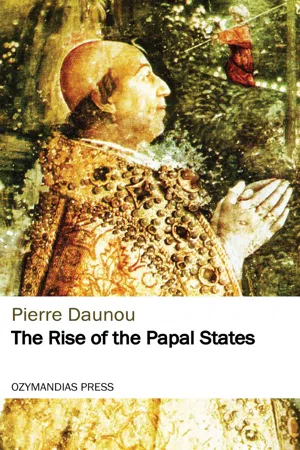
The Rise of the Papal States
About this book
WHOEVER has read the Gospel, knows that Jesus Christ founded no temporal power, no political sovereignty. He declares that his kingdom is not of this world; he charges his apostles not to confound the mission he gives them, with the power exercised by the princes of the earth. St. Peter and his colleagues are sent not to govern but to instruct and the authority with which they are clothed, consists only in the knowledge and the benefits they are to bestow.
Information
Subtopic
European Medieval HistoryIndex
HistoryPOWER OF THE POPES OF THE THIRTEENTH CENTURY
INNOCENT III. IN ONE and the same year, bestowed in the plenitude of his power three royal crowns; to Ioanice, that of Walachia ; to Premislaus, that of Bohemia ; to Peter II., that of Arragon. Peter received his at Rome, and did the pope homage for his states, which became tributary to the Holy See. But Innocent, the dispenser of kingdoms, and who even gave away that of Armenia, distinguished himself still more frequently by his anathemas. Venice, France, England, the emperor, all the great potentates of Europe, have experienced the force of his spiritual arms.
The Venetians, already powerful by their commerce, had assumed the cross but for the purpose of extending it; they gained lands and riches in meriting indulgences. Alone capable of equipping great fleets, they exacted eighty-five thousand crowns of gold for transporting the Christian army into Palestine; and, with the assistance of the legions they conveyed, conquered important places in Dalmatia. Innocent, in order to put a stop to their progress, thought of excluding them from the bosom of the Church. But one of the effects of commercial prosperity is, to weaken in people’s minds the dread of ecclesiastical censures: the Venetians made themselves masters of the city and territory of Zara: they continued to fortify and aggrandize themselves; the anathema launched against their republic, had no important effect: the pontiff abstained from renewing it.
He treated Philip Augustus more rigorously. This monarch of France received from Innocent an express order to take back the divorced Ingelburg, and send away Agnes or Maria de Meronie, whom he had married after this divorce. The king at first assumed an attitude sufficiently bold; but the kingdom was under interdict; the divine offices, the sacraments, marriages, had ceased; the permitting the beard to grow enjoined; the use of flesh forbidden; mutual salutation prohibited. It was in vain that Philip humbled himself, he was obliged to ask of the pope a new enquiry into the affair; it even became necessary to prevent the result of this examination, by declaring that he was about to recall Ingelburg. She was indeed allowed the titles of wife and queen, but it was in the confinement of a castle. Emboldened by this success, Innocent did not hesitate to erect himself into a supreme arbiter between the kings of France and England, then armed one against the other. He commanded them to assemble their bishops, abbots, and nobles of their states, to deliberate on a peace, and to think on the best means of restoring the churches and abbeys which had suffered during the war. Philip replied that it did not belong to the pope to interfere in the disputes of kings, nor especially to convey to them such ordinances. Some French lords added, that the order to make peace was but another reason for continuing the war. But Innocent replied, that an unjust war being a crime, and all crimes having for their judge the Holy Church, he fulfilled a pontifical office in disarming them both. On this principle says Fleury the pope is judge of all the wars between Sovereigns: that is, to speak in plain terms, he is the sole Sovereign in the world. However it may be, Philip, after having renewed his course of conquest, thought proper to consent to a truce, and not irritate too far a pontiff determined on the boldest undertakings. He thus deferred, but by no means avoided, the excommunication. An anathema against Philip was one of the last acts of Innocent III., and one of the results of a new war kindled by this pontiff himself, between the king of England and France, whom he had affected to reconcile.
In fact, this very king of Great Britain whom Innocent had appeared, in 1204, to support against the French, became, a few years after, one of the victims of pontifical despotism. The pope having been desirous, in contempt of the canons and the laws, to dispose of the see of Canterbury in favour of cardinal Langton, John opposed himself to it only by fits of rage which exposed his weakness. Innocent, who knew how to use his power with more prudence, employed by degrees, three modes of repressing this intractableness: first, an interdict upon the kingdom; next, the personal excommunication of the monarch; finally, the deposition of a king who had been so fully convicted of obstinacy in his disobedience to the Holy See.
The English, already dissatisfied with their sovereign, were loosed from the oaths which they had taken to him, and the crown of England was decreed to Philip Augustus, who, imprudent enough to accept it, evinced his gratitude, by releasing Ingelburg from the castle of Etampes, and re-calling her to the throne. But while Philip prepared to reap, with arms in his hands, the fruits of the pontiff’s liberality, a legate named Pandolph, took advantage in England of the fright of the deposed king, and presented him the means of recovering his sceptre, by accepting it as a pure gift from the hands of the Church. On his knees before Pandolph, John placed his hands between those of this priest, and pronounced in the presence of the bishops and lords of Ireland, the following words,
“I, John, by the Grace of God, king of
“England, and lord of Ireland, for the expiation
“of my sins, of my perfect accord, and by the
“advice of barons, give to the Roman Church, to
“Pope Innocent and his successors, the kingdom of
“England and the kingdom of Ireland, with all the
“rights attached to the one and the other: I hence-
“forward hold them of the Holy See of which I shall
“be the faithful vassal, faithful to God, to the Church
“of Rome, to the sovereign pontiff, my lord, and to
“his successors lawfully elected. I pledge myself
“to pay every year, a tax of one thousand marks of
“silver; to wit, seven hundred for England, and
“three hundred for Ireland.”
This discourse is scarcely ended, when the legate is presented with a part of the tribute promised to St. Peter: Pandolph casts the money on the ground, tramples it under his feet, nevertheless collects it again, satisfied with thus expressing the subjection of temporal treasures as well as temporal powers. The sceptre and the crown remain in his hands: he keeps them five days; and when, after he has obtained some additional securities, he finally restores them, he pretends forsooth, that they are received as a perfectly gratuitous favour. He now passes immediately into France to announce what he has performed in England.— Philip learns from Pandolph, that John, the vassal of the pope, occupies, under the protection of the Holy See, the throne of Great Britain, and that henceforth every enterprise against this kingdom will be punished by excommunication. Philip replied, that he took up arms at the solicitation of the pope alone, that the preparations for it had cost two millions, that a fleet, recently equipped, is in the road at Boulogne, that it waits the troops destined to land at Dover, and that the time for receding is departed. In the mean time, the rebellion of a vassal compels the French monarch to carry the war into Flanders: to this vassal the king of England, the emperor Otho IV. and almost all the princes of Europe join themselves. But the victory which the French obtain at Bouvines, dissipates the hopes of their enemies: Otho is no longer emperor, save in name; and John would have been already dethroned, if Rome had not obtained for him a truce of five years.
It was the English themselves who at this interval pronounced, regardless of the menaces of Rome, the dethronement of their monarch; they offered his crown to Louis, son to Philip Augustus. New decrees of Innocent’s prohibit both father and son from invading the State of a prince, a feudatory of the Holy See. The father affects to disapprove a conquest which Rome deems sacrilege, but furnishes, nevertheless, all the means for its execution: the son, in fine, embarks; and the sovereign pontiff, who clearly sees that the father and son understand each other, excommunicates them both. Louis was almost in possession of Great Britain, when the death of John gave a different direction to men’s thoughts and their affairs.
As sovereign of Rome, and as possessing in Italy a very galling preponderance, the Western Emperor was the most exposed to the attempts of Innocent III. To depress the empire, it behoved above all things to re-establish at Rome and in the ecclesiastical domains, the pontifical authority; the pope commenced, therefore, by turning to account the ascendancy which his birth, reputation, and talents, gave him over the Romans; he abolished the consulate, and arrogated to himself the imperial rights, invested a prefect, installed the public officers, and received the oaths of the senators. It was at this moment, says Muratori, that the imperial authority at Rome breathed its last sigh.
Out of Rome, Orbitello, Viterbo, Ombria, Romagna, and the March of Ancona, acknowledged Innocent III. for their sovereign. Reigning thus from one sea to the other, he conceived the hope of conquering Ravenna, which was still wanting to him, of possessing himself of the complete heritage of Matilda, of subjecting still further the two Sicilies, and, especially, prevent-ing their having for master the head of the empire; this last point was always a principle in the policy of the Holy See. Once should it govern in a direct manner the most part of the Italian provinces, it would be content to exercise elsewhere, a spiritual supremacy: the States which it could not possess, it would be satisfied to bestow, to resume, or to confer on such princes as should render themselves worthy by their docility. The conjunctures of the time altogether, as we have said, favoured this plan, at the accession of Innocent III. Frederick the II. was a child whom his father had caused to be elected King of the Romans, and his mother Constance, had placed him under the protection and even tutelage of the pope. One of this guardian’s first acts was, to deprive his pupil of the title of King of the Romans, as well as of the prerogatives attached to the crown of Sicily. Between Philip of Swabia, and Otho of Saxony, simultaneously nominated emperors, the first of whom represented the house of Ghibeline, the second that of Guelph, Innocent determined in favour of Otho, even in prejudice of Frederick, whom he considered as a third competitor. It was, he said, to the Holy See belonged the privilege of judging sovereignly the claims of these competitors of the empire. The fortune of war favoured Philip of Swabia, with whom the prudent court of Rome already treated, when he was assassinated.—His daughter became the wife of Otho the IV. who thus having United all rights and suffrages, considered himself sufficiently powerful to refuse the pope the heritage of Matilda. Innocent now took the part of fulfilling his obligations as a guardian; he opposed his ward, Frederick, to the ungrateful Otho, excommunicated this prince, whom he had himself crowned, and raised Upper Italy against him. In this conjuncture the Ghibelines were seen armed by the pope against an emperor, whom the Guelphs sustained in his resistance to the pontiff: an historical phenomenon, which ought not to astonish us, as we have already observed, that these two parties were attached rather to particular families than to opinions. We may add, that it is the fate of permanent factions to experience many unlooked for changes, to modify according to circumstances their original designs, to retain their names, and their insignia, much longer than their thoughts or their sentiments, to preserve, in fine, no other invariable interest than that of remaining rivals, and falling foul of each other; it suffices then to be, and to be at war, it matters not to what end. It was especially the battle of Bouviines, which determined, as we have remarked, the fall of Otho IV. and the preponderance of the party of Frederick II. Innocent thus reaped in part the fruits of the triumph of Philip Augustus.
These disputes were connected with the crusade of 1202, which like that of 1095, and those of 1147 and 1189, placed in the hands of the pope the clue of all the movements of Europe. Each of these expeditions occasioned quarrels between the crusaders and the Greeks, and this misunderstanding appeared to Innocent an open for re-conquering the Eastern Church, escaped now two centuries from the domination of the court of Rome. The Greek empire, worn out by war and by faction, became the prey of the crusaders, who, being unable to retain Jerusalem, made themselves masters of Constantinople. Baldwin, Count of Flanders, was nominated Emperor of the East; after him four other Frenchmen filled successively the same throne, while, having taken refuge in Nice, the Greek emperors reigned only over some provinces. The palaces and temples of Byzantium were plundered, and the booty, collected by the French lords was estimated at a quantity of silver of two hundred thousand pounds weight. They found it convenient to indemnify themselves in Greece for the losses sustained in Palestine; the vow which they had made, to combat only infidels, no longer repressed their covetousness; the re-establishment of holy places was but a pretext for pillaging the rich ones; and already the affectation of sentiments of religion was relinquished.:
“They
“cast, says Fleury, the relics into unclean places,
“they scattered on the ground the body and blood
“of our Lord; they employed the sacred vases
“for profane uses, and an insolent woman danced in
“the sanctuary and seated herself in the chair of the
“priest.”
Innocent, who was not ignorant of these profanations and complained of them, did not approve the less of the conquest:
“God, said he, willing to
“console the church by the re-union of the schisma-
“tics, has caused the empire of the haughty, supersti-
“tious and disobedient Greeks to pass over to the
“humble, catholic, and submissive Latins.”
Another benefit derived from the crusades was, the application of their names to many other leagues formed or fomented by the Roman Church. Innocent III. is the inventor of this artifice, which evinces an abundant acquaintance with the means of leading minds astray by the illusion of words: he applied to the service of his serious political designs, the enormous power of a word which, for the period of one hundred and ten years, had the effect of exciting through Europe the most blind and restless enthusiasm. He preached therefore a crusade against England when he had determined on dethroning John; a crusade against the Hungarians when he affected to become the arbiter of their intestine dissentions; a crusade against a king of Norway, whom also he wished to depose; but above all, a crusade against the Albigenses, a sect extended through the entire south of France. Raymond V...
Table of contents
- ORIGIN OF THE TEMPORAL POWER OF THE POPES
- ENTERPRISES OF THE POPES OF THE NINTH CENTURY
- TENTH CENTURY
- ENTERPRISES OF THE POPES OF THE ELEVENTH CENTURY
- CONTESTS BETWEEN THE POPES AND THE SOVEREIGNS OF THE TWELFTH CENTURY
- POWER OF THE POPES OF THE THIRTEENTH CENTURY
- FOURTEENTH CENTURY
- FIFTEENTH CENTURY
- POLICY OF THE POPES OF THE SIXTEENTH CENTURY
- ATTEMPTS OF THE POPES OF THE SEVENTEENTH CENTURY
- EIGHTEENTH CENTURY
- RECAPITULATION
Trusted by 375,005 students
Access to over 1.5 million titles for a fair monthly price.
Study more efficiently using our study tools.
Frequently asked questions
Yes, you can cancel anytime from the Subscription tab in your account settings on the Perlego website. Your subscription will stay active until the end of your current billing period. Learn how to cancel your subscription
No, books cannot be downloaded as external files, such as PDFs, for use outside of Perlego. However, you can download books within the Perlego app for offline reading on mobile or tablet. Learn how to download books offline
Perlego offers two plans: Essential and Complete
- Essential is ideal for learners and professionals who enjoy exploring a wide range of subjects. Access the Essential Library with 800,000+ trusted titles and best-sellers across business, personal growth, and the humanities. Includes unlimited reading time and Standard Read Aloud voice.
- Complete: Perfect for advanced learners and researchers needing full, unrestricted access. Unlock 1.5M+ books across hundreds of subjects, including academic and specialized titles. The Complete Plan also includes advanced features like Premium Read Aloud and Research Assistant.
We are an online textbook subscription service, where you can get access to an entire online library for less than the price of a single book per month. With over 1.5 million books across 990+ topics, we’ve got you covered! Learn about our mission
Look out for the read-aloud symbol on your next book to see if you can listen to it. The read-aloud tool reads text aloud for you, highlighting the text as it is being read. You can pause it, speed it up and slow it down. Learn more about Read Aloud
Yes! You can use the Perlego app on both iOS and Android devices to read anytime, anywhere — even offline. Perfect for commutes or when you’re on the go.
Please note we cannot support devices running on iOS 13 and Android 7 or earlier. Learn more about using the app
Please note we cannot support devices running on iOS 13 and Android 7 or earlier. Learn more about using the app
Yes, you can access The Rise of the Papal States by Pierre Daunou in PDF and/or ePUB format, as well as other popular books in History & European Medieval History. We have over 1.5 million books available in our catalogue for you to explore.