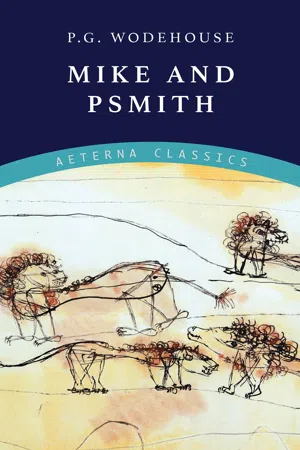
- 244 pages
- English
- ePUB (mobile friendly)
- Available on iOS & Android
eBook - ePub
Mike and Psmith
About this book
An early Wodehouse novel, this is both a sporting story and a tale of friendship between two boys at boarding school. Mike (introduced in Mike at Wrykyn) is a seriously good cricketer who forms an unlikely alliance with old Etonian Psmith ('the P is silent') after they both find themselves fish out of water at a new school, Sedleigh. Full of entertainment, the plot reaches a satisfying conclusion as the pair eventually overcome the hostility of others and their own prejudices to become stars. Even readers uninterested in cricket are likely to be gripped by descriptions of matches, but the real meat of the book is to be found in the characters, especially the elegant Psmith, one of Wodehouse's immortal creations, who features in three of his later novels.
Information
Subtopic
ClassicsIndex
LiteraturePURSUIT
These things are Life's Little Difficulties. One can never tell precisely how one will act in a sudden emergency. The right thing for Mike to have done at this crisis was to have ignored the voice, carried on up the water pipe, and through the study window, and gone to bed. It was extremely unlikely that anybody could have recognized him at night against the dark background of the house. The position then would have been that somebody in Mr. Outwood's house had been seen breaking in after lights-out; but it would have been very difficult for the authorities to have narrowed the search down any further than that. There were thirty-four boys in Outwood's, of whom about fourteen were much the same size and build as Mike.
The suddenness, however, of the call caused Mike to lose his head. He made the strategic error of sliding rapidly down the pipe, and running.
There were two gates to Mr. Outwood's front garden. The drive ran in a semicircle, of which the house was the center. It was from the right-hand gate, nearest to Mr. Downing's house, that the voice had come, and, as Mike came to the ground, he saw a stout figure galloping toward him from that direction. He bolted like a rabbit for the other gate. As he did so, his pursuer again gave tongue.
"Oo-oo-oo yer!" was the exact remark.
Whereby Mike recognized him as the school sergeant. "Oo-oo-oo yer!" was that militant gentleman's habitual way of beginning a conversation.
With this knowledge, Mike felt easier in his mind. Sergeant Collard was a man of many fine qualities (notably a talent for what he was wont to call "spott'n," a mysterious gift which he exercised on the rifle range), but he could not run. There had been a time in his hot youth when he had sprinted like an untamed mustang in pursuit of volatile Pathans in Indian hill wars, but Time, increasing his girth, had taken from him the taste for such exercise. When he moved now it was at a stately walk. The fact that he ran tonight showed how the excitement of the chase had entered into his blood.
"Oo-oo-oo yer!" he shouted again, as Mike, passing through the gate, turned into the road that led to the school. Mike's attentive ear noted that the bright speech was a shade more puffily delivered this time. He began to feel that this was not such bad fun after all. He would have liked to be in bed, but, if that was out of the question, this was certainly the next-best thing.
He ran on, taking things easily, with the sergeant panting in his wake, till he reached the entrance to the school grounds. He dashed in and took cover behind a tree.
Presently the sergeant turned the corner, going badly and evidently cured of a good deal of the fever of the chase. Mike heard him toil on for a few yards and then stop. A sound of panting was borne to him.
Then the sound of footsteps returning, this time at a walk. They passed the gate and went on down the road.
The pursuer had given the thing up.
Mike waited for several minutes behind his tree. His program now was simple. He would give Sergeant Collard about half an hour, in case the latter took it into his head to "guard home" by waiting at the gate. Then he would trot softly back, shoot up the water pipe once more, and so to bed. It had just struck a quarter to something—twelve, he supposed—on the school clock. He would wait till a quarter past.
Meanwhile, there was nothing to be gained from lurking behind a tree. He left his cover, and started to stroll in the direction of the pavilion. Having arrived there, he sat on the steps, looking out onto the cricket field.
His thoughts were miles away, at Wrykyn, when he was recalled to Sedleigh by the sound of somebody running. Focusing his gaze, he saw a dim figure moving rapidly across the cricket field straight for him.
His first impression, that he had been seen and followed, disappeared as the runner, instead of making for the pavilion, turned aside, and stopped at the door of the bicycle shed. Like Mike, he was evidently possessed of a key, for Mike heard it grate in the lock. At this point he left the pavilion and hailed his fellow rambler by night in a cautious undertone.
The other appeared startled.
"Who the dickens is that?" he asked. "Is that you, Jackson?"
Mike recognized Adair's voice. The last person he would have expected to meet at midnight obviously on the point of going for a bicycle ride.
"What are you doing out here. Jackson?"
"What are you, if it comes to that?"
Adair was adjusting his front light.
"I'm going for the doctor. One of the chaps in our house is bad."
"Oh!"
"What are you doing out here?"
"Just been for a stroll."
"Hadn't you better be getting back?"
"Plenty of time."
"I suppose you think you're doing something tremendously brave and dashing?"
"Hadn't you better be going to the doctor?"
"If you want to know what I think—"
"I don't. So long."
Mike turned away, whistling between his teeth. After a moment's pause, Adair rode off. Mike saw his light pass across the field and through the gate. The school clock struck the quarter.
It seemed to Mike that Sergeant Collard, even if he had started to wait for him at the house, would not keep up the vigil for more than half an hour. He would be safe now in trying for home again.
He walked in that direction.
Now it happened that Mr. Downing, aroused from his first sleep by the news, conveyed to him by Adair, that MacPhee, one of the junior members of Adair's dormitory, was groaning and exhibiting other symptoms of acute illness, was disturbed in his mind. Most housemasters feel uneasy in the event of illness in their houses, and Mr. Downing was apt to get jumpy beyond the ordinary on such occasions. All that was wrong with MacPhee, as a matter of fact, was a very fair stomachache, the direct and legitimate result of eating six buns, half a coconut, three doughnuts, two ices, an apple, and a pound of cherries, and washing the lot down with tea. But Mr. Downing saw in his attack the beginnings of some deadly scourge which would sweep through and decimate the house. He had dispatched Adair for the doctor, and, after spending a few minutes prowling restlessly about his room, was now standing at his front gate, waiting for Adair's return.
It came about, therefore, that Mike, sprinting lightly in the direction of home and safety, had his already shaken nerves further maltreated by being hailed, at a range of about two yards, with a cry of "Is that you, Adair?" The next moment Mr. Downing emerged from his gate.
Mike stood not upon the order of his going. He was off like an arrow—a flying figure of Guilt. Mr. Downing, after the first surprise, seemed to grasp the situation. Ejaculating at intervals the words, "Who is that? Stop! Who is that? Stop!" he dashed after the much-enduring Wrykynian at an extremely creditable rate of speed. Mr. Downing was by way of being a sprinter. He had won handicap events at College sports at Oxford, and, if Mike had not got such a good start, the race might have been over in the first fifty yards. As it was, that victim of Fate, going well, kept ahead. At the entrance to the school grounds he led by a dozen yards. The procession passed into the field, Mike heading as before for the pavilion.
As they raced across the soft turf, an idea occurred to Mike, which he was accustomed in after years to attribute to genius, the one flash of it which had ever illumined his life.
It was this.
One of Mr. Downing's first acts, on starting the Fire Brigade at Sedleigh, had been to institute an alarm bell. It had been rubbed into the school officially—in speeches from the dais—by the headmaster, and unofficially—in earnest private conversations—by Mr. Downing, that at the sound of this bell, at whatever hour of day or night, every member of the school must leave his house in the quickest possible way, and make for the open. The bell might mean that the school was on fire, or it might mean that one of the houses was on fire. In any case, the school had its orders—to get out into the open at once.
Nor must it be supposed that the school was without practice at this feat. Every now and then a notice would be found posted up on the board to the effect that there would be fire drill during the dinner hour that day. Sometimes the performance was bright and interesting, as on the occasion when Mr. Downing, marshaling the brigade at his front gate, had said, "My house is supposed to be on fire. Now let's do a record!" which the Brigade, headed by Stone and Robinson, obligingly did. They fastened the hose to the hydrant, smashed a window on the ground floor (Mr. Downing having retired for a moment to talk with the headmaster), and poured a stream of water into the room. When Mr. Downing was at liberty to turn his attention to the matter, he found that the room selected was his private study, most of the light furniture of which was floating in a miniature lake. That episode had rather discouraged his passion for realism, and fire drill since then had taken the form, for the most part, of "practicing escaping." This was done by means of canvas chutes, kept in the dormitories. At the sound of the bell the prefect of the dormitory would heave one end of the chute out of the window, the other end being fastened to the sill. He would then go down it himself, using his elbows as a brake. Then the second man would follow his example, and these two, standing below, would hold the end of the chute so that the rest of the dormitory could fly rapidly down it without injury, except to their digestions.
After the first novelty of the thing had worn off, the school had taken a rooted dislike to fire drill. It was a matter for self-congratulation among them that Mr. Downing had never been able to induce the headmaster to allow the alarm bell to be sounded for fire drill at night. The headmaster, a man who had his views on the amount of sleep necessary for the growing boy, had drawn the line at night operations. "Sufficient unto the day" had been the gist of his reply. If the alarm bell were to ring at night when there was no fire, the school might mistake a genuine alarm of fire for a bogus one, and refuse to hurry themselves.
So Mr. Downing had had to be content with day drill.
The alarm bell hung in the archway, leading into the school grounds. The end of the rope, when not in use, was fastened to a hook halfway up the wall.
Mike, as he raced over the cricket field, made up his mind in a flash that his only chance of getting out of this tangle was to shake his pursuer off for a space of time long enough to enable him to get to the rope and tug it. Then the school would come out. He would mix with them, and in the subsequent confusion get back to bed unnoticed.
The task was easier than it would have seemed at the beginning of the chase. Mr. Downing, owing to the two facts that he was not in the strictest training, and that it is only a Bannister who can run for any length of time at top speed shouting "Who is that? Stop! Who is that? Stop!" was beginning to feel distressed. There were bellows to mend in the Downing camp. Mike perceived this, and forced the pace. He rounded the pavilion ten yards to the good. Then, heading for the gate, he put all he knew into one last sprint. Mr. Downing was not equal to the effort. He worked gamely for a few strides, then fell behind. When Mike reached the gate, a good forty yards separated them.
As far as Mike could judge—he was not in a condition to make nice calculations—he had about four seconds in which to get busy with that bell rope.
Probably nobody has ever crammed more energetic work into four seconds than he did then.
The night was as still as only an English summer night can be, and the first clang of the clapper sounded like a million iron girders falling from a height onto a sheet of tin. He tugged away furiously, with an eye on the now rapidly advancing and loudly shouting figure of the housemaster.
And from the darkened house beyond there came a gradually swelling hum, as if a vast hive of bees had been disturbed.
The school was awake.
17
THE DECORATION OF SAMMY
Psmith leaned against the mantelpiece in the senior day room at Outwood's—since Mike's innings against Downing's the Lost Lambs had been received as brothers by the center of disorder, so that even Spiller was compelled to look on the hatchet as buried—and gave his views on the events of the preceding night, or, rather, of that morning, for it was nearer one than twelve when peace had once more fallen on the school.
"Nothing that happens in this loony bin," said Psmith, "has power to surprise me now. There was a time when I might have thought it a little unusual to have to leave the house through a canvas chute at one o'clock in the morning, but I suppose it's quite the regular thing here. Old school tradition, etc. Men leave the school, and find that they've got so accustomed to jumping out of windows that they look on it as a sort of affectation to go out by the door. I suppose none of you merchants can give me any idea when the next knockabout entertainment of this kind is likely to take place?"
"I wonder who rang that bell!" said Stone. "Jolly sporting idea."
"I believe it was Downing himself. If it was, I hope he's satisfied."
Jellicoe, who was appearing in society supported by a stick, looked meaningly at Mike, and giggled, receiving in answer a stony stare. Mike had informed Jellicoe of the details of his interview with Mr. Barley at the White Boar, and Jellicoe, after a momentary splutter of wrath against the practical joker, was now in a particular lighthearted mood. He hobbled about, giggling at nothing and at peace with all the world.
"It was a stirring scene," said Psmith. "The agility with which Comrade
Jellicoe boosted himself down the chute was a triumph of mind over
matter. He seemed to forget his ankle. It was the nearest thing to a
Boneless Acrobatic Wonder that I have ever seen."
Jellicoe boosted himself down the chute was a triumph of mind over
matter. He seemed to forget his ankle. It was the nearest thing to a
Boneless Acrobatic Wonder that I have ever seen."
"I was in a beastly funk, I can tell you."
Stone gurgled.
"So was I," he said, "for a bit. Then, when I saw that it was all a rag, I began to look about for ways of doing the thing really well. I emptied about six jugs of water on a gang of kids under my window."
"I rushed into Downing's, and ragged some of the beds," said Robinson.
"It was an invigorating time," said Psmith. "A sort of pageant. I was particularly struck with the way some of the bright lads caught hold of the idea. There was no skimping. Some of the kids, to my certain knowledge, went down the chute a dozen times. There's nothing like doing a thing thoroughly. I saw them come down, rush upstairs, and be saved again, time after time. The thing became chronic with them. I should say Comrade Downing ought to be satisfied with the high state of efficiency to which he has brought us. At any rate I hope—"
There was a sound of hurried footsteps outside the door, and Sharpe, a member of the senior day room, burst excitedly in. He seemed amused.
"I say, have you chaps seen Sammy?"
"Seen who?" said Stone. "Sammy? Why?"
"You'll know in a second. He's just outside. Here, Sammy, Sammy, Sammy!
Sam! Sam!"
Sam! Sam!"
A bark and a patter of feet outside.
"Come on, Sammy. Good dog."
There was a moment's silence. Then a great yell of laughter burst forth. Even Psmith's massive calm was shattered. As for Jellicoe, he sobbed in a corner.
Sammy's beautiful white coat was almost entirely concealed by a thick covering of bright-red paint. His head, with the exception of the ears, was untouched, and his serious, friendly eyes seemed to emphasise the weirdness of his appearance. He stood in the doorway, barking and wagging his...
Table of contents
- MR. JACKSON MAKES UP HIS MIND
- SEDLEIGH
- PSMITH
- STAKING OUT A CLAIM
- GUERRILLA WARFARE
- UNPLEASANTNESS IN THE SMALL HOURS
- ADAIR
- MIKE FINDS OCCUPATION
- THE FIRE BRIGADE MEETING
- ACHILLES LEAVES HIS TENT
- THE MATCH WITH DOWNING'S
- THE SINGULAR BEHAVIOR OF JELLICOE
- JELLICOE GOES ON THE SICK LIST
- MIKE RECEIVES A COMMISSION
- … AND FULFILLS IT
- PURSUIT
- MR. DOWNING ON THE SCENT
- THE SLEUTH-HOUND
- A CHECK
- THE DESTROYER OF EVIDENCE
- MAINLY ABOUT SHOES
- ON THE TRAIL AGAIN
- THE ADAIR METHOD
- ADAIR HAS A WORD WITH MIKE
- CLEARING THE AIR
- IN WHICH PEACE IS DECLARED
- MR. DOWNING MOVES
- THE ARTIST CLAIMS HIS WORK
- SEDLEIGH V. WRYKYN
Trusted by 375,005 students
Access to over 1.5 million titles for a fair monthly price.
Study more efficiently using our study tools.
Frequently asked questions
Yes, you can cancel anytime from the Subscription tab in your account settings on the Perlego website. Your subscription will stay active until the end of your current billing period. Learn how to cancel your subscription
No, books cannot be downloaded as external files, such as PDFs, for use outside of Perlego. However, you can download books within the Perlego app for offline reading on mobile or tablet. Learn how to download books offline
Perlego offers two plans: Essential and Complete
- Essential is ideal for learners and professionals who enjoy exploring a wide range of subjects. Access the Essential Library with 800,000+ trusted titles and best-sellers across business, personal growth, and the humanities. Includes unlimited reading time and Standard Read Aloud voice.
- Complete: Perfect for advanced learners and researchers needing full, unrestricted access. Unlock 1.5M+ books across hundreds of subjects, including academic and specialized titles. The Complete Plan also includes advanced features like Premium Read Aloud and Research Assistant.
We are an online textbook subscription service, where you can get access to an entire online library for less than the price of a single book per month. With over 1.5 million books across 990+ topics, we’ve got you covered! Learn about our mission
Look out for the read-aloud symbol on your next book to see if you can listen to it. The read-aloud tool reads text aloud for you, highlighting the text as it is being read. You can pause it, speed it up and slow it down. Learn more about Read Aloud
Yes! You can use the Perlego app on both iOS and Android devices to read anytime, anywhere — even offline. Perfect for commutes or when you’re on the go.
Please note we cannot support devices running on iOS 13 and Android 7 or earlier. Learn more about using the app
Please note we cannot support devices running on iOS 13 and Android 7 or earlier. Learn more about using the app
Yes, you can access Mike and Psmith by P. G. Wodehouse in PDF and/or ePUB format, as well as other popular books in Literature & Classics. We have over 1.5 million books available in our catalogue for you to explore.