- 330 pages
- English
- ePUB (mobile friendly)
- Available on iOS & Android
eBook - ePub
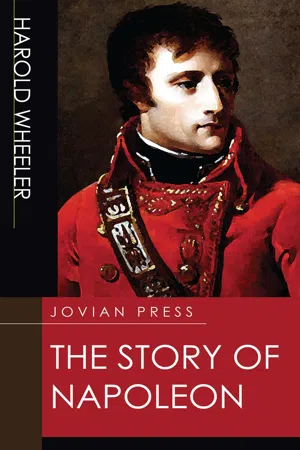
The Story of Napoleon
About this book
Whenever we hear the name of Napoleon mentioned, or see it printed in a book, it is usually in connection with a hard-fought victory on the battlefield. He certainly spent most of his life in the camp, and enjoyed the society of soldiers more than that of courtiers. The thunder of guns, the charge of cavalry, and the flash of bayonets as they glittered in the sun, appealed to him with much the same force as music to more ordinary folk. Indeed, he himself tells us that "the cries of the dying, the tears of the hopeless, surrounded my cradle from the moment of my birth."
Information
Topic
Personal DevelopmentSubtopic
World HistoryTHE AUSTRIAN CAMPAIGN(1809)
~
ON A CERTAIN MEMORABLE OCCASION, Walpole is said to have made the remark, “They are ringing the bells now; they will be wringing their hands soon!” with reference to a universal outcry for war on the part of Great Britain. Had it been uttered by an Austrian statesman at the beginning of 1809, it would have been equally apposite. Thinking men recognised that the army was not yet prepared to meet Napoleon, despite the fact that since the Austerlitz campaign of 1805 the improvement of her military forces had engrossed the attention of Archduke Charles, the Commander-in-chief. He was convinced that his troops were not ready to take the field, and he led the peace party solely on this account. The war party, however, headed by Count Stadion, the able and energetic Minister of Foreign Affairs, and aided by the Empress, who had considerable influence over her august husband, proved more powerful. Its supporters felt confident that as the war in Spain necessarily occupied so much of Napoleon’s attention, and had drawn off such a large proportion of his troops, the time to strike was come. Austrian diplomatists had vainly endeavoured to woo both Russia and Prussia without success; the Czar had no wish at that moment to break with his ally; Frederick William trembled for his throne.
In January 1809, war was imminent. Napoleon, deceived as to the real state of affairs in Spain, set out on his return journey to France on the 16th. He at once began to organise his forces, Berthier being placed in command until the Emperor’s arrival at the seat of war. Napoleon’s explicit instructions were as follows:—
“By the 1st April the corps of Marshal Davout, which broke up from the Oder and Lower Elbe on the 17th March, will be established between Nuremberg, Bamberg, and Baireuth: Masséna will be around Ulm: Oudinot between Augsburg and Donauwörth. From the 1st to the 15th, three French corps, 130,000 strong, besides 10,000 allies, the Bavarians in advance on the Iser, and the Würtembergers in reserve, may be concentrated on the Danube at Ratisbon or Ingolstadt. Strong têtes-de-pont should be thrown up at Augsburg, to secure the passage of the Lech at Ingolstadt, in order to be able to debouch to the left bank of the Danube; and above all at Passau, which should be able to hold out two or three months. The Emperor’s object is to concentrate his army as soon as possible at Ratisbon: the position on the Lech is to be assumed only if it is attacked before the concentration at the former town is possible. The second corps will be at Ratisbon by the 10th, and on that day Bessières will also arrive with the reserve cavalry of the Guard: Davout will be at Nuremberg: Masséna at Augsburg: Lefebvre at one or two marches from Ratisbon. Headquarters then may be safely established in that town, in the midst of 200,000 men, guarding the right bank of the Danube from Ratisbon to Passau, by means of which stream provisions and supplies of every sort will be procured in abundance. Should the Austrians debouch from Bohemia or Ratisbon, Davout and Lefebvre should fall back on Ingolstadt or Donauwörth.”
On the 9th April, when hostilities began, the strength of Napoleon’s forces was as follows:—His newly-named Army of Germany, on the Danube, numbered 174,000 troops, including some 54,000 of the Rhenish Confederacy; the Army of Italy consisted of 68,000; in Saxony there were about 20,000; in Poland 19,000; in Dalmatia 10,500. Consequently the Emperor had 291,500 troops at his disposal, some 275,000 of whom were ready to confront Austria by the middle of the month. This is an enormous number when it is remembered that he was still at war with Spain, where 300,000 men were engaged, but he had had recourse to his old plan of forestalling the conscription, whereby he had obtained 80,000 recruits.
The Austrian forces were divided into three armies: that of Germany, under Archduke Charles, consisting of 189,684 troops; of Italy, under Archduke John, totalling 64,768, including those for action in Tyrol under Chasteler; and of Galicia, under Archduke Ferdinand, with 35,400; in all 289,852. The Reserves, made up of the landwehr and levées en masse reached 244,247, but as Mr F. Loraine Petre points out in his masterly study of this campaign, only some 15,000 of the landwehr were used with the active army at the beginning of hostilities. “There was little of the spirit of war in the landwehr,” he adds, “and discipline was very bad. One battalion attacked and wounded its chief with the bayonet. Two others refused to march. Eleven Bohemian battalions could only be got to march when regular troops were added to them. Even then they only averaged about 500 men each, and those badly equipped and armed.” But while this organisation was of little practical service at the moment, it was creating a healthy public opinion which could not fail to be beneficial in the years to come.
Already Napoleon’s military glory was beginning to decline. In some of his principles he “became false to himself,” he omitted to make his orders to his subordinates sufficiently clear, and on one occasion, in the early stage of the campaign, threw away “chances of a decisive battle which would then probably have made an end of the war.” He also exhibited the utmost contempt for a country which “had profited by the lessons he had taught her,” with the result that “her armies, and her commander-in-chief, were very different from the troops and leaders of 1796 and 1805,” when he had crossed swords with Austria.
Yet another failing is pointed out by Mr Petre. “Napoleon’s wonderful successes in every previous campaign,” he notes, “and the height to which his power had risen, by the practical subjugation of all Europe to his dominion, tended to fan the flame of his pride, to make him deem himself invincible and infallible, to cause him to assume that what he desired was certain to happen. The wish now began to be father to the thought. Of this we shall find numerous instances in this campaign, the most notable, perhaps, being when, notwithstanding Davout’s positive assertions that the greater part of the Austrian army was in front of himself, the Emperor persisted in believing that Charles was in full retreat on Vienna by the right bank of the Danube. His constant over-estimates of his own forces, not in bulletins but in letters to his generals and ministers, are other examples of this failing.”
The campaign opened in Bavaria, where 176,000 Austrians assembled early in April 1809. Berthier, doubtless acting for the best as he conceived it, instead of concentrating at Ratisbon, Ingolstadt or Donauwörth according to orders, had seen fit to scatter his forces, “in the dangerous view,” as Alison puts it, “of stopping the advance of the Austrians at all points.” As a result of Berthier’s blunder Davout at Ratisbon and Masséna at Augsburg were thirty-five leagues from each other, and Archduke Charles with 100,000 troops were interposed between them. About Ingolstadt were the Bavarians under Wrede, Lefebvre, and the reserve under Oudinot, the only forces available to oppose the Austrians, whose march, fortunately for the French, was extremely slow.
The Emperor arrived at Donauwörth on the 17th April, and at once saw the danger. “What you have done appears so strange,” he wrote to Berthier, “that if I was not aware of your friendship I should think you were betraying me; Davout is at this moment more completely at the disposal of the Archduke than of myself.”
It was Napoleon’s task to bring the two armies in touch with each other so that a combined movement might become possible. “One word will explain to you the urgency of affairs,” the Emperor wrote to Masséna on the 18th. “Archduke Charles, with 80,000 men, debouched yesterday from Landshut on Ratisbon; the Bavarians contended the whole day with the advanced guard. Orders have been dispatched to Davout to move with 60,000 troops in the direction of Neustadt, where he will form a junction with the Bavarians. To-morrow (19th) all your troops who can be mustered at Pfaffenhofen, with the Würtembergers, a division of cuirassiers, and every man you can collect, should be in a condition to fall on the rear of Archduke Charles. A single glance must show you that never was more pressing occasion for diligence and activity than at present. With 60,000 good troops, Davout may indeed make head against the Archduke; but I consider him ruined without resource, if Oudinot and your three divisions are on his rear before daybreak on the 19th, and you inspire the soldiers with all they should feel on so momentous an occasion. Everything leads us to the belief that between the 18th, 19th, and 20th, all the affairs of Germany will be decided.”
On the 19th Davout withdrew from Ratisbon, leaving only the 65th French infantry to guard the bridge over the Danube, and after a severe but indecisive action at Haussen, reached Abensberg in the evening, thereby effecting his junction with Lefebvre. At Pfaffenhofen Masséna defeated a body of the enemy and remained there. Archduke Charles had foolishly divided his army, and while he was marching on Ratisbon, Archduke Louis and Hiller, with 42,000 troops forming the Austrian left wing, were brought to action at Abensberg by Napoleon on the 20th. The day remained with the French, who numbered 55,000, their enemies losing over 2700 killed and wounded, and some 4000 prisoners. According to Mr Petre, about 25,000 soldiers only on either side came into action. The defeated Austrians retreated in the direction of Landshut, several of the energetic Bavarian battalions following them. After a spirited fight, during which ammunition ran out and many men were killed and wounded, the solitary regiment which held Ratisbon was forced to surrender on the same day, half the troops of the 65th being taken prisoners.
On the morning of the 21st Napoleon renewed the battle against the Austrian left. About 9000 men were added to the enemy’s already extensive losses, and it had the desired effect of preventing them from joining the main army. Davout and Lefebvre also engaged the Austrian centre, which retreated, leaving many wounded and dead on the field.
The Emperor was now ready to give attention to Archduke Charles who, with 74,000 troops, was bent on destroying Davout. The French Marshal was in a tight corner, the Austrian main army being opposed to him, and not to Napoleon, as the Emperor had supposed on the morning of Abensberg. As we have seen, it was only the left wing which he had defeated on the 20th.
When the Archduke heard that Napoleon was on his track he abandoned the idea of attacking Davout and made his dispositions to meet the Emperor. Immediately they came up, the bridge, village, and château of Eckmühl were captured by the French. The heights were stormed in truly magnificent style, and a brave attempt was made by the Bavarian cavalry to capture the enemy’s battery on the Bettelberg, which was doing considerable execution. They were driven back, but an hour later a French cuirassier regiment captured the greater part of the guns, with the result that Rosenberg, the commander of the fourth Austrian army corps, was forced to retreat. The Emperor then ordered the cavalry and infantry to pursue the unfortunate Imperialists, who broke away almost in a panic.
It now became evident that a general retreat was necessary, the Austrian left wing making in the direction of the river Isar, the main army, after a further sharp conflict with the enemy, reaching the Danube, the idea being to retire into the forests of Bohemia. It is calculated that nearly 10,000 Austrians were killed, wounded, or taken prisoners on this terrible day.
At St Helena, where, like the old soldiers in Chelsea Hospital, Napoleon so often “fought his battles o’er again,” he frequently referred to the battle of Eckmühl. On one occasion he called it “that superb manœuvre, the finest that I ever executed,” attributing its indecisiveness to his lack of sleep on the previous night.
Under cover of night, and during the early hours of the morning of the 23rd, the cumbersome baggage of the Imperialists was hurried across the bridge which spans the Danube at Ratisbon. This was followed by the retreat of part of the army over a pontoon bridge hastily put together, the Austrian rear-guard protecting the necessarily slow and somewhat difficult passage. Nine battalions only remained on the right bank of the river when Napoleon was making his final preparations to take the walled town of Ratisbon by assault. Fighting had already begun near the town. Ladders were secured, and the intrepid Lannes was soon within the old-time fortress, which speedily capitulated.
In his “Incident of the French Camp” Browning has sung of a lad who took part in the storming. He depicts Napoleon standing on a little mound
“With neck out-thrust, you fancy how,
Legs wide, arms locked behind,
As if to balance the prone brow
Oppressive with its mind.”
The Emperor soliloquises that if Lannes “waver at yonder wall” his plans may miscarry, when—
“Out ’twixt the battery-smokes there flew
A rider, bound on bound
Full-galloping; nor bridle drew
Until he reached the mound.
“Then off there flung in smiling joy,
And held himself erect
By just his horse’s mane, a boy:
You hardly could suspect—
(So tight he kept his lips compressed,
Scarce any blood came through)
You looked twice ere you saw his breast
Was all but shot in two.
“‘Well,’ cried he, ‘Emperor, by God’s grace
We’ve got you Ratisbon!
The Marshal’s in the market-place,
And you’ll be there anon
To see your flag-bird flap his vans
Where I, to heart’s desire,
Perched him!’”
Napoleon’s eye flashed with the pride of victory, but presently:
“Softened itself, as sheathes
A film the mother-eagle’s eye
When her bruised eaglet breathes;
‘You’re wounded!’ ‘Nay,’ the soldier’s pride
Touched to the quick, he said:
‘I’m killed, Sire!’ And his chief beside
Smiling the boy fell dead.”
The Emperor himself was slightly wounded while directing operations. A spent musket-ball struck his right foot and caused him considerable pain. “Ah! I am hit,” he remarked quietly, adding with grim humour, “It must have been a Tyrolese marksman to have struck me at such a distance. Those fellows fire with wonderful precision.” The matter soon got noised abroad; the news was passed from rank to rank that the “little Corporal” was wounded. Anxiety was evident in almost every face. Men who had seen many a comrade struck down and had not so much as moved a muscle of their features took on a look of care and of pain until reassured that the Emperor’s injury was a mere contusion. A louder cheer was never raised during the whole of his career, than when Napoleon rode along the lines a little later. Not till then were “his children” convinced of his safety.
Thus ended what has been called the Campaign of Ratisbon, during the five days of which, according to Major-General August Keim, the Imperialists lost nearly 40,000 troops in killed, wounded, and prisoners. Truly a prodigious number and eloquent proof of the valour and energy of their opponents.
There was now nothing to prevent Napoleon from presenting himself before Vienna, but while his troops, flushed with success, were marching towards that picturesque city, their leader heard grave and disquieting news. The Bavarians under Wrede had been defeated on the 24th April by the retreating Austrians+ under Hiller, who was endeavouring to come up with Archduke Charles. Bessières had also been forced to retire. In addition Prince Eugène and the army of Italy had met with disaster at the hands of Archduke John at Sacile eight days before, and had not an immediate concentration of the various Austrian armies become essential for the defence of Vienna the consequences must have been serious.
M...
Table of contents
- Napoleon the Boy(1769–1778)
- The Schooldays of Napoleon(1779–1784)
- Napoleon as Officer and Author(1784–1791)
- Napoleon and the Corsican Volunteers(1791–1792)
- The Eve of the Reign of Terror(1792–1793)
- Napoleon’s First Fight with the English(1793)
- Napoleon the Soldier of Fortune(1794–1796)
- “The Spark of Great Ambition”(1796)
- The Italian Campaign(1796–1797)
- The Expedition to Egypt(1798)
- From Cairo to Fréjus(1798–1799)
- How Napoleon Seized the Reins of Government(1799)
- The Passage of the Alps(1799–1801)
- Blessings of Peace(1801–1803)
- The Dawn of the Empire(1803–1804)
- The Threatened Invasion of England and its Sequel(1804–1805)
- The War of the Third Coalition(1805–6)
- The Prussian Campaign(1806)
- The Polish Campaign(1806–7)
- Friedland and Tilsit(1807)
- Napoleon’s Commercial War with Great Britain(1807)
- The Genesis of the Peninsular War(1808)
- Glory at Erfurt and Humiliation in Spain(1808–1809)
- The Austrian Campaign(1809)
- The Austrian Campaign—continued(1809)
- The War in Poland and Tyrol(1809)
- A Broken Friendship and what it Brought(1810–1812)
- The Russian Campaign(1812)
- The Triumphal Entry into Moscow—and after(1812)
- The March of Humiliation(1812)
- The Beginning of the End—The Leipzig Campaign(1813)
- The Conquest of the Conqueror(1814–1821)
Trusted by 375,005 students
Access to over 1.5 million titles for a fair monthly price.
Study more efficiently using our study tools.
Frequently asked questions
Yes, you can cancel anytime from the Subscription tab in your account settings on the Perlego website. Your subscription will stay active until the end of your current billing period. Learn how to cancel your subscription
No, books cannot be downloaded as external files, such as PDFs, for use outside of Perlego. However, you can download books within the Perlego app for offline reading on mobile or tablet. Learn how to download books offline
Perlego offers two plans: Essential and Complete
- Essential is ideal for learners and professionals who enjoy exploring a wide range of subjects. Access the Essential Library with 800,000+ trusted titles and best-sellers across business, personal growth, and the humanities. Includes unlimited reading time and Standard Read Aloud voice.
- Complete: Perfect for advanced learners and researchers needing full, unrestricted access. Unlock 1.5M+ books across hundreds of subjects, including academic and specialized titles. The Complete Plan also includes advanced features like Premium Read Aloud and Research Assistant.
We are an online textbook subscription service, where you can get access to an entire online library for less than the price of a single book per month. With over 1.5 million books across 990+ topics, we’ve got you covered! Learn about our mission
Look out for the read-aloud symbol on your next book to see if you can listen to it. The read-aloud tool reads text aloud for you, highlighting the text as it is being read. You can pause it, speed it up and slow it down. Learn more about Read Aloud
Yes! You can use the Perlego app on both iOS and Android devices to read anytime, anywhere — even offline. Perfect for commutes or when you’re on the go.
Please note we cannot support devices running on iOS 13 and Android 7 or earlier. Learn more about using the app
Please note we cannot support devices running on iOS 13 and Android 7 or earlier. Learn more about using the app
Yes, you can access The Story of Napoleon by Harold Wheeler in PDF and/or ePUB format, as well as other popular books in Personal Development & World History. We have over 1.5 million books available in our catalogue for you to explore.