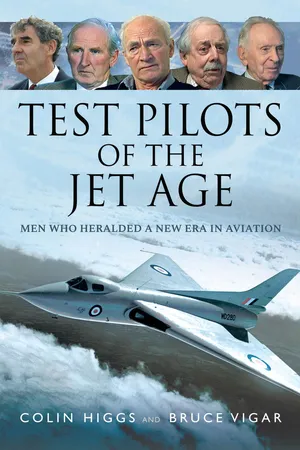
Today, as we board our flights to Adelaide, Zurich, and all points in between, we give little thought to the jet power that will take us there. But, this is only possible because just over 70 years ago a select band of British test pilots was prepared to risk all in the quest to fly further, faster, and higher than ever before. Their quest was fraught with danger; disaster and death were never far away. This book captures eleven of those stories as told by the pilots themselves – their words as to how they took British aviation to the forefront of a new era, the ‘Jet Age’. Britain’s aircraft industry was booming in the years immediately after the end of the Second World War and the demand for test pilots seemingly limitless as new aircraft types rolled off the drawing boards. Meteors, Vampires, Hunters, Comets, Victors, Vulcans and Harriers were some of the aircraft that became world-beaters. Today, these names and the role played by the test pilots in bringing these projects to fruition are all but forgotten. The stories were filmed over a number of years and it is the edited transcripts of those interviews that form a unique and rare perspective on such a pivotal era in aviation. Most were veterans of the Second World War with illustrious service records. Now they faced new battles as they flew new airframes and engines to the limit and sometimes beyond. First, they had to conquer the ‘sound barrier’ which to many, scientists and the public alike, had assumed almost mythic status. Having done that, they were soon flying at twice the speed of sound, such was the rate of progress. It took discipline, technical know-how, an above average level of flying skill and according to some, a lack of imagination to make a good test pilot. Their stories are often insightful, always modest and often tinged with humor.
eBook - ePub
Test Pilots of the Jet Age
Men Who Heralded a New Era in Aviation
- 184 pages
- English
- ePUB (mobile friendly)
- Available on iOS & Android
eBook - ePub
About this book
Information
Subtopic
Storia del XX secoloRoland ‘Bee’ Beamont
Most of the pilots in this book flew aircraft designed and built by the great British aircraft manufacturers. Companies like Fairey, Gloster, A.V. Roe, and so on. Wing Commander Roland Beamont forged his reputation test flying for a company that had never even built an aeroplane until after the war. But, just two types, the Canberra and Lightning, ensured English Electric’s reputation and that it would go down as one of the greats in the story of British aviation.
Roland Beamont – ‘Bee’ as he was widely known – had an extraordinary career as a test pilot in that it spanned four ‘generations’ of jet flight. His test flying career began during the Second World War as a production test pilot for Hawkers. He was the first British pilot to fly supersonic, albeit while he was in the United States, and in an American-built aircraft; he then went twice the speed of sound during the English Electric P1/Lightning programme before retiring as chief test pilot on the Panavia Tornado programme.
Roland Prosper Beamont was born on 10 August 1920 and spent his early years in Chichester. Tangmere aerodrome was nearby and the young Beamont was often to be found watching the aircraft come and go. In 1926 he experienced flight for the first time when he was taken up in an Avro 504. From that point on he was smitten, spending all his pocket money on aviation books and models.
But academic study was not the young Beamont’s forte and it was only after six months of private tuition that he was able to pass the all-important School Certificate before he could progress to the next stage of his career. Having scraped together enough points to pass the exam, he presented himself at No. 13 Elementary and Reserve Training School at White Waltham Airfield for ab initio flying training as a civilian. The date was 2 September, the day after the declaration of war with Germany. In order to qualify for a short service commission, pilots had to pass this course by going solo after fifteen hours tuition. Roland only just managed to pass. For the next stage of his career, he was posted to No. 13 Advanced Flying Training School, at Drem in Scotland, flying Hawker Harts and then Hurricanes. On 21 October he passed out as a pilot officer graded as exceptional.
Bee’s first operational posting was to No. 87 Squadron based in France, which had been sent as part of the British Expeditionary Force in November 1939. He had logged just fifteen hours of flying Hurricanes and poor weather meant that there was little prospect of getting more experience. His chances were diminished further when he was hospitalised with a high fever. Rather than risk being removed from the squadron strength, Beamont discharged himself and returned to his squadron just as things were starting to warm up. Throughout the spring of 1940, German incursions over France increased as they tested British and French defences. In March, Beamont took part in the interception of a Heinkel 111 bomber. Then, on 8 May, he scored his first ‘kill’ when he shot down a Dornier Do 17.
On 10 May 1940, Germany launched its ‘Blitzkrieg’ in Western Europe. From the north and east, German forces swarmed down through the Netherlands and France. No. 87 Squadron was in the thick of the action as it sought to stem the tide. Within weeks the squadron had to be withdrawn back to England to re-equip. By July, No. 87 was in Exeter in a night-fighting role. At this stage of the war, night fighting relied on searchlights to find and spot the target and so it was a largely fruitless and frustrating exercise. To improve matters, Beamont came up with the idea of attacking German airfields on moonlit nights. It was a tactic that bore results and Bee was successful in destroying a number of aircraft on the ground.
In May 1941 Beamont was transferred to No. 79 Squadron as flight commander. This was followed in June by the award of a Distinguished Flying Cross. However, it was in December that he got his first introduction to test flying. He had reached the end of his first operational tour and was offered the post of Leigh-Mallory’s personal aide. But there was a second choice that meant he could keep flying:
Becoming a test pilot, it just happened. I was an ordinary Royal Air Force fighter pilot. I had been in the Battle of France and the Battle of Britain on Hurricanes and when I came to the end of my first operational tour, ‘P Staff’, that was the postings organisation at the Air Ministry, posted me to Hawkers for test-flying duties, which was the best possible thing I could imagine happening.
I arrived at Hawkers and learned how to be a test pilot in six months’ attachment there. I got the feeling for the job, in fact I became fascinated by it and so I was very happy to go back to it when the opportunity arose later.
The requirements were very simple at that time. There were no professional organisations to train test pilots like the Empire Test Pilots’ School today. Pilots were chosen for flying aptitude, and interest or keenness in the job. If a chap was thought to be particularly interested in the flying side of the work and also had good hands and co-ordination, had a record as an accurate and skilful pilot, he stood a chance of being chosen for the job. I suppose that is the way that I was selected. I wouldn’t have known, nobody asked me. They just sent me there.
My first experience as a test pilot at Hawkers had lasted six months and after that I was posted back to operations for another tour. That time I commanded a Typhoon squadron, which was then a very new aeroplane I had learned a little about, test flying at Hawkers. At the end of that tour of operations I was posted back for a second period to Hawkers, this time to test the development of the Typhoon, which was the Hawker Tempest. I enjoyed that very much and became more well trained in the business of test flying.
The exigencies of war were driving aircraft development hard. New threats required new solutions but aircraft designers were facing new, fundamental problems. ‘Conventional’ fighters were reaching the end of their performance capabilities because of poor aerodynamics. Up until the early years of the war, the solution for more speed was met by increasing the amount of power delivered by the engine so that it could drag the airframe through the sky more quickly. But by 1942 it was realised that this was not the solution for the future as aerodynamic resistance meant that the airframe simply could not go any faster. A new era in aviation design was about to begin:
At the end of 1942/beginning of ’43 Hawkers had got in development the Hawker Typhoon, which was a bog-standard 2,000 horsepower fighter to replace the Hurricane. Some aspects of the Typhoon produced a shortfall in performance: it had a very thick wing that had been specified by the Air Ministry, which mitigated against the Typhoon being able to get very much faster than it was ever going to. Putting in a bigger engine was not going to make it go faster because the wing was too thick. At the same time, this thick wing reduced the performance at altitude so that above 20,000ft the Typhoon was inferior to the Spitfire and, of course, to the enemy aeroplanes.
At around about the end of ’42 when I joined Hawkers, the Hawker company chief test pilot, George Bulman, and his supporters, Ken Sexsmith and Bill Humble, had started to investigate a phenomenon that was occurring with these big new fighters, which was this loss of control and very considerable buffeting and roughness that was experienced when they were diving these aeroplanes high up. It wasn’t happening low down but if they tried to get these aeroplanes to dive at their limiting speeds at high altitude, they were running into control difficulties. I joined that programme and it was a very exciting experience. For example, we took a Typhoon to 30,000ft and applied full throttle and fine pitch, rolled it into a steep, nearly vertical dive. As you approached about 450mph indicated airspeed, the aeroplane started to seem as if it was riding over cobblestones – tremendous roughness, increasing noise level, a roaring noise, controls started to stiffen. The next thing was it started to roll away to the left; you would try to put opposite control on and it wouldn’t work. The next thing was the nose would go down and you would pull the stick back and it wouldn’t respond, and so you were rolling left and pitching down with this tremendous noise and this roughness that was subsequently described as compressibility. This is a condition where the airflow around the airframe as it approaches the speed of sound, that is the actual air travelling around the airframe, compressed and stopped flowing smoothly. It went off into what were known as shock waves, which reduced the effectiveness of the controls and altered the pitch of the aeroplane, and eventually if you persisted it would actually go out of control and you would appear to be in a fatal situation. There were quite a number of fatal accidents where the pilots got into trouble and dived into the ground.
We at Hawkers were investigating why and we did find during that period, that was established by about 1943, that if you got into this frightening lack of control right to the point where you were actually out of control, it was rolling and diving away from you despite everything you could do with it. If you stayed there and rode it down from about 15,000ft or so down to about 10,000ft the speed of the aircraft relative to the speed of sound, as it got into the thicker air, reduced and as that occurred the shock wave died down and control came back. This was known as compressibility. It was a recognised condition by the end of ’43 and the designers were very, very busy trying to design the next generation of aeroplanes that would overcome this problem. But, until they did, and it wasn’t really until after the war we got aeroplanes that would actually cope right through this condition, compressibility was a limitation that all the air forces had to observe and pilots had to be trained to avoid getting into it.
It must have been extremely frightening for the chaps who got into it first. My first experience – I had been briefed by Philip Lucas, who was then the chief test pilot – I knew exactly what to expect and so I recognised it. That didn’t stop it being frightening but I did at least recognise what was happening.
The German experience was similar to ours. They had actually lost an Me 109 under test at their Rechlin test establishment as early as 1941 and one of the staff pilots there, a chap called Heinrich Bauvais, then took on the programme and was instructed to dive a Messerschmitt in exactly the same conditions. He recovered from the dive and came back and reported the sort of conditions I’ve described about the Typhoons – this was in 1941.
The Germans set about their research in a way that was very effective. By the middle of the war they had advanced very considerably in terms of aerodynamics and high speed, and they had produced a number of experimental aircraft that could get very close to the speed of sound. The first one that was of practical value was the Messerschmitt 262, which was a twin-engine fighter. That, in 1943, was streets of head of anything that the Allies had. It was being built and developed at the same time as our Meteor, but it was a far better aerodynamic concept. It was so far advanced that the Germans were able to put it into service in 1944. They misapplied it under Hitler’s direct instruction; that was one of his big mistakes. But they nevertheless had an aeroplane that had they produced it in very large quantities purely for the fighter arm, they would have done enormous damage to the USAAF and its attacks on Germany in 1944. However, Hitler – on his express orders – said that these twin-engine jets were to be called jet bombers and they were used for ground attack, which was misuse of them. By the end of 1944 the Me 262 was capable of over 500mph, which was a good 120mph faster than the average Allied fighters of the time. It was potentially a very powerful weapon. Unfortunately, I never got to fly one. After the war they evaluated the 262 and they found that it was superior in nearly every way to our Meteor and yet it had been put into service two years earlier. So, they were very well advanced.
I don’t think there was any blinding revelation. I think that they studied the Germans’ achievements, in fact, some of our own people from my company, English Electric, went over to Germany in the parties of the scientists to evaluate German industry and they found that what the Germans had done was to put together all the best theory, the best of knowledge, more quickly than we had. There wasn’t any major breakthrough, with one possible exception that is that the Germans were the first people to use sweeping back the wings in order to delay the compressibility effect. In broad terms, sweeping back the wing will reduce the drag and it will make an aeroplane go that much faster for a given amount of power. The Germans introduced sweep back. It wasn’t really a breakthrough, it was a good advance, and in post-war, of course, the rest of the aviation world took that up.
At the end of that period [at Hawkers] in 1944, I was posted for a third and final tour of operations to cover the D-Day invasion period on the Tempest that I had been testing at the factory, so that I began to get a very good feel for this particular type of aeroplane.
As well as advances in aerodynamics and jet power the Germans had been experimenting with pilotless aircraft and weapons that could fly themselves to their targets. The Vergeltungswaffe 1 [‘Vengeance Weapon 1’ or more commonly referred to as the V-1] was an early cruise missile. It was powered by a pulse jet motor, the distinctive noise of which led to it being called the ‘Doodlebug’ or ‘Buzz Bomb’. Launched from northern France, the V-1s heralded a new blitz against London. Their speed and size made them difficult targets for Britain’s defences. The Tempest’s low-level performance made it one of the few aircraft fast enough to compete with the V-1. Under Wing Commander Beamont’s command, 150 Wing quickly racked up 638 of a total of 1,846 V-1s destroyed by aircraft:
Shooting down V-1s required no special skills beyond good fighter pilot qualities: a chap who knew how to fly his aeroplane, had a great degree of alertness – you didn’t have much time in which to complete an interception on a V-1 because it was flying about as fast as your fighter could, they were almost exactly matched in speed, you had to be a good marksman, you had to be a good shot. If you could bring all those things together then it wasn’t all that difficult.
By late October, 1944 the V-1 launch sites had been overrun by the advancing Allies. London was safe once again. 150 Wing resumed its role of flying armed reconnaissance missions deep into northern Europe, attacking targets of opportunity. On 12 October 1944, Beamont took off for his 492nd operational mission. He was attacking a heavily defended troop train when the radiator in his Tempest was holed by shrapnel. With no chance of making it back, he crash-landed the Tempest without injury and was taken prisoner:
Towards the end of the war it was becoming apparent that I could actually go back to Hawkers as a civilian test pilot if I left the Air Force. I was offered this by the chief test pilot, Philip Lucas. Of course, I would have had the option of staying in the Air Force – I could apply for an extension of my service – a permanent commission. At about the time when the decision was going to be taken, I got it wrong and ended up as a prisoner of war on the other side of the Rhine.
He remained a PoW until the camp he was held in was overrun by Soviet forces in May 1945. Unfortunately, they could hardly consider themselves ‘liberated’ as the Russians held them for several more weeks. On his return, Beamont found that the role of deputy experimental test pilot had been filled during his incarceration but, thanks to his contact with Philip Lucas, he was able to land a test pilot’s job at the Gloster Aircraft Company:
So, after the war I came back into the Air Force, which I had thoroughly enjoyed being in, and I had the prospect of deciding which way my career should go. I had some experience as a test pilot, which I very much enjoyed, and I equally enjoyed being in the Royal Air Force. It was a wonderful service and so I applied for a permanent commission. This was immediately after the war. In the way things went at that time with thousands of people applying for permanent commissions, bureaucracy wheels ground slowly. I was lucky to be welcomed in as a test pilot by the Gloster aircraft company. I had been there for a short time when I had an invitation from the Air Ministry to go back for induction for a permanent commission in the Royal Air Force. My wife Pat and I had a long, long discussion about this, lasting some days I think, as to whether I should resume my career in the Air Force or whether I should take up a new career in the aircraft industry. The key factor for me was that this was the beginning of the jet era, the new jets had just arrived and there was a whole new and exciting future coming up. We elected to go into the industry.
The late 1940s was a ‘golden era’ for the Gloster Aircraft Company. It had designed and built Britain’s first experimental jet aircraft, the E.28/39. It had followed this up with the Meteor, which was the RAF’s (and other air forces around the world) first jet aircraft and was the only Allied jet fighter to enter service during the Second World War:
The comparison of the Meteor to the Tempest, you could say that I was a little disappointed when I first flew one in 1944. The Meteor was very new, it was in the very early stages of development and it could be said that it had been rushed into service for political reasons because the flying bomb battle was going on and it probably helped to be able to say that we are employing our latest jet fighter against the V-1s.
When the Meteors of 616 Squadron arrived at Manston in the summer of ’44 I had my wing of Tempests just down the road at Newchurch and we were being highly successful. In two months of the V-1 battle the Tempest shot down over 600 V-1s. When the Meteors arrived I thought I must find out about this. The squadron commander was a friend of mine, so I asked him if I could come over and he said that I could come over and fly anytime. So, I went over and flew a Meteor Mk 1, I think it was, at Manston.
I was quite disappointed in it because it was not a well-developed fighter airplane. It was easy to fly. The jet engines were a remarkable experience in that they were terribly smooth and, of course, there was hardly any noise. The only thing that I felt that was of any particular interest was that at full throttle you could go about 80mph faster than my Tempest, which was capable of 430mph, so this was just about the 500mph aeroplane. But, having got to that astonishing speed, you had no alternative but to throttle back and return to base and hope to get there before the fuel ran out. So, it wasn’t a very flexible fighter aeroplane and I was sure I wouldn’t want to be operating Meteors at that time of the war.
The early jets were to some extent a disappointment. The Meteor was always a rather heavy, cumbersome aeroplane to be a fighter. The de Havilland Vampire was a little single-engine thing and that seemed to take full advantage of the jet engine in that it was a very lively aeroplane, very aerobatic. It was a good combat fighter but it was very restricted in radius of action, very short endurance. It was also not quite as fast as a Meteor, so in that sense it was not a particularly advanced aeroplane. It wasn’t until we started get swept-wing fighters that there was a real advance in fighter performance. I think that the period after the war with the development of many types of prototypes with jets didn’t produce a really effective fighter aeroplane until 1947/48, when the Americans produced the North American Sabre – F-86 – and we as a country produced by the end of the ’40s the Hawker Hunter. Now, those two types were great advances. They were 600mph aeroplanes. They were fully aerobatic, and they were potentially very good fighters, very good.
Britain’s post-war aviation industry was moving quickly to develop new aircraft and perhaps be the first to build a truly supersonic aircraft:
I stayed with the Gloster company for a while before I applied to the English Electric Company in the north of England, where I knew they had received the contract to design and produce our country’s first jet bomber – it would be one of the first jet bombers in the world for practical purposes and I applied for the job of chief test pilot as they were forming a new team. After some months, Teddy Petter, who was the chief engineer, sent for me to have an interview there and they gave me the job.
I think that I got the job because I had two things going for me. One was that I had three tours of opera...
Table of contents
- Cover
- Title
- Copyright
- Contents
- Introduction
- Jim Cooksey
- John Cunningham
- Eric Brown
- Roland ‘Bee’ Beamont
- Richard ‘Dickie’ Martin
- Duncan Simpson
- Godfrey Auty
- John ‘Jo’ Lancaster
- John Allam
- John Farley
- Peter Twiss
- Plates
Trusted by 375,005 students
Access to over 1.5 million titles for a fair monthly price.
Study more efficiently using our study tools.
Frequently asked questions
Yes, you can cancel anytime from the Subscription tab in your account settings on the Perlego website. Your subscription will stay active until the end of your current billing period. Learn how to cancel your subscription
No, books cannot be downloaded as external files, such as PDFs, for use outside of Perlego. However, you can download books within the Perlego app for offline reading on mobile or tablet. Learn how to download books offline
Perlego offers two plans: Essential and Complete
- Essential is ideal for learners and professionals who enjoy exploring a wide range of subjects. Access the Essential Library with 800,000+ trusted titles and best-sellers across business, personal growth, and the humanities. Includes unlimited reading time and Standard Read Aloud voice.
- Complete: Perfect for advanced learners and researchers needing full, unrestricted access. Unlock 1.5M+ books across hundreds of subjects, including academic and specialized titles. The Complete Plan also includes advanced features like Premium Read Aloud and Research Assistant.
We are an online textbook subscription service, where you can get access to an entire online library for less than the price of a single book per month. With over 1.5 million books across 990+ topics, we’ve got you covered! Learn about our mission
Look out for the read-aloud symbol on your next book to see if you can listen to it. The read-aloud tool reads text aloud for you, highlighting the text as it is being read. You can pause it, speed it up and slow it down. Learn more about Read Aloud
Yes! You can use the Perlego app on both iOS and Android devices to read anytime, anywhere — even offline. Perfect for commutes or when you’re on the go.
Please note we cannot support devices running on iOS 13 and Android 7 or earlier. Learn more about using the app
Please note we cannot support devices running on iOS 13 and Android 7 or earlier. Learn more about using the app
Yes, you can access Test Pilots of the Jet Age by Colin Higgs, Bruce Vigar in PDF and/or ePUB format, as well as other popular books in Tecnologia e ingegneria & Storia del XX secolo. We have over 1.5 million books available in our catalogue for you to explore.