The plethora of commentary from highly respected voices in a broad cross-section of academic disciplines, which V. S. Naipaul's death on 11 August 2018 elicited, ranged so widely, both cognitively and emotionally, that if a student of literature, unfamiliar with the Naipaulian era, read it all, they would have failed to make sense of the divergences.
Allegations included that he 'was a cruel man', 'a scarred man', 'the darkest dungeons of colonialism incarnate: self-punishing, self-loathing, world-loathing, full of nastiness and fury', 'a ventriloquist for the nastiest cliches European colonialism had devised to rule the world with arrogance and confidence' and so on. On the other hand, writers referred to Naipaul as a 'brilliant writer's writer', one 'who holds a mirror of imagination unto society to capture a certain view of reality' and one who 'has turned the genre of the travelogue into an art form'.
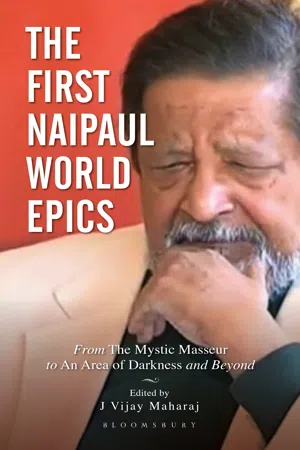
Debates aside, many of us appreciate the value of Naipaul's writing to the deepest possible comprehension of the imperial impulse and the myriad reasons it manifested as colonialism. The First Naipaul World Epics is the first in a series of critical collections that aim to demonstrate this value. At the same time, the series seeks to help the new student through the quagmire of divergent opinions his personality and writing have generated.
- 344 pages
- English
- ePUB (mobile friendly)
- Available on iOS & Android
eBook - ePub
About this book
Trusted by 375,005 students
Access to over 1.5 million titles for a fair monthly price.
Study more efficiently using our study tools.
Information
Chapter 1
V. S. NAIPAUL AND SWACHH BHARAT…
Gollamudi Radha Krishna Murty1
In memory of Sir Vidiadhar Surajprasad Naipaul, a Nobel Laureate in Literature of Indian descent, who, as an astute observer of the human condition, having written thirty-odd books that indeed caused many storms in readers’ minds, died peacefully in bed on 11 August 2018 in England.
Today, as I was flipping through the morning newspapers, there came a message in the name of our Prime Minister stating, “Aaiye swachha Bharat kaa nirman kare, 15th September se swachhtaa hi seva se juden” (Let’s strive to create a Swachh Bharat). It at once reminded me that I have over-delayed paying my tributes to one of the twentieth century’s most admired and contentious storytellers, V. S. Naipaul, who died at his home in London, aged eighty-five. And hence the following lines….
Naipaul was the grandson of a Brahman from the Banaras region who went to Trinidad in the nineteenth century as an indentured labourer. He was born in Chaguanas, Trinidad, in 1932 and later his family moved to the island’s capital, Port-of-Spain. He claims this shift transformed him from a child who knew almost nothing, nothing beyond what he picked up in his grandmother’s house, into an acute observer of the life of the street—the outside world. No wonder if Port-of-Spain then became the setting for his Miguel Street—a collection of stories that won him the Somerset Maugham Award in 1959. Much has been written about this book which establishes it as one of the most important produced in the twentieth century.
In 1950, after winning a government scholarship, Naipaul went to study at Oxford. Later, after Oxford, it is at BBC World Service where he analysed West Indian Literature that he found his footing as a writer. His breakthrough as a writer came with his first published novel, The Mystic Masseur, in 1957. In it, he presented a dialogic intercourse between two cultures: conservative Indian culture and European liberal capitalist culture. This novel, therefore, treats the reader to an authentic history through stories of the powerless people of a Trinidad ghetto. It is through caricature and irony that he presents the aspirations, energy, vulgarities, inconsistencies and corruption of characters who belong to a rapidly changing society in which there are few stable values.
Ganesh Ramsumair, the protagonist of the novel, is presented as a bundle of all the controversies of the colonial society as he, oscillating between traditional Indian values and the lure of modern consumer capitalism, rises from a teacher to a masseur, from a masseur to a mystic, from a mystic to an MLC (Member of the Legislative Council) quite spectacularly. As the novel comes to an end, this struggling Pandit Ganesh Ramsumair becomes G. Ramsay Muir—a complete transformation into a colonial puppet who even defends British colonial rule. Interestingly, while narrating these two cultures, their institutions, processes and products, Naipaul can never be said to be siding wholly with either the Trinidadian Indian or the European ways of life.
Drawing upon his real experiences among Indians in Trinidad, Naipaul went on to write all of his earlier novels—The Suffrage of Elvira (1958), Miguel Street (1959) and A House for Mr Biswas (1961)—in which he narrates the struggle of charlatans, braggarts and dreamers to eke out a life with social respectability in their new worlds of settlement. However, it is his fourth novel, A House for Mr Biswas—a treatise on the pangs of exiles—that won him major recognition. Drawing from the experiences of his father, Naipaul narrated the struggle of the protagonist of the novel, Mohan Biswas, a Trinidadian Indian, to free himself from the predicaments of family, custom and religion.
Being the son of a poor labourer and having lived as a guest in one inhospitable house after another following his father’s death and his marriage into a powerful family, Biswas vows to get a job on his own. And he vows to get his own house too. And, finally, by journeying through a variety of jobs, from sign painter to journalist, Biswas acquires a house of his own, which, in his view, is the signpost of his independence. But under the stress of getting the house repaired and the burden of repaying the debt, he suffers a heart attack and dies soon afterwards. Nonetheless, he leaves a house behind for sheltering his family for generations to come, and subsequently the literature of Trinidad and Tobago. Naipaul, while narrating the struggle of Biswas for dignity and independence, successfully explored the themes of family, poverty and the impact of colonialism on the economy of the vanquished colonial world from a postcolonial perspective. The novel has succeeded in making an entry into Time magazine’s 100 best English-language novels from 1923 to 2005 as a result of all of this.
Moving back and forth from Trinidad to other areas of the world, Naipaul used other national settings in his subsequent novels—In a Free State (1971), Guerrillas (1975), A Bend in the River (1979) and A Way in the World (1994)—but continued to explore the relationship between violence, contingency and politics and the emerging personal and collective alienation experienced by the victims in the new milieux emerging out of the struggle between native and Western-colonial heritages. In a Free State (1971), a novella with two supporting narratives, each set in different countries, which won him Britain’s Booker Prize, was hailed by Neel Mukherjee as a “remarkable, clear-eyed, truthful and brutal meditation on exile and displacement”.2
He accomplished this task by resorting to two techniques: in “One Out of Many”, he resorted to first-person narratives through the voice of Santosh, an Indian servant in Washington and, in “Tell Me Who to Kill”, it is the poor Trinidadian Indian who narrates the story in London; but in “In a Free State”, he adopts a third-person narrative perspective to tell about a long car journey undertaken by two English persons, Bobby and Linda, across an unnamed African country.
In his other novels, such as The Enigma of Arrival (1987), A Way in the World (1994) or Half a Life (2001), he examined carefully his own inner demands and analysed even his deceptions through the protagonists. In fact, some critics consider The Enigma of Arrival, written eight years after his previous publication, as his masterpiece because of its structure as a long meditation on a work by the surrealist painter Giorgio de Chirico. In this novel, the narrator, who is perhaps no other than Naipaul himself with his own melancholy sense of rootlessness, takes many journeys, starting from colonial Trinidad, both imaginary and real, to the English countryside to become a writer. Interestingly, the narrator-migrator, choosing to inhabit a pastoral England, invents the earth below his feet and in the process feels as though the new piece of land has given him a second chance, a new life, richer and fuller than any he had had anywhere else, in which he can practise his writer’s trade. However, later, in the second part of the book, the narrator, under the spell of sickness, observing the world around him from the perspective of an outsider, perhaps more as an anthropologist, describes in a sad, melancholic tone the collapse of an old coloniser.
It is his non-fiction works that are large-sized narratives of his travels to different countries over different periods of time—The Middle Passage: Five Societies in the West Indies (1963), An Area of Darkness (1964), India: A Wounded Civilization (1976), Among the Believers (1981), India: A Million Mutinies Now (1990) and Beyond Belief (1998)—that attracted for him immense critical hostility and anger, particularly from the postcolonial world. But first things first: let us examine what he wrote under these titles.
At the time of publishing his first book on India, An Area of Darkness—a chronicle of his first visit to his ancestral homeland—India was indeed passing through darkness; it was just limping back from the humiliation inflicted by Chinese aggression. Owing to the widespread drought and the resulting shortage of food grains, we were then living off the American wheat supplied under the PL480 programme. And it was this despairing and hungry India that confounded him when he landed at the Bombay airport. Naipaul’s declared state of mind as a result was: “I am profoundly Indian in my feeling, profoundly Indian in my sensibility … but not in my observation” (C. D. Narasimhaiah, The Function of Criticism in India 117). He recognised, however, that from his observatory, “from the railway train and from the dusty roads, India appeared to require only pity. It was an easy emotion, and perhaps the Indians were right: it was compassion like mine, so strenuously maintained, that denied humanity to many” (Area of Darkness 263).
At the very outset of this travelogue as he landed at the Bombay airport, he encountered the bitterest experience: despite having a permit for the two bottles of liquor that he had brought with him, they were confiscated by custom authorities who declared that a “transport permit” was needed. In search of this increasingly elusive item, he had to run from office to office, table to table facing every official behaving either indifferently or arrogantly. This was his first introduction to the real place with which he had identified in his imagination throughout his life. Thereafter, it was the all-pervading poverty and squalor that gave him a rude shock. He wrote: “I had seen the starved child defecating at the road side while the mangy dog waited to eat the excrement” (Area of Darkness 45). What was more distressing to him was that it was not only a village scene. Such habits could be seen on the slopes of Himalayas, at the bus-stand of Madras and on the beaches of Goa. It was to be seen everywhere. He went on penning:
Indians defecate everywhere. They defecate, mostly, beside the railway tracks. But they also defecate on the beaches; they defecate on the hills; they defecate on the streets; they never look for cover … the peasant, Muslim or Hindu, suffers from claustrophobia if he has to use an enclosed latrine. (Area of Darkness 210)
In the same vein, he loathed the corruption prevailing in the country and was pained to note that no shame comes to those corrupt people; instead, a lot of social prestige and status is bestowed on such unscrupulous officials:
It is estimated that in Kashmir, as in the rest of India, one-third of development funds drains away in corruption and the exchanging of gifts. No disgrace attaches to this. The Kashmir tailor spoke with envious admiration of his patwari friend, a surveyor and type of records-keeper, who in one day might collect as much as a hundred rupees; a lorry-driver had a similar admiration for a traffic inspector he knew who received monthly protection money from various lorry-drivers. (Area of Darkness 92)
He thus concluded that corruption had become deep-rooted in the Indian system of government and society and was as invisible as the habit of public defecation. And now, however sore we may feel about these observations, can we deny the fact that the same system of defecating is prevailing in the country even after about fifty years since Naipaul’s visit? And even after seventy years of independence, can we not admit that the malady of corruption is haunting us, albeit with more ferocity? These are the questions that Naipaul’s works force on us still and which made me remember him when I heard the Prime Minister’s call for Swachh Bharat.
By the time he wrote his second India book, India: A Wounded Civilization (1976), the nation was passing through the pangs of the Emergency declared by Indira Gandhi. And, of course, poverty was relentless, while corruption mounted up in all walks of life. While the leaders were twittering about socialist slogans, the countryside presented a grim scenario of undernourished children. And visiting India for the second time but under such testing times, Naipaul continued to be disappointed by India. Reacting to the institutional collapse under the Emergency imposed by Mrs Gandhi, he pronounced: “The dismantled institutions—of law, press and Parliament—cannot simply be put together again” (India: A Wounded Civilization 98).
Speaking about Indian civilisation as a “wounded civilization”—decayed and dying—Naipaul states:
No civilization was so little equipped to cope with the outside world; no country was so easily raided and plundered, and learned so little from its disasters. Five hundred years after the Arab conquest of Sind, Muslim rule was established in Delhi as the rule of foreigners, people apart, and foreign rule—Muslim for the five hundred years, British for the last 150—ended in Delhi only in 1947.
He pessimistically concludes his book with the statement: “The crisis of India is not only political or economic. The larger crisis is of a wounded civilization that has at last become aware of its inadequacies and is without the intellectual means to move ahead” (India: A Wounded Civilization 102).
No wonder if such comments attracted outrage from Indian readers: “He seems to me to write for the same reason that many ossified academics publish; else they must perish,” said C. D. Narasimhaiah (“Naipaul’s Indian Experience Again” 99). Nevertheless, one may have to admit that what Naipaul wrote about India is not wholly untrue, for India did suffer under the yoke of foreign rule for many centuries and responded by withdrawing into itself and as a result suffers from self-deception (India: A Wounded Civilization 102).
In his final book on the trilogy of India, India: A Million Mutinies Now, Naipaul appeared to have mellowed down. Or, perhaps by the 1990s, India was on the cusp of evolving into a nation, a promise in the emergence, perhaps! Although he witnessed a new generation of intellectuals crying in hoarse empty words, he could see that India was somehow managing to survive, and indeed evolving: “Independence had come to India like a kind of revolution; now there were many revolutions within that revolution…. All over India scores of particularities that had been frozen by foreign rule, or by poverty or lack of opportunity or abjectness had begun to flow again” (India: A Million Mutinies Now 19). What others might see as unrest, Naipaul saw as an awakening.
It is obvious that such a probing and the resultant writing about India in what some saw as disparaging ways brought a barrage of protests from the intellectuals of India. Some critics accused him of “look [ing] at India through Western kaleidoscope which takes myriad unreal ...
Table of contents
- Cover Page
- Half Title
- Title Page
- Copyright
- Contents
- Editor’s Preface
- Acknowledgements
- Introduction: V. S. Naipaul’s Writing: A Case of Literature Undoubtedly Transforming Our Lives J. Vijay Maharaj
- Chapter 1: V. S. Naipaul and Swachh Bharat…
- Chapter 2: Merchant-Ivory’s The Mystic Masseur: When Caribbean Literature Meets Filmi Dreams
- Chapter 3: V. S. Naipaul’s The Mystic Masseur: Defining Failure and Success for the Colonial Subject
- Chapter 4: The Suffrage of Elvira: A Study of Politics in Pre-Independence Trinidad
- Chapter 5: Elvira You Is a Bitch
- Chapter 6: The Trinidadian Calypso As Oral Heritage: Linguistic and Cultural Issues in the Italian Translation of V. S. Naipaul’s Miguel Street
- Chapter 7: With a Tassa Blending: Calypso and Cultural Identity in Indo–Caribbean Fiction
- Chapter 8: Elitist versus Vernacular Cosmopolitanism in Naipaul’s Miguel Street
- Chapter 9: The Language of Advertising and the Novel: Naipaul’s A House for Mr Biswas
- Chapter 10: Character and Rebellion in A House for Mr Biswas by V. S. Naipaul
- Chapter 11: The Implications of Transtextuality in V. S. Naipaul’s The Middle Passage: The Caribbean Revisited
- Chapter 12: Did V. S. Naipaul Hate Trinidad?
- Chapter 13: V. S. Naipaul and the 1946 Trinidad General Election
- Chapter 14: Colonial Fantasy Shattered, Cosmopolitan Dream Broken: V. S. Naipaul’s Mr Stone and the Knights Companion
- Chapter 15: Naipaul’s English Fable: Mr Stone and the Knights Companion
- Chapter 16: Failures in Decolonisation and the Return to the Past: Reading V. S. Naipaul
- Chapter 17: V. S. Naipaul and Historical Derangement
- Chapter 18: Among the Unbelievable: Rage, Faith and Reason in Selected Writings by V. S. Naipaul
- About the Editor and Contributors
- Index
Frequently asked questions
Yes, you can cancel anytime from the Subscription tab in your account settings on the Perlego website. Your subscription will stay active until the end of your current billing period. Learn how to cancel your subscription
No, books cannot be downloaded as external files, such as PDFs, for use outside of Perlego. However, you can download books within the Perlego app for offline reading on mobile or tablet. Learn how to download books offline
Perlego offers two plans: Essential and Complete
- Essential is ideal for learners and professionals who enjoy exploring a wide range of subjects. Access the Essential Library with 800,000+ trusted titles and best-sellers across business, personal growth, and the humanities. Includes unlimited reading time and Standard Read Aloud voice.
- Complete: Perfect for advanced learners and researchers needing full, unrestricted access. Unlock 1.5M+ books across hundreds of subjects, including academic and specialized titles. The Complete Plan also includes advanced features like Premium Read Aloud and Research Assistant.
We are an online textbook subscription service, where you can get access to an entire online library for less than the price of a single book per month. With over 1.5 million books across 990+ topics, we’ve got you covered! Learn about our mission
Look out for the read-aloud symbol on your next book to see if you can listen to it. The read-aloud tool reads text aloud for you, highlighting the text as it is being read. You can pause it, speed it up and slow it down. Learn more about Read Aloud
Yes! You can use the Perlego app on both iOS and Android devices to read anytime, anywhere — even offline. Perfect for commutes or when you’re on the go.
Please note we cannot support devices running on iOS 13 and Android 7 or earlier. Learn more about using the app
Please note we cannot support devices running on iOS 13 and Android 7 or earlier. Learn more about using the app
Yes, you can access The First Naipaul World Epics by in PDF and/or ePUB format, as well as other popular books in Literature & Literary Collections. We have over 1.5 million books available in our catalogue for you to explore.