- 210 pages
- English
- ePUB (mobile friendly)
- Available on iOS & Android
eBook - ePub
About this book
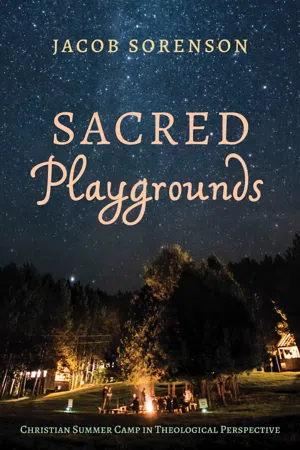
Sacred Playgrounds explores the wisdom of camping ministry for Christian education and faith formation, examining its rich history and fundamental characteristics with compelling stories, groundbreaking research, and theological grounding. Christian summer camp is an integral part of the ecology of faith formation in North America, though it has received surprisingly little attention in the scholarly community until now. Camping ministry is often dismissed as simple fun and games or a brief spiritual high that does not last. However, camp experiences often serve as deeply relational and immersive faith experiences that have lasting impacts on participants. Five fundamental characteristics combine dynamically in the effective camp experience: participatory, faith-centered, safe space, relational, and unplugged from home. Together, they open the space for participants to consider new understandings of God, to have time for deep self-reflection, and to build intentional Christian community. These camp experiences are essential components in a larger ecology of faith formation, including the home and congregation. The insight and evidence presented in this book demonstrate that the contributions of camping ministry must be taken seriously among scholars, Christian educators, and ministry professionals.
Information
Topic
Theology & ReligionSubtopic
Christian MinistryPart 1: Welcome to Camp
We rounded the first corner of the island and felt the wind buffet the side of the canoe. I chanced a look around and saw the disaster that was befalling our group. We were only a few hundred yards from the beach, but the dozen canoes were scattered in disarray. We were supposed to stay close together. That was the plan: stay close together, stay close to the shore, paddle around the island. It will be fun, they assured us. Ben and I were determined to stay on course and complete the circuit. Our counselor, Brian, sat in the middle of our canoe with a rescue tube across his lap. He was the lifeguard. He never said aloud that we were the best canoeists because he did not want the others to feel bad, but everyone knew that the lifeguard had to be in the fastest canoe.
“Hey, are they supposed to be going that way?” Ben asked.
I looked around and spotted the wayward canoe. It was drifting farther and farther away from shore. The two girls were fumbling awkwardly with their paddles, and they were laughing. Laughing! They clearly did not understand their peril. We were on the Mighty Mississippi River, and the current might draw them far downstream, capsize them, or deposit them in the mythical land known as Iowa.
“Let’s go get them,” Brian said.
Ben and I gave each other a meaningful look. It was up to us. This is where our forty-five minute canoe orientation would pay off. We pulled with all our might, straining our developing eighth-grade muscles to the max, and set an arrow-straight course to the floundering vessel. We both saw the river buoy as we passed it, knowing that we had just crossed into the main channel of the Mississippi River. As we approached the other canoe, Brian calmly gave instructions to the girls. They tried to obey, and they managed to get their canoe turning in circles, laughing the whole time.
“Barge!” we heard someone yell from shore. “BARGE!”
I looked up and saw it rounding the nearest bend in the river, heading downstream straight toward us. Our camp counselors had warned us about river barges. They were enormous, cargo-hauling flat boats, 200 feet long and churning up a huge wake that would capsize canoes and create a tremendous undertow. They could not stop or swerve to avoid you. If we encountered a barge while canoeing, we were to quickly get to shore. Barges were the precise reason we were supposed to stay close to shore in our trip around the island that morning.
Brian acted quickly. He reached out and pulled the girls’ canoe toward ours, clamping them together with his powerful man-hands. He looked at me with utmost confidence. “Okay, let’s get to shore.”
Upstream, into the wind, pulling two canoes with five people, with certain death churning inexorably nearer, Ben and I paddled for shore. We reached a rocky outcropping and disembarked into knee-deep water, exhausted but exhilarated. “Good job, guys,” Brian said to us meaningfully, as the giant river barge slipped past at a safe distance.
The girls were no longer laughing. “You saved our lives,” they said in awe.
Ben and I looked at each other and nodded. We had just met three days ago and become fast friends. Now, we were brothers. We waded through the water in dramatic slow motion. The rest of our beleaguered group came into view as we rounded a bend in the island, and a cheer broke out. We were heroes.
We never made it around the island that day. After the morning’s excitement, our counselors opted for a more relaxed day of games, Bible study, and conversation on the beach. Our evening campfire that night was emotional and powerful. Our four counselors led an interactive worship service that included a skit about Jesus’ teachings and some of our favorite songs from the week. During the prayers, one of the girls from the rescued canoe thanked God for keeping her safe that day by sending Ben and me to save her. I went to the tent that night wide awake with thoughts from the day’s events. It was our second and final night on the island. In the morning, we would pack up and canoe the short distance to the mainland before being driven back to camp. There, we would rejoin the rest of the camper groups for some unnamed large-group activities.
Ben and I shared a tent with Jon, another eighth-grade boy we had befriended that week. None of us were tired, so we talked. After our harrowing experience on the river, our conversation quickly turned to the topic of death and specifically what happens when you die. The next question came up naturally, as if it were a topic we discussed all the time. The truth is that in thirteen years of church and Sunday school, nobody had ever asked me that question. Ben asked it:
“Do you really believe in God?”
The funny thing is that I have almost no recollection of the conversation beyond that point. What I remember is that we talked about God, faith, and doubt into the wee hours of the morning. There, in a small tent on an island in the middle of the Mississippi River, three cocky eighth-grade boys shared their faith and fears with one another. For the first time in my life, I had an open and honest conversation about who I am in relation to God.
Brian was in the tent next to ours. It occurred to me years later that he must have been listening. He knew that we were awake past curfew. In fact, we were probably keeping other people awake. But he did not tell us to be quiet or speak up to correct our juvenile theology, which was probably well into the realm of heresy. He was our guide that week. He did not orchestrate the damsels in distress that day or call the barge to appear at the precise moment. He merely guided us along the way, giving us space to succeed and helping us interpret our lives’ events through theological and biblical lenses.
Looking back more than twenty-five years later, I consider that night’s conversation to be a turning point in my life that directed me on a path of discipleship and professional ministry. It was in the middle of my first camp experience. That specific community in that specific context provided space for the Holy Spirit to move in a way that I was able to recognize and articulate. I am not sure how that evening’s conversation affected Jon or Ben, neither of whom I have seen since our camp experience ended two days later. I also wondered where the Spirit led Brian after his time at camp. As I was finalizing the manuscript for this book, I finally did something that I had been meaning to do for years: I tracked down Brian and sent him a message. I told him about where the Lord had taken me and thanked him for his role in guiding me all those years ago. He wrote back a few days later, saying that he remembered that week we spent together at Sugar Creek and has used stories from that week as sermon illustrations. Maybe it should not surprise me that he is a pastor now.
Stories can be powerful. They can also be misleading. More than 2 million young people attend Christian camps in the United States each summer, but not everybody has a life-impacting experience like mine. My story does not prove the power of the camp experience, but it changed my life. This book delves deeply into the Christian camp experience to discover why stories like mine are so common and why other camp participants do not have such positive experiences. First, we will welcome you into the camp experience and orient you to what camp is and what it is not. We will venture through generations o...
Table of contents
- Title Page
- Acknowledgments
- Part 1: Welcome to Camp
- Part 2: The Fundamentals of Christian Summer Camp
- Appendix A: Self-Evaluation for Camp Directors and Full-Time Staff
- Bibliography
Trusted by 375,005 students
Access to over 1.5 million titles for a fair monthly price.
Study more efficiently using our study tools.
Frequently asked questions
Yes, you can cancel anytime from the Subscription tab in your account settings on the Perlego website. Your subscription will stay active until the end of your current billing period. Learn how to cancel your subscription
No, books cannot be downloaded as external files, such as PDFs, for use outside of Perlego. However, you can download books within the Perlego app for offline reading on mobile or tablet. Learn how to download books offline
Perlego offers two plans: Essential and Complete
- Essential is ideal for learners and professionals who enjoy exploring a wide range of subjects. Access the Essential Library with 800,000+ trusted titles and best-sellers across business, personal growth, and the humanities. Includes unlimited reading time and Standard Read Aloud voice.
- Complete: Perfect for advanced learners and researchers needing full, unrestricted access. Unlock 1.5M+ books across hundreds of subjects, including academic and specialized titles. The Complete Plan also includes advanced features like Premium Read Aloud and Research Assistant.
We are an online textbook subscription service, where you can get access to an entire online library for less than the price of a single book per month. With over 1.5 million books across 990+ topics, we’ve got you covered! Learn about our mission
Look out for the read-aloud symbol on your next book to see if you can listen to it. The read-aloud tool reads text aloud for you, highlighting the text as it is being read. You can pause it, speed it up and slow it down. Learn more about Read Aloud
Yes! You can use the Perlego app on both iOS and Android devices to read anytime, anywhere — even offline. Perfect for commutes or when you’re on the go.
Please note we cannot support devices running on iOS 13 and Android 7 or earlier. Learn more about using the app
Please note we cannot support devices running on iOS 13 and Android 7 or earlier. Learn more about using the app
Yes, you can access Sacred Playgrounds by Jacob Sorenson in PDF and/or ePUB format, as well as other popular books in Theology & Religion & Christian Ministry. We have over 1.5 million books available in our catalogue for you to explore.