An intimate look at the true story of the funerary business of a Theban mortuary priest 2800 years ago as unearthed by an ancient papyrus
Petebaste son of Peteamunip, the choachyte, or water-pourer, lived during the first half of the seventh century BCE in the reigns of the Twenty-fifth Dynasty Kushite kings Shabaka and Taharqa and was responsible for the comfortable and carefree afterlife of his deceased clients by bringing their weekly libations.
But Petebaste was also responsible for a wide range of other activities—he provided a tomb to the family of the deceased, managed the costs of the personnel and commodities, and took care of all necessary paperwork, while also tending to the gruesome preparation of the mortal remains of the deceased.
Drawing on an archive of eight abnormal hieratic papyri in the Louvre that deal specifically with the affairs of a single family, Donker van Heel takes a deep dive into the business dealings of this Theban mortuary priest. In intimate detail, he illuminates the final stage of the embalming and coffining process of a woman called Taperet ('Mrs. Seedcorn') on the night before she would be taken from the embalming workshop to her final resting place, providing fascinating insight into the practical day-to-day aspects of funerary practices in ancient Egypt.
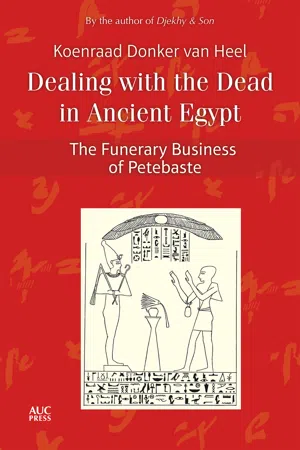
eBook - ePub
Dealing with the Dead in Ancient Egypt
The Funerary Business of Petebaste
- English
- ePUB (mobile friendly)
- Available on iOS & Android
eBook - ePub
About this book
Information
1
The Texts
This book will look at an archive of eight abnormal hieratic papyri now kept in the Louvre in Paris. Abnormal hieratic is the highly cursive business script used in the south after the New Kingdom (see Chapter 3, “So Why Was Hieratic Abnormal?”). Publishing an entire abnormal hieratic archive is something that has never been done before in Egyptology. The fact that the scientific and popular versions will appear almost at the same time is also new. The papyri we are concerned with all bear the same inventory number, namely P. (Papyrus) Louvre E 3228, but to distinguish between them they received the additional letters A–H (our docs. 1–8). Five of the eight letters were then reassigned to other Louvre E 3228 papyri somewhere in the nineteenth century and, as we will see below, this was perhaps not done by accident.
As far as can be seen, these texts most probably are only part of what was once the business archive of a Theban mortuary priest, the choachyte or water-pourer Petebaste (“Whom (the cat goddess) Bastet has given”) son of Peteamunip, who lived during the reigns of King Shabaka and Taharqa of the Twenty-fifth Dynasty, a period that is not the best documented in Egyptian history. They range between year 10 of Shabaka and year 15 of Taharqa (695–676/675 BCE), spanning a mere twenty years in what we may now refer to as the new chronology, in which the hitherto accepted order Shabaka–Shabataka–Taharqa has been reversed to Shabataka–Shabaka–Taharqa. In the old chronology, the archive would have spanned about thirty years (705–676/675 BCE). However, the new chronology has much going for it, and it is now almost unanimously accepted by the Late Period specialists. Chronological discussions tend to be only interesting for a minute. However, amidst the confusing mass of evidence––often circumstantial––the Austrian Egyptologist Claus Jurman hit upon the definitive proof. The Egyptians naturally recorded the levels of the Nile flood, knowing full well what would be needed for a good harvest. And it so happens that two inscriptions of the Karnak nilometer show that Shabataka did indeed precede Shabaka. Jurman was the first to note that the man who carved out the inscription in a specific year from the reign of Shabaka was actually forced to adapt the size of some hieroglyphs, because otherwise they would have collided with an inscription from the reign of Shabataka, which was already there. Ergo, Shabataka reigned before Shabaka.
Six or perhaps seven of the eight papyri we are concerned with (for which see the tables below) deal with the affairs of the members of a single family of Petebaste’s clients, who happened also to be his colleagues, whereas docs. 1 and 6 appear to be entirely unconnected to this family file. Doc. 1 (year 10 of Shabaka) is too early to be linked to the known members of the family––either as deceased clients, business partners, or legal opponents in court––and doc. 6, which was probably written in year 13 of Taharqa rather than year 13 of Shabaka, is about a loan from a scribe of the Royal Correspondence, who is certainly not related to our family of clients.
The funerary accounts 7 and 8––the first was written in year 15 of Taharqa and both deal with the same final stage of the embalming (and coffining) process of a woman called Taperet (“Mrs. Seedcorn”). This happened most probably during the very last night in the embalming workshop just before burial. We see a number of professionals, who were employed by our choachyte Petebaste, enact what appears to be a private version of the Khoiak Festival, which would explain the presence of dancers and singers (the latter are mentioned in the same breath as their beer ration and black eye paint, something one still sees today) and a draftsman. Valuables or commodities such as grain would have changed hands between these professionals on a continual basis, so it could well be that doc. 6 is connected to Petebaste’s client family file after all, but we have no way of knowing. The title “choachyte”––a person pouring water for the dead in the necropolis––suggests that Petebaste was only responsible for the libations to the deceased in the Theban necropolis, but docs. 7 and 8 show that his work actually comprised a much wider range of activities. Choachytes more than once also provided a tomb to the family of the deceased, while taking care of all the necessary paperwork and the gruesome déconfiture of their mortal remains (for which the choachytes would have resorted to specialists).
These are the documents in Petebaste’s archive, ordered after their sequence in the Livre d’Inventaire of the Louvre but, as we will see, this is not the only list.
P. Louvre E 3228 A | Year 3 of Taharqa |
P. Louvre E 3228 B | Year 5 of Taharqa |
P. Louvre E 3228 C | Year 6 of Taharqa |
P. Louvre E 3228 D | Year 10 of Shabaka |
P. Louvre E 3228 E | Probably year 13 of Taharqa |
P. Louvre E 3228 F | Year 15 of Taharqa |
P. Louvre E 3228 G | Date broken away, but probably years 3–4 of Taharqa |
P. Louvre E 3228 H | Same embalming as in P. Louvre E 3228 F, so year 15 of Taharqa |
All would be good if things would have remained in place as they were. But clearly they did not, because somewhere in the nineteenth century someone in the Louvre decided to relabel five of these papyri. While the original designations had been written on the blotting paper holding the papyri, someone put paper labels on them with different designations. One could surmise who this person was, and why he did it––the word “sabotage,” by the way, is derived from the French word “sabot,” referring to the clogs worn by workers that they would occasionally shove into the machine to stop it.
The documents are therefore also cited under different inventory numbers from the ones mentioned in the above table.
P. Louvre E 3228 D | Year 3 of Taharqa |
P. Louvre E 3228 F | Year 5 of Taharqa |
P. Louvre E 3228 C | Year 6 of Taharqa |
P. Louvre E 3228 E | Year 10 of Shabaka |
P. Louvre E 3228 B | Probably year 13 of Taharqa |
P. Louvre E 3228 A | Year 15 of Taharqa |
P. Louvre E 3228 G | Date broken away, but probably years 3–4 of Taharqa |
P. Louvre E 3228 H | Same embalming procedure as in P. Louvre E 3228 F, so year 15 of Taharqa |
This is of course very confusing. Something needed to be done. In the table below, the capital letters following “carton” are the original designations of the papyri written in ink on the blotting paper on which they were mounted before they went under glass, whereas “étiq.” refers to the paper label added later, and this was presumably done by the French pioneer demotist (and legal historian) Eugène Revillout (1843–1913). A demotist is someone studying the demotic script, which was a highly cursive business script used in the Delta and surroundings that ultimately managed to become the only business script in Egypt in the sixth century BCE. Revillout seems to have regarded these papyri as his personal property, because he was not prepared to let any foreign colleague come near them (as we will see in Chapter 2).
To name just one example. The original P. Louvre E 3228 A (with “A” on the blotting paper)—which was relabeled “D”—is in the scientific literature therefore also cited as P. Louvre E 3228 D, and the same confusion applies to four other texts from this archive. Sometimes they appear to be cited correctly by accident, because three papyri received labels with the same letter as on the blotting paper. So “P. Louvre E 3228 A” may also be a reference to the original P. Louvre E 3228 F bearing the “étiq. A,” which calls for another––definitive––table to put things right. This is, in fact, the way the Louvre refers to the papyri today.
Apart from this confusion, there is a very unfortunate trend in demotic studies––of which abnormal hieratic papyrology forms part––to increasingly follow the custom of Greek papyrology to cite a papyrus after its latest edition, and not after the original inventory numbers. This may mean that the papyri we are concerned with could eventually be cited as P. Petebaste Louvre 1–8, after their scientific publication as the archive that it is, but this would change if someone in the distant future––say, in a hundred years––would decide to republish them. I for one have never understood this. Greek papyri from Egypt are often reedited, and in Greek papyrology they therefore each time receive a new designation, which seems ridiculous.
And this is how this works out in practice. The early demotic P. Louvre E 7845 A is also known as P. Land Leases 3, and P. RdE 8, P. Contrats 32, P. Notice 55, and others, and––after my dissertation, feeling myself under the obligation to stick to the Greek papyrological custom––P. Louvre Eisenlohr (Diss.) 6. In the end, all these different designations still refer to one and the same papyrus. Now compare that to the original designation P. Louvre E 7845 A. It is the only desi...
Table of contents
- Cover
- Half Title Page
- Title Page
- Copyright Page
- Contents
- Note on Translation
- Preface
- Acknowledgments
- Chronology
- Map
- 1. The Texts
- 2. Previous Study of the Texts
- 3. The Choachyte Petebaste
- 4. A Family of Clients
- 5. So Why Was Hieratic Abnormal?
- 6. Just a Captive from Gaza
- 7. Are You Buying or Leasing This Man?
- 8. What Is This Document Doing Here?
- 9. Burying Your Grandparents
- 10. The Trial that Backfired
- 11. Did Petebaste Own a Field?
- 12. Accounting for a Funeral
- 13. A Second Account for the Same Funeral
- 14. Epilogue
- Index
Trusted by 375,005 students
Access to over 1.5 million titles for a fair monthly price.
Study more efficiently using our study tools.
Frequently asked questions
Yes, you can cancel anytime from the Subscription tab in your account settings on the Perlego website. Your subscription will stay active until the end of your current billing period. Learn how to cancel your subscription
No, books cannot be downloaded as external files, such as PDFs, for use outside of Perlego. However, you can download books within the Perlego app for offline reading on mobile or tablet. Learn how to download books offline
Perlego offers two plans: Essential and Complete
- Essential is ideal for learners and professionals who enjoy exploring a wide range of subjects. Access the Essential Library with 800,000+ trusted titles and best-sellers across business, personal growth, and the humanities. Includes unlimited reading time and Standard Read Aloud voice.
- Complete: Perfect for advanced learners and researchers needing full, unrestricted access. Unlock 1.5M+ books across hundreds of subjects, including academic and specialized titles. The Complete Plan also includes advanced features like Premium Read Aloud and Research Assistant.
We are an online textbook subscription service, where you can get access to an entire online library for less than the price of a single book per month. With over 1.5 million books across 990+ topics, we’ve got you covered! Learn about our mission
Look out for the read-aloud symbol on your next book to see if you can listen to it. The read-aloud tool reads text aloud for you, highlighting the text as it is being read. You can pause it, speed it up and slow it down. Learn more about Read Aloud
Yes! You can use the Perlego app on both iOS and Android devices to read anytime, anywhere — even offline. Perfect for commutes or when you’re on the go.
Please note we cannot support devices running on iOS 13 and Android 7 or earlier. Learn more about using the app
Please note we cannot support devices running on iOS 13 and Android 7 or earlier. Learn more about using the app
Yes, you can access Dealing with the Dead in Ancient Egypt by Koenraad Donker van Heel in PDF and/or ePUB format, as well as other popular books in History & Economic History. We have over 1.5 million books available in our catalogue for you to explore.