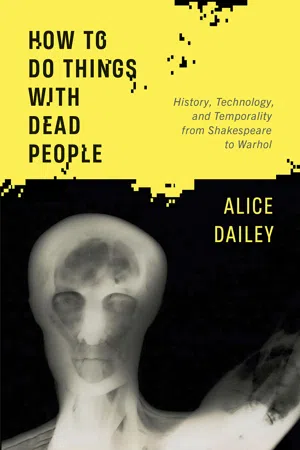
How to Do Things with Dead People studies human contrivances for representing and relating to the dead. Alice Dailey takes as her principal objects of inquiry Shakespeare's English history plays, describing them as reproductive mechanisms by which living replicas of dead historical figures are regenerated in the present and re-killed. Considering the plays in these terms exposes their affinity with a transhistorical array of technologies for producing, reproducing, and interacting with dead things—technologies such as literary doppelgängers, photography, ventriloquist puppetry, X-ray imaging, glitch art, capital punishment machines, and cloning.
By situating Shakespeare's historical drama in this intermedial conversation, Dailey challenges conventional assumptions about what constitutes the context of a work of art and contests foundational models of linear temporality that inform long-standing conceptions of historical periodization and teleological order. Working from an eclectic body of theories, pictures, and machines that transcend time and media, Dailey composes a searching exploration of how the living use the dead to think back and look forward, to rule, to love, to wish and create.
In the climactic moments of the deposition scene in act 4 of Richard II, when Richard is forced to abdicate his throne to the usurper, Henry Bolingbroke, Northumberland presses Richard to sign articles declaring himself guilty of “grievous crimes … against the state” (4.1.213, 215).1 In response, Richard initiates a pause in the transactional business of the scene to stage an interlude of self-reflection. He declines to turn his tearful eyes on the proffered articles and instead asks to see a looking glass, proposing to “read” his sins in the image of his unkinged face (4.1.267). What he sees in the mirror, however, is neither a document of sin nor the face he expects, one “bankrupt of his majesty” (4.1.257). Rather, Richard discovers the face he had when he was king:
Was this face the face
That every day under his household roof
Did keep ten thousand men? Was this the face
That like the sun did make beholders wink?
Was this the face which faced so many follies,
That was at last outfaced by Bolingbroke? (4.1.271–76)2
In the famous speech from Marlowe’s Doctor Faustus echoed here—in which Faustus admiringly wonders, “Was this the face that launched a thousand ships?”—Faustus’s verb tense consigns the face of Helen of Troy to the past, even as he seeks immortality by kissing it.3 Shakespeare repeats and amplifies this past-tense verb and, through it, conjures for Richard a particular form of immortality. Looking at himself in the mirror, Richard the living character describes the image of a bygone face—a face, marked by the past tense “Was,” that registers a temporal discrepancy between the reflected Richard and the reflecting Richard. As a face fixed in a prior time, the image declares its archaic relationship to the speaker’s present tense, documenting its own obsolescence. By simultaneously figuring himself as a thing past and as someone presently looking at that past thing—as the imaged face that “Was” and the speaking face that is—Richard multiplies himself to populate different moments in time. He pauses the action of the scene to generate a picture of his past self that encodes a Richard who postdates his own demise.
Shakespeare’s mirror scene indexes at least four Richards: the speaking character; the past King Richard he sees in the mirror; the dead, has-been, or ex-king presaged by the image and eventually produced by the assassination of act 5; and the historical, dead Richard II who antecedes the play. These Richards do not legibly correspond to those described by the medieval political theology of the king’s two bodies, which has been indelibly linked with Richard II since Ernst Kantorowicz’s 1957 reading of the play. In Kantorowicz’s account, the precept of the king’s two bodies explains how the disruptive potential of a king’s physical death is offset by reference to the abstract, immortal institution of kingship, which persists intact from one mortal king’s reign to the next. Appropriated from theological distinctions between Christ’s mortal human body (proprium et verum corpus) and the church (corpus mysticum), the juridical construct of the king’s two bodies establishes a fiction of continuity to negate the material fact of human mortality.4 Kantorowicz’s influential reading of Richard II describes the mirror scene as a pivotal moment in the play’s representation of this concept, one that dramatizes the catastrophic splitting of Richard’s body politic from his body natural. Because Richard lacks a legitimate heir who would inherit the immutable properties of kingship, Richard’s royal soul ascends to be enthroned in heaven “Whilst [his] gross flesh sinks downward here to die” (5.5.112).
The historicist project of contextualizing Richard II in the political imaginaries of Ricardian and Elizabethan England has been heavily indebted to Kantorowicz, who declares the king’s two bodies “not only the symbol but indeed the very substance and essence” of the play.5 This thesis summarizes how medieval political theology serves in his reading as a historical context, a hermeneutics, a metaphysics, and an aesthetics. “For Kantorowicz,” Victoria Kahn observes, “a legal fiction is distinguished from a literary fiction only by its institutional home,” a summation that could double as a precept of New Historicism.6 As this brief look into the mirror moment suggests, however, our historicized understanding of the concept of the king’s two bodies cannot accommodate the Richards constructed by his temporally staggered moment of self-reflection. The critical convention of reading Richard II as the literary illustration of a historically localized legal-theological concept artificially limits our appreciation of such moments’ temporal aesthetics. The teleological relationship between mortality and immortality described by medieval Christian metaphysics is complicated not only by the temporal dislocation Richard observes in moments like the mirror scene but, more broadly, by the genre of historical drama itself, in which the lively, speaking king is always bound to his deadened, inert negative, and vice versa.
I want to propose an alternative conceptual framework for describing the aesthetic and temporal effects of such moments, one suggested not by Ricardian or Elizabethan political theology but by the photographic theory of Roland Barthes. In his influential, enigmatic, and final book, Camera Lucida (1980), Barthes traces his response to a childhood photograph of his deceased mother. From this and a series of other old photos, he theorizes the effects of the photographic medium. One image of interest to him is a famous portrait of Lewis Payne, who was hanged in 1865 in connection with the Lincoln assassination conspiracy (Figure 3). The portrait was taken by Alexander Gardner aboard the USS Saugus as the condemned man awaited execution. Barthes’s fascination with the photo lies in its temporal effects, which he observes to be “vividly legible in historical photographs: there is always a defeat of Time in them: that is dead and that is going to die.” The photo captures a moment when Payne was still living while addressing itself to a viewer who is necessarily looking from a future that succeeds both the photographed moment and the subject’s death. In the viewer’s consciousness, the photograph pictures multiple temporal dimensions organized around the delimiting horizon of death, figuring “an anterior future of which death is the stake.”7
In his moment of reflection in the mirror, Richard inhabits all of the subject and object positions mapped by Barthes, including Barthes’s own. Richard is at once the photographed Lewis Payne, Payne’s photographer, and Payne’s viewer: He is the man facing inevitable death, the documentarian whose image technology makes this moment available for an afterlife of future viewing, and the timeless viewer beyond the grave to whom death appears as already completed. Richard is dead and Richard is going to die. In distinction from Camera Lucida’s meditation on Payne, however, the immediate viewer for whom Richard is both dead and going to die is not a separate consciousness, such as Barthes or the audience or reader of the play. More locally, that viewer is Richard himself, a Richard both identical to and temporally discrete from the face reflected in the image. In one sense, then, the mirror moment illustrates the technological feats of historical drama, a form in which a theatrically alive dead king can reflect on a mirror image of his own past face in a moment that both anticipates and recalls the corpse he will be in the play’s final scenes. But this moment also accomplishes something particular to Richard II that photographic theory illuminates: It pauses the play’s forward action to generate still pictures of Richard that come into view from a future perspective. This arrested past is defined by an end that has both already and not yet come, an end in which he is “at last outfaced by Bolingbroke” and murdered by the assassin Exton, Richard’s own Lewis Payne (4.1.276).
FIGURE3. Lewis Payne, in sweater, seated and manacled. Photo by Alexander Gardener. Washington Navy Yard, D.C., 1865. Library of Congress, Prints and Photographs Division, Civil War Photographs, LC-DIG-cwpb-04208 (digital file from original negative), LC-B8171-7773 (black-and-white film negative).
Camera Lucida famously analogizes photography to theater, arguing that both are arts of death—that they are kindred technologies for reproducing and looking at dead things:
If Photography seems to me closer to the Theater [than to painting], it is by way of a singular intermediary (and perhaps I am the only one who sees it): by way of Death. We know the original relation of the theater and the cult of the Dead: the first actors separated themselves from the community by playing the role of the Dead: to make oneself up was to designate oneself as a body simultaneously living and dead.… Now it is the same relation which I find in the Photograph; however “lifelike” we strive to make it …, Photography is a kind of primitive theater, the kind of Tableau Vivant, a figuration of the motionless and made-up face beneath which we see the dead.8
In Barthes’s account, early drama theatricalized the past by staging “bod[ies] simultaneously living and dead” in a representational form analogous to the photo of Payne. Barthes’s observation has been of significant interest to performance studies for the way it theorizes dramatic stagings of dead figures via living bodies. What neither Barthes nor performance studies takes up—and what this chapter considers at length—are the temporal effects generated by stilled, inert images of the past embedded within dramatic action unfolding in the present, whether on stage or in text. Implied but not explicitly theorized in Barthes’s account of both the dramatic and photographic mediums are the present viewers for whom the subject appears alive and dead—the “we” in the final phrase of this passage. Because both photography and drama address themselves to viewers, it is “we [who] see” in the play or photo the superimposition of living and dead. Static images like Richard’s mirrored face embed a living audience who occupy a temporal dimension beyond the past represented in the picture.
Although Richard II’s many composed or even Mannerist moments have invited comparison to iconography, pageantry, and painted portraiture, these forms of visual representation—while strictly contemporary to the play—operate by a different phenomenology than the one that organizes its static images of Richard.9 To describe the discrete image aesthetics that organize moments like the mirror scene, this chapter brackets both the body logic of medieval political Christology and the orthodoxies of historicist critical praxis that would confine us to acknowledged contemporaneous visual forms. I argue that the temporal effects produc...
Table of contents
List of Illustrations
Acknowledgments
Introduction
1. Little, Little Graves
2. Haunted Histories
3. Dummies and Doppelgängers
4. The King Machine
5. Fuck Off and Die
Postscript
Notes
Works Cited
Index
Trusted by 375,005 students
Access to over 1.5 million titles for a fair monthly price.
Study more efficiently using our study tools.
Frequently asked questions
Yes, you can cancel anytime from the Subscription tab in your account settings on the Perlego website. Your subscription will stay active until the end of your current billing period. Learn how to cancel your subscription
No, books cannot be downloaded as external files, such as PDFs, for use outside of Perlego. However, you can download books within the Perlego app for offline reading on mobile or tablet. Learn how to download books offline
Perlego offers two plans: Essential and Complete
Essential is ideal for learners and professionals who enjoy exploring a wide range of subjects. Access the Essential Library with 800,000+ trusted titles and best-sellers across business, personal growth, and the humanities. Includes unlimited reading time and Standard Read Aloud voice.
Complete: Perfect for advanced learners and researchers needing full, unrestricted access. Unlock 1.5M+ books across hundreds of subjects, including academic and specialized titles. The Complete Plan also includes advanced features like Premium Read Aloud and Research Assistant.
Both plans are available with monthly, semester, or annual billing cycles.
We are an online textbook subscription service, where you can get access to an entire online library for less than the price of a single book per month. With over 1.5 million books across 990+ topics, we’ve got you covered! Learn about our mission
Look out for the read-aloud symbol on your next book to see if you can listen to it. The read-aloud tool reads text aloud for you, highlighting the text as it is being read. You can pause it, speed it up and slow it down. Learn more about Read Aloud
Yes! You can use the Perlego app on both iOS and Android devices to read anytime, anywhere — even offline. Perfect for commutes or when you’re on the go. Please note we cannot support devices running on iOS 13 and Android 7 or earlier. Learn more about using the app
Yes, you can access How to Do Things with Dead People by Alice Dailey in PDF and/or ePUB format, as well as other popular books in Literature & Shakespeare Drama. We have over 1.5 million books available in our catalogue for you to explore.