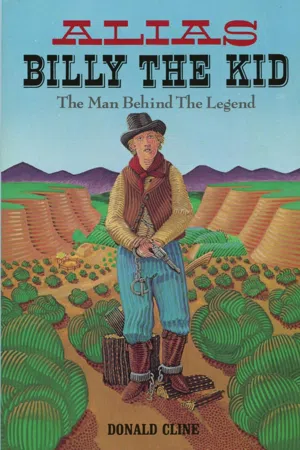
- English
- ePUB (mobile friendly)
- Available on iOS & Android
eBook - ePub
CHAPTER 1
THE BIRTH
Of all the famous and notable figures in American history none has received more widespread and undeserving attention than William H. Bonney, better known as Billy the Kid. He is known above all our presidents and patriots to every child and adult alike. More people are familiar with his exploits, both real and imagined, through an unending flow of books and articles and, in popularity, he far exceeds that of the father of our country, George Washington.
Countless parties have made him a saintly folk hero which he decidedly does not deserve. He has been canonized in legend along with Robin Hood, Dick Turpin and Johnny Appleseed. He is engrained deeply into the western history of our country. But he was not a folk hero fighting injustices against the downtrodden nor was he a defender of right and justice. He was a personable young man who was not only a coward but a petty cattle thief who sacrificed his friends’ lives in order to protect his own safety. And he preferred to live off the labor of honest men because he was unwilling to expend his own energy.
He was a liar, a thief and a user of persons. He manipulated the Governor of the Territory of New Mexico in a vain attempt to save himself by selling out his former comrades to protect his own freedom. He was a cold-blooded murderer who never risked anything. This then, is William Bonney — the man and the legend.
It has long been known, and proven, that William Bonney was born Henry McCarty and later known as Henry Antrim. Henry McCarty was born in the predominately Irish Fourth Ward section of east-side Manhattan on November 20, 1859.1 He first saw the light of day in private furnishings at 70 Allen Street. Though he was not fortunate to have entered this world through a hospital like his older brother, Joe, they shared a common bond: they were both illegitimate.2
According to Joe’s death certificate, he died at 76 years of age, which by my calculations, makes the year of his birth 1854. Some have tried to incorrectly state that Joe was younger than Henry but he was not. During the years 1852-1856 there was only one male child named McCarty born in the entire city of New York and that was Joseph M. McCarty. According to the birth records, he was born on August 25, 1854, at the New York Hospital located at 525 East 68th Street. Catherine McCarty is listed as the mother. No listing is given for the father.3
It has long been known to serious students of Billy Bonneydom that he was never William H. Bonney, Jr. with a father named William H. Bonney, Sr. A check of the birth records from 1857-1862 disclose that no male children named Bonney were born in that city.4 In fact, there were very few Bonneys in New York according to the records.
The New York City directories for the years 1850 through 1862 disclose that the last William Bonney was listed in that city in 1857 and none appear again until 1862. A check of all listed births during those years of every couple named Bonney show there were no male births during the years Henry and Joe were born and none had a mother named Catherine.
Over the years many searches have been made in New York through the City Clerk’s (Recorder) office seeking the birth of Billy the Kid. All have been fruitless and the statement has been made too often that there is no recorded birth of William Bonney. Nothing could be further from the truth.
It has always been a requirement of law in New York that all births are recorded on their day of occurrence whether the infant had been named or not, thus a listing for Bonney exists. Secondly, none of the records are maintained in the City Clerk’s office where most inquiries are directed because all records prior to 1866 are stored in the Municipal Archives and Records Center. It is here that all early births, deaths and marriages are maintained.
One writer claimed an announcement of Bonney’s birth appeared in a Brooklyn newspaper while another maintained it was the Times. Brooklyn had no major newspapers while most were of an ethnic, trade or social origin and never printed New York births. From its inception until today, the Times has maintained a standard of never printing birth or death announcements unless they were people of some social standing.5 Immigrant births and deaths were never reported.
While New York proper had many papers similar to those in Brooklyn, they had five major ones: the Tribune, New York Times, New York Sun, The World and The Mercury. All followed the prescribed pattern of births, deaths and marriages unless the individual was well-known or had some social status.
Most serious historians have never accepted the statement that William Bonney was born on November 23, 1859. The only source for this contention was the undocumented say-so of Ash Upson who created the Bonney myth for Pat Garrett in The Authentic Life of Billy the Kid which was not totally authentic at all.
Everyone has simply repeated much of what Upson claimed even though it was well-established among historians that Upson was wrong. (It is much easier to repeat than it is to research.)
Garrett was aware that Upson was wrong about the birthdate and he so informed Governor Miguel Otero. He said that Bonney had once told him the day but that he had forgotten. Bonney’s best friend during the Lincoln County War was George Coe and Coe made the same statement as Garrett. Since two of Bonney’s closest associates stated that Upson was wrong, we accept the fact that he was.
Garrett’s entire book was a commercial production of Ash Upson and never intended to be a factual book of history. Upson was down on his luck and had pinned his hopes on the Garrett folklore as a way to redeem himself. This was confirmed in the various letters to his family back east.6
Actually, Upson was neither friend nor associate of Bonney nor did he know him well. Most of what Upson wrote was gleaned from conversations with other individuals in Lincoln or what was already printed in the papers. In some instances he mixed a small amount of fact with a lot of imagination and thereby set all future standards for works on Bonney. Most writers have simply repeated what Upson claimed, none of which had documentation. Upson did not even research the object of his pronouncements.
Upson ran a small mail service between Precinct 16 and Lincoln and from rumors, stories and conversations he formed the mythical life of Henry McCarty. Not a single one of his letters back home stated that he had ever met or knew Bonney and that he was ever in Silver City, New Mexico, has always been in doubt. There is no documentation that the Antrims ever ran a boarding house in Silver City (actually it was Mrs. R.H. Brown) and no one in Silver City could ever confirm Upson’s allegations of Bonney’s life there.
What he did write home was his poor financial condition which was getting worse by the minute and that he “was a loser."7 Much of the gist of these letters centers on his complaints of being down on his luck and in dire financial straits. The Lincoln County War had been difficult for him financially and it had left him almost penniless.8
While Upson ran his mail service between the two localities Alexander McSween supposedly had been collecting school money for him at the rate of $15.00 per year. He had also run a mail sack for McSween for over a year. When McSween was killed in Lincoln he died owing Upson in excess of $200.9 He complained that other men owned him money but they had fled during the Lincoln County War without having paid him. He had a lawsuit pending against one individual in Mesilla who owed him between $400 and $500. It was at this point he made the statement that he was a born loser.
“Instead of making money I have been expending," he wrote. Wealthy Captain J.C. Lea had put in a stock of his goods in the room adjacent to Upson’s small office and asked Upson to watch over it. He did not pay Upson for this service but offered him board only to watch over the stock. Upson informed his relatives that he had written every word of Garrett’s book for him and that he expected the monetary gains therefrom would finally remove him from his debtor’s category. But the book proved to be a financial catastrophe.
Upson had once been a successful newspaper man before entering New Mexico but he was still confident that he would some day regain past glories. He constantly wrote articles to the Times in New York as well as the Daily New Mexican in Santa Fe, The Optic in Las Vegas, New Mexico, and possibly the Thirty-Four in Las Cruces, New Mexico. He often submitted these articles under fictitious names. Like all newspaper men, past and present, he was often hard-pressed for news at times and during these slack periods was prone to create the news. He followed this pattern in the early parts of the Garrett book.
While it was mandatory for all births to be recorded as of the day of birth in hospitals or private residences where a doctor or medical personnel were in attendance this was not always adhered to when friends and relatives delivered the child. The Municipal Archives and Records Center has stated that during those early years few of the births are recorded under the name of the child. Many were not named at the moment of delivery and the doctor was not required to obtain the name of the infant but only the parent’s name, date of birth, sex and location of birth.
Almost all of the older births are therefore listed under the names of the parents or parent and rarely under the name of the infant. They are likewise cross-indexed in this manner. This is why Bonney’s birth has been so elusive. Secondly, his birth was November 20th and not November 23rd.
Bonney never had a father named William H. Bonney, Sr. for this is the alias assumed or given him by March 1878. His father was named Edward McCarty and was not married to Bonney’s mother. Edward also fathered brother Joe. Edward’s identity was given in an article by a policeman who not only identified Edward as the father of the boys but also the date of Bonney’s now-famous stabbing and the particulars surrounding the dastardly affair. 10
Edward McCarty, no relation to Catherine, was a married man with a wife, a son and two daughters in Brooklyn. He was sometimes known as “Dad” McCarty. He kept a fruit stand at the corner of Nassau and John Streets and it was thought that he had some money. Henry’s father did not die in 1862...
Table of contents
- Cover
- Title Page
- Copyright Page
- Contents
- Illustrations
- Foreword
- Special Acknowledgments
- 1. The Birth
- 2. The Stabbing
- 3. The Cahill Killing
- 4. Mesilla and Lincoln
- 5. Side Lights
- 6. Final Days
- 7. Counterfeit Kids
- Bibliographic Sources
- Index
Trusted by 375,005 students
Access to over 1.5 million titles for a fair monthly price.
Study more efficiently using our study tools.
Information
Publisher
Sunstone PressYear
2016Topic
HistorySubtopic
Historical BiographieseBook ISBN
9781611392456
Index
HistoryFrequently asked questions
Yes, you can cancel anytime from the Subscription tab in your account settings on the Perlego website. Your subscription will stay active until the end of your current billing period. Learn how to cancel your subscription
No, books cannot be downloaded as external files, such as PDFs, for use outside of Perlego. However, you can download books within the Perlego app for offline reading on mobile or tablet. Learn how to download books offline
Perlego offers two plans: Essential and Complete
- Essential is ideal for learners and professionals who enjoy exploring a wide range of subjects. Access the Essential Library with 800,000+ trusted titles and best-sellers across business, personal growth, and the humanities. Includes unlimited reading time and Standard Read Aloud voice.
- Complete: Perfect for advanced learners and researchers needing full, unrestricted access. Unlock 1.5M+ books across hundreds of subjects, including academic and specialized titles. The Complete Plan also includes advanced features like Premium Read Aloud and Research Assistant.
We are an online textbook subscription service, where you can get access to an entire online library for less than the price of a single book per month. With over 1.5 million books across 990+ topics, we’ve got you covered! Learn about our mission
Look out for the read-aloud symbol on your next book to see if you can listen to it. The read-aloud tool reads text aloud for you, highlighting the text as it is being read. You can pause it, speed it up and slow it down. Learn more about Read Aloud
Yes! You can use the Perlego app on both iOS and Android devices to read anytime, anywhere — even offline. Perfect for commutes or when you’re on the go.
Please note we cannot support devices running on iOS 13 and Android 7 or earlier. Learn more about using the app
Please note we cannot support devices running on iOS 13 and Android 7 or earlier. Learn more about using the app
Yes, you can access Alias Billy the Kid by Donald Cline in PDF and/or ePUB format, as well as other popular books in History & Historical Biographies. We have over 1.5 million books available in our catalogue for you to explore.