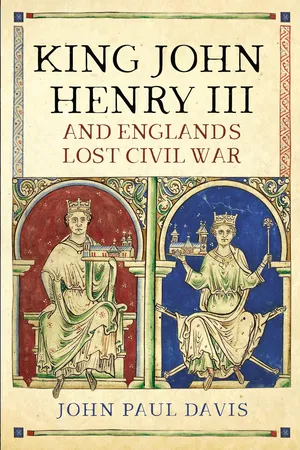
In 1204, the great Angevin Empire created by the joining of the dynasties of Henry II of England and his queen, Eleanor of Aquitaine, was fragmenting. At its height, the family landholdings had been among the largest the world had ever seen. From the border of England and Scotland in the north to south of the Pyrenees, it seemed there was nowhere in Europe destined to escape Plantagenet control. Yet within five years of his accession, King John’s grip on the family holdings was loosening. Betrayal against his father and brother, the murder of his nephew, and breaking promises made to his supporters were just some of the accusations levelled against him. When Philip II conquered Normandy, the chroniclers believed that an ancient prophecy was fulfilled: that in this year the sword would be separated from the sceptre. For the first time since 1066, England’s rule over the ancestral land was over. For John, troubles on the continent were just the beginning of a series of challenges that would ultimately define his reign. Difficult relations with the papacy and clergy, coupled with rising dissent among his barons ensured conflict would not be limited to the continent. When John died in 1216, more than half of the country was in the hands of the dauphin of France. Never had the future of the Plantagenet dynasty looked more uncertain. As the following pages will show, throughout the first eighteen years of the reign of Henry III, the future direction of England as a political state, the identity of the ruling family and the fate of Henry II’s lost empire were still matters that could have gone either way. For the advisors of the young king, led by the influential regent, William Marshal, 1st Earl of Pembroke, the effects of John’s reign would be long and severe. Successful implementation of the failed Magna Carta may have ensured his son’s short-term survival, yet living up to such promises created arguably a more significant challenge. This is the story of how the varying actions of two very different kings both threatened and created the English way of life, and ultimately put England on the path to its Lost Civil War.
- 240 pages
- English
- ePUB (mobile friendly)
- Available on iOS & Android
eBook - ePub
King John, Henry III and England's Lost Civil War
About this book
Information
Chapter 1
940–1204 The Devil’s Brood
A howling gale tore through the streets of Newark on the evening of 18 October 1216. A mid-sized market town located some forty miles inland from the North Sea, it was rare for a storm to give rise to the levels of concern often felt by citizens of its coastal counterparts. Lying on both the Great North Road and the Fosse Way, the area was popular with travellers, especially cloth and wool merchants in town to sell their wares. The early twelfth-century bridge over the Trent had improved the trade links further, and by the reign of Henry II, the market had become well established. Though most of the buildings were of timber construction, even at the height of winter weather damage was often repairable.
This was not the first time the town had been forced to endure such a tempest.
Behind the sturdy stone walls of the nearby Norman castle, the abbot of Croxton had far more troubling issues to address. The south riverside fortress, though by no means immune to regular splashback, was far better prepared for nature’s challenges than the earlier motte-and-bailey that had preceded it. The same lack of worry, however, could not be said of the crisis that had brought him there. Renowned for his medical expertise, it didn’t take him long to realise that the patient he had been asked to treat was beyond hope of recovery. Rather than prolong the inevitable, he heard the dying man’s confession and performed the last rites. The storm was over by sunrise.
Blighted by a combination of chronic fatigue, dysentery brought about from years of poor diet and a sudden fever, King John passed away in the early hours of 19 October after more than seventeen years on the throne. His final year had been a black one for England. Accusations of betrayal against his own family and an inability to keep his allies on side had contributed in no small part to humiliating defeat on the Continent. By 1214, the loss of much of his ancestral birthright had been compounded by domestic discord. Loathed in equal measure by natural adversary and should-be follower, John’s life ended ignominiously amid a strange alliance of foreign invader and baronial rebel. Somewhat surprisingly perhaps, it ended through natural causes.1
If John’s fall from grace was not extraordinary in itself, his path to the throne was every bit so. The fifth and youngest son of Henry II and Eleanor of Aquitaine, John’s chances of wearing the crown had been slim. Having lived through the deaths of two of his older brothers, Henry the Young King and Geoffrey, Duke of Brittany, the former of whom had ruled briefly as joint king alongside his father before his ill-advised uprising preceded his premature downfall, on the older king’s death the throne passed to his one surviving brother, Richard.
Famed in both history and literary romance for inheriting his father’s fortitude, less so his restraint, the Lionheart subsequently ruled for ten years over an England he rarely saw as he concentrated instead on his life mission of bringing about a Christian Holy Land. In his absence, the inevitable cracks in government began to appear, and a kingdom that included Ireland, the duchies of Normandy and Aquitaine and the counties of Poitou and Anjou slowly began to fragment. While the ‘Angevin’ empire’s erosion may have been reversible under a prolonged Ricardian kingship, a chance hit by a crossbow bolt in the neck as he inspected his troops at the siege of Chalus-Chabrol doomed him to an early death. Minus a legitimate heir, the dying king was left little choice than to offer his blessing to the brother who had connived to usurp him. With this, John, the last standing of Henry and Eleanor’s infamous brood, was proclaimed heir to the throne of England and ruler of all of his father’s territories.2
How the rulers of England had come to acquire such vast swathes of land is itself a story that has often been retold. Indicative of the name, the Angevin Empire had its ruling dynasty in Anjou, the so-called Garden of France whose regions included the Loire Valley and its capital at Angers. The lucky – or unlucky – beneficiary of this had been Henry II himself.3 Son of the empress Matilda, daughter of Henry I, Henry was, on his father’s side, also descended of the original counts of Anjou, who had dominated the county since the tenth century. In the eyes of Henry’s contemporaries, this was of no little significance. Back in the reign of Edward the Confessor, the future saint prophecised that the green tree of England would once again flourish when the split parts of the trunk were rejoined, something that Henry’s accession appeared to satisfy. As the grandson of Matilda of Scotland, the first wife of Henry I and ipso facto descended of the Saxon kings, Henry was the first descendant of Alfred the Great to occupy the throne of England since the Norman Conquest. Ever mindful of this, Henry made sure to promote the idea, a fact that helped ensure Edward’s canonisation and translation to Westminster Abbey in 1163.4
It was the success of these original counts as previously unknown castellans that helped pave the way for such remarkable wealth. Renowned for the typical characteristics possessed of a leader, namely intellect, prowess in battle and devotion to the church, a far rarer knack for warcraft, diplomacy and a string of carefully arranged marriages had brought almost unprecedented success in France that even in Henry’s own time remained a highly fragmented kingdom.5
Of the origins of the house, there are many stories. From the mists of obscurity, the first to rise is Ingelgar: a somewhat legendary soldier of fortune who made his name fighting his way through the Loire Valley. Building on these early victories was his son, Fulk the Red, who in 941 became count of Anjou: a title that in the tenth century came close to rivalling that of king of France. Over the coming 180 years, further successes gave rise to more fanciful legend. Preceding the antics of the influential eleventh-century warlord and later pilgrim, Fulk Nerra, who apparently achieved victory over the count of Brittany by preventing his army’s retreat with the creation of a ‘gale sweeping corn’, few tales compare with that of Geoffrey Greygown (Count of Anjou 960–987), who reputedly single-handedly slew a giant.6
By 1128, the rule of the giant slayer’s descendants reached new heights when the respected Fulk V was chosen to replace the childless Baldwin II as king of Jerusalem. In Fulk’s absence, the rule of his son Geoffrey the Fair as count of Anjou saw the Garden of France flourish. It was Geoffrey who laid the foundations for future prosperity by conquering Normandy and laying claim to the throne of England through his impressive wife Matilda – the same Matilda who was a daughter of Henry I and Matilda of Scotland. Though Geoffrey would never wear the crown of England, partly due to Matilda’s hatred of him, the honour would soon be bestowed upon their son, named in honour of his grandfather and crowned, Henry II.7
Both on the surface and beneath it, Henry had much in common with the original counts, especially his father. Handsome and tall, both father and son were strong of mind and body. Labelled ‘the little fox’ by his enemies, apparently in honour of both his red hair and a passage in the Song of Solomon, Henry inherited not only his father’s determination but also an occasional wrathful streak. Of the latter, the little fox appears to have been particularly proud. In conversation with his court confessor, Henry is alleged to have remarked, ‘And why not, when God himself is capable of such anger?’ Charming and affable when the mood suited, both men were well educated in the arts of warcraft and politics. Shrewd administrators, they shared their ancestors’ spirit of adventure and were often generous to the poor. As time would tell, Henry would also follow his father’s example of being extra careful when it came to choosing a wife, accepting a woman a decade older than himself with a significant dower. It is equally vital that Henry bore his father’s surname ‘Plantagenet’, sprung from Geoffrey’s wearing a sprig of a broom in his hat.8
By 1144, Geoffrey’s conquest of Normandy had almost been completed, ending nine years of conflict in the hope of cementing Matilda’s claim to both there and England. As the daughter of Henry I, Matilda’s claim was unbroken to William the Conqueror, who had been invested with the dukedom back in 1035. On Henry I’s death in 1135, a number of the barons reneged on their oaths to Matilda and declared Stephen king on his arrival in England. For Geoffrey and Matilda, news of Stephen’s rushed accession placed them on a path to war with the new king in both England and Normandy. Further to Angevin control of western England, Geoffrey’s investiture as duke of Normandy as well as inheriting Anjou ensured approximately half the future Anglo-Norman dominions were already safely under his rule. When a bloodthirsty Henry faced Stephen at Wallingford in 1153, the pressure was on for the latter to submit. The following year, Henry’s time finally came. Thus ended the nineteen-year-winter and began a dynasty that would be fraught with both intrigue and turmoil.9
As history would later recall, under Henry II’s rule the ever-developing empire would reach its zenith. As a consequence of his marriage to Eleanor of Aquitaine in 1152, new dominions were added to the originals, most significantly the region after which she was named. Despite the plethora of biographies of Eleanor written over the centuries, what is known of her as a person is disappointingly limited and plagued by legend.10 Annulment of her marriage to Louis VII of France had been a contentious issue. Fifteen years together had delivered two daughters. In her earlier years, she had gained notable sway over the French king and was derided as a bad influence by future saint and leader of the Cistercian order, Bernard of Clairvaux. Evidence suggests that on her divorce from Louis, she set her sights on Henry early. His own set on her duchy, Henry was only too pleased to oblige, and their marriage followed two months later. The fact that Henry later imprisoned her for sixteen years is undoubtedly a testament to her capabilities and the threat she possessed, not least in terms of her intellect and influence over her children.11
From the early efforts of the self-made Ingelgar to Geoffrey of Anjou’s conquest of Normandy, this unique combination of skills and circumstances had gained Henry an empire that stretched from the borders of Scotland in the north to the Pyrenees in the south. Never before in the history of England or France had the people known one overlord. In the eyes of the contemporary chronicler, such power could only have been born of sinister origins. If the musings of Gerald of Wales were to be believed, Plantagenet success had come as the unholy consequence of one of the early counts being seduced into marriage by the daughter of the devil, who later flew screaming out of a window on being forced to endure Holy Communion. In later times, Richard I took great satisfaction in such tales, stating: ‘What wonder if we lack the natural affections of mankind – we come from the Devil, and must needs go back to the Devil.’ Such legends would also leave their mark outside of the king’s court. In the same chronicle, Gerard of Wales paid similar testament, taking inspiration from another Bernard of Clairvaux quote: ‘From the Devil they came and to the Devil they will return.’12
Undoubtedly one of England’s most competent monarchs, ruling over such dominions caused several problems, not least concerning his children’s inheritance. On paper, the situation seemed simple. Come 1170, Henry had four living sons, his first-born son, William, IX Count of Poitiers, having died in 1156 at the age of 3. Consistent with the usual customs, his eldest surviving son, Prince Henry, would become king of England, duke of Normandy and count of Anjou – the three most important lands – with Eleanor’s Aquitaine being granted to Richard. Geoffrey, the third child, would rule Brittany as Henry the Young’s vassal, leaving John, the youngest of the bunch, lacking land. In a bid to appease his youngest son, Henry allocated him Chinon, Loudun and Mirebeau, a move that contributed in no small part to the younger Henry’s rebellion of 1173–74.13
Such violent acts of rebellion by his own sons would have a profound effect on the mental health of the old king. It was recounted, again by Gerard of Wales, that one panel in his magnificent painted chamber in Winchester Castle had been kept deliberately blank before a painting was commissioned in his later years. True to the king’s design, the image presented a fine eagle and its four young eaglets, one seated on the father’s back while two tore at the flesh of its wings. All the while, the youngest sat patiently on the eagle’s head. Viewed together, the scene represented a portentous thought in the king’s increasingly paranoid mind that none of his sons could be trusted. Worse still, that his favourite would cause him the most pain.14
Henry’s fears would soon become real, but not until after the heir to the throne, Henry the Young, lost his life to dysentery in 1183. On the king’s death in 1189, the mantle fell upon Richard, who had also waged war against his father. Like Henry the Young, Richard had much of his father in him. A talented warrior and administrator in his own right, Henry had been reluctant to go to war for war’s sake. Whereas both Henrys had died with their crusader vows unfulfilled, during Richard’s reign the opposite would be true. For this, the empire suffered. The lands Henry had managed so carefully for more than three decades were, in the reign of his son, often seen as little more than a cash cow. Indeed, Richard famously claimed he would sell London if he could find a buyer.15
For the first time since the Norman Conquest, conflict with France would become a recurring theme. Richard’s refusal to honour his long-time betrothal to the king of France’s sister Alice reignited tensions on the Continent, which were compounded by his failure to father an heir with his chosen bride, Berengaria of Navarre. When Richard died, his reputation as a great warrior and crusader was already cemented. His failures were primarily limited to the Holy Land, his inability to recapture Jerusalem the major disappointment. At the time of John’s accession, the Angevin Empire was still intact; thanks to Richard’s charismatic personality and good relations with the Norman and Angevin nobles, loyalty to the Lionheart was far less in question than it had been in England. While Richard’s absence can explain much of this, the ever-deepening entrenchment of Norman rule and interbreeding between Angle, Saxon, Jute and Norman alike would inevitably ensure that the different clusters of long-time native and the pre- and post-1066 settlers became gradually lost. Just as the term Norman had grown from Norsemen – Vikings who became Gallicised – by Henry II’s reign Norman English had already given way to a softer Anglo-Norman. As time would tell, the ensuing schism would prove irreversible.
Replacing a king who had been absent for all but seven months of the last decade inevitably presented a unique set of challenges. Unfortunately for John, these would be compounded by new problems that tended to be self-inflicted. Spoiled by his father and intimidated by his mother and elder siblings, John’s reputation as the runt of the litter was already well established. On Richard’s dea...
Table of contents
- Cover
- Title
- Copyright
- Contents
- Introduction
- Chapter 1 940–1204: The Devil’s Brood
- Chapter 2 1204–1213: In God We Trust
- Chapter 3 1214–1215: From Runnymede to the Wash
- Chapter 4 1146–1216: The ‘Greatest Knight’
- Chapter 5 1216: The Hollow Chaplet
- Chapter 6 1216–1217: The Long Winter
- Chapter 7 1217: God Helps the Marshal
- Chapter 8 1217–1219: Tearful Farewells
- Chapter 9 1195–1219: The Three Wise Men
- Chapter 10 1219–1220: Rocking the Castles
- Chapter 11 1221–1223: War and Peace
- Chapter 12 1223–1224: An Englishman’s Home is His Castle
- Chapter 13 1224: The Baying of Bedford
- Chapter 14 1224–1227: The Poitevin Potential
- Chapter 15 1227–1230: A Steep Learning Curve
- Chapter 16 1230–1231: The Awakened Dragon
- Chapter 17 1232: The Harrowing of Hubert de Burgh
- Chapter 18 1232–1233: Between a Rock and a Hard Place
- Chapter 19 1233–1234: The Marshal War
- Epilogue The Birth of a Nation
- Bibliography
- Notes and References
- Plate section
Trusted by 375,005 students
Access to over 1.5 million titles for a fair monthly price.
Study more efficiently using our study tools.
Frequently asked questions
Yes, you can cancel anytime from the Subscription tab in your account settings on the Perlego website. Your subscription will stay active until the end of your current billing period. Learn how to cancel your subscription
No, books cannot be downloaded as external files, such as PDFs, for use outside of Perlego. However, you can download books within the Perlego app for offline reading on mobile or tablet. Learn how to download books offline
Perlego offers two plans: Essential and Complete
- Essential is ideal for learners and professionals who enjoy exploring a wide range of subjects. Access the Essential Library with 800,000+ trusted titles and best-sellers across business, personal growth, and the humanities. Includes unlimited reading time and Standard Read Aloud voice.
- Complete: Perfect for advanced learners and researchers needing full, unrestricted access. Unlock 1.5M+ books across hundreds of subjects, including academic and specialized titles. The Complete Plan also includes advanced features like Premium Read Aloud and Research Assistant.
We are an online textbook subscription service, where you can get access to an entire online library for less than the price of a single book per month. With over 1.5 million books across 990+ topics, we’ve got you covered! Learn about our mission
Look out for the read-aloud symbol on your next book to see if you can listen to it. The read-aloud tool reads text aloud for you, highlighting the text as it is being read. You can pause it, speed it up and slow it down. Learn more about Read Aloud
Yes! You can use the Perlego app on both iOS and Android devices to read anytime, anywhere — even offline. Perfect for commutes or when you’re on the go.
Please note we cannot support devices running on iOS 13 and Android 7 or earlier. Learn more about using the app
Please note we cannot support devices running on iOS 13 and Android 7 or earlier. Learn more about using the app
Yes, you can access King John, Henry III and England's Lost Civil War by John Paul Davis in PDF and/or ePUB format, as well as other popular books in History & Historical Biographies. We have over 1.5 million books available in our catalogue for you to explore.