Reconstructs London Bridge's houses and inhabitants over five centuries, revealing architecture, trades, and daily life.
London Bridge lined with houses from end to end was one of the most extraordinary structures ever seen in the city. It was home to over 500 people, perched above the rushing waters of the Thames, and was one of the city’s main shopping streets. It is among the most familiar images of London in the past, but little has previously been known about the houses and the people who lived and worked in them. This book uses plentiful newly-discovered evidence, including detailed descriptions of nearly every house, to tell the story of the bridge and its houses and inhabitants.
With the new information it is possible to reconstruct the plan of the bridge and houses in the seventeenth century, to trace the history of each house back through rentals and a survey to 1358, revealing the original layout, to date most of the houses that appear in later views, and to show how the houses and their occupants changed during five and a half centuries. The book describes what stopped the houses falling into the river, how the houses were gradually enlarged, what their layout was inside, what goods were sold on the bridge and how these changed over time, the extensive rebuilding in 1477−1548 and 1683−96, and the removal of the houses around 1760.
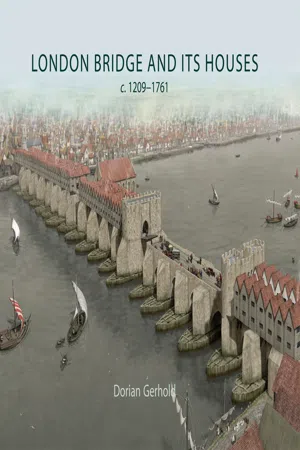
There are many new discoveries − about the structure of the bridge, the width of the roadway, the original layout of the houses, how the houses were supported, the size and internal planning of the houses, the quality of their architecture, and the trades practised on the bridge. The book includes five newly-commissioned reconstruction drawings showing what we now know about the bridge and its houses.
- 208 pages
- English
- ePUB (mobile friendly)
- Available on iOS & Android
eBook - ePub
London Bridge and its Houses, c. 1209-1761
About this book
Information
Subtopic
British HistoryIndex
Social Sciences
Fig. 1 John Norden’s view of the east side of the bridge in 1597–98. It is dedicated to Sir Richard Saltonstall, who was Lord Mayor in 1597–98, and bears the arms of Saltonstall and the City. In the foreground a boat has overturned and its passengers are in the water, probably after making the dangerous passage through the arches.
CHAPTER 1
Introduction
Views of London Bridge lined with houses from end to end are among the most familiar images of London in the past. Up to the late seventeenth century they show a higgledypiggledy collection of houses apparently developed piecemeal (Frontispiece and Figs 1–2). Thereafter a more regular set of houses lined the bridge, until these were eventually removed in 1757–61 (Fig. 84). The very familiarity of the views has perhaps dulled our sense of the extraordinary fact that 500 or more people lived directly above the Thames, with the water rushing through the arches below them. The equivalent of a small town was perched on the bridge, and probably some people lived their entire lives there. Inhabited bridges were common in western Europe from medieval times until the eighteenth century, but none was as long as London Bridge.1
Little has been written about the houses, and some important questions remain unanswered. When were the buildings in the views constructed? How were they prevented from falling into the river? How were they organised internally? How did they change over time? Who occupied them? What were the advantages of trading on the bridge? Also, the views show only the backs of the houses facing away from the bridge, and nothing has been known for certain about their fronts facing the roadway.
The houses are in fact unusually well documented, and some of the most valuable sources have not previously been exploited. Apart from the views, there are the extensive records of the Bridge House, which maintained the bridge and owned the buildings on it. These include annual or near-annual rentals in house-by-house order back to 1460, listing the leaseholders, together with rentals of 1358 and 1404–21.2 Accounts of expenditure also go back to 1460, and less informatively, with a gap, to 1404, and provide much useful information, especially about the rebuilding of houses.3 However, the rentals and accounts are of limited value without knowing exactly where the individual houses were. For this, the leases, which are plentiful from the early seventeenth century onwards, are essential. From about 1604 to 1660 almost all of them list the rooms in each dwelling with their dimensions, providing a detailed survey of nearly all the houses on the bridge, and of some at more than one date (see the Survey below). Only one of them has ever previously been used, and that in an unsatisfactory way without the dimensions.4 There is especially good coverage for the 1650s, when all the bridge houses were re-let. The other new source, and the single most illuminating document, is a table of measurements drawn up in 1683 covering most of the houses then standing, hitherto unnoticed among the papers of the committee which managed the Bridge House estates.5 As explained below, the leases and the table of measurements are the key to understanding the information in the rentals and accounts.

Fig. 2 View of the west side of the bridge in the Pepys Library, Cambridge, referred to in this book as the Pepys view. The date is unknown, but it cannot be earlier than 1590 (the date of the mills at the south end) or later than 1633 (when the principal part was burnt), unless compiled from earlier materials.
With this evidence the questions posed above can be answered, and we can greatly increase our understanding of the houses and the community they contained. Much of what the documents tell us is surprising, and contrary to what has previously been believed about the bridge. The measurements of 1683 will provide our starting point, but first the bridge itself and the views and plans of it must be introduced.
The bridge
London Bridge, linking the City to Southwark and southeast England, was the only fixed crossing of the Thames downstream of Kingston-upon-Thames until 1729. There were earlier timber bridges, but the first with stone arches was built between about 1176 and 1209, at the time when such bridges were becoming common in England.6 Timber used in the southern abutment was felled in 1187 or 1188, and a datestone of 1192 was found ‘in the arch work’ in a cellar close to the north end in the eighteenth century.7 This was the bridge that remained in use until 1831, and on which the houses stood. It was about 150 feet east of the present London Bridge (see Fig. 106). Its length was 926 feet, and it had nineteen piers linked by nineteen arches and a wooden drawbridge.8 It is usually said to have been built by Peter of Colechurch, who was chaplain of St Mary Colechurch in the City and had earlier rebuilt London’s wooden bridge. However, it is possible that his main role was as fundraiser rather than builder, at least from 1202 until his death in 1205. In 1202 King John intended Isembert of Saintes to complete the bridge and add houses to it, and Isembert may well have done so, though there is no direct evidence of him coming to London. Isembert had experience of building bridges in France, and had constructed houses on the bridge at La Rochelle to help pay for it.9

Fig. 3 Reconstruction drawing by Museum of London Archaeology of three stages of the bridge’s construction.

Fig. 4 Reconstruction drawn by Peter Jackson in about 1970 showing the bridge under construction, demonstrating the challenging conditions under which the bridge was built. The bridge in the background reflects an earlier belief, since disproved, that the preceding timber bridge was further east.
Constructing a bridge over such a large river was a major undertaking, comparable to building an important cathedral or castle. There is no evidence that before the nineteenth century anyone was capable of building coffer dams (watertight structures to exclude water from an area of riverbed) in the Thames at London. Instead, piles were driven into the riverbed from a boat at low tide, creating an enclosure that could be filled with rubble (forming the base of the pier) and across which planks could be laid to provide a firm working surface. Larger piles could then be driven in to form the ‘starling’ around the pier, after which the pier could be completed, with its stone facing (Figs 3–5). The starlings were essential, because the method of construction meant that the piers had relatively shallow foundations, which would soon have been undermined without the starlings. The price paid for this was that a great part of the river’s flow was obstructed: at high tide, when the starlings were covered, the width of flow was reduced to 508 feet, and at low tide, when the starlings were exposed, it was reduced to 237 feet, only 26% of its full width.10 The bridge was almost a dam, and, depending on the tide, the difference in the level of the water upstream and downstream could be as much as 5 feet; Ned Ward wrote in about 1700 of ‘the frightful roaring of the bridge water-falls’.11 The river flowed with great force through the arches, scouring the foundations, and constant and expensive maintenance of the starlings was necessary throughout the bridge’s life. To build a bridge that endured for more than six centuries in such conditions and with such limited technology was an immense achievement (Fig. 6). Only twice in that long history, in 1281 and 1437, did parts of the structure collapse (five arches and two arches respectively), a better record than many major bridges.
The arches seemed unnecessarily small to later generations, and the piers unnecessarily numerous and wide (from north to south).12 In fact the arches were slightly larger than was usual at the time, averaging about 24 feet, compared with usually less than 18 feet. Only from about the mid-thirteenth century were much larger bridge arches built, mainly in northern England.13 Wide piers made it easier to build one pier at a time, as they could more easily withstand unequal loads on their two sides, and it was less likely that the collapse of one pier would endanger neighbouring ones. In the eighteenth century Hawksmoor suggested that the exceptionally large pier on which the bridge’s chapel stood was intended as a buttress, which would withstand shocks such as the collapse of an arch and prevent such a collapse spreading.14 The number of piers and arches increased the cost of maintaining the bridge but, as we shall see, made it easier to build houses on it, and the houses provided revenue for maintenance.

Fig. 5 William Knight’s cross-section of several piers and arches of the bridge in 1826–27, during the removal of a pier and its adjoining arches, showing the relatively ...
Table of contents
- Cover
- Title
- Copyright
- Contents
- Author’s acknowledgements
- Abbreviations and notes on house numbering, measurements and currency
- 1. Introduction
- 2. Reconstructing the bridge and its houses
- 3. The houses from c 1209 to 1358
- 4. The major buildings
- 5. The houses from 1358 to 1633
- 6. Inside the houses in the seventeenth century
- 7. Fires and rebuildings 1633–82
- 8. Trading on the bridge
- 9. Families and community
- 10. The great rebuilding of 1683–96
- 11. From the fire of 1725 to the removal of the houses
- Survey of the houses on London Bridge, 1604–83
- Appendices
- Notes
- Image credits
Trusted by 375,005 students
Access to over 1.5 million titles for a fair monthly price.
Study more efficiently using our study tools.
Frequently asked questions
Yes, you can cancel anytime from the Subscription tab in your account settings on the Perlego website. Your subscription will stay active until the end of your current billing period. Learn how to cancel your subscription
No, books cannot be downloaded as external files, such as PDFs, for use outside of Perlego. However, you can download books within the Perlego app for offline reading on mobile or tablet. Learn how to download books offline
Perlego offers two plans: Essential and Complete
- Essential is ideal for learners and professionals who enjoy exploring a wide range of subjects. Access the Essential Library with 800,000+ trusted titles and best-sellers across business, personal growth, and the humanities. Includes unlimited reading time and Standard Read Aloud voice.
- Complete: Perfect for advanced learners and researchers needing full, unrestricted access. Unlock 1.5M+ books across hundreds of subjects, including academic and specialized titles. The Complete Plan also includes advanced features like Premium Read Aloud and Research Assistant.
We are an online textbook subscription service, where you can get access to an entire online library for less than the price of a single book per month. With over 1.5 million books across 990+ topics, we’ve got you covered! Learn about our mission
Look out for the read-aloud symbol on your next book to see if you can listen to it. The read-aloud tool reads text aloud for you, highlighting the text as it is being read. You can pause it, speed it up and slow it down. Learn more about Read Aloud
Yes! You can use the Perlego app on both iOS and Android devices to read anytime, anywhere — even offline. Perfect for commutes or when you’re on the go.
Please note we cannot support devices running on iOS 13 and Android 7 or earlier. Learn more about using the app
Please note we cannot support devices running on iOS 13 and Android 7 or earlier. Learn more about using the app
Yes, you can access London Bridge and its Houses, c. 1209-1761 by Dorian Gerhold in PDF and/or ePUB format, as well as other popular books in Social Sciences & British History. We have over 1.5 million books available in our catalogue for you to explore.