Research tells us that when most people suffer from a mental health crisis, the first person they turn to for help is not a physician, a psychiatrist, or a social worker, but a pastor, a priest, or a minister. In other words, a leader in their church. Unfortunately, many church leaders are not trained to recognize mental illness and don't know when to refer someone to a mental health professional. The consequence—unintended yet tragic—is continued and unnecessary suffering.
Madness and Grace is a comprehensive guide for church ministry to alleviate this situation. Written by Dr. Matthew Stanford, the book is carefully constructed to help build competency in detecting a wide spectrum of mental disorders, such as knowing when a person is contemplating suicide based on telltale patterns of speech. It also explodes common discriminatory myths that stigmatize people with mental illness, such as the myth that they are more prone to violence than others.
Dr. Stanford has treated clients throughout his career who were afflicted with all manner of mental disorders. In Madness and Grace, he takes the full extent of his experience and makes it accessible and actionable for the lay reader. He begins by explaining what constitutes a mental illness and how these disorders are classified according to science. He next teaches how to notice the presence of a mental illness by listening carefully to phraseology, observing behavior, and asking discerning questions. He goes on to discuss methods of treatment, common religious concerns about mental health, and ways church communities can support people on the road to recovery.
As a Christian, Dr. Stanford wants his fellow believers to know that acknowledging and seeking help for a mental illness is not a sign of weak faith. That's why, in addition to sharing his medical expertise with church leaders, he commends pertinent biblical passages that underscore God's concern for our mental wellbeing. These passages provide strength and comfort as complements to clinically-derived treatment and are essential to Dr. Stanford's approach. "When working with those in severe psychological distress," he writes, "compassion and grace are always the first line of pastoral care."
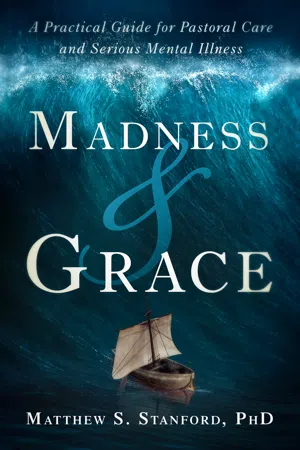
eBook - ePub
Madness and Grace
A Practical Guide for Pastoral Care and Serious Mental Illness
- English
- ePUB (mobile friendly)
- Available on iOS & Android
eBook - ePub
About this book
Information
Topic
Theology & ReligionSubtopic
Mental Health in Psychology
Recognition


Understanding Mental Illness
In a pair of highly publicized interviews in 2003 and 2005, actor Tom Cruise called psychiatry a “pseudoscience,” questioned the validity of mental disorder diagnoses—specifically that of attention-deficit/hyperactivity disorder (ADHD)—and criticized actress Brooke Shields for taking psychiatric medication to treat her postpartum depression.1 While the media suggested that Mr. Cruise’s statements were driven primarily by his Scientologist beliefs, the reality is that these naïve and inaccurate opinions are common in our society. Let’s look at the experience of Martin, a young man that I worked with for several years, as an illustration.
Martin has suffered with severe depression and anxiety since he was in junior high. While he did graduate from high school, his mental health problems made it impossible for him to complete college or hold a full-time job. Now twenty-three, he spends his days raising exotic plants and birds and pursuing his faith through Bible study, prayer, and volunteering at his church. While his problem symptoms are somewhat under control, due to a combination of medication and therapy, he still has intrusive thoughts of suicide on a daily basis. His unwavering pursuit of Christ, despite his prolonged and overwhelming suffering, is both heroic and inspirational.
One afternoon Martin called to ask for my advice about a conversation he’d had with his small group leader, Dan. Dan had asked him to meet that morning for coffee. During their time together, Dan shared that he had received the impression from the Holy Spirit that God wanted to heal Martin of his depression but that Martin first needed to stop taking his medication to show the “strength of his faith.” To Martin, this information was both exciting and terrifying. He desperately wanted to be released from his suffering but knew the potentially lethal consequences of stopping his medication. I was filled with anger. I assured Martin that if God chose to miraculously heal his depression, he would do so, but that taking medication in no way limited or hindered the Sovereign Creator of the universe. I also told him he was one of the most godly and faithful men I knew, that his mental health problems were not the result of weak faith, and that God often chooses to use physical remedies such as medication to heal us. He wasn’t completely convinced by my words but agreed not to stop taking his medication until after a period of personal prayer. I also asked him if he would allow me to talk with his small group leader about his illness. Martin was very supportive of the idea and set up a phone call between Dan and me for later that evening.
While I was angered by what Dan had said to Martin, I approached our conversation from the perspective that Dan must simply not understand the severity of Martin’s illness. Dan confirmed that he had indeed told Martin to stop taking his medication and felt God wanted to bring healing to his life. I attempted to explain Martin’s diagnosis and the severity of his illness. Dan’s response floored me. He said, “Those diagnoses are so ill-defined and very subjective.” Although he was only a recent college graduate (twenty-four years old) and had no formal training in mental health, he went on to lecture me about the uselessness of psychiatry/psychology and equated virtually all mental disorders with either personal sin or weak faith. Struggling to contain my now boiling anger, I told him that encouraging Martin to stop taking his medication would ultimately lead to his death by suicide, and I ended our conversation. Even though it was quite late in the evening, I immediately called the senior pastor of Dan and Martin’s church, who, by God’s providence, happened to be a longtime friend.
My friend was disturbed by what he heard. He assured me that Dan’s views were not what he believed or taught and that he would immediately take care of the situation. Dan was removed as small group leader. My pastor friend met with Martin later that week, to reassure him that his illness was not the result of weak faith and that he should continue to follow his psychiatrist’s instructions for taking medication. It took months for Martin to work through the trauma of that event, and a year later, he did attempt to take his life.
As this example shows, naïve and inaccurate opinions concerning mental illness are not just emotionally hurtful but have the potential to be deadly. It is important for us to recognize that those with mental illness are suffering people that God is placing in our lives. Regardless of what we may personally believe is causing their psychological distress, we must see them with the eyes of Christ and let grace be our guide.
MENTAL HEALTH/ILLNESS SPECTRUM
A mental illness, also called a mental disorder, is a disruption of a person’s thoughts, moods, behavior, and/or ability to relate to others that is severe enough to require treatment or intervention. While most people experience significant changes in thoughts, moods, and relationships at some point during their lifetimes, those changes are not always severe enough to require treatment or intervention.2 For a mental state to be classified as a disorder (or illness), it must cause dysfunction in the person’s life.
The World Health Organization defines mental health as “a state of well-being in which an individual realizes his or her own abilities, can cope with the normal stresses of life, can work productively and is able to make a contribution to his or her community.”3 In other words, mental health is far more than the absence of mental illness. All people have positive and negative variations in the...
Table of contents
- Cover
- Title
- Copyright
- Contents
- Introduction: Engaging the Crisis
- Recognition
- Referral
- Relationship
- Restoration
- NOTES
Trusted by 375,005 students
Access to over 1.5 million titles for a fair monthly price.
Study more efficiently using our study tools.
Frequently asked questions
Yes, you can cancel anytime from the Subscription tab in your account settings on the Perlego website. Your subscription will stay active until the end of your current billing period. Learn how to cancel your subscription
No, books cannot be downloaded as external files, such as PDFs, for use outside of Perlego. However, you can download books within the Perlego app for offline reading on mobile or tablet. Learn how to download books offline
Perlego offers two plans: Essential and Complete
- Essential is ideal for learners and professionals who enjoy exploring a wide range of subjects. Access the Essential Library with 800,000+ trusted titles and best-sellers across business, personal growth, and the humanities. Includes unlimited reading time and Standard Read Aloud voice.
- Complete: Perfect for advanced learners and researchers needing full, unrestricted access. Unlock 1.5M+ books across hundreds of subjects, including academic and specialized titles. The Complete Plan also includes advanced features like Premium Read Aloud and Research Assistant.
We are an online textbook subscription service, where you can get access to an entire online library for less than the price of a single book per month. With over 1.5 million books across 990+ topics, we’ve got you covered! Learn about our mission
Look out for the read-aloud symbol on your next book to see if you can listen to it. The read-aloud tool reads text aloud for you, highlighting the text as it is being read. You can pause it, speed it up and slow it down. Learn more about Read Aloud
Yes! You can use the Perlego app on both iOS and Android devices to read anytime, anywhere — even offline. Perfect for commutes or when you’re on the go.
Please note we cannot support devices running on iOS 13 and Android 7 or earlier. Learn more about using the app
Please note we cannot support devices running on iOS 13 and Android 7 or earlier. Learn more about using the app
Yes, you can access Madness and Grace by Matthew Stanford in PDF and/or ePUB format, as well as other popular books in Theology & Religion & Mental Health in Psychology. We have over 1.5 million books available in our catalogue for you to explore.