![]()
PART 1
Overview
![]()
CHAPTER 1
Overview of the Research
OUTLINE
I. MENTAL HEALTH
1. Positive Emotions
a. Well-Being
b. Hope and Optimism
c. Meaning and Purpose
d. Self-Esteem
e. Sense of Personal Control
2. Negative Emotions
a. Depression
b. Suicide
c. Anxiety
d. Alcohol Use/Abuse
e. Drug Abuse
II. SOCIAL HEALTH
1. Human Virtues
2. Social Support
3. Social Capital
III. PHYSICAL HEALTH
1. Health Behaviors
a. Exercise
b. Diet
c. Weight
d. Risky Sexual Activity
e. Smoking
2. Physical Disorders
a. Heart Disease
b. Hypertension
c. Cerebrovascular Disease
d. Dementia
e. Immune Dysfunction
f. Endocrine Dysfunction
g. Cancer
h. Overall Mortality
IV. RELATIONSHIPS WITH HEALTH
V SUMMARY AND CONCLUSIONS
FOR THOUSANDS OF years, as far back as historical records go, people around the world have held religious beliefs and engaged in religious practices. Why would humans spend their time and energy on such activities? Why would such beliefs and practices persist and even flourish in some of the most developed countries of the world and among well-educated and informed people? For example, recent national polls of the United States by the Gallup and Pew organizations have found that 55 to 65 percent of Americans indicate that religion is an important or very important part of their daily life.1 What function does religion serve that keeps people believing and practicing? One possibility is that it helps to preserve health.
Overall, there now exist about three thousand original data-based studies on R/S and health.
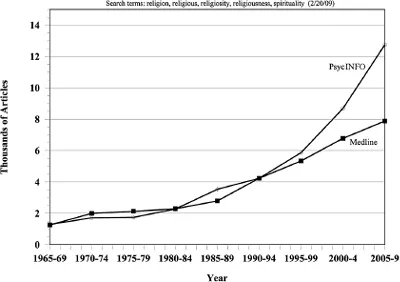
In this first chapter I briefly review research on the relationships between religious involvement and mental, social, and physical health. That research has been rapidly increasing in volume, especially over the past twenty years. Figure 1.1 shows the number of peer-reviewed articles on religion/spirituality (R/S) and health appearing in Medline and PsychINFO from 1965 to 2009. Note that the figures are noncumulative, referring to the number of articles published during each five-year period. Although only about 5 to 10 percent of these articles are research related, the number of research studies is rapidly accumulating. Overall, there now exist about three thousand quantitative original data-based studies on R/S and health. The review in this chapter sets the stage for the remainder of this book, which focuses on a critique of the research and, in particular, on a discussion of how to conduct, analyze, interpret, publish, and fund research on religion, spirituality and health.
MENTAL HEALTH
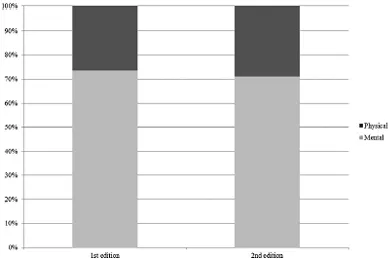
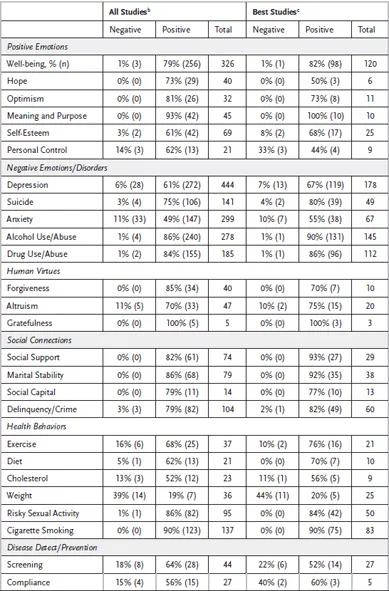
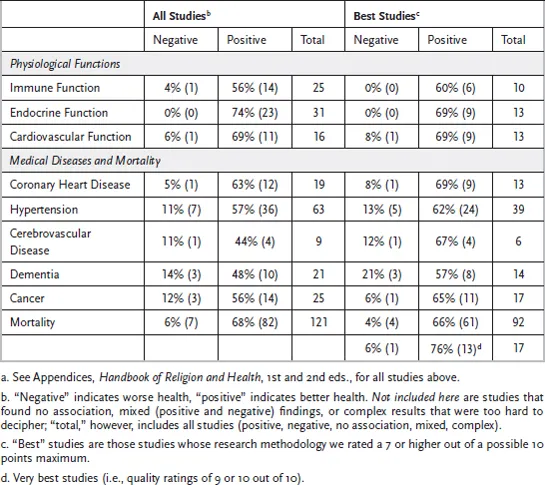
The majority (70 to 75 percent) of research on R/S and health has focused on mental health (Figure 1.2). I summarize this research by dividing it into studies on positive emotions and studies on negative emotions. The summaries presented here (see Table 1.1 on page 19) are from systematic reviews of the literature contained in the appendices of two editions of the Handbook of Religion and Health; all studies referred to below are reviewed there in detail.2
The majority (70 to 75 percent) of research on R/S and health has focused on mental health.
Positive Emotions
R/S has been linked to a number of positive psychological emotions that represent the opposite of the negative emotions and mental disorders that I discuss in the next section.
FIGURE 1.1.
Religion/Spirituality and Health Articles Per Five-Year Period
FIGURE 1.2.
Percentage of Studies on Mental and Physical Health. Compiled by Dr. Wolfgang v. Ungern-Sternberg; based on studies reported in the first and second editions of the Handbook of Religion and Health.
Well-Being
As of early 2010 at least 326 quantitative studies had examined relationships between R/S and well-being, with 256 (79 percent) finding greater happiness, satisfaction with life, or overall sense that life is good in those who were more R/S. All of these studies reported statistically significant findings, except for eight studies in which results were at a trend level (0.05 < p < 0.10). Of the 120 studies judged as the methodologically most rigorous, 98 (82 percent) found greater well-being among those who were more R/S (two at a trend level). Less than 1 percent reported lower well-being in the more R/S.
Hope and Optimism
At least 40 studies have examined relationships between R/S and hope, with 29 (73 percent) finding greater hope among the more R/S (two at a trend level). Likewise, at least 32 studies have examined relationships between R/S and optimism, and of those, 26 (81 percent) reported a significant positive relationship.
Meaning and Purpose
Having meaning and purpose in life is a positive aspect of mental health that is not only strongly correlated with well-being but also associated with resilience in the face of difficult circumstances. Of the 45 studies that have now examined relationships with R/S, 42 (93 percent) reported greater meaning or purpose among the more R/S. Of the 10 best studies in terms of methodological rigor, all 10 (100 percent) reported significant positive relationships.
Self-Esteem
Low self-esteem is often associated with an emotional disorder such as depression. In contrast, high self-esteem is strongly correlated with positive emotions and good mental health. Of 69 quantitative studies examining the relationship between R/S and self-esteem, 42 (61 percent) found significantly higher levels of self-esteem in those scoring higher on R/S; only 2 studies (3 percent) reported that R/S persons had lower self-esteem. Of the 25 methodologically most rigorous studies, 17 (68 percent) reported greater self-esteem in the more R/S.
Sense of Personal Control
Persons with a high internal locus of control (LOC) believe that events in life are a result of their own actions; in contrast, those with an external LOC believe that powerful others or external events control their lives. Of the 21 studies we identified in our systematic review that examined relationships between R/S and LOC, 13 (62 percent) reported that those who were more R/S scored significantly higher on having a sense of personal control.
Negative Emotions
In contrast to these positive indicators of mental health are negative emotional states, which when they interfere with an individual’s functioning are called “mental disorders.” These include depression, suicide, anxiety, alcohol abuse, and drug abuse.
Depression
Depression was the leading cause of disability in the world (measured by years of life lived with disability) in 19903 and is expected to be the world’s second-leading cause of disability in 2020, surpassed only by cardiovascular disease.4 The lifetime prevalence of depression in the United States is 20 percent in women and 10 percent in men.5 At least 444 studies have now quantitatively examined relationships between R/S and depression, and 272 (61 percent) of those found less depression, faster remission from depression, or a reduction in depression severity in response to an R/S intervention (ten studies at a trend level). In contrast, only 6 percent reported greater depression in those who were more R/S. Of the 178 methodologically most rigorous studies, 119 (67 percent) found inverse relationships between R/S and depression.
Suicide
Strongly linked to depression is suicide. Nearly 10 percent of those with severe depression end their lives by committing suicide,6 and depression is the most common cause of suicide.7 We identified 141 studies that had examined relationships between R/S and some aspect of suicide (completed suicide, attempted suicide, or attitudes toward suicide), and 106 (75 percent) reported significant inverse relationships; 80 percent of the best designed studies reported this finding.
Anxiety
Anxiety is a negative emotion that may present as an isolated problem by itself or in combination with depression. Of the 299 studies we located that examined relationships with R/S, 147 (49 percent) reported inverse relationships. Of the 67 best-designed studies, 38 (55 percent) reported inverse relationships. Of 33 studies reporting greater anxiety among the more R/S, all but 2 studies were cross-sectional in design, leaving open the possibility that anxiety led to greater R/S as individuals turned to religion to cope with whatever was making them anxious (as the saying goes, “There are no atheists in foxholes”8). Interestingly, of the 40 experimental studies or clinical trials, 29 (73 percent) reported that an R/S intervention was effective in reducing anxiety.
There is a lot of evidence indicating that R/S beliefs and behaviors are associated with more positive emotions and fewer negative emotions, emotional disorders, and substance use problems.
Alcohol Use/Abuse
We identified 278 studies that examined relationships between R/S and alcohol use or abuse, and 240 (86 percent) of those found less alcohol use or abuse among the more R/S (eleven at a trend level). Of the 145 best-designed studies, 131 (90 percent) reported significant inverse relationships with R/S. Less than 1 percent reported a positive relationship.
Drug Abuse
At least 185 studies have examined relationships between R/S and drug abuse, and 155 (84 percent) of those found less drug abuse among those who were more R/S. Of the 38 prospective cohort studies, clinical trials, or experimental studies, 36 (95 percent) found that R/S predicted less drug use or reported that R/S interventions reduced drug use.
Thus, there is a lot of evidence indicating that R/S beliefs and behaviors are associated with more positive emotions and fewer negative emotions, emotional disorders, or substance use problems.
TABLE 1.1.
Summary of Findings on Religion, Spirituality and Specific Health Conditionsa
SOCIAL HEALTH
Social health is known to influence physical health and disease susceptibility on the individual level9 and to affect resiliency in response to trauma or disaster on the individual and community levels.10 Under social health I include human virtues (prosocial positive psychological traits), social support, marital stability, social capital, and delinquency/crime.
Human Virtues
Among the human virtues (or prosocial positive psychological traits), I include forgiveness, altruism, and gratefulness. These virtues enhance and maintain social relationships. With regard to forgiveness, at least 40 studies have now examined relationships with R/S. Of those, 34 (85 percent) found that R/S was significantly correlated with being more forgiving (one at a trend level). Similarly, at least 47 studies have examined relationships between R/S and altruism (volunteering, donating money to the needy, etc.), of which 33 (70 perce...