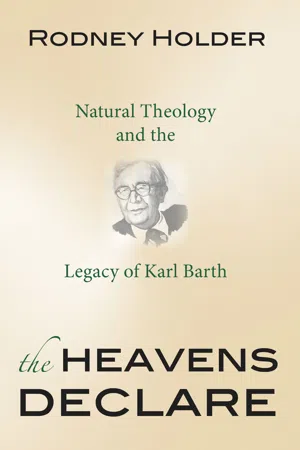
One of the central themes of inquiry for Karl Barth, the twentieth-century Protestant theologian, was the notion of revelation. Although he was suspicious of natural theology (i.e. the seeking of evidence for God's existence in the ordered structure of the world), recent scientific advances (notably in physics and cosmology) and the flourishing modern dialogue between science and religion offer compelling reasons to revisit Barth's thinking on the concept. We must again ask whether and how it might be possible to hold together the notion of revelation whilst employing reason and scientific evidence in the justification of belief.
In The Heavens Declare, author Rodney Holder re-examines Barth's natural theology argument and then explores how it has been critiqued and responded to by others, starting with Dietrich Bonhoeffer and Wolfhart Pannenberg. Holder then considers the contributions of two notable British participants in the science-religion dialogue, Thomas Torrance and Alister McGrath, who, despite their repudiation of natural theology in the traditional sense, also provide many positive lessons. The book concludes by defending an overall position which takes into account the ideas of the aforementioned theologians as well as others who are currently engaged positively in natural theology, such as John Polkinghorne and Richard Swinburne.
Holder's new study is sure to be of interest to theologians, philosophers of religion, and all scholars interested in the science-religion dialogue, especially those interested in natural theology as an enterprise in itself.
NATURAL THEOLOGY is generally understood to concern the knowledge of God available to all human beings without recourse to special revelation, although, as we shall see in later chapters, some modern theologians wish to define it differently. John Macquarrie gives a typical definition: “Natural theology is the knowledge of God (and perhaps also of related topics, such as the immortality of the soul) accessible to all rational human beings without recourse to any special or supposedly supernatural revelation.”1 It is an area of intellectual inquiry with a long if checkered history, dating back at least to the era of classical Greek thought. Within Christian theology the expression theologia naturalis was coined by St. Augustine.
Natural theology found classic expression in the works of St. Anselm and, supremely, in the “Five Ways” of St. Thomas Aquinas presented in the Summa Theologiae (hereafter, ST). These are all variations on the notion of “First Cause.” We see change in the world so there must be an unchanged changer. There must be a stopping point to the regress of causes, and even if there is an infinite backward chain of causes, there must be a first cause of the chain itself. The world and everything in it is contingent, so there must be a necessary being to explain why anything contingent exists. Things in the world exhibit the qualities of truth, goodness, and nobility to varying degrees, so there must be a being that is the truest, best, and noblest of all and which causes the being, goodness, and any other perfection of everything else. Things in the world are ordered for a purpose or goal, and that requires an orderer (this is the teleological or “design” argument that features in differing guises in much subsequent discussion). Aquinas ends each of his Ways by stating “and this we call God” (ST, 1a. 2, 3).
Before expounding the Five Ways, Aquinas makes an important distinction that is relevant to much of the discussion of this book: “The truths about God which St. Paul says we can know by our natural powers of reasoning—that God exists, for example—are not numbered among the articles of faith, but are presupposed to them” (ST, 1a. 2, 2). Arguing that effects only demonstrate the existence of prior causes, and not their essence, he states more explicitly, “God’s effects, therefore, can serve to demonstrate that God exists, even though they cannot help us to know him comprehensively for what he is.” My own claim for what natural theology can deliver is very much in line with this, though even more limited in eschewing the words “demonstrate” (demonstrare) and “prove” (probare,) which Aquinas uses.
With the rise of modern science in the sixteenth and seventeenth centuries, natural theology started to take a different form, appealing to particular structures within the natural order, rather than order per se, as exhibiting the signs of design. This was the physico-theology of such figures as Boyle, Hooke, and John Ray—indeed, of many of the early founders of the Royal Society. For example, the intricate detail of the eye of a fly shown under a microscope, and illustrated in Hooke’s Micrographia, far outshone that of a human artifact such as a nail, which showed rough edges. However, arguments of this kind were often combined with an appeal to more general features, too, such as the lawlike behavior of the natural world that the sciences were uncovering. The early Boyle Lectures gave expression to much natural theology at the beginning of the eighteenth century.
The fortunes of natural theology fluctuated with the advent of the Enlightenment. At first, natural theology was elevated because the alternative way of knowing God, through revelation and therefore through external authority, was deemed suspect: the Enlightenment also saw the advent of biblical criticism. But theologically there was a considerable danger in utilizing natural theological arguments to the neglect of revelation, since this seemed to point only to the need for a deistic conception of God, rather than the Trinitarian theistic conception of orthodox Christian faith—particularly as the universe came to be seen as a clockwork mechanism.
Enlightenment philosophers Immanuel Kant and David Hume attacked natural theology vigorously. Kant said that we can only experience phenomena; we cannot experience “noumena,” things “as they are in themselves.” And we impose order on the phenomena via the structures of our minds. It is human mind–imposed order rather than real order that we can know nothing about. It is thus not “God-imposed” order, so the design argument of natural theology is apparently undermined. However, scientists in particular find, contrary to Kant, that the empirical reality of the world does seem to force itself on us. Prime examples would be the totally counterintuitive phenomena described by quantum theory, and the four-dimensional curved space-time of general relativity. Indeed, as we shall have cause to reiterate, Kant has been shown to be in error in claiming the necessity of describing the world through Euclidean geometry because this is embedded in the structure of our minds.
Hume made a number of criticisms of natural theology, particularly the argument from design.2 For example, he pointed to the lack of analogy between mechanical artifacts pointing to a human designer and natural phenomena supposedly pointing to God. A house points to an architect or builder because we have many instances of existing houses. Natural phenomena are not like houses in that respect, and one needs a very close analogy to make the inference to design. To transfer an inference about parts of the universe exhibiting design to the whole doing so would be disproportionate: there is no similarity between a house and a universe!3 Moreover, since a cause ought to be proportioned to its effect, one cannot infer an infinite deity from anything finite. And then, why infer one god as the creator and not several deities, if the analogy is with a house or ship that was built by many men?4
Perhaps a better analogy for the universe, says Hume, is an animal. God would then be its soul (curiously an idea that some modern theologians have actually favored, though it certainly departs from classical orthodoxy’s maintenance of the distinction between the creator and the universe).5 The animal analogy also leads him to a different idea for the cause of the universe, namely generation; an ostrich lays an egg in the sand to produce another ostrich, and so on. Intelligence and design do not at any rate constitute the only option.6
Hume’s arguments have been very influential, with many scholars today believing he dealt the death blow to the argument from design. Historically that seems not to be the case, since natural theology, even in its physico-theological form, continued flourishing well into the first half of the eighteenth century. Indeed the high point was William Paley’s 1802 volume, Natural Theology.7 However, even this was not the end, with important contributions coming in the Bridgewater Treatises of the 1830s. These publications resulted from the will of the late Earl of Bridgewater, who had left £8,000 at the disposal of the president of the Royal Society, to pay those selected to “write, print and publish one thousand copies of a work On the Power, Wisdom, and Goodness of God as Manifested in the Creation.”
One of the most significant of these later writers, and a Bridgewater Treatise author, was William Whewell. Whewell coined the term “scientist” for the person who had previously been known as a “natural philosopher” or “man of science.” Whewell’s 1833 Bridgewater Treatise was titled Astronomy and General Physics Considered with Reference to Natural Theology, and in the dedication he made an important distinction. The aim was to show religious believers “how admirably every advance in our knowledge of the universe harmonizes with the belief of a most wise and good God.” He noted, however, how much more important was revelation, which was required “for the purpose of reforming men’s lives, of purifying and elevating their characters, of preparing them for a more exalted state of being.”8 Here we have an example of natural theology that accords more with the concept as expounded by Thomas Torrance and Alister McGrath, whom I discuss in later chapters, of supporting existing religious belief, as well as the recognition of its relatively minor status in comparison with revelation. John Hedley Brooke also thinks that the function of much natural theology is not exclusively to “prove the existence of God” for unbelievers, but to fulfill various roles within the community of faith, such as encouraging a “sense of awe and wonder” in believers.9 It is interesting that Darwin used a quotation from Whewell’s Bridgewater Treatise to face the title page of The Origin of Species: “But with regard to the material world, we can at least go so far as this—we can perceive that events are brought about not by insulated interpositions of Divine power, exerted in each particular case, but by the establishment of general laws.”10
Notwithstanding the importance of contributions such as that of Whewell, Paley’s famous image of himself crossing a heath and finding a watch has undoubtedly abided as the paradigm of natural theological reasoning. On examination the watch seems intricately put together for a purpose, to tell the hour of day, and if the parts were differently shaped or differently arranged from how they are, then the watch would have failed in its purpose. The natural conclusion to draw is that the watch had a maker who designed it for its purpose. Of course, Paley’s ultimate point is that “every indication of contrivance, every manifestation of design, which existed in the watch, exists in the works of nature; with the difference, on the side of nature, of being greater and more, and that in a degree which exceeds all computation.”11
Paley’s argument is more subtle than is often given credit for nowadays. Thus he has clearly considered various objections to the argument, some of which remind one of Hume—for example, whether the imperfection or malfunctioning of the watch should affect our conclusion that it was designed. The answer is no, because the original intention could still be discerned. A particularly interesting question is whether the existence of the watch would be accounted for if we were told that it was one out of a large number of possible combinations of material forms. That kind of argument is sometimes advanced today in order to deny that the fine-tuning of the universe requires explanation. Paley dismisses it as not something “any man in his senses” would think.12 I have argued that it fails in the fine-tuning case both because there is special significance in the configuration of the universe we observe and because, in fact, we have a good explanation for this particular configuration.13
Another objection Paley considers is whether it would make any difference to the argument if one found that the watch could generate other watches. In the first place, that would enhance the impression of design, not lessen it, he says, because it is evidence of even greater contrivance. Second, while a watch might generate another watch, it is not the maker in the same sense as a carpenter is the maker of a chair. It is not the source of order and purpose in the new watch, which must still be sought from an overall designer. Paley writes, “There cannot be design without a designer; contrivance without a contriver; order without choice; arrangement, without anything capable of arranging; subserviency and relation to a purpose, without that which could intend a purpose….”14 Even if our watch was produced by a preceding watch, that would not explain the contrivance of watches and their fitness for purpose. This seems to me to answer a point raised by Richard Dawkins, namely that evolution explains the appearance of design, and of purpose, in the natural world. Paley was therefore “wrong, gloriously and utterly wrong,” according to Dawkins.15 What Dawkins fails to realize is that the process of evolution needs a designer: a backward sequence of causes does not explain the existence of the sequence itself nor why it is productive of design and purpose. The remark of Charles Kingsley that it is even cleverer of God to “make things make themselves” than to create them all separately seems to be in line with what Paley says here.
Paley is widely discredited nowadays, precisely because it is thought that Darwin showed how evolution could produce the appearance of design without a designer. Of course, Paley did not take account of the possible mutation of species, and thus the evolution from simple beginnings of the immense and complex diversity of life we see today. However, as noted above, he was astute enough to consider whether a process of generation could substitute for design, and concluded that design was still required. It seems to me that that point is still valid, and in accord not only with the way such figures as Kingsley, Frederick Temple, and Aubrey Moore enthused about evolution, but also how Darwin himself described it in the closing pages of The Origin of Species: “To my mind it accords better with what we know of the laws impressed on matter by the Creator, that the production and extinction of the past and present inhabitants of the world should have been due to secondary causes, like those determining the birth and death of the individual.”16 And again: “There is grandeur in this view of life, with its several powers, having been originally breathed into a few forms or into one; and that, whilst this planet has gone cycling on according to the fixed law of gravity, from so simple a beginning endless forms most beautiful and most wonderful have been, and are being, evolved.”17
Paley’s thought also ranged wider than the design or “contrivance” of particulars within the natural world, such as the individual organs of animals, which are indeed explained by evolution even if evolution itself requires an explanation. Thus he also considered the design of the laws of nature. In particular he realized that the stability of planetary orbits is owed to the inverse square law of gravitation. Other laws would have resulted in the planets either spiraling into the sun or flying away from it. When the very narrow range in which the law must fall for preservation of the system is compared with the infinite range of possibilities, the only reasonable conclusion to draw, says Paley, is that a “designing mind” is responsible for the choice.18 To my mind this is the best of Paley’s arguments, and it is one that has lasted. It has been resurrected in the modern discussion of anthropic fine-tuning with the added nuance that only if there are three (out of infinitely many possible) spatial dimensions is there an inverse square law and hence a stable solar system.19 But the focus on the design of physical law, rather than the design of individual features separately, is most significant here, since individual features might come about through the operation of laws.
Despite Paley’s acknowledgment that there may be deficiencies in design, a problem is that he paints a picture of such a harmonious and “happy world” that the problem of suffering is almost trivialized: “In a spring noon, or a summer evening, on whichever side I turn my eyes, myriads of happy beings crowd upon my view.”20 What John Polkinghorne refers to as the “shadow side” of nature21 needs seriously to be addressed in any cumulative argument for the existence of a loving God. Indeed, although Darwin had been content to adopt Paley’s view when wandering in the meadows around Cambridge, he found the pain and suffering in nature hard to reconcile with God’s providential design. He made this clear in a letter to his friend and supporter, the Harvard botanist and Christian beli...
Table of contents
Cover
Half Title Page
Title Page
Copyright
Dedication
Contents
Preface
1. The Enterprise of Natural Theology
2. Karl Barth Natural Theology Challenged
3. Dietrich Bonhoeffer Disciple and Critic
4. Wolfhart Pannenberg Theology, Truth, and Science
5. Thomas Torrance Natural Theology Redefined
6. Alister McGrath Renewing Natural Theology
7. Conclusion The Way Forward for Natural Theology
Notes
Trusted by 375,005 students
Access to over 1.5 million titles for a fair monthly price.
Study more efficiently using our study tools.
Frequently asked questions
Yes, you can cancel anytime from the Subscription tab in your account settings on the Perlego website. Your subscription will stay active until the end of your current billing period. Learn how to cancel your subscription
No, books cannot be downloaded as external files, such as PDFs, for use outside of Perlego. However, you can download books within the Perlego app for offline reading on mobile or tablet. Learn how to download books offline
Perlego offers two plans: Essential and Complete
Essential is ideal for learners and professionals who enjoy exploring a wide range of subjects. Access the Essential Library with 800,000+ trusted titles and best-sellers across business, personal growth, and the humanities. Includes unlimited reading time and Standard Read Aloud voice.
Complete: Perfect for advanced learners and researchers needing full, unrestricted access. Unlock 1.5M+ books across hundreds of subjects, including academic and specialized titles. The Complete Plan also includes advanced features like Premium Read Aloud and Research Assistant.
Both plans are available with monthly, semester, or annual billing cycles.
We are an online textbook subscription service, where you can get access to an entire online library for less than the price of a single book per month. With over 1.5 million books across 990+ topics, we’ve got you covered! Learn about our mission
Look out for the read-aloud symbol on your next book to see if you can listen to it. The read-aloud tool reads text aloud for you, highlighting the text as it is being read. You can pause it, speed it up and slow it down. Learn more about Read Aloud
Yes! You can use the Perlego app on both iOS and Android devices to read anytime, anywhere — even offline. Perfect for commutes or when you’re on the go. Please note we cannot support devices running on iOS 13 and Android 7 or earlier. Learn more about using the app
Yes, you can access The Heavens Declare by Rodney Holder in PDF and/or ePUB format, as well as other popular books in Theology & Religion & Christian Theology. We have over 1.5 million books available in our catalogue for you to explore.