![]()
PART 1
The Templeton Touch
William Proctor
![]()
1
What Is the Templeton Touch?
EVERY AGE produces individuals who possess an extraordinary capacity for acquiring wealth. They seem to have a special gift or “touch” that enables them to accumulate material goods at a rapid rate.
Less successful people—including those who may have great aspirations to “make it big” but have not yet reached real wealth—often wonder: “Do I really have what it takes to reach the top…to formulate a personal investment strategy that could secure my family’s financial future…or even to move beyond mere security and make a fortune?”
A major purpose of this book is to explore, through the life of John Marks Templeton—who may justifiably be called one of “the world’s greatest investors”—the question of what it takes to succeed as an investor. Templeton was born into a small-town Tennessee family of limited means, and he and his folks were severely pinched by the Great Depression. Yet this relatively poor southern boy had the seeds of success in his personality, and he nurtured those seeds into full bloom in his adult life as an investment sage.
How did Templeton do it? What is the secret of his success as a “super investor”?
Part of Templeton’s formula for material success is very practical: It’s been a matter of implementing specific investment techniques that can be learned and applied by almost anyone who possesses a fair amount of desire and persistence. In the ensuing pages we’ll see how John Templeton’s upbringing was crucial in implanting in him the basic inner drive and personal values necessary to reach the peak of performance as an investor. And we’ll also examine in detail—through Templeton’s own words and advice—how anyone with adequate motivation can learn his key investment techniques, like bargain-hunting and developing good judgment in selecting stocks.
But there is also another important side to the highest levels of happiness and success in investing—a side that encompasses far broader considerations than just the “nuts and bolts” techniques of accumulating wealth. As we’ll see, it’s essential to understand and affirm this broader dimension of making big money if you want to be truly successful and live happily with your wealth once you acquire it. Too often a person may forge ahead and do quite well in building up personal assets. But then the unexpected pressures and temptations of newfound wealth present so many problems that “success” turns out to be not a success at all, but rather a curse in disguise.
But Templeton has learned how to be comfortable with his riches. He’s a self-made man who didn’t have the benefit of a family tradition of “old money” and philanthropy, but he has avoided the danger of being “blown away” by his wealth, because he has learned the secret of “successful living with success.” Indeed, John Templeton provides one of the best living examples of how a person’s wealth can become a satisfying extension of his or her inner drives and values.
Many of the key ingredients in successful investing are present in the life of John Templeton. He has developed a special “touch” with money that few others even approach. It’s a touch that has enabled him to build one of the most successful stock-market investing vehicles in history, the Templeton Growth Fund. And it’s also a touch that has inspired him to use the rewards from his investments to promote the moral and spiritual progress of mankind.
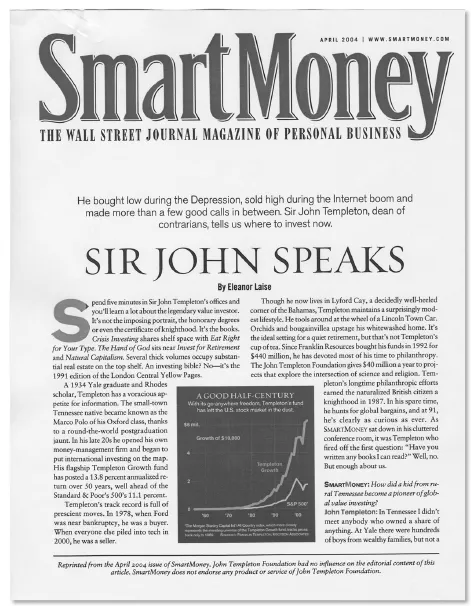
Performance of the Templeton Growth Fund versus the S&P 500 over fifty years as presented in the April 2004 issue of Smart Money. Reprinted with permission.
But what exactly does this “Templeton Touch” consist of—and how can you make it a part of your own life?
The essential qualities that enable a person like John Templeton or any other successful individual to do exceptionally well in business are undoubtedly dependent to some extent on good genes—or inherited brain power and other natural bodily endowments. But sometimes success seems to have little to do with innate abilities, as when a person stumbles upon good fortune and then has the ambition and desire to make the best use of that opportunity. In other words, in any great success story there are strong elements of “being at the right place at the right time,” and being prepared to act decisively when you find yourself there.
History abounds with tales of various people who were chosen for special tasks and material rewards by God, by the gods, or maybe just by good fortune. But perhaps the most famous story about a special power to create great wealth is the legend of King Midas, the ruler of Phrygia, a large district of Asia Minor in ancient times. There were a number of kings with the name “Midas” who governed Phrygia in the eighth century BC. But the Midas of ancient mythology probably came from an earlier era—possibly the second millennium BC, when the Phrygians migrated from Thrace or Macedonia.
According to ancient mythology, on one occasion the legendary Midas encountered the forest god Silenus, who was a close companion and mentor of Dionysus, the Greek god of wine, fertility, and revelry. Silenus wandered drunkenly into Midas’s royal gardens, got lost, and finally was rescued by the king. Dionysus was so happy when Midas returned his friend that he promised Midas he would grant him anything he wanted. And Midas, a materialistic man, asked for the power to turn everything he touched into gold.
Dionysus agreed and bestowed this gift upon him. But the problem with the “Midas Touch” was that everything that the king touched, without exception, turned to gold—including his food and drink. In other words, the touch, valuable as it was, also proved to be fatal.
But Midas was lucky. He went back to Dionysus and asked the god to take away the touch, and Dionysus agreed. He told the king to bathe in a certain stream, and the golden touch disappeared—though the stream continued to be a great source of gold!
A number of interpretations of this story might be offered. But the lesson that seems most appropriate for our present discussion is that even though the king had great powers to create wealth, he almost killed himself because he got caught up in total materialism: He became consumed by an unbridled desire to build up a store of vast riches without considering the consequences.
Wealth, if it is to be accompanied by true satisfaction and meaning, must have a purpose that goes beyond mere accumulation. Otherwise, material goods may actually careen out of control, turn on their possessor, and eventually destroy him or her.
If the Midas Touch is one side of the coin of wealth, the Templeton Touch is the other.
You see, the Templeton Touch is, in fact, the opposite of the Midas Touch. King Midas’s ability to produce wealth was a negative force that remained radically self-centered and, as a result, nearly destroyed him.
In contrast, the Templeton Touch is essentially a positive power.
First of all, it’s a capacity which enables the investor not only to make a good investment, but also to have more “staying power” in turning that good investment into a great one. Hard work and good judgment, supported by self-discipline and patience, are key qualities that have catapulted John Templeton from being merely “good” to being “great.”
Second, the Templeton Touch implies a willingness and an ability to use one’s material gains in some beneficial way for other people. But this social consciousness of wealth goes beyond mere “do-goodism” or ordinary philanthropy. In essence, this attitude involves a sense of stewardship, a belief that what you have is held in trust for the good of mankind.
Her Majesty, Queen Elizabeth II, knighted Templeton in 1987 for his philanthropic contributions.
Now let’s examine the Templeton Touch in more detail by moving from these general principles to the practical world of making money. There are several key personal characteristics—at least fifteen—that have helped John Templeton to be regarded by many people as the world’s greatest living investor. He had the seeds of some of these qualities as a child, but none really came into full flower until his adult life. In other words, he developed into a great investor. So his story is a story of personal progress, with success growing gradually until it finally bloomed years later.
Here is an overview of those fifteen key ingredients in Templeton’s personality and some suggestions about how they may relate to a successful investing strategy.
Self-reliance.
From his earliest youth, Templeton was taught to think and act for himself. He developed a belief in himself, a self-assurance and self-confidence. Invariably, this is a crucial quality in the successful investor, who must ultimately stand alone to make the final decision about where his or her money will be placed.
Reasonable risk-taking.
Most successful investors—and John Templeton is no exception—seem to have a bit of the entrepreneur in them. But even though Templeton is willing to take adventurous risks with big money, he is, above all, a rational and responsible risk-taker. He carefully analyzes all the factors before he puts even a penny on the line.
A sense of stewardship.
This may seem a strange quality to include among those associated with successful investing. But actually it’s one of the most important.
Many outstanding investors, including Templeton, have a feeling that the money they are accumulating represents something of value beyond mere worldly riches, and perhaps even something sacred. This is not to say that they worship money. Rather, it’s a matter of showing great respect for the potential power of wealth and also gratitude for their ability to earn fortunes. In Templeton’s case, this attitude really does approach a sense of stewardship, or an assumption that he has merely been given the privilege of managing assets that have been entrusted to him.
In some ways, Templeton’s attitude is true in a purely worldly sense, in that he does manage great sums for others through his mutual funds and the investment accounts that wealthy individual clients have entrusted to him. But there is also a spiritual dimension to his approach because he believes that even his personal assets were given to him by God.
This sense of stewardship encourages great care in making decisions that involve the disposition of money. And it also engenders a deep commitment to thrift—one of John Templeton’s most apparent personal characteristics.
A drive toward diversity.
The principle of diversity has always been one of the foundations of successful investing: In other words, it’s important to spread your risk by putting your funds into a variety of investment vehicles, so that if one investment has a bad year or goes under, you won’t lose all your capital.
But Templeton goes beyond this traditional interpretation of the diversity principle to search worldwide for good investments. Many pundits who have tried to explain his success have stressed the fact that his diversity is not merely national, but is international as well.
A bargain-hunting mentality.
Searching for bargains is part of John Templeton’s basic approach to life: This orientation affects the way he buys furniture, cars—and stocks. Part of his bargain-basement style with stocks involves looking at low price-earnings ratios and other traditional investment techniques. But, as we’ll see, his approach is much broader than that taken by most of his fellow investors.
A broad social and political awareness.
The present and future value of stocks and other investments is always dependent to some degree on the nature of local social movements, laws, and government regulations. Even the basic nature of the political system may have a dramatic effect on how well a given investment will do in future years. For example, Templeton steers clear of investments in countries that are characterized by what he calls “socialization”—or various forms of socialism and other concerted governmental influence in business.
Flexibility.
There’s no ironclad formula or doctrinaire, rigid rules that guide the top investors. These experts are always willing to “roll with the punches,” always flexible when new situations and challenges confront them.
Templeton reading the Wall Street Journal at the exact North Pole, July 27, 1996. Russian icebreaker Yamal is in the background.
A willingness to devote large quantities of time to studying potential investments and developing sound moneymaking strategies.
This key quality of the best investors may not be particularly glamorous. On the contrary, it is a rather ordinary characteristic. But at the same time, it’s an absolutely essential ingredient for investment success. A willingness to work hard for relatively long hours and to do in-depth analyses of specific stocks and investment situations is a sine qua non for making profits in this field.
John Templeton doesn’t waste many of his free minutes when he travels in airplanes, waits for business appointments, or finds himself in situations that most people would consider “dead” or wasted time: Instead of sitting for minutes or hours staring out into space, he reads articles and studies by security analysts on various companies that interest him. As a result, he is one of the best-prepared investors in the world when it comes to knowing the facts about a variety of potentially profitable opportunities.
An ability to “retreat” periodically from daily pressures.
The retreat concept is a religious notion that has direct application to effective investment strategy. Templeton found that when he moved from Wall Street to his present home in the Bahamas in the 1960s, his success as an investor improved markedly. The hours he spends in solitude help him to get a perspective that was impossible in the hullabaloo of the New York financial markets. These times of reflection also give him the courage to make decisions counter to prevailing market fashions—and often enable him to make money even as the majority of other investors are losing theirs.
An ability to develop an extensive friendship network.
One of Templeton’s most endearing qualities is his ability to make and keep friends in a wide variety of fields and geographical locations. As it happens, many of these friends are in influential positions in the business and investment community, and they are invaluable contacts when he needs advice or information about a particular investment possibility.
Patience.
One of the “fruits of the Spirit” listed in St. Paul’s letter to the Galatians (5:22) is patience. And this personal quality is just as important in successful investing as it is in authentic spirituality. John Templeton has learned to be patient and persistent as he selects a certain stock and then waits calmly for it to start an upward climb. The wait may be months or years, but Templeton takes the long view—and his patience has proven him right more often than not.
Thought control.
This quality may at first seem rather ominous, because thought control may be associated with control from the outside, as happens in some religious cults or political brainwashing situations. But Templeton’s approach to thought control is just the opposite. He advocates and practices imposing, from within, a discipline and restraint on the direction of one’s thoughts and emotions. In other words, his thought control is really a form of self-control or self-discipline. He has learned over the years to focus his mental powers only on the task at hand and to block out all extraneous influences that might distract him from his main purposes in business and life. The result has been an ability to achieve great things in the worlds of investing and philanthropy.
Positive thinking.
This is a form of thought control that Templeton practices, but it has a “life of its own” and therefore must be listed as a separate quality. He believes that negative thoughts are a kind of psychological poison that tends to sap a person’s energy and distracts that person from accomplishing important goals. He certainly recognizes poor or negative investments when he sees them, but he doesn’t dwell on them. Instead, he moves on quickly to those investments that offer the positive promise of greater profits.
Simplicity.
Although there is a great deal of intricate analysis involved in evaluating many of the companies and special investment situations that Templeton considers every week, a major feature of his investment decisions—and of his entire life for that matter—is simplicity.
After all the complex elements in an investment decision have been considered, he tries to boil them down to their essential components. But even though the final statement of the solution of a problem may reflect classic simplicity, it still takes a genius of sorts to get to the true essence of an investment problem—just as it took a genius like Einstein to state the simple formula for the theory of relativity.
Great intuitive powers.
This final key quality for successful investing has an almost mystical aura about it. It’s a matter of knowing through some indefinable insight—after all the hard work, risk-taking, and other concrete ingredients for a good investment choice have been added—that a certain decision is the right one.
In part, this special intuitive quality may be innate: Some people may naturally be more farsighted and have better judgment and insight than others into what may make a...