These highly original essays illuminate Virginia Woolf and a selection of other twentieth-century writers and artists. Based on detailed research and presenting previously unpublished texts, pictures, and photographs, they are notable feats of scholarly detective work.
Six of them focus on four pivotal members of the Bloomsbury Group – Virginia Woolf, Vanessa Bell, Clive Bell, and Roger Fry. Prominent ingredients of their story include art, writing, friendship, love, sex, mental illness, and Greek travel. The five 'out of Bloomsbury' essays are about the 'new' letters from the novelist Rose Macaulay to the Irish poet Katharine Tynan; the prodigious teenage talents of Dorothy L. Sayers; the remarkable story of Tolkien's schoolmaster R. W. Reynolds; and the artist Tristram Hillier in Portugal.
The collection creates a richly varied and entertaining picture of British culture in the first half of the twentieth century.
eBook - ePub
In and out of Bloomsbury
Biographical essays on twentieth-century writers and artists
- 316 pages
- English
- ePUB (mobile friendly)
- Available on iOS & Android
eBook - ePub
In and out of Bloomsbury
Biographical essays on twentieth-century writers and artists
About this book
Information
1
“New” portraits by Roger Fry of Helen Fry and Vanessa Bell
Two portraits by Roger Eliot Fry, a drawing and a painting, were recently acquired by me from separate sources in the United States. Neither has been exhibited or published before.
The earlier one (Portrait 1), drawn in pencil on paper that is now slightly foxed, is a quarter-length portrayal of a woman who looks to be in her late twenties or early thirties (Plates 1–2). The handsome face is turned slightly to the left (the viewer’s right). The head is carefully drawn, as is the left hand, which is raised and turned in front of the body in such a way as to display a ring on the fourth finger, with two long, thin bands of material running over and through the fingers. The bands come loosely across the chest from a floral object, which appears incompletely at the left edge of the drawing. Although it is possible that the bands are fine chains, which were sometimes looped and pinned across the bodice, they are more plausibly interpreted as ribbons attached to the floral object, which in that case is to be identified as a bouquet rather than a floral brooch. A choker, probably a ribbon-band or possibly composed of very fine beads, with a shield-shaped front clasp or slide, is worn on the neck, and a cluster-ornament across the parting of the hair at the front. The rest of the drawing is decidedly sketchy, but it can be seen that the dress is heavily padded at the shoulders. Behind the head is the outline of what is almost certainly a cushion or pillow, and to the right of that the outline of what is probably part of a cushion or pillow or chair.
The drawing, which is unsigned, was offered for sale as Pencil Portrait of an Unidentified Woman. It was mounted as an oval (maximum 21 × 14 cm) inside a rectangular frame. The mount concealed a significant area of the drawing, which occupies what may be a page removed from a sketchbook. The drawing has now been remounted, no longer as an oval and with no part of it concealed. Curved lines that are just visible upper left, lower left, and on the right suggest that at some stage, perhaps when more of the drawing survived, a larger oval was planned, if not executed. Certainly these lines do not match the oval in place when the picture was acquired by me. On the verso of the drawing is the start of, or a sketch for, a painted landscape with trees. On the back of the frame is the label of The Bloomsbury Workshop, 12 Galen Place, London WC1A 2JR, with the description “ROGER FRY (1866–1934) / Head of a Woman / Pencil / c1905”. This label was attached to the frame not by The Bloomsbury Workshop, but after the drawing was acquired by the next owner, when she had it matted and framed.
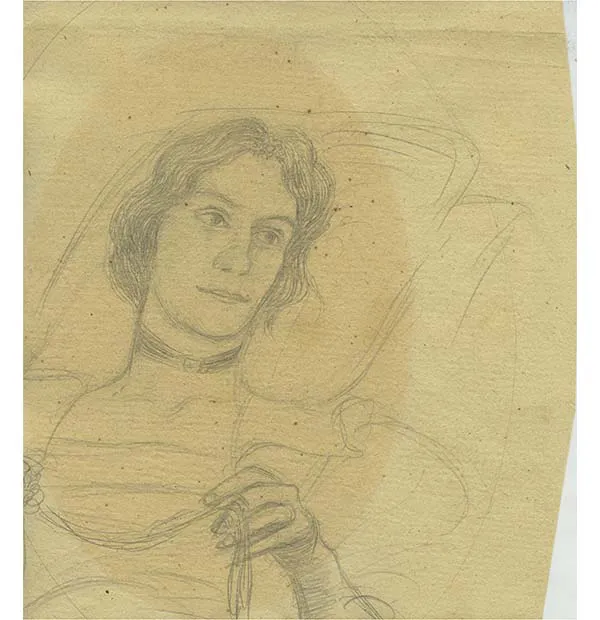
1 Portrait of Helen Fry by Roger Fry, 3 December 1896. Pencil on paper, 22.8 × 19.7 cm.
The ascription of Portrait 1 to Roger Fry is correct, but the suggested date is not, and the sitter is the artist’s wife, Helen Fry née Coombe. Being familiar with drawings and photographs of her, I recognised her at once, and the identification has been endorsed by many others who have viewed the drawing alongside known images of her. But, wanting to be in the best position to combat any possible challenge, I consulted Richard Neave,1 long recognised as a leading authority on facial comparison. I sent him four images: a scan of Portrait 1; two photographs of Helen with Roger2 – one taken in autumn 1896 during their engagement (Plate 3), the other probably about a year later;3 and a drawing of Helen by Roger in King’s College Cambridge Archive Centre (REF/4/8/5). Neave devoted several hours to scientific study of the images, comparing proportions and morphology. In his detailed report of 29 January 2015 he noted numerous similarities between the “new” portrait and the other images and found no discernible dissimilarities of any significance. In making the proportional comparison, he used digital technology to produce vertically split images, combining the known portrait of Helen with each of the photographs, and carrying out a similar exercise with Portrait 1. In every case the vertical and horizontal proportions were found to be consistent. The split images that combine the head of the sitter in Portrait 1 with the head of Helen Fry in the engagement photograph are reproduced in Plates 4 and 5.
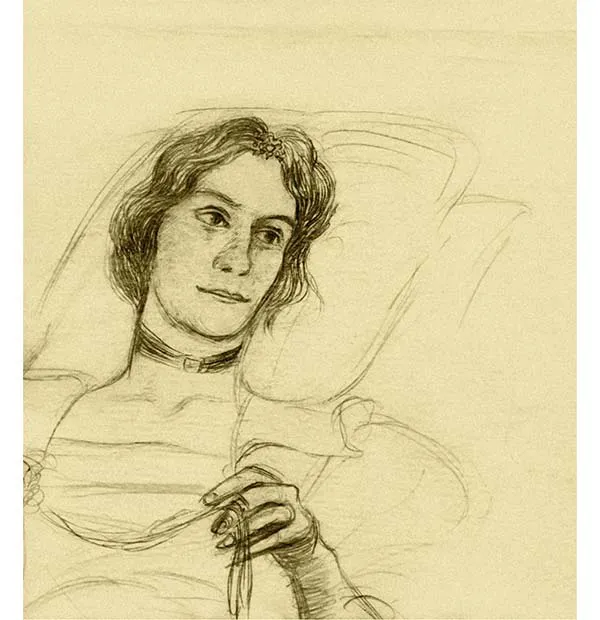
2 Portrait of Helen Fry by Roger Fry. The same drawing as in Plate 1, but with the image digitally restored.
Like Roger Fry, Helen was an artist, and a very talented one. I describe and assess her life, personality, training, and career elsewhere in this book,4 and I will be very brief here. After studying at the St John’s Wood Art Schools in London, she was admitted to the Royal Academy of Arts Schools (RAS) in December 1882. On leaving the RAS at a date unknown, but not later than 1888, she turned her attention to the decorative arts. In 1896, the year of her marriage, her fine Mary-and-Martha stained-glass window, commissioned in memory of Elizabeth Martin-Leake, had been installed in the Church of the Evangelist at High Cross, Hertfordshire (16–19 March), and she had superbly decorated Arnold Dolmetsch’s “Green Harpsichord” for display at the Fifth Exhibition of the Arts and Crafts Exhibition Society (7 October–5 December).
She was widely admired not only for her artistic ability, but also for her attractive personality and voice, witty conversation, deportment, and, despite bad teeth, good looks. Roger Fry had been captivated by her at their first meeting, which occurred in his lodgings at 29 Beaufort Street, Chelsea, on Monday, 27 May 1895. What happened is described by the poet Robert (“Bob”) Calverley Trevelyan in a letter written to Edward Marsh. Marsh, destined to become a distinguished civil servant and a notable patron of the arts, had, like Trevelyan, read Classics at Trinity College, Cambridge, and, like him and Roger Fry, was an “Apostle”.5 Trevelyan had called with Helen at 30 Bruton Street, off Berkeley Square, where Marsh lived with his parents, hoping to introduce her to him, but Marsh was not at home. The following day Trevelyan wrote to tell Marsh what he had missed:
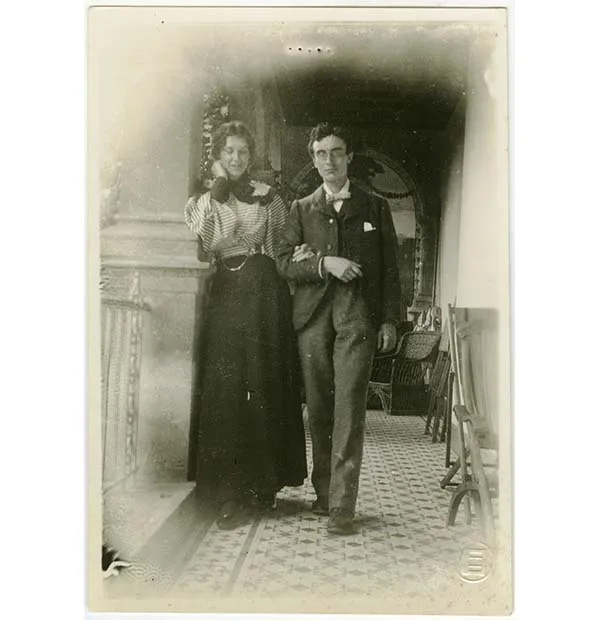
3 Helen Coombe (Fry) and Roger Fry at Failand House, Failand, near Bristol, autumn 1896. Photograph.
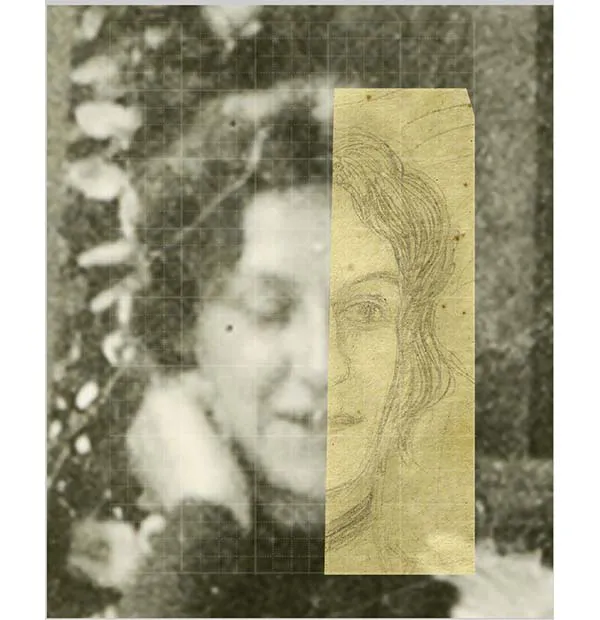
4 Vertically-split image, combining the left (viewer’s right) half of the head of the sitter in Plates 1 and 2 with the right (viewer’s left) half of the head of Helen Coombe (Fry) in Plate 3.
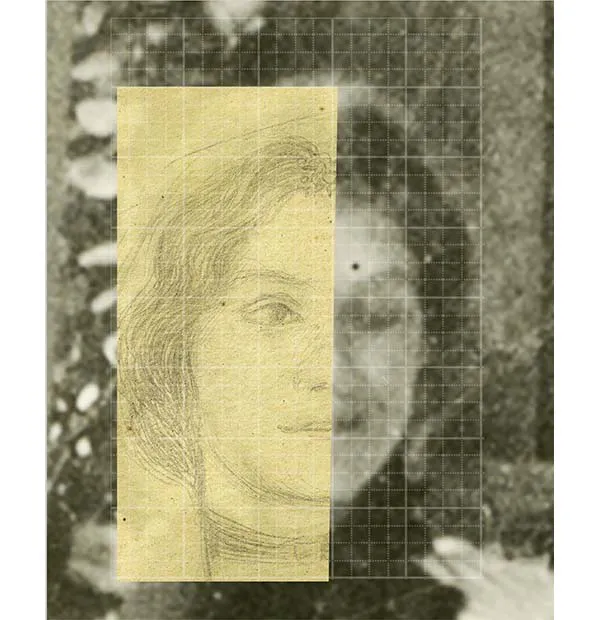
5 Vertically-split image, combining the right (viewer’s left) half of the head of the sitter in Plates 1 and 2 with the left (viewer’s right) half of the head of Helen Coombe (Fry) in Plate 3.
5 Barton Str. [Westminster]
28 May [18]95
28 May [18]95
My dear Edward,
… I went round to Bruton Str yesterday morning to see if you were alive, but found that you had gone back on Sunday. You should have stayed, for I had for you a rose of Shiraz the direct descendant of the one which intoxicated Hafiz when he looked on it, and led his spirit forth like wine on the turnpikes of imagination into a land of luminous horizons. You would have had this rose, if you had been there. As it was I took it round to Fry who fell violently in love with it, and fell to painting it. Seriously it was the most perfect flower I ever set eyes on.
…
Yours affectionately
R C Trevelyan6
R C Trevelyan6
Helen was much slower to fall in love with Roger, but did so in the summer of 1896, stimulated by the support and advice he gave her about the decoration of the Green Harpsichord. They were married in the Priory Church of St Bartholomew the Great in the City of London on 3 December 1896. She was aged thirty-two. He was twenty-nine, but gave his age as thirty, which he did not become until 14 December. The couple’s genuine love for one another, combined with their shared interest in art, seemed to augur well for the success of their marriage, but there was soon to be much anxiety about her health – first about her physical health, then, much more alarmingly, about her mental state, as she began to display symptoms of what is now recognised to have been chronic paranoid schizophrenia. The first major episode occurred at the end of May 1898. She was in an asylum for over six months, and, although she made a recovery and had several largely trouble-free years during which she produced some more fine artistic work and two children, she had further spells in asylums in 1903 and 1907–1908, and in November 1910 was admitted to The Retreat, the Quaker asylum in York, where she was to spend the last twenty-seven years of her life.
When did Roger make the drawing under discussion? The answer is at the time of their marriage and almost certainly on the wedding day itself. There are some likely indications of this in the drawing, and they are strongly supported by a previously unpublished document.
At the time when parts of the drawing were hidden, consideration was given to the possibility that the “pillow” or “cushion” behind Helen’s head is actually the thrown-back veil of her wedding-dress, and the cluster-ornament on her head an anchor for the veil. This now seems unlikely. But, whether the object partly visible below the right shoulder, at the left edge of the picture, is a bouquet with ribbons attached, or whether it is a floral cluster-brooch and the “ribbons” are fine chains looped and pinned across the bodice, they well suit a bridal context. The care that has been taken to show the wedding-ring would not of course by itself prove that Helen has just got married, but its emphasis is the more understandable if the drawing was made on her wedding-day. Given that she was not at all well off, the jewellery she is wearing suggests at the very least a special occasion, as does the dress with its padded shoulders and puffed, leg o’ mutton sleeves, very much in fashion, including for wedding-dresses, in and about 1896. If the special occasion for which she was attired and ornamented was not her wedding, it is difficult to think what it could have been.
It might be questioned whether there would have been time for a sitting on the wedding-day, but Roger worked rapidly, and he was never one to waste any opportunity for a drawing or painting. As we have seen, when Helen and he met for the first time, he immediately started painting her. No wedding photographs are known to have been taken, and it is natural that he should have wanted to record how she looked on the day. The wedding service, which took place at 2 p.m., was followed by tea at Helen’s mother’s house in Hammersmith. Then, in the evening, the couple had dinner with four friends, including Helen’s friend the artist Selwyn Image and Roger’s best man, Bob Trevelyan, at Solferino’s in Rupert Street near Piccadilly Circus. The establishment, known affectionately as Solfi’s, was much favoured...
Table of contents
- Cover
- Half Title
- Title Page
- Copyright
- Contents
- List of illustrations
- Preface
- Acknowledgements and dedication
- Introduction
- 1 “New” portraits by Roger Fry of Helen Fry and Vanessa Bell
- 2 A complete strip-off: A Bloomsbury threesome in the nude at Studland
- 3 Clive Bell’s memoir of Annie Raven-Hill (co-written with Helen Walasek)
- 4 “Far the best holiday for years”: Virginia Woolf’s second visit to Greece
- 5 “Suicidal mania” and flawed psychobiography: Two discussions of Virginia Woolf
- 6 Virginia Woolf and “the hermaphrodite”: A feminist fan of Orlando and critic of Roger Fry
- 7 “I am afraid I am not Irish”: Letters from Rose Macaulay to Katharine Tynan
- 8 A teenage star: The forgotten contribution of Dorothy L. Sayers to a pageant
- 9 “She had quite unusual gifts”: Dorothy L. Sayers at school
- 10 The secret love-child of an American Civil War commander: The strange story of Tolkien’s schoolteacher
- 11 “A land pre-eminently to inspire a painter”: Tristram Hillier’s first visit to Portugal
- Details of original publications
- Index
Trusted by 375,005 students
Access to over 1.5 million titles for a fair monthly price.
Study more efficiently using our study tools.
Frequently asked questions
Yes, you can cancel anytime from the Subscription tab in your account settings on the Perlego website. Your subscription will stay active until the end of your current billing period. Learn how to cancel your subscription
No, books cannot be downloaded as external files, such as PDFs, for use outside of Perlego. However, you can download books within the Perlego app for offline reading on mobile or tablet. Learn how to download books offline
Perlego offers two plans: Essential and Complete
- Essential is ideal for learners and professionals who enjoy exploring a wide range of subjects. Access the Essential Library with 800,000+ trusted titles and best-sellers across business, personal growth, and the humanities. Includes unlimited reading time and Standard Read Aloud voice.
- Complete: Perfect for advanced learners and researchers needing full, unrestricted access. Unlock 1.5M+ books across hundreds of subjects, including academic and specialized titles. The Complete Plan also includes advanced features like Premium Read Aloud and Research Assistant.
We are an online textbook subscription service, where you can get access to an entire online library for less than the price of a single book per month. With over 1.5 million books across 990+ topics, we’ve got you covered! Learn about our mission
Look out for the read-aloud symbol on your next book to see if you can listen to it. The read-aloud tool reads text aloud for you, highlighting the text as it is being read. You can pause it, speed it up and slow it down. Learn more about Read Aloud
Yes! You can use the Perlego app on both iOS and Android devices to read anytime, anywhere — even offline. Perfect for commutes or when you’re on the go.
Please note we cannot support devices running on iOS 13 and Android 7 or earlier. Learn more about using the app
Please note we cannot support devices running on iOS 13 and Android 7 or earlier. Learn more about using the app
Yes, you can access In and out of Bloomsbury by Martin Ferguson Smith in PDF and/or ePUB format, as well as other popular books in Literature & History of Modern Art. We have over 1.5 million books available in our catalogue for you to explore.