- 248 pages
- English
- ePUB (mobile friendly)
- Available on iOS & Android
eBook - ePub
About this book
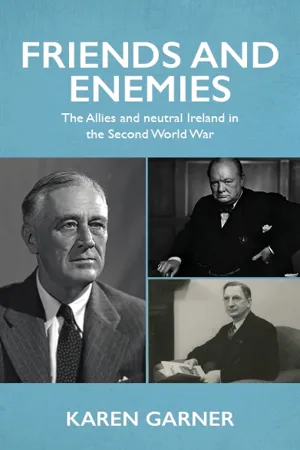
This history of Anglo-American efforts to overturn Ireland's neutrality policy during the Second World War adds complexity to the grand narrative of the Western Alliance against the Axis Powers, exploring relatively unexamined emotional, personalised, and gendered politics that underlay policymaking and alliance relations. Friends and enemies combines the methodologies of diplomatic history through its close reliance on archival documentation with attention to new theoretical understandings regarding the roles played by personal friendships and enmities and competing masculine ideologies among national leaders. Including, Winston Churchill, Franklin Roosevelt and Eamon de Valera, and their close foreign policy advisers in London, Washington DC and Dublin, as they constructed national identities and defined their nations' special relationships in time of war.
Trusted by 375,005 students
Access to over 1.5 million titles for a fair monthly price.
Study more efficiently using our study tools.
Information
1
Agreements made, pledges broken: Europe in the 1930s
When Helen Kirkpatrick began her graduate studies in history and politics at the Institute des Hautes Études Internationales in Geneva, Switzerland in September 1931, her goal, at the young age of twenty-two, was to travel throughout Europe and to learn at first hand about the conduct of world affairs. Kirkpatrick (1909–1997) was a hardworking and ambitious young woman, raised in a middle-class family in upstate New York. She enrolled at Smith College in 1928 and graduated in June 1931 near the top of her class. At the time she had no clear vision of the path her life would follow. The future that many bright young Americans faced at the depths of the Great Depression was uncertain, yet Kirkpatrick sensed that new opportunities could open for her in the city where the League of Nations, the decade-old forum for member state delegations and global activists, gathered to debate the most pressing issues of the day. In fall 1931, planning for the World Disarmament Conference that the Great War’s victor nations had promised to convene in postwar peace settlements was finally underway. Preparations, however, were marred by a new global security crisis that erupted in September when the rising Japanese imperial power invaded and occupied Chinese Manchuria. In Geneva, the proposed disarmament conference and Japan’s not-yet-officially-acknowledged act of war dominated the conversations in her classes, in League of Nations public sessions, and at the flurry of social events hosted by foreign delegations and global lobbyists that Kirkpatrick attended.
The opening of the annual League General Assembly in mid-September launched both the social and political seasons in Geneva. Advocacy groups hoping to influence their nation’s leaders, whose policies and governing decisions shaped their constituents’ fates, mingled with businessmen hoping to gain inside information regarding the direction of the world economy that affected their financial futures, and with journalists gathering news they could report to readers across the globe. In 1931, the world’s leading statesmen, along with their nations’ often jaded diplomatic envoys and global civil servants, joined earnest advocates of “peace” through disarmament. The women’s international organizations, veteran soldiers, socialists and labor unionists, and university students who represented a postwar generation that hoped for a different fate than those who lost their lives in the last war all converged on the international capital with plans and schemes, intent on shaping their national leaders’ disarmament pledges and global governance treaties.
Helen Kirkpatrick set out to learn from them all. In classes taught by a host of elite male scholars and government dignitaries whose international reputations were well established – including Swedish economist Gunnar Myrdal, former Italian foreign minister Count Carlo Sforza, Spanish diplomat Salvatore Madariaga, and historian of the Great War Bernadotte Schmidt – Kirkpatrick’s studies focused on debating world events and the relative merits of democratic, socialist, and fascist governments to lead their peoples through dangerous global transformations. She also attended League of Nations sessions presided over by General Secretary Sir Eric Drummond, where the foreign ministers of the world’s “Great Powers,” including Aristide Briand, Sir John Simon, Dino Grandi, and Heinrich Brüning, addressed the global Assembly. An awestruck Kirkpatrick “sat not ten feet away from … all the men I have read about and studied so long.”1
Years later, Kirkpatrick wrote about the actions taken by the League member states during her days as a graduate student in Geneva from 1931 to 1933, and marked these years, as many of her contemporaries would, too, as the inception of the fascist powers’ aggressive imperial projects that culminated in a second world war. Yet even at the time, in her youthful naivety, she noted the moral and political failures of world leaders who refused to recognize Japan’s war in China for what it was and continued the charade that they were honestly debating the terms of an international disarmament treaty that would preserve an already shattered world peace.2 Following two years spent back in the United States, from 1933 to 1935, when Kirkpatrick tried without success to land a job as a newspaper reporter and was married briefly to a New York businessman, she returned to Geneva in September 1935 to establish herself as a journalist and commentator on international affairs. She was immediately drawn back into the self-serving and backroom-deal-making world of League of Nations politics. In 1935, Fascist Italy led by Benito Mussolini launched a territorial land grab to establish their colonial power over defenseless League member state Ethiopia, and throughout the fall session the League’s leading Western European powers deliberated inconclusively regarding collective sanctions that were never imposed on the Italian aggressors. Kirkpatrick also jumped back into Geneva’s swirling social life that accompanied League Assemblies, and cultivated networks of diplomats, League civil servants, and foreign reporters, parlaying these contacts into journalistic assignments that paid her rent and served her professional ambitions.3
Over the next two years, Kirkpatrick witnessed intergovernmental relations in both public and private arenas that shaped her distinctive reporter’s blend of cynicism and idealism as she searched for the “real” story behind increasingly violent global conflicts. One shocking episode that took place in July 1936 helped to define her anti-fascist reportorial perspective throughout the cataclysmic next decade. She was standing next to a Jewish journalist, Stefan Lux, in the League general meeting hall as Italy’s annexation of Ethiopia was announced to the member states. Following Italy’s attack on Ethiopia in October 1935, Britain and France negotiated a “peace” in January 1936 that ceded 220,000 square miles of Ethiopian territory to Italy.4 When Ethiopia rejected the settlement and fought back, Italy dropped poison gas bombs on both military and civilian targets until Ethiopia surrendered in May.5 The terms of Ethiopia’s capitulation were announced at the July League session; Lux leapt to his feet, shouted “This is the last blow,” and shot himself. He died from his wounds as the assembled government delegations looked on helplessly. Kirkpatrick became a part of the media reports, as she had overheard his last words calling out to the Secretary General, Joseph Avenol, to take charge of his briefcase. The case contained letters explaining his suicide to Britain’s Foreign Minister Anthony Eden, King George VI, and to several journalists.6 Lux’s letters expressed his despair at the failure of the League to stand up to the fascist powers and to call attention to the plight of the Jewish peoples in Nazi Germany, and he urged the British government to form a European alliance to halt the dangerous dictators directing Germany’s and Italy’s violent assaults on undefended populations.7
In 1936, Kirkpatrick’s reports from Europe focused on Germany’s and Italy’s provocative empire-building policies that threatened the continental peace, including German-Italian interventions in the Spanish Civil War, and German occupation of the Rhineland.8 She also joined critics of Britain’s Conservative Party government then led by Prime Minister Stanley Baldwin, denouncing the government’s failures to check the fascist powers’ aggressive rearmament programs or to establish a vigorous British rearmament program in response.9 In 1937, Kirkpatrick relocated to London to work with Daily Telegraph reporter Victor Gordon Lennox and Economist deputy editor Graham Hutton on a new publication, the Whitehall Letter, an international affairs newsletter that circulated through private subscriptions and was able to avoid some of the press censorship that stifled reporting in other mainstream newspapers.10 Articles published in the Whitehall Letter were based on inside information Kirkpatrick, Gordon Lennox, and Hutton gleaned from their closely guarded diplomatic contacts and on their own investigative reporting.11 While Gordon Lennox continued his post as the Daily Telegraph’s diplomatic correspondent and he and Hutton remained anonymous,12 Kirkpatrick wrote and edited copy for the Whitehall Letter. Together they built up a “small but influential” readership that included Winston Churchill and Anthony Eden, among other government-affiliated European and American subscribers.13
The Whitehall Letter was, in Kirkpatrick’s words, “objective in its approach and designed to inform its readers of the realities of world politics.”14 In fact, the Whitehall Letter was anything but objective; it actively opposed the appeasement policy that Neville Chamberlain (1869–1940) adopted when he succeeded Stanley Baldwin in May 1937 as Prime Minister and leader of the Conservative Party government. Kirkpatrick, Gordon Lennox, and Hutton set out to cultivate American anti-fascist, anti-isolationist public opinion in league with an “Old Guard of Tory dissenters,” who also opposed appeasement.15 In 1938–1939, British anti-appeasers joined forces with American expatriate reporters, including Kirkpatrick, Edgar Mowrer, Dorothy Thompson, John Gunther, Vincent Sheehan, and Bill Stoneman, whose firsthand experiences covering European politics had already convinced them of the existential fascist threat. The Brits introduced American reporters to Britain’s ruling elite, and shared insights regarding the inner workings of British government.16 At the suggestion of Victor Gordon Lennox and other British friends, Kirkpatrick wrote two books that focused on the follies of the British appeasement policy and the dangers that the Nazi German Reich’s imperial expansion and attacks on European Jewish people posed to world peace, both books intended to explain American responses to European affairs to British readers and to undermine American isolationist opinion in the United States. This Terrible Peace17 was written after Neville Chamberlain orchestrated the Munich Agreement in September 1938, forcing the Czechoslovakian...
Table of contents
- Cover
- Half Title
- Title Page
- Copyright
- Dedication
- Contents
- List of figures
- Acknowledgments
- Map of Eire during the Emergency
- Introduction
- 1 Agreements made, pledges broken: Europe in the 1930s
- 2 Neutral states in a world at war, September 1939 to May 1940
- 3 “Unstoppable” Germany, “unbeatable” Britain, June to December 1940
- 4 In pursuit of America’s friendship, January to June 1941
- 5 British friend, Irish foe, July to December 1941
- 6 Efforts to “break the backbone” of Irish neutrality, January 1942 to December 1943
- 7 Eire, neutral to the bitter end, January 1944 to June 1945
- Conclusion
- Bibliography
- Index
Frequently asked questions
Yes, you can cancel anytime from the Subscription tab in your account settings on the Perlego website. Your subscription will stay active until the end of your current billing period. Learn how to cancel your subscription
No, books cannot be downloaded as external files, such as PDFs, for use outside of Perlego. However, you can download books within the Perlego app for offline reading on mobile or tablet. Learn how to download books offline
Perlego offers two plans: Essential and Complete
- Essential is ideal for learners and professionals who enjoy exploring a wide range of subjects. Access the Essential Library with 800,000+ trusted titles and best-sellers across business, personal growth, and the humanities. Includes unlimited reading time and Standard Read Aloud voice.
- Complete: Perfect for advanced learners and researchers needing full, unrestricted access. Unlock 1.5M+ books across hundreds of subjects, including academic and specialized titles. The Complete Plan also includes advanced features like Premium Read Aloud and Research Assistant.
We are an online textbook subscription service, where you can get access to an entire online library for less than the price of a single book per month. With over 1.5 million books across 990+ topics, we’ve got you covered! Learn about our mission
Look out for the read-aloud symbol on your next book to see if you can listen to it. The read-aloud tool reads text aloud for you, highlighting the text as it is being read. You can pause it, speed it up and slow it down. Learn more about Read Aloud
Yes! You can use the Perlego app on both iOS and Android devices to read anytime, anywhere — even offline. Perfect for commutes or when you’re on the go.
Please note we cannot support devices running on iOS 13 and Android 7 or earlier. Learn more about using the app
Please note we cannot support devices running on iOS 13 and Android 7 or earlier. Learn more about using the app
Yes, you can access Friends and enemies by Karen Garner in PDF and/or ePUB format, as well as other popular books in History & 20th Century History. We have over 1.5 million books available in our catalogue for you to explore.