The Moth and the Mountain
eBook - ePub

The Moth and the Mountain

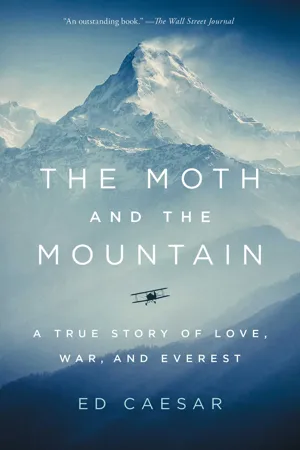
A True Story of Love, War, and Everest

  1. 288 pages
  2. English
  3. ePUB (mobile friendly)
  4. Available on iOS & Android
eBook - ePub

The Moth and the Mountain

A True Story of Love, War, and Everest

About this book

“An outstanding book.” —The Wall Street Journal * “Gripping at every turn.” —Outside * “A hell of a ride.” —The Times (London)

An extraordinary true story about one man’s attempt to salve the wounds of war and save his own soul through an audacious adventure.

In the 1930s, as official government expeditions set their sights on conquering Mount Everest, a little-known World War I veteran named Maurice Wilson conceives his own crazy, beautiful plan: he will fly a plane from England to Everest, crash-land on its lower slopes, then become the first person to reach its summit—completely alone. Wilson doesn’t know how to climb. He barely knows how to fly. But he has the right plane, the right equipment, and a deep yearning to achieve his goal. In 1933, he takes off from London in a Gipsy Moth biplane with his course set for the highest mountain on earth. Wilson’s eleven-month journey to Everest is wild: full of twists, turns, and daring. Eventually, in disguise, he sneaks into Tibet. His icy ordeal is just beginning.

Wilson is one of the Great War’s heroes, but also one of its victims. His hometown of Bradford in northern England is ripped apart by the fighting. So is his family. He barely survives the war himself. Wilson returns from the conflict unable to cope with the sadness that engulfs him. He begins a years-long trek around the world, burning through marriages and relationships, leaving damaged lives in his wake. When he finally returns to England, nearly a decade after he first left, he finds himself falling in love once more—this time with his best friend’s wife—before depression overcomes him again. He emerges from his funk with a crystalline ambition. He wants to be the first man to stand on top of the world. Wilson believes that Everest can redeem him.

This is the “rollicking” (The Economist) tale of an adventurer unlike any you have ever encountered: complex, driven, wry, haunted, and fully alive. He is a man written out of the history books—dismissed as an eccentric and gossiped about because of rumors of his transvestism. The Moth and the Mountain restores Maurice Wilson to his rightful place in the annals of Everest and tells an unforgettable story about the power of the human spirit in the face of adversity.
Frequently asked questions

Yes, you can cancel anytime from the Subscription tab in your account settings on the Perlego website. Your subscription will stay active until the end of your current billing period. Learn how to cancel your subscription.
At the moment all of our mobile-responsive ePub books are available to download via the app. Most of our PDFs are also available to download and we're working on making the final remaining ones downloadable now. Learn more here.
Perlego offers two plans: Essential and Complete
  • Essential is ideal for learners and professionals who enjoy exploring a wide range of subjects. Access the Essential Library with 800,000+ trusted titles and best-sellers across business, personal growth, and the humanities. Includes unlimited reading time and Standard Read Aloud voice.
  • Complete: Perfect for advanced learners and researchers needing full, unrestricted access. Unlock 1.4M+ books across hundreds of subjects, including academic and specialized titles. The Complete Plan also includes advanced features like Premium Read Aloud and Research Assistant.
Both plans are available with monthly, semester, or annual billing cycles.
We are an online textbook subscription service, where you can get access to an entire online library for less than the price of a single book per month. With over 1 million books across 1000+ topics, we’ve got you covered! Learn more here.
Look out for the read-aloud symbol on your next book to see if you can listen to it. The read-aloud tool reads text aloud for you, highlighting the text as it is being read. You can pause it, speed it up and slow it down. Learn more here.
Yes! You can use the Perlego app on both iOS or Android devices to read anytime, anywhere — even offline. Perfect for commutes or when you’re on the go.
Please note we cannot support devices running on iOS 13 and Android 7 or earlier. Learn more about using the app.
Yes, you can access The Moth and the Mountain by Ed Caesar in PDF and/or ePUB format, as well as other popular books in History & Historical Biographies. We have over one million books available in our catalogue for you to explore.

CHAPTER ONE DO I UNDERSTAND THIS MADMAN?

• 2011–19 •
In 2011, you read a paragraph about an Englishman from the 1930s who decided to climb Everest and was forbidden from doing so—a man so driven and defiant that he flew a plane thousands of miles, then walked hundreds more in a priest’s outfit, to the foot of the world’s tallest mountain, just to begin his attempt—and you want to know more. The question is why. Not just for him, but for you. Why did he need Everest, and why do you care?
The first question is the work of this book. But the second? Perhaps because you have watched Everest become a high-altitude bucket-list item for tourists, with nightmarish consequences, and you are drawn to a time when even traveling to its base camp was like flying to the moon. Perhaps it is because when the story of Maurice Wilson first bites, you are in your thirties, the same age as he was when he began to feel the pull of the mountain. Perhaps it is because you have often felt the lure of adventure. Perhaps because you also understand a little about loss, and trauma—not as much as Wilson did, but enough. Or perhaps some stories hook writers unaccountably. In any event, you want to know him better. The kind of knowledge you desire is total. He begins, not unhappily, to haunt your nights.
You read the literature on Wilson. It’s nowhere near satisfactory. He is dismissed by generalists as a crank, and by alpine historians as a reckless amateur—a footnote in the history of mountaineering. The first serious attempt to narrate his story, I’ll Climb Mount Everest Alone, a slim book written by an English journalist named Dennis Roberts, and published in London in 1957, is not only frequently and corrosively wrong, but is hamstrung by a deal the author struck with his best sources, Enid Evans and her husband, to keep scandal from their door. Roberts never spoke to Wilson’s family. You want to go back and shake him. The most enduring legacy of Roberts’s work, you soon understand, is to paint Wilson as a religious eccentric who attempted Everest to prove the strength of his version of Christianity—an interpretation for which there is scant supporting evidence. The book, you soon realize, does not begin to explain the man.
You sense Wilson’s story is richer. You look for raw material. But Wilson has never been considered a major figure. No libraries are dedicated to his work, no archivists guard his legacy. You try to find a living relative: someone who knew someone who knew him. No luck. Wilson died childless and so did two of his three brothers. You are nearly certain that the only Wilson brother to have had children has no living grandchildren. Nearly certain.
One day you read The Crystal Horizon, a book written by the world’s most accomplished high-altitude mountaineer, Reinhold Messner. This wild and intense man from the South Tyrol became the first person to climb all fourteen of the world’s “eight-thousanders”—the peaks measuring more than 8,000 meters (or 26,247 feet). You find that Messner was bitten by Wilson, too.
The Crystal Horizon relates how, in 1980, Messner made the first solo ascent of Mount Everest, without the use of supplementary oxygen. It was an astonishing achievement, one of many in Messner’s life. But the thing that grips you is his fixation on Maurice Wilson. Time and again he returns to the story of the Englishman’s attempt on Everest. Messner describes Wilson as a kindred spirit and sees a similar motivation in his own desire to climb mountains. During his account of the Everest coup, Messner writes to Wilson as if to a friend:
“The way is the goal” is a Buddhist saying, and mad as Wilson might seem, I have taken this persevering Don Quixote, who always carried with him in his rucksack some mementoes of the for him unattainable Enid Evans, to my heart. He is dearer to me than the legion of all those who anxiously build their little houses and preserve their lives for the old-age pension.
Messner describes sitting, in 1980, on a rock outside of his bivouac, at twenty-six thousand feet, looking out across the Tibetan plateau, two days’ climb away from the summit of Everest. He knows he should be melting snow, to create the four liters of water he needs to drink. But somehow, he can’t make himself do it. He is exhausted, and terribly cold. He cannot move. Death is close. At this moment, Messner becomes lost in a waking dream about Maurice Wilson:
If Wilson had managed to get up here, I think suddenly, would he have reached the summit? Wilson was tougher than I am, uncompromising and capable of enduring loneliness. The stretch above me seems to be really easy, so Wilson would have been able to climb it, at least as far as the North-East ridge. Do I understand this madman so well because I am mad myself? Or do I take comfort in the constancy of this man in my delusion to prove something?
One brilliant autumn day in 2015, you visit Messner in his castle near Bolzano, in the Dolomite Mountains. Stone lions and Buddhas guard the gates. Messner’s face is weathered and gray-bearded, and his eyes are as icy blue as the Tyrolean sky. As you talk about Wilson, a rueful smile creeps across his face. It’s been more than thirty years since Messner wrote The Crystal Horizon. Evidently, Wilson has not released his bite.
“He was alone,” Messner says. “He was really alone.”

You redouble your efforts and once more scour the archives. You strain to interpret the original pencil scrawl in Wilson’s Present Time Book. You read every migration record and every ship’s manifest that bears his name, and many more that don’t. Eventually, you find pertinent documents in New Zealand, and in America; in Britain, and in Canada. You befriend historians who unearth nuggets of gold. You read war diaries and dozens more books. One day, you fly to Bremen, Germany, where a writer of incalculable kindness, recognizing a fellow seeker, hands you a box full of documents that includes Wilson’s letters—letters that have never been reproduced in English; letters you’ve never seen. The only payment he requires for the treasure he has given you is lunch.
Years pass. A complicated, dazzling, difficult picture of Wilson accretes. You soon understand that so much that has been written about him is inaccurate. Wilson now seems close enough that you can sometimes hear him. How do you like your eggs boiled? Sometimes, you sit next to him as he eats his dinner, like a friend or lover. But sometimes, you lose him. He feels distant and ancient. You approach him less like an intimate than like a detective. Months, even years, of his life go by in which you track him by his passport stamps. When you do find him again, sometimes you don’t like him much. For every moment in which he seems amiable and heroic, in another he can seem unkind and reckless. It is all the same person. You find that his occasional cruelty only makes the question of his motivation more urgent.
How to know him better? You drive to an airfield in the rolling countryside of southwest England to fly a de Havilland Tiger Moth, a flimsy biplane built only a few years after the Gipsy Moth that Wilson flew to India. You hear the roar he heard; you shiver in the open cockpit; you feel the thing slip and yaw as you yank the joystick this way and that. It’s still not quite enough. You’re not a climber, but you consider whether to walk to Everest from Darjeeling, and then to attempt the mountain yourself, by Wilson’s route. It would be a journey of months: a mad, dangerous, and ruinously expensive proposition. You get as far as registering your interest in an expedition to the mountain, before your spot is taken by a more resolute and solvent traveler. The idea is parked.
You decide to take one more shot at finding a family member close enough to Wilson to know something of real value. You check every line on the tree. You often wish he had a less common surname. You write to the probate offices in several cities, asking to read last wills and testaments. Maurice Wilson had three brothers: Fred, Victor, and Stanley. If one of them left something to a name you don’t recognize, maybe there’s an opening: someone who knows someone who knows something. The wills arrive in the post. One morning, a document arrives that quickens your heart.
Wilson’s oldest brother, Fred, married twice. You didn’t know that. One grandson from that second union survives, Wilson’s great-nephew. You didn’t know that, either. You find the great-nephew’s name, and you call him. He is in his seventies. Before you even state your business, he knows who you are.
“This about Maurice, then?”
The thick Yorkshire accent: sonorous vowels and dropped aitches. No writer has talked to the great-nephew before. It seems as if he were waiting his whole life for the call. He invites you to tea. When you get to his house, he brings out a box of documents from a chest in his dining room. Inside are things you’ve never seen—photographs, documents, marginalia, the second half of a poem you assumed was lost forever. You take pictures of the trove on your phone. You realize that your hands are shaking.
The great-nephew then tells you almost everything he knows about Maurice Wilson. It’s not a lot, but it’s something. He was ten years old when his grandfather died. What would an old man tell his young grandson about his long-dead brother? In fact, you find yourself telling Maurice Wilson’s great-nephew things that cause his eyes to widen: things he has never heard.
There is one great secret about Maurice that the great-nephew says he will take to his grave. Those are his words: “I’ll take it to me grave.” No amount of questioning on that afternoon, or at any other time, will release it. Nevertheless, you’re as certain as you can be that you know what the secret is.

In the moment, the great-nephew’s tease is unbearable. But on the drive home, you experience a minor and happy epiphany: there is never one fact or secret about a life that explains someone. To think so would be to misunderstand both people and stories. None of us could ever satisfactorily relate the unfathomably dense experience of our own lives, let alone someone else’s. “No,” wrote Joseph Conrad in Heart of Darkness, “it is impossible; it is impossible to convey the life-sensation of any given epoch of one’s existence—that which makes its truth, its meaning, its subtle and penetrating essence. It is impossible. We live, as we dream—alone.”
The thing that saves us is stories. Not the whole truth, but the essence of it. Of course, the storyteller strives for facts and secrets. That is the noble, Sisyphean task. But narratives are always incomplete. They swirl around spots of time. In most people’s lives, and certainly in Wilson’s, some days come to mean more than the others. You understand that to explain Wilson, you need to know which days mattered to him.
One windy morning in April 2018, you drive through northern France, and across the border into Belgium, in search of one of the days in which Wilson’s story was forged. You park in an unremarkable town now called Wijtschate. There is an empty church, and a bar doing a brisk trade at 11:00 a.m. You walk northwest out of the town. A thin road leads down a hill, alongside a stream. Copses dot the landscape. The fields are cut neatly; black-and-white cows watch you stupidly. There is nothing here, at first glance, to suggest the tumult that occurred on this unremarkable and lightly undulating patch of Belgian countryside, exactly one hundred years ago to the day—nothing until you enter the pristine cemeteries filled with English surnames: Belcher, Healey, Greaves.
16 years since I went into the line for stunt.

CHAPTER TWO OWING TO HIS PLUCK

• April 24–August 10, 1918 •
On the night of April 24, 1918, Second Lieutenant Maurice Wilson lay flat in a dewy field in Flanders, awaiting the first battle of his life. Mist and fog were in the air, but the moon was bright, and the stumps of the trees that had once formed pleasant hillside woods were downlit like props. For three days, Wilson’s battalion—the 1/5 West Yorkshire Regiment (Prince of Wales’s Own), which was universally known as the First Fifth battalion—had waited in position near the ruined town of Wytschaete. The English troops called the place White Sheet.
Wilson and his men were strung out in lines around a ravaged clump of trees known by the local farmers as le grand bois: the big wood. Their front line was in an exposed spot, fifty to a hundred feet below the crest of a hill, and in full view of the enemy. The First Fifth had no trenches. Its lines consisted of a series of shell holes, dugouts, and ditches. When the Germans shelled the British troops, as they did that night, it was purely a matter of luck who caught one, and who did not.
After nearly four years of war, the whole British army was in retreat. Millions of men from both the German and the Anglo-French sides of the conflict had already died along the Western Front—a jagged stitch in northern Europe, which stretched from the English Channel to the Swiss border, whose entrenched outline had not significantly changed between the end of 1914 and the beginning of 1918, despite all the mud, rats, murder, shellfire, and barbed wire there.
Now, finally, in the spring of 1918, the conflict was in flux, and it seemed likely that the whole business would soon be decided. The United States had entered the war on the side of the British and the French. The Germans knew they had to make a decisive breakthrough before the arrival of the American military. In March, the Germans launched their Spring Offensive with a massive artillery bombardment—their biggest of the war—followed by infantry attacks. First, the Germans attacked south of Wilson’s battalion, and then they attacked farther north, in Flanders itself. The British and the French fought a retreat, but they would eventually have to rebut the German advance. For Wilson’s battalion, that moment had now arrived.
As the First Fifth dug in, near White Sheet, Wilson celebrated his twentieth birthday. He and his men were defending the Vierstraat Ridge, and the high ground at Kemmel, where the British heavy artillery was positioned. In a landscape that was notably flat, the hill at Kemmel was a major prize for the Germans as they tried to break the British defenses, then advance all the way to the English Channel at Dunkirk. The outcome of the entire war seemed to hinge on whether the Germans could rupture the Allied lines that spring. On April 11, 1918, the British commander, Field Marshal Douglas Haig, sent a message to his troops:
There is no other course open to us but to fight it out. Every position must be held to the last man: there must be no retirement. With our backs to the wall and believing in the justice of our cause each one of us must fight on to the end. The safety of our homes and the Freedom of mankind alike depend upon the conduct of each one of us at this critical moment.
Now, Wilson lay on his belly, in the fog, awaiting the onslaught.

It had taken two years for Wilson to see real action. In May 1916, he enlisted at Belle Vue Barracks, in Bradford—the industrial city where he had spent all his life, and where his father, Mark, owned a small but thriving textiles business, in the world capital of the wool trade. Maurice was just eighteen years old when he joined up. More than 2.5 million British recruits had preceded him.
When the war broke out, in the late summer of 1914, the regular British army was dwarfed by Germany’s. Britain’s regular soldiers, nicknamed the Old Contemptibles, numbered around 270,000. More than half of those men were stationed overseas, in the British Empire. Britain also had at its disposal around 220,000 “territorials,” men who trained as soldiers on weekends and at summer camps. Lord Kitchener, the new secretary of state for war, understood that Britain had to rapidly enlarge its army if it was to stand a chance in a long conflict in Europe. Forced conscription, however, was considered politically unviable. Britain needed volunteers.
Parliament sanctioned a dramatic increase in army numbers. Kitchener immediately began his campaign to recruit one hundred thousand young men. In the music halls—the variety theaters that were still wildly popular in Bradford, and around the country—entertainers sang sickly patriotic songs such as “Your King & Country Want You” to attract young men to the cause. Its ref...

Table of contents

  1. Cover
  2. Title Page
  3. Dedication
  4. Epigraph
  5. Prologue: The World Will Be on Fire
  6. Chapter One: Do I Understand This Madman?
  7. Chapter Two: Owing to His Pluck
  8. Chapter Three: Exiles in a Strange Country
  9. Chapter Four: Good Old Days of Early Freedom
  10. Chapter Five: Bullet-Proof Soldier
  11. Chapter Six: The Naked Soul
  12. Chapter Seven: Most Amazing Air Adventure Ever Attempted
  13. Chapter Eight: He Is Not Repeat Not to Proceed
  14. Chapter Nine: Adventure Personified
  15. Chapter Ten: All Pretty
  16. Chapter Eleven: Moorland Grass
  17. Chapter Twelve: Cheerio
  18. Epilogue
  19. Acknowledgments
  20. Notes on Sources
  21. About the Author
  22. Notes
  23. Bibliography
  24. Image Credits
  25. Copyright