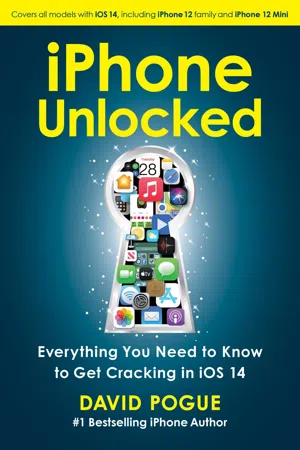
iPhone Unlocked
eBook - ePub

iPhone Unlocked

  1. 608 pages
  2. English
  3. ePUB (mobile friendly)
  4. Available on iOS & Android
eBook - ePub

iPhone Unlocked

About this book

Make the most of your iPhone with this witty, authoritative, full-color guide to iOS 14.

Apple has sold over 2.2 billion iPhones—but not one has come with a user guide. And with each annual update of iOS, Apple piles on more and more features; at this moment, the Settings app alone bristles with over 1,000 options.

In iPhone Unlocked, the #1 bestselling iPhone author David Pogue offers a curated guide to the essential and useful features of the new iPhone 12 family—and all other models that can run the iOS 14 software. A former New York Times tech columnist and bestselling how-to author, no one is better equipped than Pogue to offer expert instruction to this complicated iPhone.

With his trademark humor, crystal-clear prose, and 300 full-color illustrations, Pogue guides readers through everything in iOS 14: Home-screen widgets, the new App Library, the all-new Translate app, the redesigned Search, FaceTime, and calling screens, and much more. Whether you’re a new iPhone user or a seasoned veteran, iPhone Unlocked is a gorgeous, authoritative, all-in-one master class on all things iPhone.

Frequently asked questions

Yes, you can cancel anytime from the Subscription tab in your account settings on the Perlego website. Your subscription will stay active until the end of your current billing period. Learn how to cancel your subscription.
No, books cannot be downloaded as external files, such as PDFs, for use outside of Perlego. However, you can download books within the Perlego app for offline reading on mobile or tablet. Learn more here.
Perlego offers two plans: Essential and Complete
  • Essential is ideal for learners and professionals who enjoy exploring a wide range of subjects. Access the Essential Library with 800,000+ trusted titles and best-sellers across business, personal growth, and the humanities. Includes unlimited reading time and Standard Read Aloud voice.
  • Complete: Perfect for advanced learners and researchers needing full, unrestricted access. Unlock 1.4M+ books across hundreds of subjects, including academic and specialized titles. The Complete Plan also includes advanced features like Premium Read Aloud and Research Assistant.
Both plans are available with monthly, semester, or annual billing cycles.
We are an online textbook subscription service, where you can get access to an entire online library for less than the price of a single book per month. With over 1 million books across 1000+ topics, we’ve got you covered! Learn more here.
Look out for the read-aloud symbol on your next book to see if you can listen to it. The read-aloud tool reads text aloud for you, highlighting the text as it is being read. You can pause it, speed it up and slow it down. Learn more here.
Yes! You can use the Perlego app on both iOS or Android devices to read anytime, anywhere — even offline. Perfect for commutes or when you’re on the go.
Please note we cannot support devices running on iOS 13 and Android 7 or earlier. Learn more about using the app.
Yes, you can access iPhone Unlocked by David Pogue in PDF and/or ePUB format, as well as other popular books in Technology & Engineering & Computer Science General. We have over one million books available in our catalogue for you to explore.

PART ONE Meet the Machine

CHAPTER 1
The Hardware in Your Hand
CHAPTER 2
Eleven Settings to Change First Thing
CHAPTER 3
Cellular, Wi-Fi, and 5G
CHAPTER 4
Home Screen Extreme Makeover

CHAPTER ONE The Hardware in Your Hand

The very first iPhone, which Steve Jobs unveiled onstage in 2007, was a Model T by today’s standards. There was so much it was missing! It didn’t have a front camera, or a flash for the back camera. It couldn’t shoot video. It couldn’t cut, copy, or paste. It had no GPS. You couldn’t send pictures as text messages. You couldn’t dial by voice. There was no autocomplete or autocorrect. There was no app store, either—you got 16 apps, and you were happy.
Technology has surged ahead since that day, and yet, incredibly, the essential layout of the iPhone hasn’t changed much at all. It still has a multitouch screen on the front, earpiece at the top, camera on the back, microphone and charging connector at the bottom. The volume buttons and silencer switch are still in the same places on the left edge.
And you still have to recharge the thing pretty much every day.
Whether you’ve got a shiny new (and shiny expensive) iPhone 12 Pro Max, or an iPhone 6s that’s been soldiering on since 2015, the fundamental hardware design is the same.
The tour is now departing; please remain seated at all times.

On, Off, and Asleep

When your iPhone comes from the factory, it’s turned off; Apple didn’t want it to arrive with a dead battery.
You turn it on by pressing the side button for a few seconds. When the
Image
logo appears, you can let go. It takes about 15 seconds for the full startup process to bring you to the lock screen, where you’re supposed to enter your password, supply your fingerprint, or use face recognition to unlock your iPhone.
NOTE: On the iPhone SE, the power button is on the top edge instead. And it has a different name: the top button.
That ecstatic moment of unboxing a new iPhone is one of the few times you’ll ever arouse the iPhone from its fully off state. For the rest of its life, when you’re not actually looking at the iPhone, you aren’t supposed to turn it off. You’re supposed to put it to sleep.
To do that, just give the side button a quick click.
TIP: The iPhone also goes to sleep on its own if you ignore it long enough. You can specify how long that takes in Settings→Display & Brightness→Auto-Lock.
When the iPhone is asleep, the screen goes black and the machine uses very little power. But everything you’ve been doing is still open in the phone’s memory; all your apps are still running. Your music keeps playing, your audiobook keeps reading, your GPS keeps guiding you, your email keeps downloading.
Waking the phone once again doesn’t take much. Just tapping the screen, pressing the home button (on the older models), or even picking up the phone brings the screen to life. (Technically, it brings up the lock screen; see page 34.)
Image
The lesson here: When you’re finished using the phone for now, don’t shut it down; put it to sleep. It costs you almost no battery power, and the phone will be immediately ready to go next time you need it.
That side button, by the way, has a thousand uses. It’s involved in commanding Siri, taking screenshots, silencing an incoming call, and so on. But for your very first iPhone lesson, it’s enough to understand that you press it to put the phone to sleep—or to wake it up again.
NOTE: If you do need to turn the phone fully off—if, for example, you don’t plan to use it for a week—the side button is involved with that process, too. Press the side button and the top volume button—directly across the screen from it—simultaneously for a few seconds, until you see the message slide to power off. Do as it says—swipe your finger across that slider; the phone is now fully off.
On the 2016 iPhone SE, you hold down the top button by itself for a few seconds.

The Left-Side Buttons

On the skinny left edge of the phone, three more buttons await your inspection. At top: the silencer switch.
It’s a little flipper. When you use your fingernail or the pad of your thumb to click it toward the back of the phone, so a little patch of orange appears in the flipper socket, the phone will make no unbidden sounds. You’ll never be embarrassed by the phone ringing, a text-message chime, or some social-media notification. That’s probably what you want in a meeting, in a theater, or in a church. (Flip it forward, toward the screen, when you want to hear the rings, chirps, and chimes again.)
Note, by the way, that the silencer switch doesn’t silence everything. It does not silence the following types of sounds:
Image
  • Alarms. Even when you’ve got the silencer on, your phone still rings for any alarms you’ve set. Apple figures that if you’ve gone to the trouble of setting an alarm, you really want to hear it. You wouldn’t want to oversleep, now, would you?
  • Sounds you play. If you request a sound—if you play a video, listen to a podcast, play some music, play back a voicemail, start an audiobook—you’ll hear it, even if you have “silenced” the phone. Apple calculates that if you’ve tapped a
    Image
    button, you probably want to hear something.
    Below the silencer switch are two other buttons: volume up and volume down. Mostly, of course, you’ll use them to adjust the phone’s speaker volume. But there’s a little more nuance to them than that:
  • When you’re not on a call, they adjust the volume of sound effects: the phone-ringing sound, alarms, the voice of Siri, and so on.
NOTE: That statement is true as long as you haven’t turned off Settings→Sounds & Haptics→Change with Buttons.
  • When a call comes in, press one of these buttons to make the ringing or vibrating stop.
  • When you’re on a call, these buttons control the speaker or earbud volume.
  • When you’re playing music or podcasts, they adjust the playback volume. They work even when the screen is off.
  • When you’re taking a photo or video, you can press one of these volume keys to snap the photo or start/stop the video.

The Screen

If Apple is going to design a computer that’s all screen and no keys, it had better provide one amazing screen. And sure enough: Every year, the iPhone screen gets better, brighter, an...

Table of contents

  1. Cover
  2. Title Page
  3. Introduction
  4. Part One: Meet the Machine
  5. Part Two: Info In, Info Out
  6. Part Three: The iCommunicator
  7. Part Four: The iOS Software Suite
  8. Part Five: Beyond the Basics
  9. Part Six: Appendixes
  10. Acknowledgments
  11. About the Author/Illustrator
  12. About the Creative Team
  13. Index
  14. Copyright