2. Macromycetes and Humans: Old and Current Industrial Avenues
The evolution of fungal sexual reproduction strategies involving the formation of fruit bodies, which are most prominent in basidiomycota and ascomycota, resulted in the most likely oldest form of utilisation of fungi by mankind. The collection and eating of mushroom fruit bodies by humans dates back to early human history. Edible species were found associated with people living 13,000 years ago in Chile and mushroom consumption has been evidenced since ancient Chinese, Greek and Roman times (Boa, 2004). Today the commercial production and exploitation of easily cultivatable edible mushrooms for food represents one of the economically most important forms of utilisation of macrofungi, even if limited to only a handful of genera (Hawksworth, 2019) (Carrasco et al., Chap. 2). Globally, a much higher number of Macromycetes in the range of several hundred (and perhaps even more) species can reasonably be assumed to be currently collected for nutrition purposes from the wild for both consumption by local communities and trade (Boa, 2004; Hawksworth, 2019) (Fung and Tan, Chap. 3). In this context a clear need to extend ethnomycological surveys in remote areas of many parts of the world has been emphasised (Hawksworth, 2019) and it is quite likely that the full potential beyond the use for food purposes of such underexplored resources still remains to be discovered (Ravikrishnan et al., Chap. 9).
Macrofungi were also used for various medicinal purposes since a long time and various genera are well known to produce different bioactive compounds (Hawksworth, 2019; Hyde et al., 2019). These include polysaccharides, peptides, amino acids, phenolics, triterpenoids, sterols, steroids, dietary fibres, fatty acids and corresponding esters and vitamins, and form the basis for various health-promoting functions of mushrooms (e.g., immune-stimmulatory, anticancer, anti-inflammatory, antiviral, antioxidant, antibacterial, antifungal, antihypotensive, and antidiabetic) (Hyde et al., 2019; Lu et al., 2020). The famous mummified Ice Man 'Ötzi', who lived in the Alps about 5,300 years ago and was found in the receding ice of the Val Senales glacier (South Tyrol, northern Italy), carried a part of a fruit body of the birch fungus (Piptoporus betulinus), which is known to have anthelmintic properties and was perhaps used for medicinal purposes (Capasso, 1998). Highly prized delicacies, such as truffles, are ectomycorrhizal fungi and therefore much more difficult to cultivate than saprotrophic decomposer fungi, which may easily be cultivated on agricultural residues (Hyde et al., 2019). Truffles provide their mycorrhizal host plants with macronutrients (potassium, phosphorus, nitrogen, sulphur) and micronutrients (iron, copper, zinc, chloride) in exchange for carbohydrates mainly via an intercellular hyphal network between plant root cells, which is referred to as Hartig net (Allen et al., 2003). These fungi are known for their complex chemical-based ecological interactions with other organisms, which involve various volatiles and bioactive compounds and therefore also offer medicinal and industrial values beyond those solely related to nutrition (Splivallo et al., 2011) (Thomas et al., Chap. 6; Elsayed et al., Chap. 10). Contrary to truffles, Pleurotus species involving the oyster mushroom (Pleurotus ostreatus) together with other species of the genus (Raman et al., Chap. 7) can easily be cultivated on lignocellulosic residues from agriculture and forestry. These fungi belong to the commercially most important mushrooms produced and have also been implicated with various health-promoting effects in addition to their nutritional value (Hyde et al., 2019; Lu et al., 2020). Due to their impressive biodegradation capabilities, Pleurotus species are further attractive biocatalysts for mycoremediation purposes (Hyde et al., 2019) (see also below). Medicinal fungi may further be employed in the production of alcoholic beverages and due to the excretion of bioactive compounds improve certain functional beverage properties (Veljović et al., 2019) (Vunduk and Veljović, Chap. 8). Fungal bioactive compounds are also attractive for cosmetic industry (Hyde et al., 2019; Lu et al., 2020) (Fung and Razif, Chap. 4).
Arising from growing concern related to potential harmful effects of synthetic colourants on both human and environmental health, the demand for natural colourants in the food, cosmetic and textile industries is rapidly increasing (Kalra et al., 2020). Pigments from Basidiomycete mushrooms were used for the dyeing of wool and silk in ancient times (Hernández et al., 2019). Especially filamentous fungi (in particular ascomycetous and basidiomycetous mushrooms), which can be grown in fermenters, and also lichens (symbiotic associations of fungi with green algae and/ or cyanobacteria) produce a wide range of pigments of different chemical classes, such as, e.g., melanins, anthraquinones, hydroxyanthraquinones, azaphilones, carotenoids, oxopolyene, quinones and naphthoquinones (Hyde et al., 2019; Kalra et al., 2020). Fungal pigments are usually reported as secondary metabolites with either yet unknown or known biological functions, such as acting as enzyme cofactors (flavins), or preventing from photooxidative (carotenoids) and other environmental stress (melanins) (Gmoser et al., 2017; Kalra et al., 2020). Pigments from Macromycetes hence represent a very attractive but still underexplored resource for a wide range of applications (Suthar et al., Chap. 13; Lagshetti et al., Chap. 14; De Souza et al., Chap. 15).
Fungi can attack a wide range of organic environmental pollutants, resulting in the formation of organic biotransformation products or in mineralisation to CO2. Only a limited number of organic pollutants with mostly rather simple and only rarely more complex structures are utilised as fungal growth substrates, whereas the vast majority of such pollutants are cometabolised in the presence of carbon-and energy-delivering cosubstrates (Harms et al., 2017; Schlosser, 2020). The ecological background of this type of biochemical attack may relate to fungal defence against and detoxification of natural toxic compounds present in many fungal environments, e.g., in lignocellulosic plant material utilised by saprotrophic fungi, or in plants as defence compounds against pytopathogenic fungi (Harms et al., 2017; Schlosser, 2020). The cometabolic mineralisation of lignin to CO2 and H2O by Basidiomycetes, causing the so-called 'white rot' decay type of wood, aims to access lignocellulosic polysaccharides that serve as fungal carbon and energy sources. The corresponding fungal degraders and their special ligninolytic enzymes have evolved from nonligninolytic ancestors following the evolution of wood lignin in plants (Floudas et al., 2012; Eastwood, 2014; Ayuso-Fernández et al., 2019). The lignin-degrading machinery enables white rot Basidiomycetes to mineralise a very broad range of environmental pollutants. To a considerably lesser extent, mineralisation of environmental pollutants is also known from brown rot decay Basidiomycetes, which employ extracellularly produced hydroxyl radicals as very unspecific and highly reactive oxidants to attack organic compounds. Cometabolic biotransformations of environmental pollutants to organic products predominate in other Macromycete groups (Harms et al., 2017; Schlosser, 2020). Fungal cometabolism is generally much less compound-specific than growth on organic pollutants as frequently found in bacteria. Moreover, cometabolic degraders do not depend on the utilisation of pollutants as growth substrates, thereby providing advantages under conditions of poor bioavailability of pollutants or very low pollutant concentrations. Such characteristics render macrofungi attractive for mycoremediation purposes by targeting organic environmental pollutants (Harms et al., 2011; Harms et al., 2017; Schlosser, 2020). Beyond that fungi are also reported to exhibit pesticidal properties (Hyde et al., 2019), which may be employed in mycoremediation schemes (Nyochembeng, Chap. 16).
The extraordinary capabilities of Macromycetes to decompose complex natural organic matter in their diverse habitats depend on the effective arrays of extracellular enzymes, which initiate the breakdown of macromolecules. Such enzymes include oxidoreductases (oxidases like laccase and various peroxidases; among them are the powerful ligninolytic peroxidases) and many different hydrolases (e.g., amylases, cellulases, lipases, phytases, proteases, tannases and xylanases), which possess a very wide range of applicability for both biodegradative and biosynthesis processes (Harms et al., 2011; Hyde et al., 2019; Schlosser, 2020). Examples of this include the degradation of fat in wastewater treatment; applications in animal feed, pulp and paper, and detergent industries; for food and leather processing; in textile and pharmaceutical industries; treatment of contaminated water and biorefinery applications (Hyde et al., 2019) to mention a few (Al-Dhabi et al., Chap. 11; Rahi et al., Chap. 12).
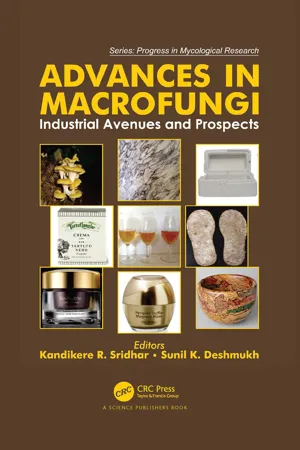
Moreover, beyond main traditional and current industrial uses, macrofungi are also attractive for niche applications and based on their great metabolic and adaptive versatility with regard to diverse habitats, hold promise for possible new applications in future (Elkhateeb et al., Chap. 5). The fascinating natural networks of fungal mycelia have attracted humans since a long time. Meanwhile, mushrooms are also being used as objects of art (https://v-meer.de/; accessed December 22, 2020) and fungal mycelia are considered as composite construction (Jones et al., 2020) and packaging materials (https://interestingengineering.com/ikea-moves-mushrooms-replace-current-packaging/; accessed December 22, 2020) (Elkhateeb et al., Chap. 5; Suthar et al., Chap. 13).