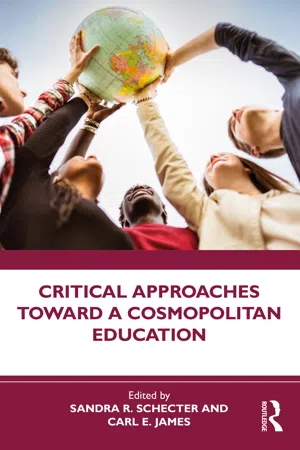
This book aims to reconceptualize teaching and learning in spaces with diverse populations of young people. Chapters focus on the schooling experiences and social and cultural adaptation issues of individuals who, through the meaning that they assign to their lived experiences, ascribe to multiple identity qualifiers. Contributors explore the impact of this cosmopolitan awareness on students, educators, and educational institutions, presenting issues such as curricular concerns around civic engagement, individual subjectivity versus social identity, and the convergence of context-specific policy and teaching environments on global dynamics in education reform. An emphasis on this understanding promises to better equip educators and policy-makers to plan instructional approaches and devise pedagogic resources that serve the needs and career aspirations of an expanding cohort of multifaceted learners.
eBook - ePub
Critical Approaches Toward a Cosmopolitan Education
- 280 pages
- English
- ePUB (mobile friendly)
- Available on iOS & Android
eBook - ePub
Critical Approaches Toward a Cosmopolitan Education
About this book
Trusted by 375,005 students
Access to over 1.5 million titles for a fair monthly price.
Study more efficiently using our study tools.
Information
Topic
EducationSubtopic
Education GeneralPart 1
Critical Cosmopolitanism in Contemporary Education
1
SUBALTERN VOICES, DIGITAL TOOLS, AND SOCIAL IMAGINARIES
Glynda A. Hull, Devanshi Unadkat, and Jessica Adams-Grigorieff
DOI: 10.4324/9780429327780-1
Can the Subaltern Speak?
Three decades ago, the postcolonial theorist Gayatri Spivak (1988) asked a question about the dispossessed of the world that rocked the academy and reverberates still: Can the subaltern speak?1 This striking question raised to consciousness the great divide between Western academics and people elsewhere, particularly “migrants in the metropolis,” most often women, rendered invisible and voiceless. Spivak’s short answer was “no,” the subaltern cannot speak, because the gap between the subaltern and the rest is too wide, and the West cannot hear, being deaf to its own complicity in the world’s problems and the injurious effects of “projecting oneself or one’s world onto the Other” (Spivak, 2002, p. 6). Now, decades past Spivak’s essay, the West continues to exert outsized political, economic, and epistemological influence in an increasingly globalized world where inequalities still abound and gaps still separate people and indeed grow wider. Global legacies of colonialism continue to mute conversations and understandings across differences and stymie the social futures of a majority of the world’s population.
In this chapter, we describe a small project, one in a decade-long line of research (e.g., Hull, Jury, & Sahni, 2014; Hull & Scott, 2013; Hull & Stornaiuolo, 2014) that bears on speaking and hearing across geopolitical and ideological divides, even when the distance is great and the barriers high. We argue for the importance and necessity of embracing the educational and ethical imperative of ensuring that subaltern voices are heard, especially in an age when public discourse is characterized by rising incivility and compassion appears in short supply. Drawing on a reinvented account of cosmopolitanism, and appropriating the communicative power and human reach of stories fashioned for a digital age, we provide a somewhat different answer to Spivak’s question: strongly affirming her concerns for rights and capacities to speak and be heard, we want to demonstrate that educational opportunities can be designed and deployed to connect across distance and difference, to cultivate semiotic acts of imagination, empathy, and trust, and to mitigate communicative and representational inequalities.
At the heart of our work is a desire to reframe the notion of worlding the world, which to Spivak meant the domination of the rest by the West, through the unreflective projection of a particular view of reality onto other people and their own differently figured worlds. Instead of this imperialist take on relationships and meaning-making, we appropriate the notion of worlding the world to describe the social practices of youthful subalterns who are engaged in representing their own lived experiences—in sharing their own takes on their own worlds—in relation to understanding the lived realities of others. These acts of perspective-offering and perspective-taking we see as quintessential critical cosmopolitan capacities for a global era—an era in which, as Appadurai (1996) explained, flows of people, texts, media, and capital continually challenge the boundaries of nation-states, providing the raw material for imagining ourselves in relation to the local, national, and global. Especially important are the linguistic and semiotic aspects of these imaginings, seen in the ways that youth world their worlds by marshaling symbolic resources that cross and blend languages, modes, and media. In so doing, they engage in translingual and transmedia practices (Canagarajah, 2013) that challenge the hegemony of bounded notions of national language (cf. Poza, 2017) as well as logocentric notions of texts (Lizárraga, Hull, & Scott, 2015).
To be sure, optimism about the permeability of national borders, and the ease and alacrity of the mobility and interconnectedness implied, have been tempered (cf. Appadurai, 2006). Rising populism and authoritarianism the world over, not to mention pandemics and other disasters on a global scale, seem to have greatly discouraged and diminished capacities to look outward and welcome inward with generosity and compassion, while logocentric conceptions of language, literacy, and learning persist, especially in school contexts (Canagarajah, 2011; Lizárraga et al., 2015; May, 2014). Yet, we would argue, the imagination remains—human beings’ generative capacity to see, take the measure of, creatively engage with, and influence different worlds, a capacity potentially amplified through digitally mediated contact. Appadurai (1996) notes, “the work of the imagination … is neither purely emancipatory nor entirely disciplined but is a space of contestation in which individuals and groups seek to annex the global into their own practices of the modern” (p. 4). We agree, and thus we ask, how do youthful subalterns world the world, deploying their imaginations to assemble, curate, remix, and circulate multimodal meanings that are impactful, that are heard (cf. New London Group, 1996; O’Connor & Penuel, 2017)?
Who is Cosmopolitan?
For a long time, for centuries in fact, the prominent philosophical starting place for theorizing proper interaction with others’ worlds has been the ancient idea of cosmopolitanism, with its emphasis on global as well as local allegiances, affiliations, and relationships. But it has been the last quarter-century that has witnessed the biggest uptake across most disciplines of cosmopolitan ideas, in tandem with the rapid transformation of space and time, and of consciousness and sociality, associated with processes of globalization. As social, political, economic, and cultural worlds compress and collide, the movement of media, capital, ideas, and people brings distant places and different realities within perceptual reach, making the challenge and need to understand one another through and across our difference all the more crucial. Philosopher Kwame Appiah (2006), who wrote in the aftermath of the 9/11 destruction of New York City’s World Trade Center, argued that now our responsibilities as citizens must perforce go beyond “kith and kind” (p. xv). He optimistically offered, as a response to things that divide, dialogue and conversation “across the boundaries of race, religion, tribe, and nationality”—conversations not for the purpose of agreeing but for “getting to know each other in ways that mean we can share the world precisely without agreement” (p. 272; cf. Canagarajah, 2013). Writing at the same time as Appiah, and in response to the same cultural, economic, and geopolitical ruptures, communications scholar Roger Silverstone (2006) likewise theorized cosmopolitan identities, but specifically in relation to the omnipresence of media. Since the globe appears to us now largely through liquid crystal displays—the ubiquitous screens of computers, phones, and televisions—Silverstone recognized the importance of treating media as a symbolic moral space—largely fractious and cacophonous, but offering, as well the possibility, indeed the obligation, for the cosmopolitan individual “to recognize not just the stranger as other, but the other in oneself. In political terms,” Silverstone (2006) wrote, cosmopolitanism “demands justice and liberty, In social terms, hospitality. And in media terms … an obligation to listen” (p. 14).
Appiah’s and Silverstone’s ideas about cosmopolitanism were pivotal for our own early projects on multimodal literacy and global citizenship (Hull & Stornaiuolo, 2014; Hull, Stornaiuolo, & Sahni, 2010); they helped us explore interactions among global youth, differently positioned geographically, economically, ideologically, and linguistically, and how they might be productively fostered, especially when mediated through digital narratives shared across digital networks. But even as Appiah, Silverstone, and others were appropriating cosmopolitanism to speak to the social and political conditions of the early 21st century, those conditions themselves continued to shift, erupt, and realign, as did scholarship on belonging, identity, language, and citizenship. Literatures began to speak in less static and bounded ways regarding ethnicity, embracing, for example, the notion of “superdiversity” in an effort to signal social dynamics and configurations that are increasingly complex, riven, and unequal (Creese & Blackledge, 2018; Vertovec, 2007, 2019). Simultaneously, scholars of coloniality offered analyses of global capitalism, laying bare both the subjugation of subaltern groups and their shared resistance across geographic, linguistic, and racial lines (e.g., Mignolo, 2011). This work has amplified and challenged older conceptions of who is considered cosmopolitan and what it means to be a global citizen, and it has enlivened and sharpened debates about what constitutes a meaningful education for subaltern youth (e.g., de los Rios & Seltzer, 2017; Harshman, 2018).
Robbins and Horta (2017) reframed cosmopolitanism as plural, as evoking “any one of many possible modes of life, thought, and sensibility that are produced when commitments and loyalties are multiple and overlapping, no one of them necessarily trumping the others” (p. 3). The emphasis here, then, is not only on multiple and plural selves but also on the complexity of the identities (Blommaert, 2012) that develop through the variegated roles and relationships emerging in superdiverse contexts, animated as well by shifts in consciousness that are occurring everywhere. Steger (2017), for example, referred to a developing global imaginary, the palpable sense that we all inhabit a broader world, with its differences and its samenesses, in addition to the time-honored imaginaries of neighborhood, town, and nation. Social imaginaries for subaltern youth can extend beyond the cultural and the geographic to include and embrace the political, resulting in their ideological becoming, to borrow Bakhtin’s (1986) phrasing. We are especially interested in how young people, interconnected via a visual popular culture circulated through new media technologies, develop senses of self in critical relation to the local, the national, and the global.
The new plural cosmopolitanism does not aim to index, as in olden days, the experiences of elites, perpetuating the longstanding exclusivity of the privileged traveler who is free from personal and local obligations. It repels as well pernicious anti-Semitic associations (cf. Gelbin & Gilman, 2017) and Eurocentric stances of who is considered human, being ever mindful of the mechanism of colonialism through which processes of globalization emerged. The new plural cosmopolitanism embraces those who are not cosmopolitan by choice but have “had cosmopolitanism thrust upon them by traumatic histories of dislocation and dispossession” (Robbins & Horta, 2017, p. 3). To wit, Silviano Santiago’s (2017) conceptualization of the cosmopolitanism of the poor. These repositioned conceptions gesture toward a recognition of the historical and continued violence of fashioning conceptions of humanity on adopted European ideals and a single universalism and move us closer to a decolonial or postcolonial cosmopolitanism—one fashioned from below or cultivated on border zones of difference and constructed by those who necessarily live with multiple commitments and loyalties. In such cases, an identity as a cosmopolitan does not so much bestow a privilege as call out an injustice or a challenge. Thus, subaltern youth are cosmopolitans too. What might we learn from them about their relationship to the global?
In the new cosmopolitanisms, while acknowledging, as Appiah (2006) does, the importance of dialogue, there is also the recognition that when people from different cultures and positionings, representing asymmetrical power relations, bump up against one another, there must be space for disagreement, misunderstanding, and discord, captured by Mary Louise Pratt (1991) in the term contact zones. A pedagogy appropriate for contact zones provides means and opportunities for subaltern youth, not to be heard in the patriarchal sense of the more powerful bestowing the gift of attention, but to dialogue as coequals engaged in worlding. A rethought cosmopolitanism thus benefits from an examination of linguistic and semiotic practices, rights, and responsibilities. In that regard, it benefits from a perspective on language and pedagogy that assumes and encourages subaltern interlocutors, particularly emergent bilingual and multilingual youth, to bring to bear, as they exercise their right to speak, any and all linguistic and semiotic resources that they have on hand: languages, to be sure, but other symbol systems and their sociotechnical systems as well.
Worlding through Translanguaging
The last quarter-century has witnessed a vast increase in people’s mobility, through forced migration as well as voluntary movement and relocation, and through the capacity to connect via digital networks across distance and diasporas. Worldwide migration, along with other social, political, and economic ruptures, has disturbed sedentary academic paradigms too, such as how we conceptualize language. “Rather than working with homogeneity, stability and boundedness as the starting assumptions,” Blommaert and Rampton (2011) explain, “mobility, mixing, political dynamics and historical embedding are now central concerns in the study of languages, language groups and communication” (p. 4).
For a long time in language education, particularly bilingual education in the United States, the major principle for imagining instruction has been the separation of languages, the cordoning off a learner’s home language(s) from a school’s target langua...
Table of contents
- Cover
- Half-Title
- Title
- Copyright
- Contents
- List of Contributors
- Foreword
- Preface: Critical Approaches Toward a Cosmopolitan Education
- Acknowledgments
- PART 1 Critical Cosmopolitanism in Contemporary Education
- PART 2 Schooling and the Development of Cosmopolitan Identities
- PART 3 Forging Cosmopolitan Pedagogies
- PART 4 Challenges for Cosmopolitan Education
- Index
Frequently asked questions
Yes, you can cancel anytime from the Subscription tab in your account settings on the Perlego website. Your subscription will stay active until the end of your current billing period. Learn how to cancel your subscription
No, books cannot be downloaded as external files, such as PDFs, for use outside of Perlego. However, you can download books within the Perlego app for offline reading on mobile or tablet. Learn how to download books offline
We are an online textbook subscription service, where you can get access to an entire online library for less than the price of a single book per month. With over 1.5 million books across 990+ topics, we’ve got you covered! Learn about our mission
Look out for the read-aloud symbol on your next book to see if you can listen to it. The read-aloud tool reads text aloud for you, highlighting the text as it is being read. You can pause it, speed it up and slow it down. Learn more about Read Aloud
Yes! You can use the Perlego app on both iOS and Android devices to read anytime, anywhere — even offline. Perfect for commutes or when you’re on the go.
Please note we cannot support devices running on iOS 13 and Android 7 or earlier. Learn more about using the app
Please note we cannot support devices running on iOS 13 and Android 7 or earlier. Learn more about using the app
Yes, you can access Critical Approaches Toward a Cosmopolitan Education by Sandra R. Schecter, Carl E. James, Sandra R. Schecter,Carl E. James in PDF and/or ePUB format, as well as other popular books in Education & Education General. We have over 1.5 million books available in our catalogue for you to explore.