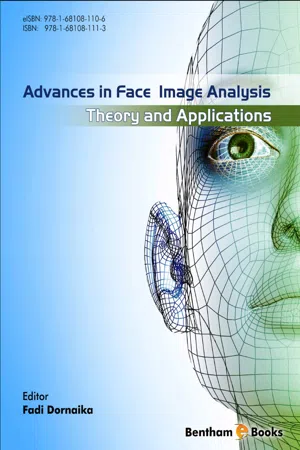
Advances in Face Image Analysis: Theory and applications describes several approaches to facial image analysis and recognition. Eleven chapters cover advances in computer vision and pattern recognition methods used to analyze facial data. The topics addressed in this book include automatic face detection, 3D face model fitting, robust face recognition, facial expression recognition, face image data embedding, model-less 3D face pose estimation and image-based age estimation. The chapters are also written by experts from a different research groups. Readers will, therefore, have access to contemporary knowledge on facial recognition with some diverse perspectives offered for individual techniques. The book is a useful resource for a to a wide audience such as i) researchers and professionals working in the field of face image analysis, ii) the entire pattern recognition community interested in processing and extracting features from raw face images, and iii) technical experts as well as postgraduate computer science students interested in cutting edge concepts of facial image recognition.
- English
- ePUB (mobile friendly)
- Available on iOS & Android
eBook - ePub
Advances in Face Image Analysis: Theory and Applications
About this book
Trusted by 375,005 students
Access to over 1.5 million titles for a fair monthly price.
Study more efficiently using our study tools.
Information
Face Detection Using the Theory of Evidence
Franck Luthon*
Computer Science Lab., University of Pau, 2 allée parc Montaury, 64600, Anglet, France
Abstract
Face detection and tracking by computer vision is widely used for multimedia applications, video surveillance or human computer interaction. Unlike current techniques that are based on huge training datasets and complex algorithms to get generic face models (e.g. active appearance models), the proposed approach using evidence theory handles simple contextual knowledge representative of the application background, due to a quick semi-supervised initialization. The transferable belief model is used to counteract the incompleteness of the prior model due to lack of exhaustiveness in the learning stage.
The method consists of two main successive steps in a loop: detection, then tracking. In the detection phase, an evidential face model is built by merging basic beliefs carried by a Viola-Jones face detector and a skin color detector. The mass functions are assigned to information sources computed from a specific nonlinear color space. In order to deal with color information dependence in the fusion process, a cautious combination rule is used. The pignistic probabilities of the face model guarantee the compatibility between the belief framework and the probabilistic framework. They are the inputs of a bootstrap particle filter which yields face tracking at video rate. The proper tuning of the few evidential model parameters leads to tracking performance in real-time. Quantitative evaluation of the proposed method gives a detection rate reaching 80%, comparable to what can be found in the literature. Nevertheless, the proposed method requires a scanty initialization only (brief training) and allows a fast processing.
Keywords: Belief function, Cautious rule, Classification, Computer vision, Conjunctive rule, Dempster-Shafer, Face tracking, Fusion of information, LUX color space, Mass set, Particle filter, Pattern recognition, Pignistic probability, Region of interest, Skin hue, Source of information, Transferable belief model, Uncertainty management, Viola-Jones detector, Visual servoing.
* Address Corresponding Author F. Luthon:IUT de Bayonne Pays Basque, Université de Pau Pays d’Adour, 2 allée du parc Montaury, 64600, Anglet, France; Tel: +33(0)5.59.57.43.44; Fax: +33(0)5.59.57.43.49; E-mail: [email protected]
INTRODUCTION
Real-time face detection and tracking in video sequences has been studied for more than twenty years by the computer vision and pattern recognition com-munity, owing to the multiplicity of applications: teleconferencing, closed-circuit television (CCTV), human machine interface and robotics. Despite the ongoing progress in image processing and the increase in computation speed of digital processors, the design of generic and robust algorithms is still the object of active research. Indeed, face image analysis (either detection, recognition or tracking) is made difficult by the variability of appearance of this deformable moving object due to many factors: individual morphological differences (nose shape, eye color, skin color, beard), presence of visual artifacts (glasses, occlusions, make-up), illumination variations (shadow, highlight) and facial expression changes depending on context (social, cultural, emotional). Those are difficult to model and do not easily cope with real-time implementations. Moreover, the scene background might disturb detection, in...
Table of contents
- Welcome
- Table of Contents
- Title Page
- BENTHAM SCIENCE PUBLISHERS LTD.
- FOREWORD
- PREFACE
- Facial Expression Classification Based on Convolutional Neural Networks
- Sparsity Preserving Projection Based Constrained Graph Embedding and Its Application to Face Recognition
- Face Recognition Using Exponential Local Discriminant Embedding
- Adaptive Locality Preserving Projections for Face Recognition
- Face Recognition Using 3D Face Rectification
- 3D Face Recognition
- Model-Less 3D Face Pose Estimation
- Efficient Deformable 3D Face Model Fitting to Monocular Images
- Face Detection Using the Theory of Evidence
- Fuzzy Discriminant Analysis: Considering the Fuzziness in Facial Age Feature Extraction
- Facial Image-Based Age Estimation
Frequently asked questions
Yes, you can cancel anytime from the Subscription tab in your account settings on the Perlego website. Your subscription will stay active until the end of your current billing period. Learn how to cancel your subscription
No, books cannot be downloaded as external files, such as PDFs, for use outside of Perlego. However, you can download books within the Perlego app for offline reading on mobile or tablet. Learn how to download books offline
Perlego offers two plans: Essential and Complete
- Essential is ideal for learners and professionals who enjoy exploring a wide range of subjects. Access the Essential Library with 800,000+ trusted titles and best-sellers across business, personal growth, and the humanities. Includes unlimited reading time and Standard Read Aloud voice.
- Complete: Perfect for advanced learners and researchers needing full, unrestricted access. Unlock 1.5M+ books across hundreds of subjects, including academic and specialized titles. The Complete Plan also includes advanced features like Premium Read Aloud and Research Assistant.
We are an online textbook subscription service, where you can get access to an entire online library for less than the price of a single book per month. With over 1.5 million books across 990+ topics, we’ve got you covered! Learn about our mission
Look out for the read-aloud symbol on your next book to see if you can listen to it. The read-aloud tool reads text aloud for you, highlighting the text as it is being read. You can pause it, speed it up and slow it down. Learn more about Read Aloud
Yes! You can use the Perlego app on both iOS and Android devices to read anytime, anywhere — even offline. Perfect for commutes or when you’re on the go.
Please note we cannot support devices running on iOS 13 and Android 7 or earlier. Learn more about using the app
Please note we cannot support devices running on iOS 13 and Android 7 or earlier. Learn more about using the app
Yes, you can access Advances in Face Image Analysis: Theory and Applications by Fadi Dornaika in PDF and/or ePUB format, as well as other popular books in Informatique & Vision par ordinateur et reconnaissance de formes. We have over 1.5 million books available in our catalogue for you to explore.