Genome science or genomics is essential to advancing knowledge in the fields of biology and medicine. Specifically, researchers learn about the molecular biology behind genetic expression in living organisms and related methods of treating human genetic diseases (including gene therapy). Advances in Genome Science is an e-book series which provides a multi-disciplinary view of some of the latest developments in genome research, allowing readers to capture the essence and diversity of genomics in contemporary science. The fourth volume of this ebook series features a selection of articles covering the genetic mechanisms in the development of specific plants (orchids, thale cress), Prader-Willi Syndrome, enzyme genetics (tyrosine kinase inhibitors and fungal laccases) and much more.

- English
- ePUB (mobile friendly)
- Available on iOS & Android
eBook - ePub
Genes in Health and Disease
About this book
Trusted by 375,005 students
Access to over 1.5 million titles for a fair monthly price.
Study more efficiently using our study tools.
Information
The MADS-box Genes Involved in Orchid Flower Development
Serena Aceto*, Luciano Gaudio
Department of Biology, University of Naples Federico II, Napoli, Italy
Abstract
Since the advent of Darwinian genetics, there has been much interest in the evolutionary origin of the Orchidaceae, one of the most species-rich angiosperm families. Orchids have highly diversified and specialized flowers, and some species exhibit an uncoupled rate of morphological and molecular evolution. Recently, these peculiar characteristics have enhanced the study of the orchid MADS-box genes involved in flower development. This large gene family encodes transcription factors that constitute the main regulatory network driving the formation of flower organs. Recent analyses have highlighted the role of the MADS-box genes in orchids and shown that different evolutionary forces act on the coding and non-coding regions of these genes. The most widely accepted theory proposed to explain the evolution of the orchid perianth is the “orchid code”, which posits that the orchid floral organs became diversified through a series of duplications and mutations of the MADS-box genes, followed by functional diversification.
Keywords: ABCDE model, adaptation, column, consensus sequence, development, evolution, flower, inflorescence, labellum, MADS-box, Orchidaceae, orchid code, ovary, phylogeny, quartet model, regulation, resupination, tepals, transcription, zygomorphy.
* Corresponding author Serena Aceto: Department of Biology, University of Naples Federico II, via Mezzocannone 8, 80134 Napoli, Italy; Tel: +390812535190; Fax: +390812535035; E-mail: [email protected]
INTRODUCTION
Among the angiosperms, the Orchidaceae is one of the families with the highest number of species and is characterized by flowers with extremely divergent morphologies and specialized organs. Orchid species have colonized widely different habitats. Epiphytism, specialized pollination strategies [1], natural selection and genetic drift [2] are considered the main causes of their evolutionary success.
The orchid flower is known for its intriguing beauty and mystery, and despite great morphological variability among the different species, its organization can
be traced to a common scheme. The orchid flower is zygomorphic (bilaterally symmetrical) and includes three outer tepals (sepals), two lateral inner tepals (petals) and a highly diversified median inner tepal (lip or labellum) (Fig. 1). The reproductive structure of the orchid flower is the column, a fusion of male (stamen/anther) and female (pistil/stigma) tissues. The pollen grains (pollinia) are located at the top of the column, whereas the ovary, whose development is triggered by pollination, is placed at the base of the column [3-5]. The outer tepals can have different shapes and pigmentations, can be similar to the lateral inner tepals, or can form nectar spurs. Generally considered the most distinctive structure of the orchid perianth, the lip has a peculiar shape and color pattern and is sometimes adorned with calli, spurs and glands. The lip is homologous to the adaxial tepal of other monocots and, therefore, should be the uppermost tepal; however, during the development of the orchid flower, resupination takes place: the 180° rotation in floral orientation that shifts the lip to the lowest tepal position. The orientation and position opposite to the fertile anther of the lip after resupination suggest that the morphological diversifications in lip shape and color are the result of specific adaptations to pollinators [6].
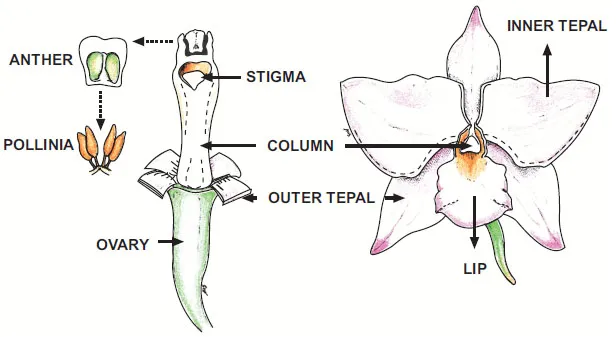
Scheme of an orchid flower.
Before the widespread use of molecular techniques, the phylogeny of Orchidaceae was based on a restricted number of morphological characteristics. Some of these characteristics, e.g., the floral structures involved in the interactions between...
Table of contents
- Welcome
- Table Of Contents
- Title
- BENTHAM SCIENCE PUBLISHERS LTD.
- Prader-Willi Syndrome: A Rare Obesity-related Genomic Imprinting Disorder
- GJB2 Gene Mutations in Syndromic Skin Diseases with Sensorineural Hearing Loss
- Tyrosine Kinase Inhibitors; Therapies for Thyroid Cancer
- Shaping the Genome with Non-coding RNAs
- Directed Evolution of Fungal Laccases: An Update
- The MADS-box Genes Involved in Orchid Flower Development
- Perspectives on Systematic Analyses of Gene Function in Arabidopsis thaliana: New Tools, Topics and Trends
- Genetic Engineering for Cold Stress Tolerance in Crop Plants
Frequently asked questions
Yes, you can cancel anytime from the Subscription tab in your account settings on the Perlego website. Your subscription will stay active until the end of your current billing period. Learn how to cancel your subscription
No, books cannot be downloaded as external files, such as PDFs, for use outside of Perlego. However, you can download books within the Perlego app for offline reading on mobile or tablet. Learn how to download books offline
Perlego offers two plans: Essential and Complete
- Essential is ideal for learners and professionals who enjoy exploring a wide range of subjects. Access the Essential Library with 800,000+ trusted titles and best-sellers across business, personal growth, and the humanities. Includes unlimited reading time and Standard Read Aloud voice.
- Complete: Perfect for advanced learners and researchers needing full, unrestricted access. Unlock 1.5M+ books across hundreds of subjects, including academic and specialized titles. The Complete Plan also includes advanced features like Premium Read Aloud and Research Assistant.
We are an online textbook subscription service, where you can get access to an entire online library for less than the price of a single book per month. With over 1.5 million books across 990+ topics, we’ve got you covered! Learn about our mission
Look out for the read-aloud symbol on your next book to see if you can listen to it. The read-aloud tool reads text aloud for you, highlighting the text as it is being read. You can pause it, speed it up and slow it down. Learn more about Read Aloud
Yes! You can use the Perlego app on both iOS and Android devices to read anytime, anywhere — even offline. Perfect for commutes or when you’re on the go.
Please note we cannot support devices running on iOS 13 and Android 7 or earlier. Learn more about using the app
Please note we cannot support devices running on iOS 13 and Android 7 or earlier. Learn more about using the app
Yes, you can access Genes in Health and Disease by Atta-ur-Rahman in PDF and/or ePUB format, as well as other popular books in Biological Sciences & Genetics & Genomics. We have over 1.5 million books available in our catalogue for you to explore.