This book summarizes key information required for planning and implementing a healthy diet for patients based on sound nutritional concepts. Readers will find information on the background of nutrition in disease management and nutritional regulations in the USA. The book also describes macro- and micronutrients (including minerals and vitamins) and the applications of relevant nutritional concepts to real-life situations, using well-designed simulated clinical scenarios. Additionally, factors contributing to disease as well as the link between socio-economic status, culture and nutrition are discussed. This book should serve as a useful handbook for nutritionists and health care providers and medical or pharmacology students taking courses in nutritional sciences.

eBook - ePub
Nutrition: An Approach to Good Health and Disease Management
- English
- ePUB (mobile friendly)
- Available on iOS & Android
eBook - ePub
Nutrition: An Approach to Good Health and Disease Management
About this book
Trusted by 375,005 students
Access to over 1.5 million titles for a fair monthly price.
Study more efficiently using our study tools.
Information
Topic
MedicineSubtopic
Nutrition, Dietics & BariatricsThe Role of Nutrition in Disease Management
Introduction
Previous chapters discussed the importance of nutrition and exercise in maintaining or improving the health of an individual. It is also important to consider good nutritional principles important to preventing disease. This chapter will discuss the dietary modifications to prevent specific diseases such as cardiovascular disease and hypertension, diabetes, osteoporosis, cancer and obesity (as a component of malnutrition). Nutritional aspects of each disease will be discussed along with risk factors for the disease. A focus will be on modifiable or preventable risk factors since dietary modifications or lifestyle changes may be directed at these risks to prevent individuals from developing disease. Finally, malnutrition will be defined and content specific to screening individuals at nutritional risk and understanding the criteria for diagnosis of malnutrition will establish the basis for future applications of nutritional principles in managing and treating disease.
Cardiovascular Disease and Hypertension
Cardiovascular disease (CVD) is a general term that refers to any disease (any condition that impairs normal function) of the heart and circulating system. This includes conditions such as heart failure, heart attack, arrhythmias and stroke. Pre-existing disorders that are closely associated with CVD are hyperlipidemia (cholesterol) and hypertension (HBP). CVD is the main killer of North Americans including about 500,000 people per year (or more than 1 million if deaths from stroke and other circulatory diseases are included). Heart disease and stroke account for more than $500 billion in healthcare expenditures. (HealthyPeople.gov, 2012) CVD mortality has fallen 50% over the past 50 to 60 years with preventive efforts accounting for over ½ of the decline. Primary contributors to this effect are associated with a decline in average cholesterol concentration, mean blood pressure levels, and tobacco use rates. (Gidding SS et al., 2009) However, the increased prevalence of obesity and diabetes has dramatically slowed this rate. Therefore, preventing CV disease continues to be a challenge. Nutrition is the cornerstone of strategies used to prevent CV disease.
The cardiovascular system is responsible for delivering nutrients and oxygen to tissues as well as removing cellular wastes and delivering them to the body’s excretory organs. The cardiovascular system also serves to deliver hormones to target organs, maintain a constant body temperature and distribute white blood cells throughout the body (facilitating the body’s immune response). The capillaries are where the cardiovascular system connects with cells and the fluids surrounding them (Fig. 1).
Observe the delivery of amino acids; oxygen, water and glucose from the arteriole side while water, carbon dioxide, and other waste molecules are picked up in the venous circulation for transport to the liver and/or kidneys for excretion.
Risk Factor is a term used frequently when discussing factors that contribute to the development of disease. A risk factor is an aspect of our lives – such as heredity, lifestyle choices (e.g. smoking) or nutritional habits. Risk factors for cardiovascular disease are listed below:
- Total blood cholesterol > 200 mg/dl
• Smoking
• Hypertension
• Diabetes
• HDL cholesterol < 40 mg/dl
o Total:HDL cholesterol ratio > 4:1
• Age: Men > 45, Women >55
• Family history of CVD
• Blood triglyceride > 200 mg/dl
• Obesity
• Inactivity
o Exercise conditions the arteries and improves insulin action
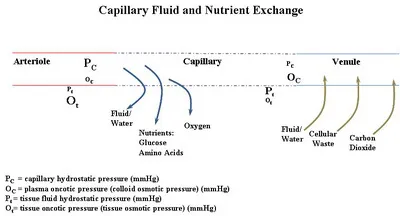
Figure 1)
Capillary exchange depicting the delivery of nutrients, fluid and hormones while receiving cellular waste to be delivered to the body’s excretory organs. In the arterioles, hydrostatic pressure in the capillary exceeds capillary and tissue hydrostatic pressure creating a net movement of fluid out of the capillary into the fluid surrounding the tissues (interstitial fluid) and thereby delivering water, nutrients and oxygen to tissues. On the venule side, tissue oncotic pressure is lower and tissue hydrostatic pressure pushes fluid back into the capillary for delivery to the venous system. The fluid pulled in from the interstitial space contains waste, carbon dioxide as well as water.
“The leading modifiable (controllable) risk factors to heart disease and stroke are: high blood pressure, high cholesterol, cigarette smoking, diabetes, poor diet and physical activity and overweight and obesity”(https://www.healthypeople.gov/2020/topics-objectives/topic/heart-disease-and-stroke).
Cardiovascular disease is generally characterized by the deposition of fatty material in the blood vessels (Fig. 2) a process frequently termed; hardening of the arteries. CVD is also known as coronary artery disease (CHD), as the vessels of the heart are the primary sites of the disease.
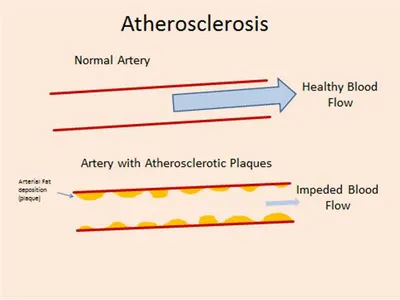
Figure 2)
Atherosclerosis comparing a normal artery with an artery containing atherosclerotic plaque. Accumulation of fatty deposits (plaque) creates an impediment to blood flow and initiates an inflammatory process characteristic of cardiovascular diseases.
Atherosclerosis develops as a result of damage to the blood vessel lining. Damage can be associated with smoking, diabetes, hypertension, LDL cholesterol and viral and bacterial infections. The atherosclerotic plaque that builds up in the vessel leads to hardening of arteries and veins and low elasticity. Typical forms of CVD are associated with inadequate blood circulation due to the buildup of this plaque, which if combined with blood clots could cause complete blockage of the vessel. The complete blockage of blood vessels results in the following serious, life-threatening conditions:
- Myocardial infarction: death of a part of the heart muscle, also known as heart attack.
- Cerebrovascular accident: death of a part of the brain tissue due to a blood clot. Also termed a stroke.
Cholesterol. Cholesterol is a waxy lipid found in all body cells. It comes from 2 sources; about 75% is produced in the liver and other body cells while 25% comes from dietary sources. The two types of cholesterol ‘good’ or ‘bad’ are measured in cholesterol screening. The good cholesterol is HDL which helps keep the bad ‘LDL’ cholesterol from depositing in artery walls. A healthy level of HDL may also protect against heart attacks and stroke while low levels are associated with cardiac risk. Regular physical activity may improve HDL levels. Reducing trans fats and eating a balanced nutriti...
Table of contents
- Welcome
- Table OF Contents
- Title
- FOREWORD
- PREFACE
- Background: Nutrition in Health and Disease
- Food Regulations in the United States
- Macronutrients
- Macronutrients Nutritional Requirement Applications
- Micronutrients
- Micronutrients: Nutritional Requirement Applications
- Phytochemicals in Nutrition and Health
- Influence of Socio-economic Status and Culture in Diet and Nutrition
- Factors Contributing to Health and Disease
- The Role of Nutrition in Disease Management
Frequently asked questions
Yes, you can cancel anytime from the Subscription tab in your account settings on the Perlego website. Your subscription will stay active until the end of your current billing period. Learn how to cancel your subscription
No, books cannot be downloaded as external files, such as PDFs, for use outside of Perlego. However, you can download books within the Perlego app for offline reading on mobile or tablet. Learn how to download books offline
Perlego offers two plans: Essential and Complete
- Essential is ideal for learners and professionals who enjoy exploring a wide range of subjects. Access the Essential Library with 800,000+ trusted titles and best-sellers across business, personal growth, and the humanities. Includes unlimited reading time and Standard Read Aloud voice.
- Complete: Perfect for advanced learners and researchers needing full, unrestricted access. Unlock 1.5M+ books across hundreds of subjects, including academic and specialized titles. The Complete Plan also includes advanced features like Premium Read Aloud and Research Assistant.
We are an online textbook subscription service, where you can get access to an entire online library for less than the price of a single book per month. With over 1.5 million books across 990+ topics, we’ve got you covered! Learn about our mission
Look out for the read-aloud symbol on your next book to see if you can listen to it. The read-aloud tool reads text aloud for you, highlighting the text as it is being read. You can pause it, speed it up and slow it down. Learn more about Read Aloud
Yes! You can use the Perlego app on both iOS and Android devices to read anytime, anywhere — even offline. Perfect for commutes or when you’re on the go.
Please note we cannot support devices running on iOS 13 and Android 7 or earlier. Learn more about using the app
Please note we cannot support devices running on iOS 13 and Android 7 or earlier. Learn more about using the app
Yes, you can access Nutrition: An Approach to Good Health and Disease Management by Esperanza J. Carcache de Blanco,Jay Mirtallo, Esperanza J. Carcache de Blanco, Jay Mirtallo in PDF and/or ePUB format, as well as other popular books in Medicine & Nutrition, Dietics & Bariatrics. We have over 1.5 million books available in our catalogue for you to explore.