Maintaining ideal fish health and production, both of farmed and wild fish populations, requires continuous infrastructural and process upgrades to avoid significant losses as well as to facilitate seafood safety. Aquaculture is multidisciplinary in nature, combining knowledge from biology, veterinary medicine and food technology.
Practical Notions on Fish Health and Production brings an integrated approach concerning practical aspects of ichthyology, fish health and aquaculture systems. The textbook will give readers a better understanding of issues related to the management of fish health and production, seafood processing, security, quality and safety.
The book is organized in three sections which cover 1) general aspects of fish biology and development, 2) fish diseases and veterinary medicine, and 3) aquaculture and marine food supply chain management.
Practical Notions on Fish Health and Production is an essential text for students, food industry professionals and novice fish farmers undertaking courses or training programs in veterinary medicine, aquaculture, and marine food processing systems.
eBook - ePub
Practical Notions on Fish Health and Production
- English
- ePUB (mobile friendly)
- Available on iOS & Android
eBook - ePub
Practical Notions on Fish Health and Production
About this book
Trusted by 375,005 students
Access to over 1.5 million titles for a fair monthly price.
Study more efficiently using our study tools.
Information
Processed Fishery Products
Maria João Fraqueza1, *, Manuel Abreu Dias2
1 CIISA/Faculdade de Medicina Veterinária, Universidade de Lisboa, Avenida da Universidade Técnica, 1300-477 Lisboa, Portugal
2 Alicontrol, Tecnologia e Controlo de Alimentos, Lda., Rua Fernando Vaz, lote 26-B, 1750 108 Lisbon, Portugal
Abstract
Many fish preservation technologies are based on multiple hurdles used to inhibit or reduce biochemical changes and microbial contamination that leads to spoilage. This chapter aims to describe some of the most traditional technologies currently applied to fishery products based on the control of water activity, pH, oxide-reduction potential, temperature, relative humidity and gaseous composition of the atmosphere. Emergent technologies, such as Ohmic heating and microwaving; amongst others, can be seen with particular interest for future application at industrial scale. In fact, the combination of traditional and emergent technologies (thermal or non-thermal processes) in processed fishery products, might be the trend to achieve and supply safer and high quality products.
Keywords: Chemical treatments, Emergent technologies, Non-thermal treatments, Processed fishery products, Thermal treatments.
* Address correspondence to Maria João Fraqueza: Faculdade de Medicina Veterinária, Universidade de Lisboa, 1300-477 Lisboa, Portugal; E-mail: [email protected]
INTRODUCTION
A major purpose of the processed fish production is to preserve fish, minimising losses in the distribution chain, over time and space. Another important goal for that industry is to add value to raw fish materials, which might be related to the application of emergent technologies, in order to develop new fishery products. Nowadays, there is an increased demand of ready-to-eat food products, or those
requiring little or no preparation before serving. So, the further industrial processing of fish is not only common, but also desirable, to sustain the demand for a wide variety of value-added products. Fishery products processing industry receives raw fish materials (sardines, tuna, cod, mackerel, anchovy, crustaceans, molluscs) directly from fishery and preserves them using traditional preservation technologies. Presently, these technologies are more mechanized and automated in some processing steps. Processed fishery products include preparations, canned, chilled, frozen, smoked and dried fish, crustaceans and molluscs. The technologies for fish preservation aim the inhibition or reduction of the metabolic and biochemical changes that lead to spoilage. These preservation technologies are based on the control of specific parameters such as water activity, pH, oxide-reduction potential, temperature, relative humidity and gaseous composition of the atmosphere surrounding food under packaging. In general, technological treatments are physical (thermal treatments: cooling, freezing, pasteurization, sterilization, Ohmic heating, microwaving, and non-thermal treatments: irradiation, high hydrostatic pressure, ultrafiltration, pulsating electric fields, ultrasound and even dehydration) or chemical (addition of sugar, salt, acids, additives), the last with repercussion on the chemical composition of foods. Some of these technologies are currently applied to fishery products processes (pasteurization, sterilization, dehydration, addition of sugar, salt, acids, additives), others have been tested but without large industrial application (irradiation) while emergent technologies, such as Ohmic heating, microwaving, high hydrostatic pressure, pulsating electric fields, may be seen with particular interest by industry. Many fish preservation technologies are based on Leistner’s [1] multiple hurdle theory, such as pasteurization-refrigeration, cook-chill, modified atmosphere packaging - refrigeration, salting-drying, salting-smoking, drying-smoking and salting-marinating .
All these technological processes may be applied to raw fish material aiming to have the best quality; however, it is mandatory to assure food safety. With that purpose, not only unitary preservation technologies should be applied but also safety measures founded on proactive methodologies such as Hazard Analysis Critical Control Point (HACCP) method. Finally, proper waste structures should be included in fish processing operations.
PRELIMINARY PROCESSING FISH OPERATIONS
The type of raw fish material affects its processing, being relevant to distinguish demersal fish (codfish, flatfish), pelagic fish, crustaceans (shrimp, prawn, lobster) and molluscs. Preliminary processing should assure the best market quality and safety of fish products, a suitable presentation of semi- processed final product, labor saving on raw materials processing, and waste reduction. Considering different fish, crustaceans and molluscs raw materials, with different specificities that enter a processing unit and all the obtained final products, proactive methodologies need to be implemented for hazards prevention and for decreasing human health and environmental risks.
Concepts related to HACCP methodologies and “cleaner production” must not be forgotten. The application of a proactive methodology, such as HACCP, involves a precise methodology of preventive measures to be managed throughout the fish products processing steps, according to an established plan which is a document for identifying, evaluating and controlling food safety hazards [2]. “Cleaner production” is a concept that seeks efficiency improvement and reduction of risks to humans and environment by the applying precautionary ecological approaches to practices, produces and services. It intends the preservation of fresh resources and energy, removal of toxic constituents, and decrease in quantity and toxicity of litters and discharges [3]. Typically, a fish processing industry spends considerable amounts of energy and water, and releases substantial amounts of biological effluents and solid wastes. Also, because of all the hand labor and manual operations, the fish industry is dependent on the operator performance, which in turn influences plant performance, mainly in small-scale units and low automated automat operations. The main steps of fish preliminary processing can be illustrated in a diagram as shown in Fig. (1). Fish is a perishable raw material, and immediately after death must be beheaded, gutted, washed and chilled to prevent enzymatic degradation and spoilage by microorganisms. Main fish preliminary processing operations are common to different methods of preservation beginning by sorting, grading, washing, flaking, head and tail removal, gutting, de-skinning, filleting, and trimming.
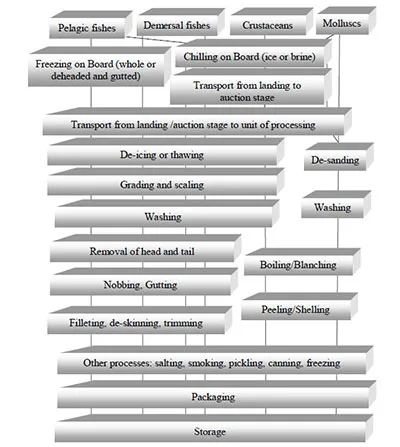
Preliminary operations in fish processing industry.
Demersal fish processing is usually quite straightforward, but pelagic fish involves further processing for the production of more elaborated foods, including pickled herring and canned mackerel and sardine. Crustaceans and bivalve molluscs can be transformed into several products, being usually boiled. Fish transport inside an industry should be seen as a fundamental operation that contributes to a cleaner production. Dry transport is a better solution to avoid large quantities of water waste and to reduce the content of organic material in wastewater, with a high benefit for the environment [4], but it damages fish more than water transportation. This kind of transport is able to move and position fish in the machinery by the use of specific filter conveyer belts and brushes [4].
Sorting and grading can be done by specie and size, either manually or mechanized. Roller, vibration and belt graders are commercially available depending on the fish products to be graded. Small or large pelagic, demersal fish and crustaceans are usually sorted by grading machines. Fish grader is designed and built for high capacity grading of fish into several size categories according to species, ranging from sardines, herring and mackerel to large cod, salmon and tuna. The machines segregate the fish into different grades using as example rollers tracks (Fig. 2).
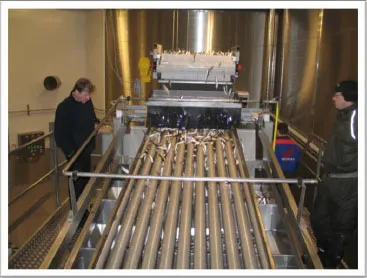
Roller grader machine performing fish grading (courtesy of Timars manufactor).
The fish fall into the containers or belts positioned below, from where they are separated into storage boxes or transferred to other conveyors for further processing. These equipment’s might include water sprays that wash the fish at the same time as it passes down the tracks. In order to clean fish and diminish bacterial contamination, washing is usually performed with potable water in a minimum proportion 1:1 water and fish [5]. The optimal washing is reinforced by the mechanical friction of a rotating drum (with vertical or horizontal axis), depending on rotational speed, fish washer height and angle, angle of water supply and vane angle. This operation step may be performed when the fish enters...
Table of contents
- Welcome
- Table of Contents
- Title Page
- BENTHAM SCIENCE PUBLISHERS LTD.
- FOREWORD
- PREFACE
- List of Contributors
- Particular Features of Fish Anatomy and Physiology – A Brief Review
- Embryonic and Larval Development
- Introduction to Aquaculture
- Microbial and Parasitic Diseases of Fish
- Introduction to Anaesthesia and Surgery in Fish
- Fish Production, Catch, Trade and Processing on Board
- Official Veterinary Inspection of Fish
- Processed Fishery Products
Frequently asked questions
Yes, you can cancel anytime from the Subscription tab in your account settings on the Perlego website. Your subscription will stay active until the end of your current billing period. Learn how to cancel your subscription
No, books cannot be downloaded as external files, such as PDFs, for use outside of Perlego. However, you can download books within the Perlego app for offline reading on mobile or tablet. Learn how to download books offline
Perlego offers two plans: Essential and Complete
- Essential is ideal for learners and professionals who enjoy exploring a wide range of subjects. Access the Essential Library with 800,000+ trusted titles and best-sellers across business, personal growth, and the humanities. Includes unlimited reading time and Standard Read Aloud voice.
- Complete: Perfect for advanced learners and researchers needing full, unrestricted access. Unlock 1.5M+ books across hundreds of subjects, including academic and specialized titles. The Complete Plan also includes advanced features like Premium Read Aloud and Research Assistant.
We are an online textbook subscription service, where you can get access to an entire online library for less than the price of a single book per month. With over 1.5 million books across 990+ topics, we’ve got you covered! Learn about our mission
Look out for the read-aloud symbol on your next book to see if you can listen to it. The read-aloud tool reads text aloud for you, highlighting the text as it is being read. You can pause it, speed it up and slow it down. Learn more about Read Aloud
Yes! You can use the Perlego app on both iOS and Android devices to read anytime, anywhere — even offline. Perfect for commutes or when you’re on the go.
Please note we cannot support devices running on iOS 13 and Android 7 or earlier. Learn more about using the app
Please note we cannot support devices running on iOS 13 and Android 7 or earlier. Learn more about using the app
Yes, you can access Practical Notions on Fish Health and Production by Manuela Oliveira,Joana Robalo,Fernando Bernardo, Manuela Oliveira, Joana Robalo, Fernando Bernardo in PDF and/or ePUB format, as well as other popular books in Biological Sciences & Zoology. We have over 1.5 million books available in our catalogue for you to explore.